
Exclusive:
In the days before one of the largest Emirati business delegations in years arrived in Lebanon in late August, Saudi Arabia was doing more than watching Abu Dhabi’s renewed push into a country whose economic collapse has left it urgently seeking foreign capital and regional investment.
According to well-placed sources familiar with contacts made ahead of the UAE–Lebanon Business Forum, Saudi envoy to Lebanon Yazid bin Mohammed bin Farhan reached out to a number of Lebanese political figures and encouraged them to mobilize against the conference, with the explicit aim of obstructing the political and investment outcomes expected to emerge from it.
The sources said bin Farhan urged those he contacted to frame their opposition around the rejection of “normalization money,” a reference to the UAE’s relationship with Israel. The purpose, they said, was to make future Emirati investment politically costly inside Lebanon by shifting the debate away from the commercial value of individual projects and toward the legitimacy of accepting capital from a country that maintains formal ties with Israel. Such framing could make Lebanese politicians, officials, and local partners more reluctant to facilitate Emirati projects even after the conference itself had ended.
The Saudi interest continued after the forum concluded. Bin Farhan subsequently asked Saudi Ambassador Fahd bin Abdulrahman al-Dosari to prepare a detailed report on Lebanese political figures who attended the event, supported it, or publicly welcomed its outcome, according to the sources. They said the purpose was to assess and classify political actors according to the extent of their support for the Emirati initiative and to help Riyadh evaluate where Lebanese figures stood as Abu Dhabi expanded its economic and institutional presence in the country.
The information comes from sources familiar with the contacts and discussions surrounding the conference. This publication was not able to independently verify the substance of those communications.
The episode may point to a broader change in the Saudi–Emirati rivalry. Competition between Riyadh and Abu Dhabi has long been visible in areas such as Yemen, Sudan, energy policy, ports, trade, and regional influence. But the Lebanese case suggests a more consequential model: not simply competing to offer greater capital, stronger political backing, or better commercial access, but seeking to limit a rival’s ability to consolidate influence in a third Arab state.
But the Lebanese case suggests a more consequential model: not simply competing to offer greater capital, stronger political backing, or better commercial access, but seeking to limit a rival’s ability to consolidate influence in a third Arab state.
The difference is important because it changes who bears the cost. When Riyadh and Abu Dhabi compete by offering better financing, stronger commercial terms, or more ambitious projects, countries such as Lebanon can benefit from having more options. When one capital attempts to obstruct the other’s initiatives, the cost is transferred to the country hosting the competition, and investment decisions become entangled with regional power politics.
A Business Forum with a Broader Political Meaning
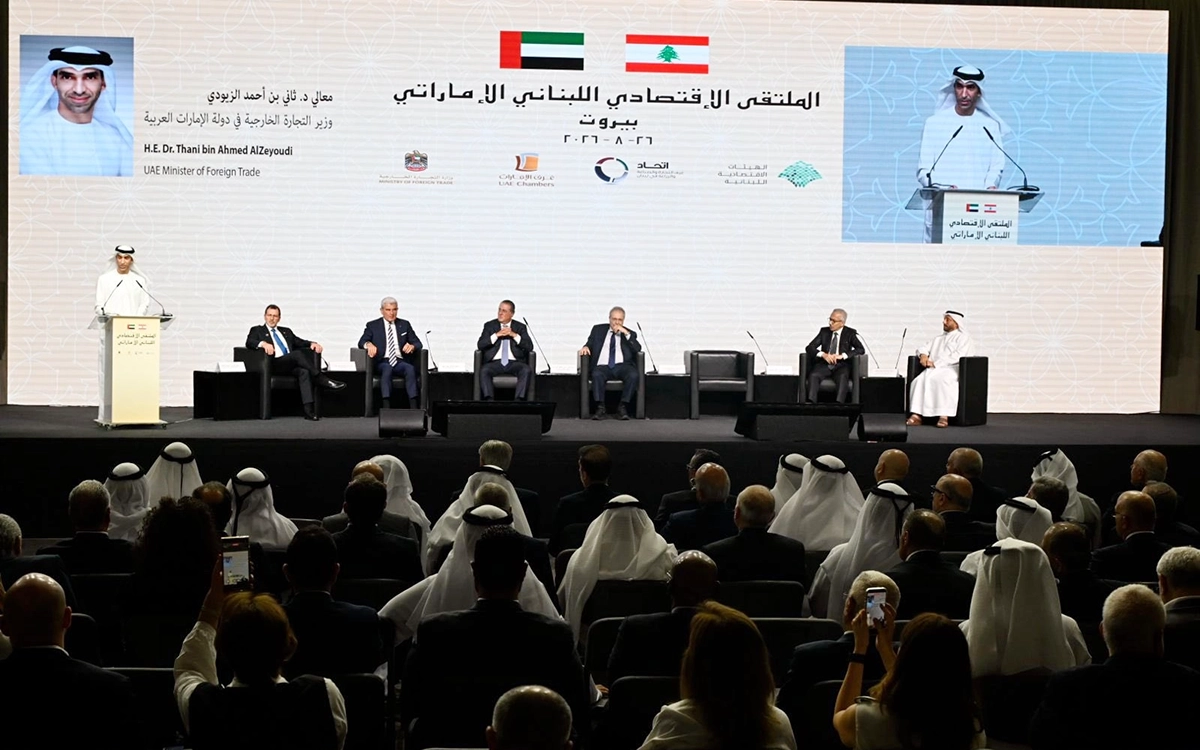
The UAE–Lebanon Business Forum was held in Beirut on August 26 and 27 under unusually high-level official sponsorship. The Emirati delegation, led by Minister of State for Foreign Trade Thani bin Ahmed Al Zeyoudi, included dozens of executives and business leaders representing more than 50 companies, while the Lebanese side included senior private-sector figures and five ministers.
By the end of the first day, four memoranda of understanding had been signed, including the establishment of a joint UAE–Lebanon Business Council, which held its first meeting immediately after its creation. Other agreements linked the Abu Dhabi Chamber with the Beirut and Mount Lebanon Chamber and included cooperation in agriculture and food security involving Emirati and Lebanese institutions. A fifth memorandum, signed the following day by Lebanese Economy Minister Amer Bisat and Al Zeyoudi, created a government-to-government framework for expanding trade and investment.
President Joseph Aoun received the delegation at Baabda Palace and described the visit as a “message of hope,” while Prime Minister Nawaf Salam’s government gave the forum full political backing. The visit also carried considerable political weight. Beirut and Abu Dhabi were in contact immediately before the delegation arrived, while Emirati representatives were exploring sectors including customs, airport and port operations, energy facilities, agriculture, tourism, and digital infrastructure.
The forum was held in the absence of Lebanese Prime Minister Nawaf Salam, who is considered close to Saudi Arabia. Salam did not attend the meeting with the UAE delegation despite the significance of the event for Lebanon, citing a family vacation outside the country.
The trip nevertheless produced more institutional architecture than immediate capital investment. No binding multibillion-dollar commitment was announced, and none of the memoranda had, by the end of the reporting period, advanced into a fully financed project. Memoranda create channels and opportunities, but the more consequential stage begins later, when feasibility studies, procurement procedures, financing, regulatory approvals, and contract awards determine which initiatives actually move forward.
It is also the stage at which there are far more opportunities for political pressure to have an effect. Preventing a high-profile conference from taking place would have required an overt confrontation and would have been difficult once the Lebanese government had formally embraced the visit. Slowing or complicating the conversion of memoranda into contracts is less visible and potentially more effective, particularly in Lebanon, where political competition, bureaucratic delays, banking risk, and public procurement procedures already provide multiple points at which projects can stall.
Why the “Normalization Money” Frame Matters
The language attributed to bin Farhan was politically potent because normalization with Israel remains one of the most sensitive issues in Lebanese public life. Linking Emirati capital to normalization changes the question facing Lebanese decision-makers: instead of asking whether a project is commercially viable or economically useful, they can be pushed to defend whether accepting the investment itself carries a political cost.
The “normalization money” frame therefore offers a way to discourage investment without challenging each project on its economic merits.
The “normalization money” frame therefore offers a way to discourage investment without challenging each project on its economic merits.
A Lebanese minister, political leader or business partner considering involvement in an Emirati initiative could be made to weigh not only the potential economic return, but also the reputational and political consequences of being portrayed as facilitating a broader normalization agenda.
Signs of internal opposition surfaced as the Emirati visit unfolded. Two days after the delegation left Beirut, Asas Media published an article titled “A Chamber of Commerce or a Chamber of Normalization?” questioning the political implications of the Emirati opening and arguing that any significant Gulf re-engagement in Lebanon required broader Arab strategic consent—represented first and foremost by Saudi Arabia.
More significantly, the article treated Saudi primacy not merely as an existing feature of Gulf engagement with Lebanon, but as a principle that should shape the room available to other Gulf capitals to act independently. It also linked the Emirati commercial push to the politics of normalization, turning what had been presented publicly as an investment initiative into a question about regional alignment and political legitimacy.
A Lebanese journalist also accused a regional actor, implicitly the UAE, of spending money on Lebanese media and officials to promote normalization. The intervention remained limited in reach, but it reflected how quickly the Emirati initiative could be reframed from an economic opening into a political test involving Israel, Gulf influence, and domestic Lebanese loyalties.
Why Lebanon Matters to Both Riyadh and Abu Dhabi
The sensitivity surrounding the forum cannot be explained by the amount of money announced, because relatively little binding capital was committed. Its importance lies instead in the institutional structure Abu Dhabi is attempting to build.
A joint business council, direct links between chambers of commerce, sector-specific partnerships, and sustained contact between companies and ministries create a network that can outlast individual political relationships. If that network matures, it could give the UAE a durable role in shaping project pipelines, identifying investment opportunities, and influencing the commercial architecture of Lebanon’s recovery and eventual reconstruction.
This differs from the model of Gulf influence historically associated with Lebanon, in which political sponsorship, personal relationships, and ties to specific parties or leaders often played a central role.
For Saudi Arabia, which has spent decades as the most consequential Gulf actor in Lebanese politics, the issue is therefore not simply whether the UAE signs a memorandum or finances a particular project. The more strategic question is whether Abu Dhabi is building a parallel gateway into Lebanon that reduces Riyadh’s traditional ability to shape Gulf political and economic access to the country.
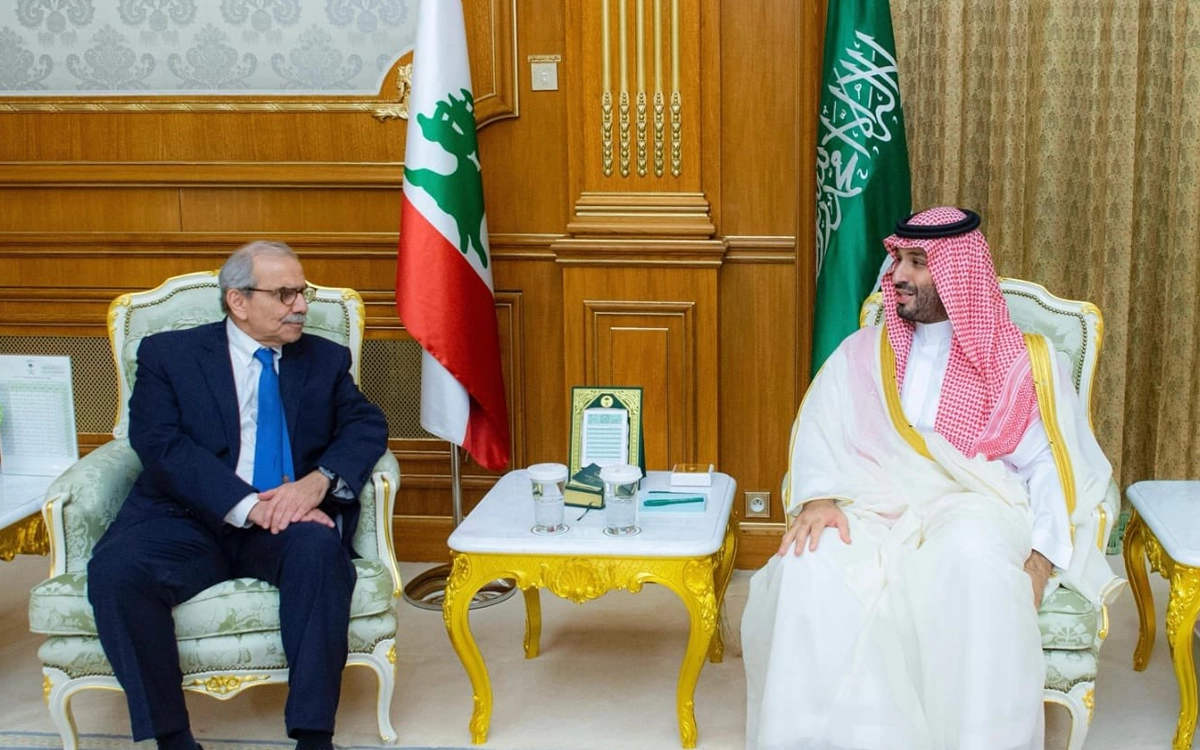
Saudi Arabia has itself been restoring its presence in Lebanon, but on a different timetable and with a different emphasis. In June, Crown Prince Mohammed bin Salman ordered the resumption of Lebanese exports to the kingdom after years of restrictions, while bin Farhan intensified diplomatic engagement in Beirut as part of a Saudi policy that has linked broader re-engagement to state sovereignty, institutional reform, and the issue of weapons outside government control.
The Saudi return has therefore been gradual, conditional, and heavily political. The Emirati return has been faster, more commercially institutionalized, and more visibly centered on businesses, chambers, and project exploration. Those approaches could coexist and even complement one another from Lebanon’s perspective, but they become a source of friction when the expansion of one actor is treated by the other as a loss of strategic space.
From Competition to a Saudi Veto
The Saudi–Emirati rivalry is no longer a matter of analytical speculation. Over the past several years, differences between Riyadh and Abu Dhabi have become increasingly visible across Yemen, Sudan, the Red Sea, energy policy, ports, logistics, and regional business competition. They have exposed a widening gap between two governments that were once routinely described as operating within the same strategic bloc.
Competition between ambitious regional powers is neither unusual nor inherently destabilizing. For smaller or economically vulnerable states, it can even be beneficial when competing powers seek influence by offering more attractive financing, stronger trade access, better infrastructure, or more efficient investment vehicles.
The problem begins when competition ceases to be about presenting a better offer and turns instead into an effort to deny the rival access.
The problem begins when competition ceases to be about presenting a better offer and turns instead into an effort to deny the rival access.
There is a fundamental difference between Saudi Arabia responding to an Emirati business push in Beirut by sending a larger Saudi investment delegation and seeking to persuade Lebanese political figures to obstruct the Emirati initiative. The first expands Lebanon’s options and increases competition for its market. The second narrows those options by making access to foreign capital contingent on regional political calculations.
The Lebanese episode therefore raises a broader question about Saudi regional strategy: whether Riyadh, in trying to preserve a leadership role that is increasingly contested by other Gulf capitals, is beginning to treat independent initiatives by those capitals as challenges to be contained rather than opportunities for complementary engagement.
Such an approach would carry costs well beyond Lebanon. A state seeking investment should not have to decide whether accepting Emirati capital will damage its relationship with Saudi Arabia, just as participation in one Arab economic initiative should not automatically be interpreted as an alignment against another Arab capital.
The Return of Bloc Politics by Another Route
Lebanon has no compelling national interest in choosing between Saudi and Emirati investment. Its economic interest lies in attracting as much credible regional capital as possible, provided projects meet legal, financial, and strategic requirements.
The same logic applies across much of the Arab world, particularly in countries facing reconstruction needs, fiscal pressure, infrastructure gaps, or limited access to international capital.
The behavior described by the sources creates a different set of incentives. If attendance at an Emirati investment conference becomes relevant to a Saudi assessment of Lebanese political figures, then participation itself can acquire a meaning beyond the event. Politicians begin to consider not only whether an initiative benefits Lebanon, but how their involvement will be interpreted in Riyadh and what it might mean for their future political or financial relationships with the kingdom.
That is how regional bloc politics can re-emerge without the creation of formal blocs.
In political systems heavily dependent on foreign financial and diplomatic relationships, expectations can shape behavior long before explicit pressure is applied. Political leaders, ministers, business figures, and officials may begin to avoid certain initiatives not because they oppose the projects themselves, but because they fear the regional interpretation attached to their participation.
In political systems heavily dependent on foreign financial and diplomatic relationships, expectations can shape behavior long before explicit pressure is applied.
The result is a return to a familiar “which side are you on?” logic, imposed on issues that should not require such a choice. A port concession, an agricultural investment, a business council, or a reconstruction project can become a marker of geopolitical alignment even when the underlying economic decision has little to do with the rivalry between Gulf capitals.
For Arab states attempting to diversify their partnerships, the result is less strategic autonomy at precisely the moment when broader regional investment should be increasing their room for maneuver.
Blocking Abu Dhabi Does Not Necessarily Benefit Riyadh
There is also a basic flaw in obstruction as a regional strategy: Saudi Arabia does not automatically capture what the UAE loses.
If an Emirati agricultural project in Lebanon is blocked, it does not automatically follow that a Saudi company will replace it. If an Emirati investor is discouraged from entering a port, tourism project, or logistics concession, there is no guarantee that Riyadh will finance an alternative.
The project may simply disappear.
This is particularly relevant in high-risk economies such as Lebanon, where investors already face institutional weakness, financial instability, political uncertainty, and complex procurement procedures. Additional geopolitical risk can be enough to send capital elsewhere.
In such cases, the immediate loser is Lebanon, not Abu Dhabi.
That outcome would also conflict with the broader regional narrative promoted in recent years by Gulf governments themselves: that economic integration, trade corridors, and investment should increasingly replace proxy conflict and ideological polarization as the organizing principles of Middle Eastern politics.
Regional economic cooperation cannot function effectively if every major Arab investment must first survive the strategic objections of the region’s most powerful capital.
What the Participant Report Was Meant to Do
Embassies routinely report on local political actors and their relationships with foreign governments, and political mapping is a normal component of diplomacy. In this case, however, the significance lies in the relationship between the requested assessment and the earlier effort described by the sources to obstruct the conference and constrain its results.
In that context, the report becomes part of a broader effort to understand which Lebanese actors were prepared to cooperate with Abu Dhabi despite Saudi objections and how support for the Emirati initiative was distributed across the Lebanese political landscape.
Such monitoring can have consequences even without formal sanctions or explicit threats. Political actors who know that their participation is being assessed through the lens of Gulf rivalry may become more cautious about future Emirati initiatives, particularly if they depend on Saudi political backing, financial relationships, or access.
The pressure, in other words, does not need to take the form of a public veto to influence behavior. The expectation that political choices will be recorded and interpreted can itself become a form of leverage.
Lebanon as an Early Test
So far, the Emirati initiative has not been derailed.
The forum took place on schedule, official Lebanese participation remained high, five memoranda were signed, and the joint business council was established. The Lebanese state did not retreat from the initiative after criticism emerged, and the UAE left Beirut with a new institutional framework for pursuing future opportunities.
That makes the next phase more important than the conference itself.
The real test will be whether the business council continues to meet, whether feasibility studies progress, whether tenders are issued, whether Emirati companies move from exploratory discussions to formal bids, and whether any projects eventually stall for commercial, bureaucratic, or political reasons.
This will matter because Lebanon already has enough internal obstacles to delay or derail investment without outside intervention. Procurement procedures, banking risk, legal disputes, infrastructure weakness, and competition among local political and commercial networks can all slow projects independently.
A stalled memorandum will not, by itself, establish that Saudi pressure succeeded, just as the signing of memoranda does not guarantee that Emirati investment will materialize.
What the Beirut episode already reveals, however, is a sharper form of competition over Gulf influence in Lebanon. Riyadh appears increasingly concerned not merely with rebuilding its own position, but with the political consequences of Abu Dhabi building an independent one.
That matters for Lebanon because the country’s recovery requires more sources of capital, not fewer. It is also significant because forcing local actors to treat Arab investment as a test of political loyalty risks reproducing the same bloc politics that have repeatedly limited the region’s ability to cooperate across rival alignments.
It is also significant because forcing local actors to treat Arab investment as a test of political loyalty risks reproducing the same bloc politics that have repeatedly limited the region’s ability to cooperate across rival alignments.
Saudi Arabia can compete with the UAE in Lebanon by investing more, expanding trade, offering stronger financing, and presenting Lebanese institutions with a more attractive economic partnership. That kind of competition would increase Lebanon’s options and reinforce Saudi influence through performance rather than restriction.
Trying to make Emirati investment politically costly produces the opposite effect: it turns a contest for leadership into a constraint on the choices of the very Arab states over which that leadership is being contested.
For a region that increasingly describes economic integration as a strategic objective, that may prove to be one of the more damaging consequences of the widening Saudi–Emirati rivalry.