
The competition for Africa has intensified, but the autonomy of its governments has not increased with it. They have more diplomatic partners, more competing investors, and more geopolitical attention than at any point since the Cold War. What that abundance has yet to deliver is the power to set terms.
Ghanaian President John Dramani Mahama put the case plainly in a televised interview in August, urging the continent to break what he called its dependency syndrome. Partnership is welcome, he said, provided African capitals set the terms. Ownership of resources, he argued, should come with a real say over how they are used. His Accra Reset, launched at the World Economic Forum in January, envisions greater economic independence and a stronger continental voice in international decision-making.
His argument reaches one of the defining contradictions of the continent’s place in the emerging global order. Access to capital, technology, and markets has multiplied, while control over any of them has not. A state can borrow from 25 creditors and still find that none of them can be refused. Breadth of relationships is one thing, and depth of leverage another.
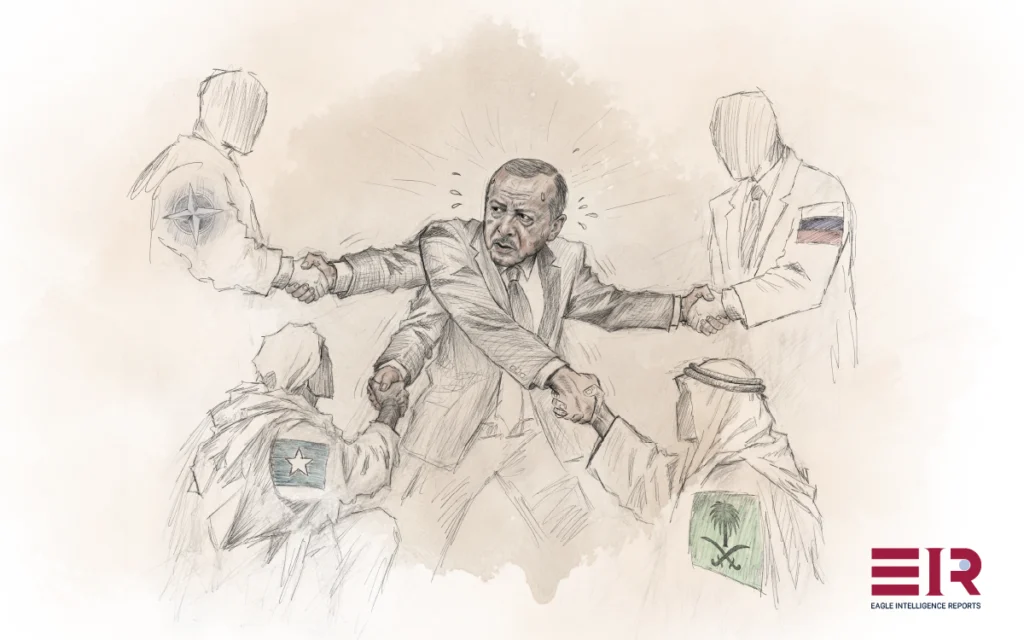
The distinction matters because Africa’s geopolitical problem is becoming more sophisticated. The old argument about choosing the West or looking East increasingly obscures the real contest. Multi-alignment without productive power risks becoming dependency diversification. Governments can expand relations with Beijing, Washington, Brussels, Moscow, Ankara, and the Gulf. They may still depend on outsiders to finance infrastructure, process minerals, provide technology, guarantee markets, or secure their states.
Those dependencies separate three forms of autonomy that are easily confused. Diplomatic autonomy is the freedom to choose partners. Policy autonomy is the capacity to set rules that bind them. Productive autonomy is the ability to make those rules pay through processing, technology, financing, infrastructure, and market access. The first two can be won at a negotiating table. The third has to be built.
Diplomatic and policy autonomy can be won at a negotiating table. Productive autonomy has to be built.
Ghana offers an unusually useful test of whether the third form can be built. The country is Africa’s largest gold producer and one of the world’s major cocoa producers. Its recent economic history demonstrates how possession of strategic commodities does not automatically translate into strategic autonomy.
Ghana’s recent fiscal record shows how quickly policy autonomy can disappear. The country lost access to international capital markets during its 2022 economic crisis, defaulted on most external debt, and entered a $3 billion International Monetary Fund program. On July 27, the Fund completed the sixth and final review of that program, releasing about $371 million and noting improvements in reserves, fiscal performance, and debt sustainability. Accra then requested a 36-month Policy Coordination Instrument, a monitoring arrangement that carries no lending. That recovery is important. But geopolitically, the crisis exposed a fundamental constraint: a resource-rich state can still lose significant policy room when external financing disappears.
The debt restructuring reinforces the point. Parliament approved a $2.8 billion debt-relief agreement in June 2025 involving 25 creditor countries, including China, France, Germany, the United Kingdom, and the United States. The diversity of creditors illustrates contemporary multi-alignment; the necessity of negotiating with them to restore fiscal stability illustrates its limits.
Gold Becomes a Test of Sovereignty
Gold now provides perhaps the clearest indication that Accra understands this contradiction. Ghana produced 4.8 million ounces in 2024, according to the Ghana Chamber of Mines, cementing its position as Africa’s leading producer. Export earnings then reached $20.9 billion in 2025, roughly double the level of the previous year. But producing a strategic commodity and controlling its value chain are different forms of power.
Beginning September 1, Ghana will prohibit the export of unrefined artisanal gold dore by self-financing aggregators and require it to be refined domestically. The Ghana Gold Board, the state gold buyer known as GoldBod, says the measure is intended to ensure domestic refining and value addition. That is more than an industrial-policy decision. It represents an attempt to shift the location at which value is captured.
Certification is where that attempt meets its limit. No Ghanaian refinery appears on the London Bullion Market Association’s Good Delivery List, and Rand Refinery in South Africa remains the only accredited African plant. Bullion from an unaccredited refinery may require testing or remelting elsewhere before international buyers accept it at full value. Accreditation demands a tangible net worth of about $20 million, at least ten metric tons of refined gold a year, and five years in business. Applicants must also pass independent audits under the association’s responsible sourcing program, which covers the origin of the metal they refine.
No Ghanaian refinery appears on the London Bullion Market Association’s Good Delivery List, and Rand Refinery in South Africa remains the only accredited African plant.
The directive also demonstrates how difficult economic sovereignty is to manufacture through regulation alone. Days before the refining directive, industry accounts described GoldBod buyers going weeks without funding, disrupting purchases. GoldBod disputed claims of a funding shortage. It said it had raised more than $450 million from banks and offtakers since March, in a transition from central-bank financing toward its own balance sheet.
The episode offers a useful measure of autonomy. Ghana controls extraction and can now compel domestic refining. It does not yet finance purchases domestically with any reliability, hold the accreditation international buyers require, or place refined product without foreign validation. Where those conditions remain unmet, ownership of the mineral itself provides only partial sovereignty.
The Cocoa Paradox
Cocoa makes the structural problem even clearer. Ghana’s installed grinding capacity stood near 505,000 metric tons in 2025, against annual production averaging close to 600,000 metric tons. Actual processing averaged roughly 220,000 metric tons a year between 2023 and 2025, on U.S. Department of Agriculture figures. The plants exist, and they run at well under half of capacity.
Processing fundamentally changes the economics. Ghana’s cocoa product exports rose about 90 percent to $1.8 billion in 2025, led by paste and butter. Those are intermediate goods sold to foreign manufacturers rather than branded products sold to consumers. The significance is not simply that Africa should manufacture more chocolate. It is that the geopolitical value of a resource is determined by the chain surrounding it: financing, processing technology, logistics, branding, distribution, and access to consumers.
Even trade policy can preserve that hierarchy. UNCTAD has documented tariff escalation across developing-country exports, where finished goods face higher duties than the raw materials inside them. Raw cocoa enjoys more favorable market access than chocolate, which disadvantages producers seeking to move further downstream. That is dependency operating through market architecture rather than colonial administration.
Raw cocoa enjoys more favorable market access than chocolate. That is dependency operating through market architecture rather than colonial administration.
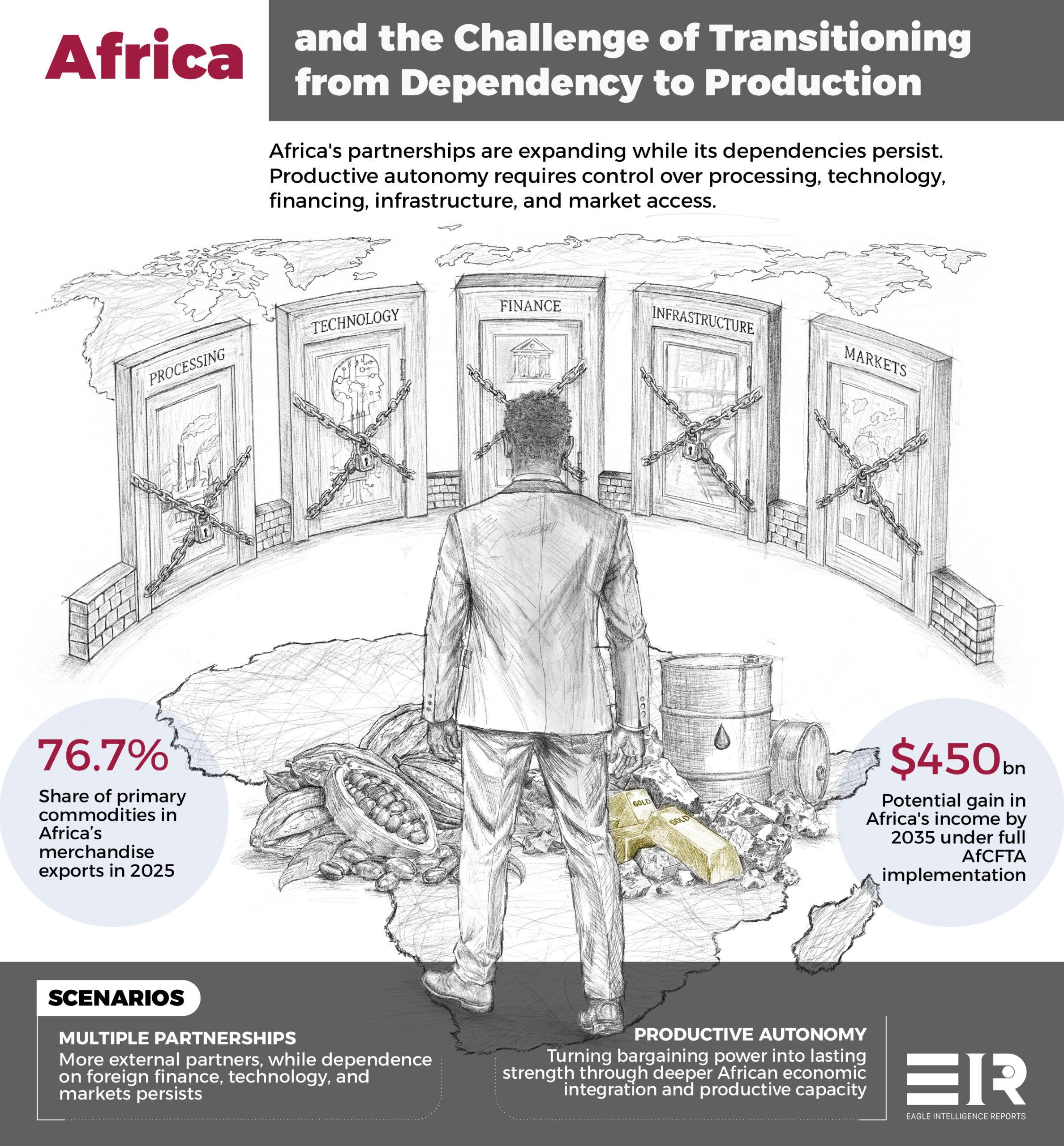
And the problem extends far beyond Ghana. UNCTAD data show primary goods still accounted for 76.7 percent of African merchandise exports in 2025. Its broader research has found that commodity dependence remains especially severe across developing and least-developed economies.
West Africa’s Two Experiments
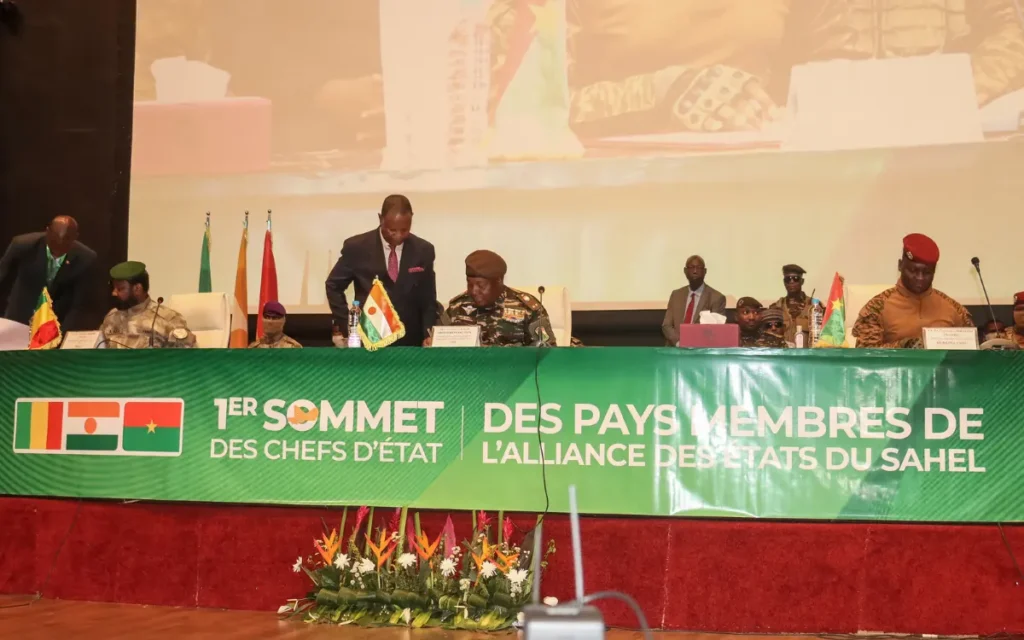
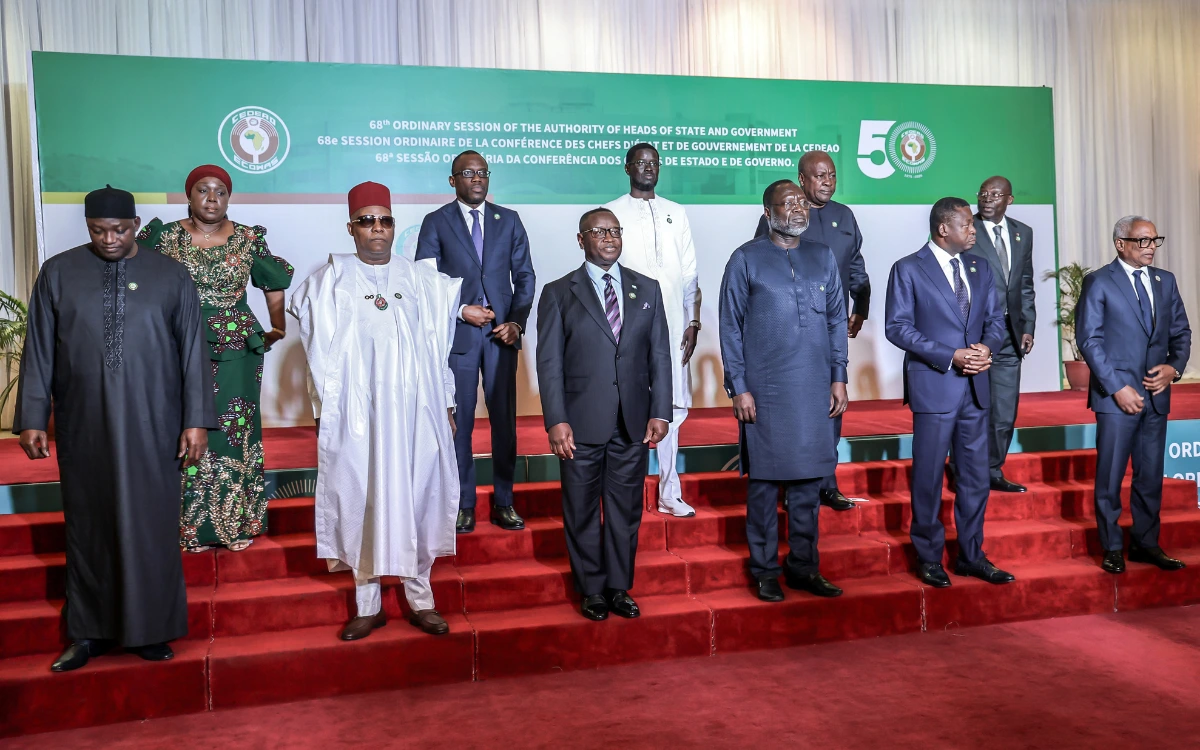
Ghana’s economic diplomacy is unfolding beside a dramatically different experiment in sovereignty. Across the Sahel, Mali, Burkina Faso, and Niger have pursued strategic autonomy principally through security and political rupture. All three formally left the Economic Community of West African States in January 2025 and consolidated their Alliance of Sahel States after relations deteriorated with France. Niger went further in June 2025 by announcing the nationalization of Somair, the uranium venture operated by France’s Orano. The move followed a prolonged confrontation between the military government and the French nuclear company.
Ownership, however, has not produced revenue. More than 1,000 metric tons of yellowcake have stood on trucks near Niamey’s airport, and Niger reports no completed sale. The Benin corridor has been shut since 2023, and French criminal complaints designating the cargo as stolen property closed the route through Togo.
Meanwhile, Russian security involvement has expanded as French and other Western military influence has retreated. In Mali, Moscow developed military ties alongside interests in gold and energy, although deteriorating security has raised questions over Russia’s effectiveness as a security partner. Bamako and Russia’s Yadran created Soroma-SA, 62 percent state-owned, to build a 200-metric-ton refinery near the capital. Mali’s refineries also lack London accreditation, and the Russian partnership exists partly to obtain it. Mali’s lithium, meanwhile, went to neither patron: China‘s Ganfeng took operatorship of the Goulamina mine, and the output ships east.
This produces West Africa’s geopolitical laboratory. Ghana is attempting to increase room for maneuver while retaining Western institutions, multilateral finance, and diversified investment. The Sahel juntas have sought autonomy through rupture, resource nationalism, and alternative security partnerships. Neither model automatically guarantees sovereignty. Expelling one foreign military while depending on another does not necessarily create security autonomy. Nationalizing a mine without the financing, expertise, infrastructure, and market access required to operate it competitively can leave another form of dependence intact.
Applied to both models, the three tests return the same answer. Each has diplomatic autonomy, and each has exercised policy autonomy, Ghana through a refining directive and Niger through expropriation. Neither has productive autonomy, and both are blocked at the same layer of certification, financing, and market access. Likewise, attracting investors from six competing powers instead of two creates leverage only when governments possess sufficient domestic capacity to dictate meaningful terms. The relevant question is therefore not how many partners an African country has, but what it can do without them.
The relevant question is not how many partners an African country has, but what it can do without them.
From Multi-Alignment to Productive Power
That provides a more rigorous test of Mahama’s “dependency syndrome.” Strategic autonomy can be measured across six areas: processing, technology, infrastructure, financing, market access, and policy freedom. African economies must transform their minerals before export and acquire the technologies required to move further up value chains. They must finance strategic infrastructure without recurrent debt distress, transport goods efficiently across African borders, and reach large markets on competitive terms. And governments must make fiscal and foreign-policy choices without an external creditor, security provider, or dominant export market acquiring disproportionate leverage.
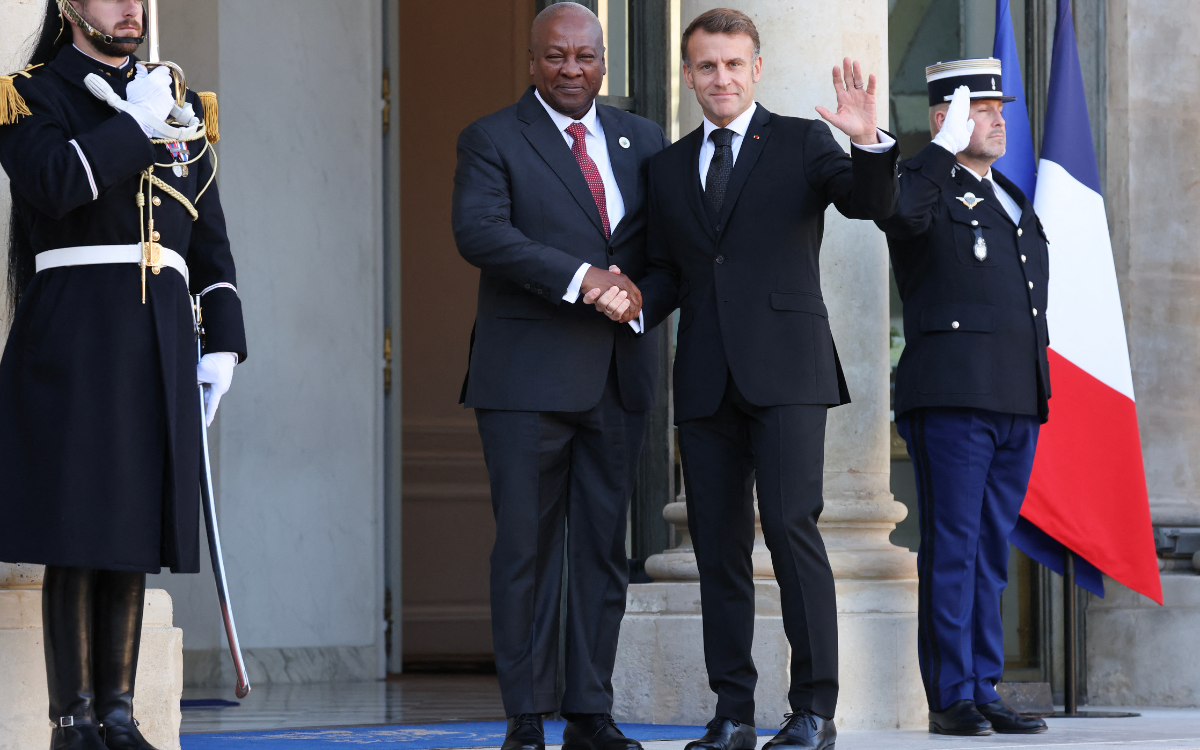
By those standards, diplomacy alone cannot deliver autonomy. Mahama’s $4 billion 24-Hour Economy and Accelerated Export Development Program, launched in July 2025, is therefore relevant. Its declared ambition is explicitly productive: integrated value chains, manufacturing, infrastructure, logistics, and export competitiveness. The program is intended to reduce import dependence and strengthen domestic production. But Ghana cannot solve a continental structural problem alone.
The Continental Trade Question
This is where the African Continental Free Trade Area becomes geopolitical rather than merely commercial. Only about 16 percent of Africa’s trade currently takes place between African countries, according to UNCTAD. That share has moved little since the agreement began trading in 2021. Earlier UNCTAD research found that processed and semi-processed goods make up about 61 percent of Africa’s regional exports, a far larger share than in its exports outside the continent.
That suggests regional trade can do something strategic that commodity exports often cannot: create markets for African manufactured goods. The World Bank estimated in 2020 that full implementation could increase African income by about $450 billion, or 7 percent, by 2035. That estimate assumes an implementation that has not arrived. But the strategic importance goes beyond GDP. A genuinely integrated market would give African states greater scale for industrial production, cross-border infrastructure, regional supply chains, and collective bargaining.
The obstacles are administrative. Rules of origin remain unsettled in textiles, processed foods, and several industrial categories, which are precisely the sectors that value addition would create. Customs clearance still runs in days or weeks, standards differ across borders, and trade under the guided initiative has stayed small against total African trade.
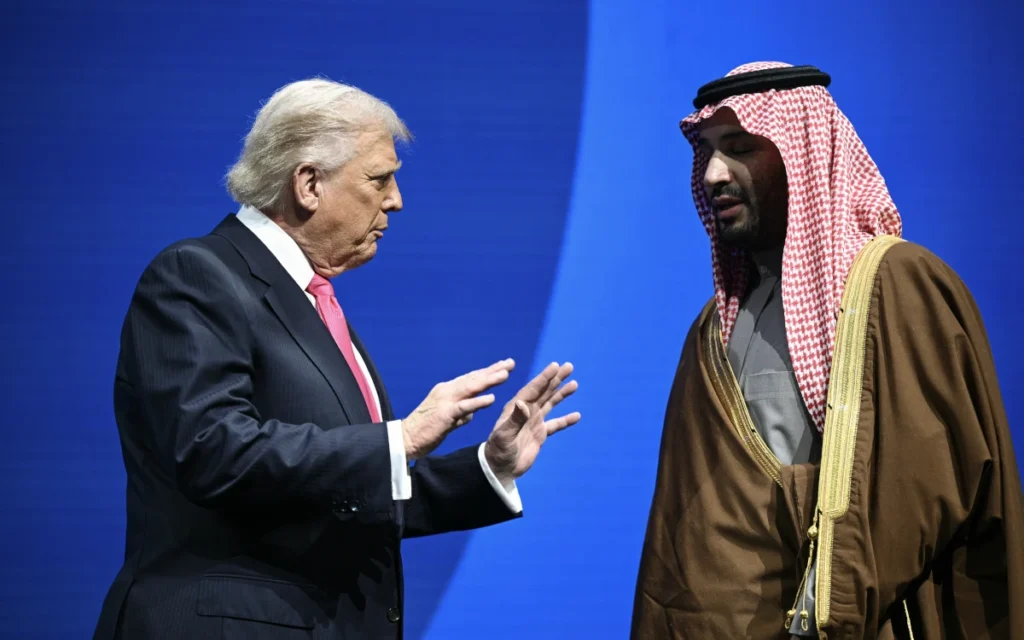
Without continental coordination, geopolitical competition may produce impressive diplomatic diversity without altering Africa’s place in the world economy. China can finance a railway. Europe can offer market access. The United States can invest in critical minerals. Gulf states can finance ports. Russia can provide security cooperation. Each offer may be valuable, and competition between them can improve African bargaining power. But none substitutes for productive capacity.
The emerging multipolar order therefore presents Africa with an opportunity and a trap. More competing powers mean African governments have more options than during periods of overwhelming Western dominance. But if those governments continue exporting commodities, importing technology, borrowing externally, and negotiating individually, they may simply distribute their dependencies among a larger number of patrons.
Mahama’s challenge consequently reaches beyond Ghana. Africa’s defining geopolitical choice is not East versus West. Nor is sovereignty achieved simply by replacing Paris with Moscow, Washington with Beijing, or one creditor with five. The deeper contest is competition among outsiders versus coordination among Africans. The first can create leverage. Only the second can convert that leverage into lasting power.
Africa’s defining contest is competition among outsiders versus coordination among Africans. The first can create leverage. Only the second can convert that leverage into lasting power.
Until Africa controls the processing, financing, technology, infrastructure, and markets surrounding its strategic assets, multi-alignment may change who the continent deals with without changing its position in the global hierarchy. That would not be independence from dependency. It would merely be a dependency with more options.