
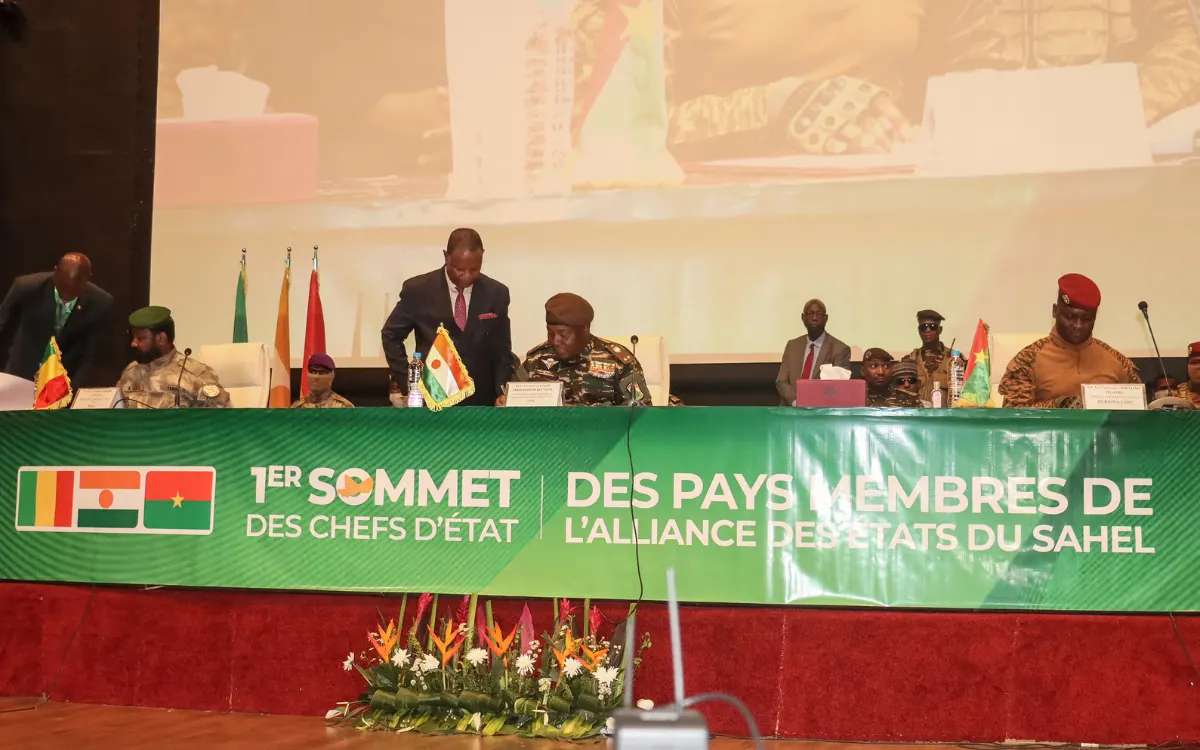
The argument against established international institutions has been made many times; the case for their replacements has rarely been tested. Three Sahel states are leaving the International Criminal Court and West Africa’s main regional bloc. But the strategic significance of the withdrawals lies less in exit than in what will follow. The departure of Burkina Faso, Niger, and Mali is part of a wider attempt by the Alliance of Sahel States to replace external institutions with regional structures it controls. The experiment is a test of whether sovereignty can produce real institutional capacity rather than simply freedom from external constraints. Its outcome could influence how other states interpret the opportunities and risks created by an increasingly fragmented international order.
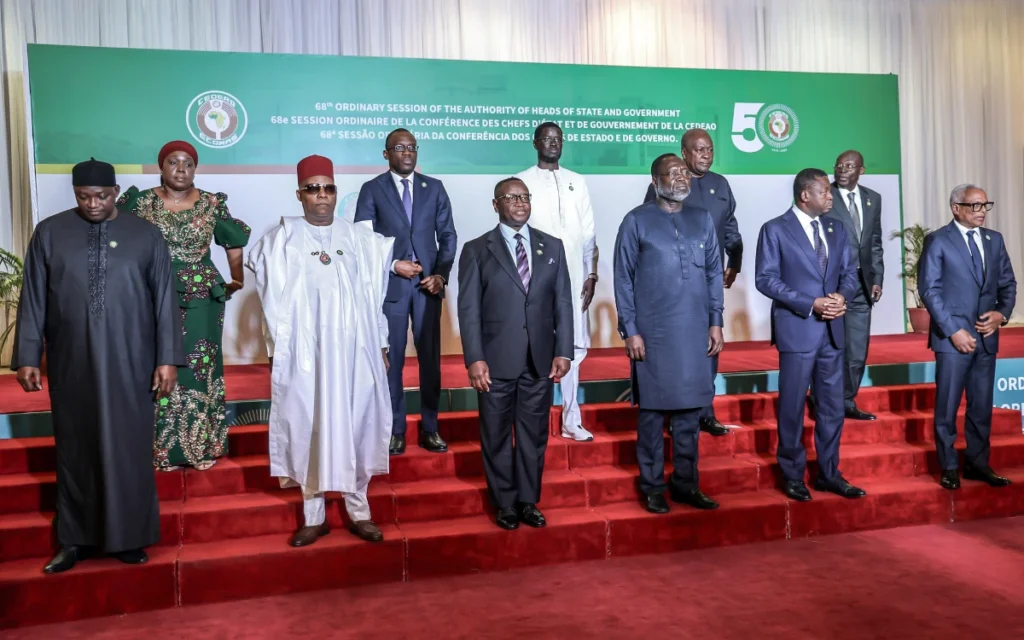
The three governments announced their International Criminal Court (ICC) withdrawal in September 2025, accusing the Court of selective justice and promising “endogenous mechanisms” for accountability. They formally deposited withdrawal notifications in June 2026, beginning the one-year process required by the Rome Statute. The exit from the ICC follows their formal departure from the Economic Community of West African States (ECOWAS) in January 2025. These decisions suggest something more systematic than diplomatic estrangement. The three states, members of the Alliance of Sahel States (AES), are attempting to relocate authority over security, economic cooperation, and justice from established institutions toward their own structures.
This distinction matters because withdrawal itself is not unprecedented. Burundi left the ICC in 2017 and the Philippines in 2019, while South Africa and Gambia filed withdrawal notices in 2016 before reversing course. A broader withdrawal challenge is now emerging: Venezuela and Chad also moved toward leaving the Rome Statute in 2026. What distinguishes the AES is the attempt to combine institutional exit with institutional substitution. The central strategic question is therefore whether three governments can reproduce the functions they are abandoning without weakening the constraints those institutions placed upon them.
The central strategic question is whether three governments can reproduce the functions they are abandoning without weakening the constraints those institutions placed upon them.
Building Beyond ECOWAS
The AES has moved beyond being primarily a defensive pact. It has developed a joint military project, financial structures, and plans for judicial integration. In December 2025, its leaders inaugurated the Confederal Bank for Investment and Development with initial capital of 500 billion CFA francs, intended to finance infrastructure, agriculture, energy, and private-sector projects. In January 2025, Niger’s defense minister said the alliance was preparing a 5,000-member joint force with its own air assets, equipment, and intelligence resources.
These structures reveal the strategic logic behind the AES. Political autonomy becomes durable only when institutions can supply functions previously obtained elsewhere. ECOWAS provided more than diplomatic membership: it created rules governing mobility, commerce, residence, and regional economic integration. The difficulty of disentanglement was evident after the withdrawal. ECOWAS kept recognizing AES passports and identity cards, maintained visa-free movement, and continued applying its trade liberalization arrangements to goods from the three countries.
Geography creates an additional constraint. The three AES countries are landlocked and remain dependent on commercial corridors through neighboring coastal states. Recent disruptions demonstrate this structural vulnerability: Ghana’s state-owned BOST Energies reduced fuel exports to Burkina Faso and Mali in 2026 while prioritizing domestic supply. Institutional separation from ECOWAS cannot eliminate economic interdependence with its members. The AES must develop greater bargaining autonomy while preserving access to transport corridors, markets, and infrastructure controlled partly beyond its borders.
The strategic test is functional rather than ideological. A regional organization becomes consequential when its institutions lower transaction costs, resolve disputes, and deliver collective goods that individual states cannot efficiently provide. The AES bank and joint force are steps toward that capacity, but their existence alone does not establish institutional effectiveness. Their durability will depend on financing, enforceable rules, and whether member governments accept collective decisions when national interests diverge.
The strategic test is functional rather than ideological. A regional organization becomes consequential when its institutions lower transaction costs, resolve disputes, and deliver collective goods that individual states cannot efficiently provide.
The Harder Accountability Test
Justice presents an even more demanding test because an effective judicial institution must sometimes act against the governments that created it. AES justice ministers agreed in 2025 to pursue the Sahelian Criminal and Human Rights Court. Its planned jurisdiction covers terrorism, financing of terrorism, war crimes, crimes against humanity, genocide, and serious human-rights violations. This makes the ICC withdrawal more analytically significant, because the alliance is pairing its rejection of international criminal justice with a regional substitute.
The decisive issue will be institutional independence. A regional court capable of prosecuting insurgents but unable to investigate national armed forces would strengthen state coercive capacity without creating equivalent accountability. That risk is material rather than theoretical. Human Rights Watch has documented serious abuses attributed both to Islamist armed groups and to government forces across the central Sahel. The Africa Center for Strategic Studies reported that, in Mali and Burkina Faso, Sahelian and allied Russian security forces were linked to more civilian fatalities than militant Islamist organizations.

Domestic political conditions also complicate the construction of an independent supranational judiciary. Human Rights Watch reported that Mali’s authorities banned political parties and extended Assimi Goïta’s presidency without elections, while Niger’s military government has weakened institutions capable of scrutinizing executive power. A regional court operating above these national systems would therefore need safeguards stronger than those increasingly absent domestically. Its credibility will depend on appointment procedures, prosecutorial independence, access for victims, and whether governments comply with judgments against their own security institutions.
Withdrawal also does not immediately remove existing ICC obligations. The situation in Mali has been under ICC investigation since 2013, and Article 127 of the Rome Statute preserves obligations and matters arising before withdrawal becomes effective. The transition consequently creates overlapping accountability systems rather than an immediate replacement of The Hague. The ECOWAS exit, by contrast, has already deprived victims of possible redress before the ECOWAS Community Court of Justice, as Human Rights Watch has noted. Whether the proposed Sahelian court develops sufficient authority during this period will provide an early measure of whether institutional substitution is occurring or accountability is simply contracting.
New Patrons, Old Dependencies
Security will provide the most immediate test because the AES derives much of its political rationale from the failure of previous security arrangements. Yet the threat has continued to intensify despite the removal of French forces, the termination of several Western security relationships, and closer cooperation among AES militaries. The Africa Center recorded 9,928 fatalities linked to militant Islamist groups in the Sahel during the 12 months ending in mid-2026, more than in any other African region. The al-Qaeda-linked Jama’at Nusrat al-Islam wal-Muslimin, or JNIM, accounted for 76 percent of those fatalities, demonstrating the scale and organizational resilience of the threat confronting the new security architecture.
The AES response has been to internalize regional military coordination while diversifying external partnerships. Russia has become especially important. After Wagner announced its departure from Mali in 2025, the Kremlin-linked Africa Corps remained, while Moscow stated that it intended to deepen defense and security cooperation across Africa. Russian personnel operating alongside Sahelian governments represent direct external involvement in the regional security system, which rules out any reading of the partnership as non-interference.
Russia has become especially important. After Wagner announced its departure from Mali in 2025, the Kremlin-linked Africa Corps remained, while Moscow stated that it intended to deepen defense and security cooperation across Africa.
The more important analytical question concerns dependency. Replacing French or American security assistance with Russian military support may diversify partnerships, but diversification does not automatically create autonomy. Strategic autonomy increases when governments can change partners without jeopardizing essential state functions. If intelligence, equipment, training, or combat capacity remain dependent on another external actor, the geography of dependency changes more quickly than its underlying structure.
Recent developments in Niger illustrate that relationships are also more fluid than an East–West realignment suggests. Despite Niamey’s expulsion of American forces and stronger Russian ties, the United States approved financing of up to $414 million in September 2026 for a major uranium project in Niger. The AES trajectory is therefore better understood as transactional multi-alignment than movement into a fixed Russian sphere. Its governments are seeking greater negotiating room among competing external actors while centralizing political authority domestically.
A Wider Legitimacy Crisis
The AES challenge is unfolding while the institutions it rejects face their own credibility pressures. The ICC’s November 2024 warrants for Israeli Prime Minister Benjamin Netanyahu and former Defense Minister Yoav Gallant demonstrated that nationals of non-member states are not automatically beyond the Court’s jurisdiction. The judges held that Israel’s consent was unnecessary because the alleged conduct fell within the Court’s territorial jurisdiction through Palestine. That legal assertion of universality, however, has collided with geopolitical power.

Washington subsequently imposed sanctions on ICC officials over investigations involving Israel and the United States, including additional sanctions against judges and prosecutors in August 2025. France reported further American sanctions against the ICC president and a member of the prosecutor’s office in August 2026, describing them as contrary to judicial independence. Such pressure does not establish the AES claim that the ICC itself administers selective justice. It does, however, strengthen a broader criticism: international legal institutions can assert jurisdiction more easily than they can compel powerful states to accept enforcement.
That gap creates political space for the AES. Its governments can point to asymmetries in the international system when defending institutional withdrawal, even while facing separate questions about domestic accountability. The result is a legitimacy competition rather than a simple confrontation between sovereignty and international law. Established institutions must demonstrate that their rules survive geopolitical pressure, while challengers must demonstrate that their alternatives can impose meaningful rules on themselves.
The result is a legitimacy competition rather than a simple confrontation between sovereignty and international law. Established institutions must demonstrate that their rules survive geopolitical pressure, while challengers must demonstrate that their alternatives can impose meaningful rules on themselves.
The Test of Self-Restraint
The AES experiment therefore matters beyond the three countries. The international system is becoming more institutionally contested as governments seek alternative security partnerships, financial arrangements, and regional organizations. Multipolarity may increase states’ choices, but greater choice does not necessarily produce stronger governance. The strategic question is whether new centers of power generate institutions capable of constraining their members or merely expand governments’ room for maneuver.
For the AES, measurable indicators are beginning to emerge. Its joint force must improve security rather than merely relocate military partnerships. Its development bank must mobilize sustainable capital and finance cross-border infrastructure. Its proposed criminal court must be capable of investigating state forces as well as insurgents. Its regional arrangements must also preserve mobility and commerce despite separation from ECOWAS.
Failure in those areas would produce a different strategic outcome from the sovereignty project the AES describes. The alliance could acquire greater freedom from ECOWAS, Western governments, and the ICC while remaining dependent on coastal trade routes, external security partners, and national institutions with weak accountability. That would amount to greater executive autonomy without equivalent institutional capacity.
Success would carry wider implications. If the AES can build effective regional institutions while preserving economic access, improving security, and establishing credible judicial accountability, it would demonstrate that institutional fragmentation need not mean institutional decline. It could provide evidence that regional blocs can renegotiate their relationship with established international structures without abandoning the functions those structures perform.
The significance of the ICC withdrawal should not be measured by the departure itself. The more consequential test is whether the AES can transform sovereignty from a doctrine of institutional rejection into a system of institutional restraint. The ability of its emerging institutions to constrain their own creators will determine whether the Sahel is constructing an alternative regional order or simply reducing constraints on state power.
The deeper implication concerns the international system, where great-power rivalry is lowering the price of exit. Russia supplies security forces to the Sahel, while Washington finances a uranium project in Niger despite the expulsion of U.S. troops. When outside powers compete for access, rules become easier to escape and harder to enforce. The AES is thus an early test of whether institutions that bind governments can survive a world of competing patrons. If they cannot, there may be an order in which the strong defy courts and the weak simply leave them.
When outside powers compete for access, rules become easier to escape and harder to enforce. The AES is thus an early test of whether institutions that bind governments can survive a world of competing patrons.