
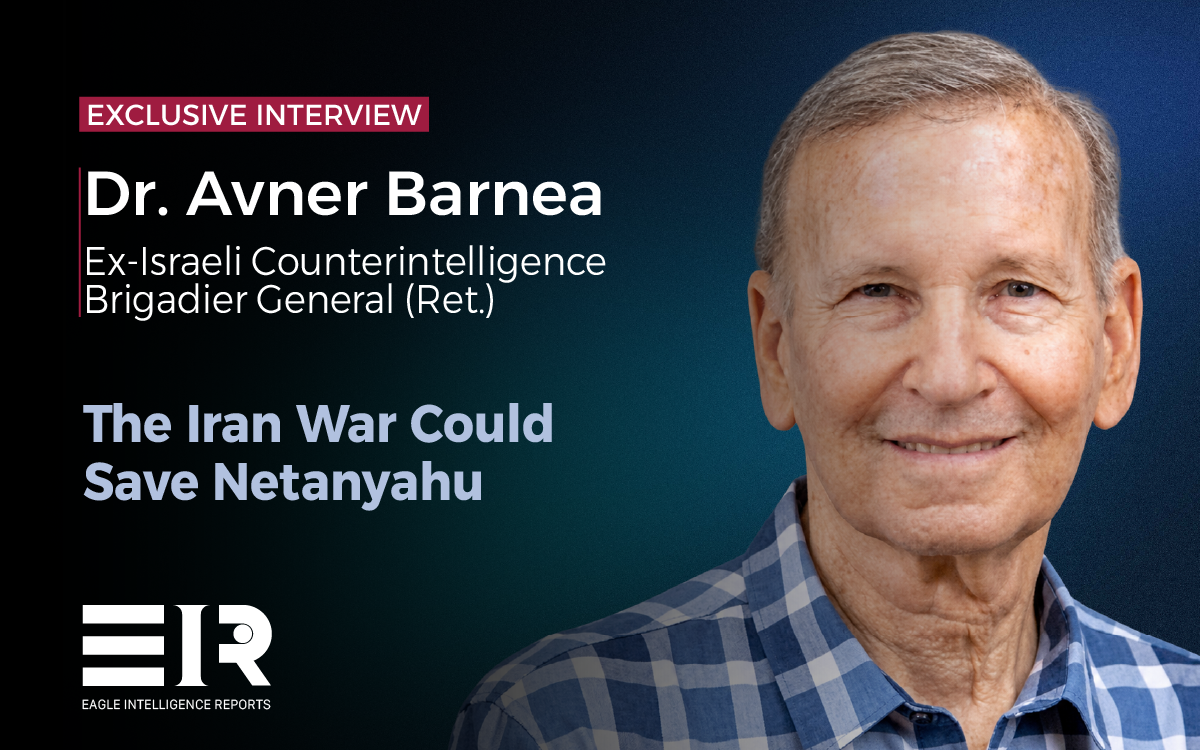
Former Israeli intelligence official Avner Barnea tells Eagle Intelligence Reports that a renewed U.S.–Israeli attack on Iran could reshape Israel’s political transition, despite Netanyahu’s electoral losses.
Former Israeli intelligence official Dr. Avner Barnea has warned that a renewed U.S.–Israeli military campaign against Iran could give Prime Minister Benjamin Netanyahu an opportunity to prolong his political career, despite a sharp electoral setback. In an exclusive interview with Eagle Intelligence Reports, Barnea linked the risk of escalation to the uncertain formation of Israel’s next government.
Barnea’s comments come after Israel’s October 27 parliamentary election, which left Netanyahu’s right-wing bloc with 53 seats in the 120-member Knesset, down from 68 in the outgoing parliament. The rival opposition bloc won 48 seats, while Arab-led parties secured a record 19, according to the completed vote count. No political bloc independently reached the 61-seat threshold needed for a majority.
For Barnea, the result represents a substantial rejection of Netanyahu’s governing coalition, even though Likud remained Israel’s largest individual party.
“He lost 15 seats in the Knesset,” Barnea said, describing the losses as “huge.” He attributed them to the October 7, 2023, Hamas-led attack, subsequent wars, economic pressures, deepening social divisions, and declining public confidence in the prime minister.
Yet Barnea argued that Netanyahu’s continued leadership during coalition negotiations creates a critical window for possible military action against Iran. Under Israeli law, the first lawmaker tasked with forming a government has 28 days to do so, with a possible 14-day extension. The outgoing government remains in office until a successor takes power, meaning the transition could last considerably longer than 40 days.
Barnea argued that Netanyahu’s continued leadership during coalition negotiations creates a critical window for possible military action against Iran
“Netanyahu is staying in power until the new government is elected,” he said. “So, he can make a decision about joining Trump, who is a very good friend of his, to attack Iran.”
Barnea suggested that the timing could be politically significant. He assessed that President Donald Trump might prefer to coordinate a new operation with Netanyahu before a different Israeli government takes office, because a successor administration might be less willing to participate.
Barnea also argued that Netanyahu believes another successful operation against Iran could help him remain in power. In his assessment, Netanyahu sees a renewed conflict as a potential means of delaying Israel’s political transition.
“He believes that if he tries again, maybe he will be successful, and he will be able to stay in power for more time, because if Israel is under attack, you can’t change the government,” Barnea said.
His assessment comes amid reports that U.S. and Israeli officials have prepared options for renewed strikes after the November 3 U.S. midterm elections.
The former intelligence official warned that renewed fighting could bring significant retaliation against Israel, potentially disrupting international flights, damaging infrastructure, and imposing further economic costs.
“There are no flights; people can’t leave, can’t arrive in Israel,” he said, describing the consequences of previous exchanges with Iran. He warned that another confrontation could again leave the country effectively isolated for an extended period.
Barnea also questioned the strategic justification for additional strikes, arguing that Netanyahu had previously portrayed earlier operations as successful in degrading Iran’s nuclear capabilities.
“This is the major thing: it’s not essential for the national security of Israel,” he said.
He further suggested that Netanyahu’s interest in renewed military action could be linked to hopes of weakening or overthrowing Iran’s government, an objective Barnea doubted could be achieved through another bombing campaign.
Beyond the Iranian confrontation, Barnea described the election as evidence of changing attitudes toward Netanyahu’s coalition and its policies toward Palestinians.
“Israelis don’t want an extreme right government anymore. They are looking for a change,” he said, arguing that growing numbers of voters want alternatives to prolonged conflict and a greater emphasis on diplomatic agreements.
“Israelis don’t want an extreme right government anymore. They are looking for a change,” he said, arguing that growing numbers of voters want alternatives to prolonged conflict and a greater emphasis on diplomatic agreements
Barnea also condemned what he called “very strong Jewish terrorism against the Palestinians in the West Bank,” accusing the outgoing government of supporting attacks on Palestinian communities. He argued that opposition to such policies had contributed to the electoral backlash against Netanyahu’s coalition.
He maintained that a substantial share of Israeli society supports eventually reaching an agreement with the Palestinians, although he acknowledged that the country remains deeply divided over territorial and security questions.
Arab citizens’ participation was another major factor in his interpretation of the results. Barnea linked their increased political mobilization to concerns about crime, public safety, unequal resources, and the treatment of Arab communities under the outgoing government.
“They said, we’re fed up, enough is enough. We can’t live in a country where you look at us as enemies,” he said, describing what he viewed as the motivations of Arab voters.
Barnea described Arab voter participation as the highest since Israel’s establishment in 1948. While turnout among Arab voters surged and Arab-led parties secured a record 19 parliamentary seats, the precise historical turnout ranking has not been independently established.
The 19 seats won by Arab-led parties could prove consequential for coalition formation. However, cooperation between those parties and the broader anti-Netanyahu opposition remains politically contentious, meaning their combined parliamentary strength does not automatically translate into a governing majority.
Despite that obstacle, Barnea was emphatic in his assessment of Netanyahu’s future.
“I think it’s a new era in Israel,” he said. “I think that Netanyahu has finished his political career here.”
He predicted that Netanyahu would eventually move into opposition and that a different government could pursue improved relations with European countries, greater domestic reconciliation, and new diplomatic approaches toward Syria, Lebanon, and the Palestinians.
He predicted that Netanyahu would eventually move into opposition and that a different government could pursue improved relations with European countries, greater domestic reconciliation, and new diplomatic approaches toward Syria, Lebanon, and the Palestinians
Barnea also argued that removing Netanyahu’s government could “dramatically” transform Israel’s international relations and economic prospects.
For Israel’s regional partners and adversaries, the immediate question is whether the political transition will unfold before another confrontation with Iran. Barnea’s warning underscores how the overlap between U.S. military planning, Israel’s unresolved coalition negotiations, and Netanyahu’s political future could influence decisions with consequences far beyond Israel’s borders.