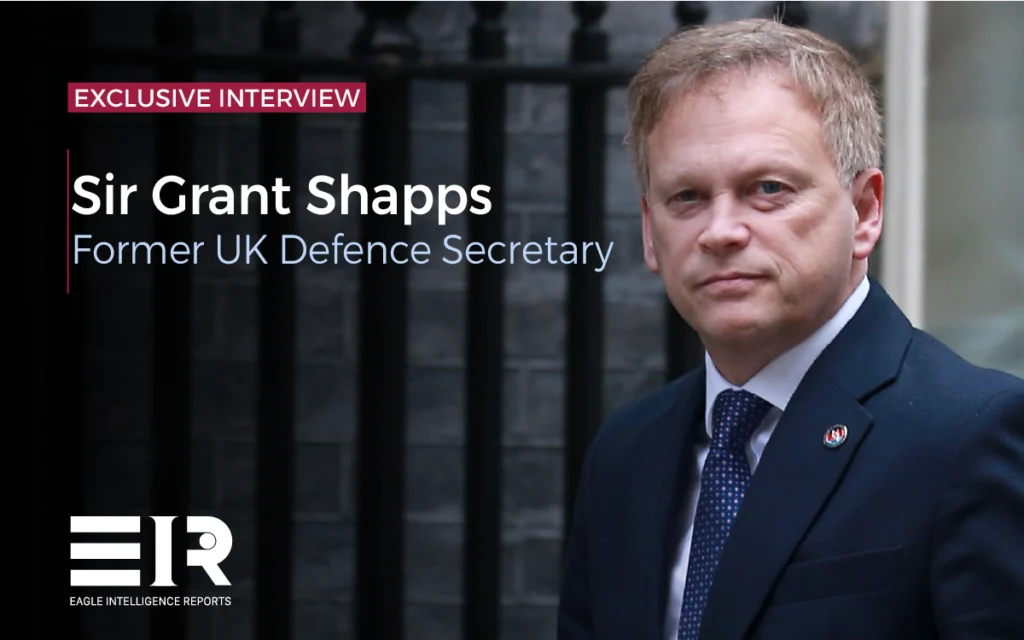

Former British Defence Secretary Sir Grant Shapps has revealed that British, Israeli, and possibly U.S. intelligence was shared with Gulf partners, including Saudi Arabia, helping, he said, to prevent atrocities in the Kingdom.
In an exclusive interview with Eagle Intelligence Reports, Shapps described intelligence cooperation between Britain, Israel, and the United States as an important factor in regional security, arguing that maintaining these relationships serves broader strategic interests despite growing diplomatic tensions between London and Tel Aviv.
Shapps defended Britain’s close military and security ties with Israel despite concerns over potential violations of international law. He argued that allegations should be properly investigated and that diplomatic disagreements should not undermine intelligence cooperation that benefits the wider region.
Shapps defended Britain’s close military and security ties with Israel despite concerns over potential violations of international law
Turning to British–Israeli relations, Shapps criticized what he described as rash decisions by the British government that contributed to the closure of Britain’s mission in Ramallah. He warned that the development had damaged not only bilateral relations with Israel but also British efforts to strengthen the Palestinian Authority in the West Bank.
He also opposed diplomatic retaliation against Israel over restrictions on Britain’s diplomatic presence, arguing that long-term relationships between countries should not be dictated by disagreements with individual governments or political leaders.
Addressing the Israeli–Palestinian conflict, Shapps acknowledged the considerable obstacles to achieving a two-state solution and advocated quiet diplomacy rather than public confrontation. He suggested that ongoing geopolitical changes in the Middle East could eventually create opportunities for broader regional stabilization, potentially including normalizing diplomatic relations between Saudi Arabia and Israel.
He suggested that ongoing geopolitical changes in the Middle East could eventually create opportunities for broader regional stabilization, potentially including normalizing diplomatic relations between Saudi Arabia and Israel
Shapps argued that the Middle East was undergoing a fundamental transformation, with established assumptions about regional politics increasingly challenged. He expressed hope that a future regional order could place greater emphasis on economic cooperation, prosperity, and improved living standards.
Reflecting on Britain’s diplomatic approach, Shapps said he had privately worked to persuade Israel to facilitate humanitarian aid deliveries to Gaza during his time as Defence Secretary. He argued that subtle diplomatic engagement was more effective than public criticism or high-profile political gestures.
On accountability, Shapps stressed the importance of ensuring that investigations into questioned Israeli military operations produce meaningful outcomes. However, he maintained that the broader security benefits of cooperation between Britain, Israel, and the United States made preserving those relationships preferable to abandoning them.
Throughout the interview, Shapps emphasized the strategic importance of intelligence cooperation, the need to preserve diplomatic relationships amid political disagreements, and the challenges facing Britain and its regional partners as the Middle East undergoes significant geopolitical change.
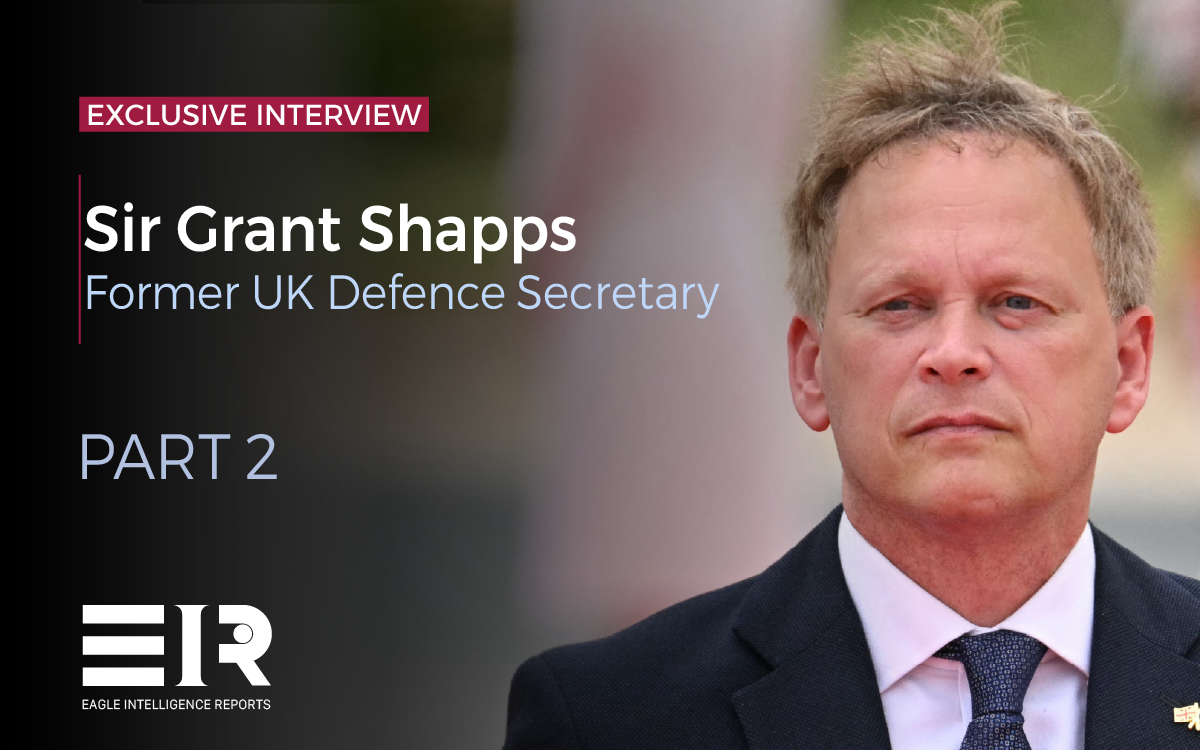
The following is the second part of Eagle Intelligence Reports’ exclusive interview with Sir Grant Shapps, conducted by Jonathan Sherry and Andra Maciuca.
Interview Excerpt
Jonathan Sherry:
Israel ordered the closure of Britain’s nearly two-hundred-year-old consulate in Jerusalem, although the mission remains open under a new name and with reduced staff. Britain rejects Israel’s decision but has ruled out retaliation. Has Israel crossed a diplomatic red line, and has Britain done enough to respond?
Sir Grant Shapps:
Well, actually, I think I regret what the United Kingdom has done in this case because I know a lot of it is driven by the politics in the UK of who’s in power. Now, I say this not because I agree with what the Netanyahu government does either. But I think it’s always important in any bilateral relationship with another country to separate the country from the individual who’s in power or the government that’s in power at any given time. And our relations with all the countries across the Middle East, and with many other countries around the world, shouldn’t be governed by the individual who happens to be there at that moment in time.
Now, I can apply that as much to Israel as I’d apply it to the United States. You do not have to agree with everything that the government of the day is doing to still recognize and value your longer-term relations. So, as I say, I think the escalation was unwelcome and probably unwarranted as far as what the United Kingdom has done and with the situation that’s now arisen with the consulate in Jerusalem.
Jonathan Sherry:
So do you think the British should retaliate diplomatically if Israel refuses to lift the restrictions?
Sir Grant Shapps:
No, I don’t. And I think that the whole situation is unfortunate. I’ve been to, for example, our mission in Ramallah, where we were helping to strengthen the unfortunately famously weak Palestinian Authority because, you know, solutions in the end are going to revolve around Palestinians needing to have their own sense of security based on having the training and the rest of it.
Now, I’ve been to visit that mission in Ramallah. That mission’s now being closed, and it’s been closed because the United Kingdom took, I think, some rash decisions that ended up creating the political circumstances in which that mission’s been closed down. That’s bad. It’s not just bad for British–Israeli relations, but it’s bad for training of the Palestinian Authority in a way that might have been helpful in the West Bank. So, no one wins under these situations.
Jonathan Sherry:
Do you think Britain can credibly support a two-state solution if its diplomatic representation to the Palestinians is restricted effectively?
Sir Grant Shapps:
I mean, look, I don’t want to—as I said, I’ve been to visit that actual mission that was training people in Ramallah, and it’d been running for many years, by the way. It wasn’t anything new. I don’t think the opening or closing of a single operation within a country—and there’s still diplomatic relations and all the rest of it—I don’t think those things individually would stop support for, for example, a two-state solution. But unfortunately, it’s not like we’re on the eve of a solution to those problems.
I do have wider hopes for the Middle East, actually. I think even with this current war, and certainly since October 7th, 2023, I think so much has changed and happened in the Middle East that actually all the old assumptions are gone. We’ve got a world in which numerous Gulf Arab states are being attacked by Iran. Everyone understands that Iran is the center of this network of difficulty in the region. And where there is the opportunity to get to a position where—although difficult to see how that happens at this point, I agree—but there is a sort of reshaping of the Middle East taking place in front of our eyes, where perhaps eventually we get normalization between Saudi and Israel. We’ve already seen that normalization elsewhere with the Emiratis and others.
And the other side of this turns out to be a very different Middle East, where really economic prowess and economic gains and better quality of life and better way of life for all the inhabitants of the region are put at the top of the agenda. And that’s the one I think would be an extraordinary and brilliant outcome. Obviously, a very, very long way to go and quite difficult to map out exactly how that happens. But things have changed and they’re not going back to the way they were before this Iranian war broke out.
Andra Maciuca:
Britain maintains strong security and military ties with Israel while also supporting the two-state solution and Palestinian rights. Would you say Britain struck the right balance between international humanitarian law and Israeli security? And what should your government have done differently?
Sir Grant Shapps:
I mean, I always took the view that—and particularly after October 7th, which was when I was defense secretary—that Israel had just been attacked mercilessly. There was then a reaction. And during that reaction, I would constantly but privately work to persuade Israel that it needed to, for example, ensure that humanitarian aid was getting to Gaza. And there are various different ways to try to achieve that.
I’ve always found that in the region—this applies to Israel, but actually it also applies to all our Gulf partners—the very best kind of diplomacy is not the one which does it over the television and internet and posting on X accounts. It’s actually where you go and have the quiet conversation and achieve things for peace and security in the region. And I rather feel that the current approach is a little bit too shouty and not enough diplomacy. And I think it would be advantageous for the United Kingdom to be pursuing the goals of a peace—a two-state solution ultimately—by working quietly rather than big gestures. And so that would be my sort of concern.
Is it the right way forward? Interesting question. I already said that the level of complexity between where we are today and getting to a two-state solution is obviously very deep. But I am a little hopeful inasmuch as if we get to a form of normalization in the region where the majority of countries have formal diplomatic relations with Israel, where everyone recognizes that Iran is the real threat to stability in the region, then I think the United Kingdom has an important part in facilitating that conversation and helping through our own security apparatus and cooperation. You mentioned intelligence cooperation with Israel. That similar intelligence cooperation takes place with the vast majority of the Gulf states as well.
Andra Maciuca:
But should Britain reconsider its military and security ties with Israel because of concerns over violations of international law?
Sir Grant Shapps:
I think it’s Britain’s place to always be very clear and clear-eyed with Israel and Israeli ministers about the way that their actions may be viewed and making sure that, for example, where things go wrong—and we’ve seen this—that they’re properly investigated, and there’s actually an outcome. I saw a report yesterday of military actions that have been questioned. A lot of inquiries have been set up. But there’ve not been outcomes to very many of them in Israel. And I think getting to the bottom of things like that is important.
We must not forget that Israel is a democracy—that people have the free will to vote there. And it’s important that I think that that process is respected once there’s been an election. But I also think that the broader interest is in ensuring that the sort of intelligence shared between the United States, the United Kingdom, and Israel on what’s going on in Iran is used to the wider benefit of the region as a whole. And so that security anchor, that three-way security—your triangle, if you like—I think has been very important for security for the region.
And without going into excessive detail, I can tell you as a fact: information that Israel and the United Kingdom have had, perhaps with the U.S. as well, have been usefully passed on to Gulf partners like Saudi in the past, which have prevented, I think, atrocities from taking place in Saudi Arabia. It’s a great example of how this cooperation could and should work.
Andra Maciuca:
So are you saying that despite concerns about potential international law violations, Britain should continue its military and security ties with Israel?
Sir Grant Shapps:
So what I’m saying is every country at some point or other will be accused of something that it shouldn’t have done. Same could be said for Saudi. The same could be said for Israel. I’m sure the same for the United Kingdom. Right? If, as soon as somebody makes an accusation—unproven but until proven sort of thing—everyone then says, “Well, all right, that’s it. We’ll never deal with Israel again. We’ll never deal with Saudi again.” That is not the way that strong diplomacy works.
And what I’m saying is that with the relationships that we have, the United Kingdom in particular, on the intelligence front, the whole of what I call the civilized region—very much including Saudi—have benefited from that intelligence in a way that perhaps wouldn’t have happened if that intelligence cooperation didn’t exist between the U.S., UK, and Israel.
Now, it has been very frayed, I should say, in the last few months in particular between the UK and Israel. I suppose your question is: should the UK push that further? No, I think the UK should push to get the outcome of some of these inquiries that have taken place where things have gone wrong. I think we accept that no country is perfect. But I think that the overall benefit of working together benefits the region more than trying to walk away from it.