
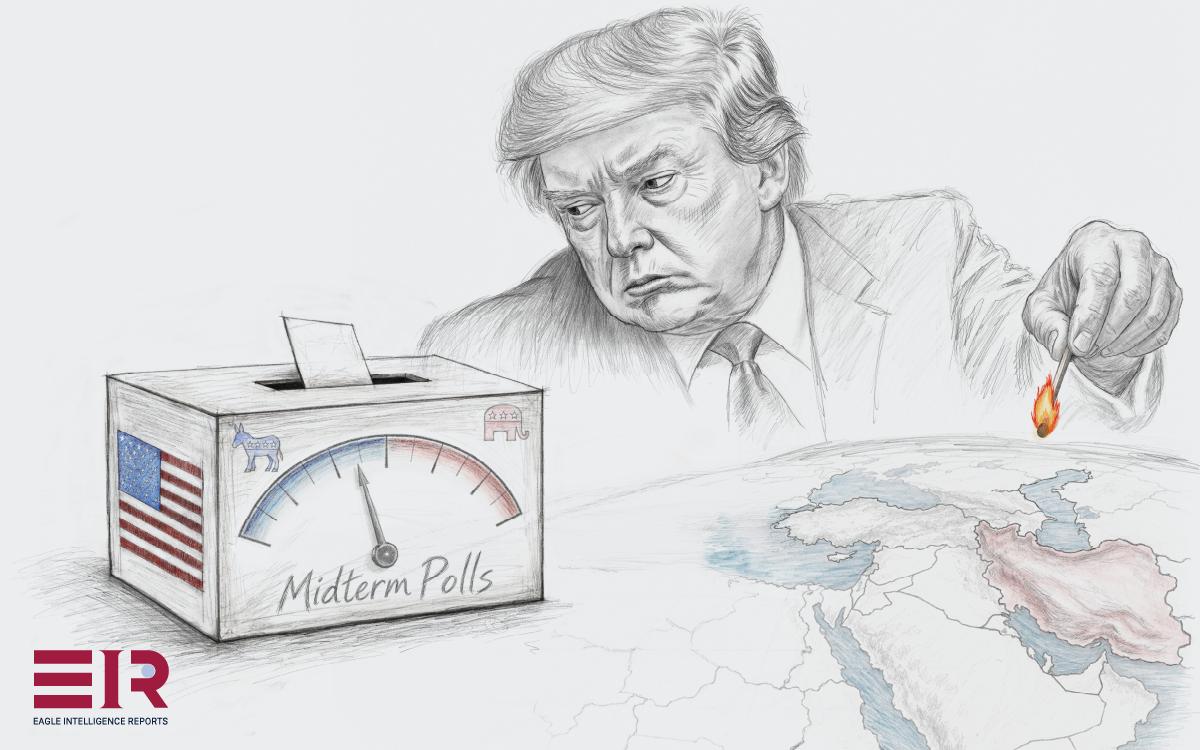
Much of the discussion surrounding the U.S.–Iran war has focused on what the November 3 midterm elections could mean for President Donald Trump’s ability to sustain the conflict, particularly if Republicans suffer significant losses. But this framing overlooks a paradox: the same election result that could constrain Trump later may first give him a short window in which to act before those constraints take effect.
The new Congress will not assume office immediately after the election. That creates a potentially critical period between November 3 and January 3. If the results weaken the administration’s position in the incoming Congress, the White House may see those two months as a final opportunity to establish a new military or political reality before heightened oversight, investigations, appropriations battles, and legislative pressure make the war more difficult to manage.
Iran’s apparent wager is not that it can achieve military superiority over the United States; the balance of power makes that unrealistic. Rather, Tehran has an incentive to endure long enough for the costs of the conflict to migrate from the Iranian economy into American politics through higher fuel prices, growing public pressure, and declining support for Trump and the war.
Here lies the paradox. If Tehran expects the elections to narrow Trump’s room for maneuver, the same outcome could produce the opposite effect in the short term, encouraging the administration to move faster before January. The most dangerous phase of the war may therefore come not in the weeks before the election, but in those immediately afterward.
This is not an inevitable outcome. But it is a possibility that governments across the region should take seriously. November 3 should not be treated as a finish line. It may instead mark the beginning of a new and potentially more volatile phase.
November 3 should not be treated as a finish line. It may instead mark the beginning of a new and potentially more volatile phase
Three Electoral Outcomes, Three Different Wars
The November 3 elections will not produce a single political consequence for the war. Different congressional outcomes could create very different strategic environments.
If Democrats retake the House while Republicans retain the Senate, Washington could enter a prolonged period of political and military attrition. A Democratic-controlled House would possess significant oversight and political tools with which to raise the cost of military decisions, including hearings, investigations, appropriations battles, and demands that the administration justify the continuation or expansion of the conflict.
At the same time, divided control of Congress would limit Democrats’ ability to force a fundamental change in foreign policy while the Senate remained Republican and the president retained broad executive authority. The result might be neither peace nor major escalation, but a conflict that becomes politically harder to expand while remaining equally difficult to end.
For Tehran, such an outcome could appear to validate the strategy of endurance by demonstrating that the conflict is beginning to impose political costs inside the United States. That perception could encourage Iranian leaders to continue absorbing pressure in the hope that time is increasingly working in their favor.
One possible consequence would be a prolonged low- or medium-intensity confrontation extending into 2027, punctuated by intermittent negotiations and reciprocal economic and military pressure. Neither side would necessarily have sufficient incentive to escalate to full-scale war, but neither might yet possess the political conditions required for a durable settlement.
If, however, Democrats gain control of both chambers, the period between the election and the seating of the new Congress could become considerably more sensitive.
In that scenario, the White House may calculate that actions available before January will become politically more difficult afterward. The November 3–January 3 window would therefore assume greater strategic importance.
A Democratic Congress could not simply end the war, nor would the president suddenly lose his foreign-policy powers. But the political environment surrounding the conflict would become more adversarial. The more restrictive the coming environment appears, the stronger the administration’s incentive could become to lock in military or negotiating gains before those constraints begin.
The more restrictive the coming environment appears, the stronger the administration’s incentive could become to lock in military or negotiating gains before those constraints begin
That could mean a limited but consequential escalation, a major military operation, or an effort to impose new terms on Tehran before the new Congress takes office. In this scenario, the election result Iran expects to constrain Trump later could create a short-term incentive for him to act more quickly.
The third scenario—Republicans retaining control of both chambers—could be the most disruptive to Tehran’s calculations.
Such a result would weaken the assumption that prolonging the war until the midterms will necessarily erode Trump’s political capacity to continue it. The elections would not give the president a blank check on Iran, nor would they eliminate domestic opposition to the war or its economic costs. But they would remove one of the clearest near-term political deadlines around which Tehran may be calibrating its strategy.
If Iran absorbs additional months of sanctions, military strikes, and pressure on its oil exports in the expectation that November will alter the political balance in Washington, only to see Republicans retain both chambers, Tehran would face a more difficult question: if November does not provide an exit, how long can the strategy of endurance continue?
That question could prove strategically significant because Iran would then have to reassess not only how much additional pressure it can absorb, but also whether the political logic underlying its willingness to wait remains valid.
At that point, another paradox emerges. The electoral result seemingly most favorable to Trump’s ability to maintain pressure on Iran could also be the one most likely to encourage Tehran to explore a settlement.
If the U.S. elections no longer offer a plausible near-term route to improved political conditions, negotiations could become a means of ending an attritional process whose endpoint is increasingly uncertain. In that sense, a Republican victory could strengthen Washington’s position while simultaneously creating new incentives for diplomacy.
November 3 May Be the Beginning
Gulf states and other Arab countries affected by the confrontation should therefore resist treating the U.S. elections as a turning point that will automatically reduce the risk of escalation. Under some circumstances, the opposite could occur. If the elections weaken Trump’s position in the incoming Congress, the White House may seek to consolidate military or political gains before January. If Republicans remain strong, Tehran may be forced to reconsider its wager on time itself.
Israeli calculations add another source of uncertainty, particularly if Prime Minister Benjamin Netanyahu concludes that developments in the conflict create an opportunity to alter the strategic balance with Iran. Perhaps the strangest thing about this war is that everyone is on edge. If a major incident occurs, all of these calculations may disappear at once.
Israeli calculations add another source of uncertainty, particularly if Prime Minister Benjamin Netanyahu concludes that developments in the conflict create an opportunity to alter the strategic balance with Iran
A major security incident could overturn these calculations almost instantly. The recent reports surrounding an alleged attempt to shoot down a Flydubai aircraft bound for Tel Aviv with more than 170 Israelis on board illustrate how quickly escalation dynamics could change. Had the attempt succeeded and the aircraft gone down, it would have been difficult to imagine the confrontation remaining within its current limits, as the incident could have become the spark that ignited the war at full force. Benjamin Netanyahu may not have needed much time to decide on direct Israeli intervention, because in moments like these, fingers are already closer to the trigger than to any long-term political calculations.
This is the central danger of the present phase: strategic actors may believe they are managing escalation while remaining vulnerable to a single event capable of changing the political context overnight.
For that reason, governments should watch more than aircraft carriers, U.S. bases, Iranian missile launchers, oil prices, and opinion polls. Four variables deserve particular attention: the precise outcome of the congressional elections, the November 3–January 3 transition period, Israeli political and security calculations, and the possibility of an unexpected incident that forces all sides into a conflict trajectory they had not intended.
Focusing on November 3 alone risks producing a misleading reading of the war. The elections may alter the political environment, but they will not end the conflict. The more important question is what kind of war they produce afterward.
A divided Congress could prolong an attritional confrontation. Democratic control of both chambers could increase Trump’s incentive to establish facts on the ground before January. Republican control could force Tehran to confront the possibility that the political clock on which it had been waiting has failed to provide the opening it expected.
The question, therefore, will no longer simply be which side managed to endure until November 3. It will be what each side does when it discovers that November 3 has produced a different war from the one it had been preparing to fight.
The question, therefore, will no longer simply be which side managed to endure until November 3. It will be what each side does when it discovers that November 3 has produced a different war from the one it had been preparing to fight