
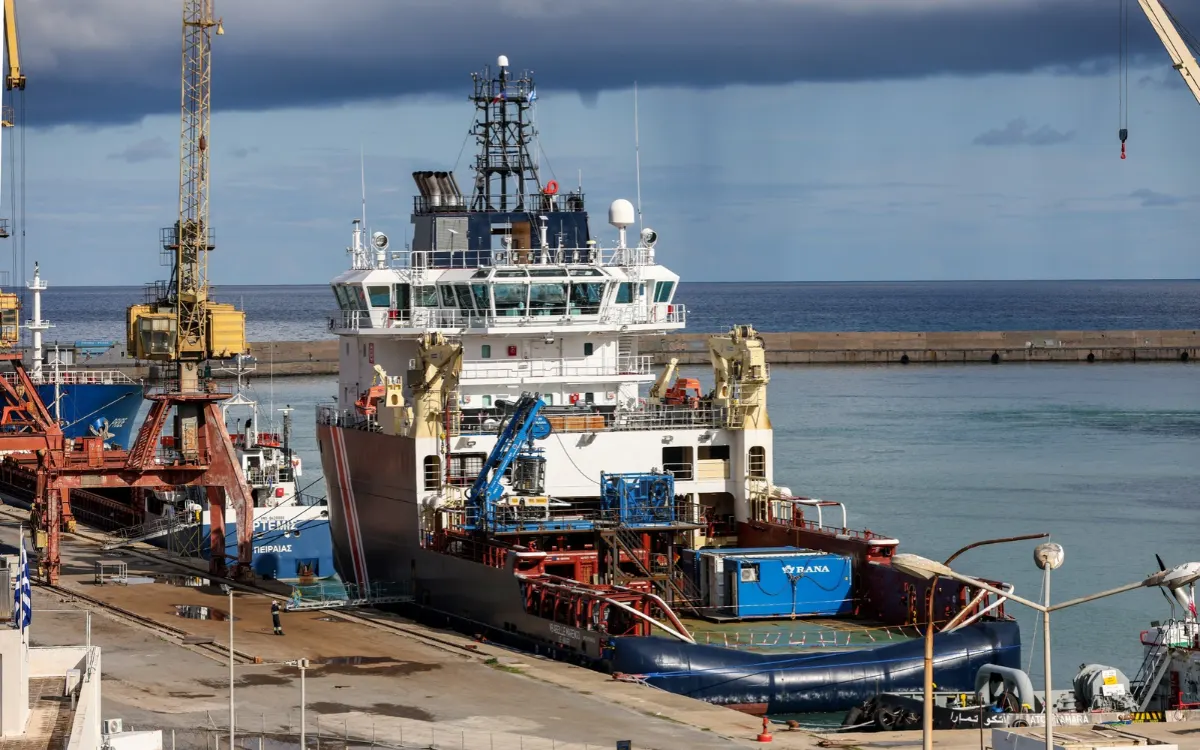
The arrival of the French-flagged Abeille Marengo in Crete on October 27 has brought a longstanding maritime dispute between Greece and Turkey back into focus. The vessel is preparing to conduct seabed surveys for the Great Sea Interconnector, a planned electricity cable connecting Greece and Cyprus. But Turkey is demanding advance consultation over operations in waters it claims, raising the prospect of another confrontation over a project Washington supports.
For Ankara, delaying construction may be as useful as blocking it: repeated consultations could give Turkey leverage over regional infrastructure without settling the underlying maritime dispute. Greece and Cyprus, meanwhile, want an electricity connection to the European grid that does not depend on Turkish consent.
Washington backs the interconnector as part of its energy partnership with Greece, Cyprus, and Israel. Yet it also relies on Turkey’s military capabilities and strategic position on the Black Sea. This creates a dilemma: pressing Ankara too hard could strain relations with an important NATO ally, while remaining passive risks allowing Turkey to establish a precedent for influencing future infrastructure projects.
Pressing Ankara too hard could strain relations with an important NATO ally, while remaining passive risks allowing Turkey to establish a precedent for influencing future infrastructure projects
Cyprus and the European Grid
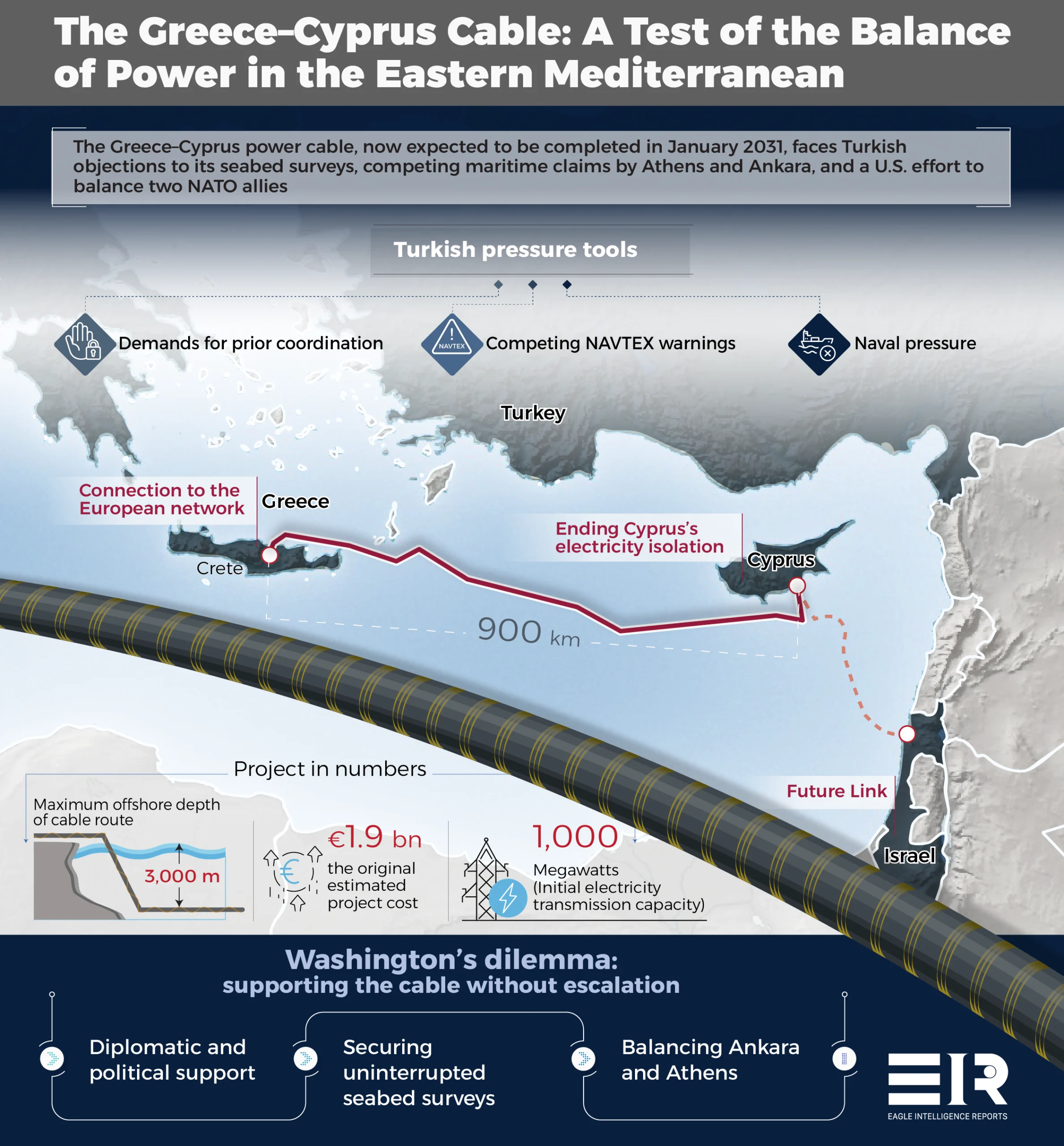
Cyprus is the only European Union member state without an electricity connection to another country’s grid. It relies on domestic power generation and cannot import electricity when local supply falls short. The Great Sea Interconnector would connect Cyprus to Greece’s electricity network, allowing power to flow in both directions and giving the island greater flexibility to integrate renewable energy.
The link could later extend to Israel. The European Union has designated the interconnector a Project of Common Interest and awarded €657 million in EU infrastructure funding for the Greece–Cyprus section. In December 2025, the European Commission also identified it as one of eight priority Energy Highways, placing it among the cross-border electricity projects Brussels wants to accelerate.
Before construction can proceed, however, contractors must complete seabed surveys in waters where Greece and Turkey maintain competing maritime claims. American political support will have limited practical effect if Turkey repeatedly uses those claims to obstruct the surveys.
Delaying the Cable Without Blocking It
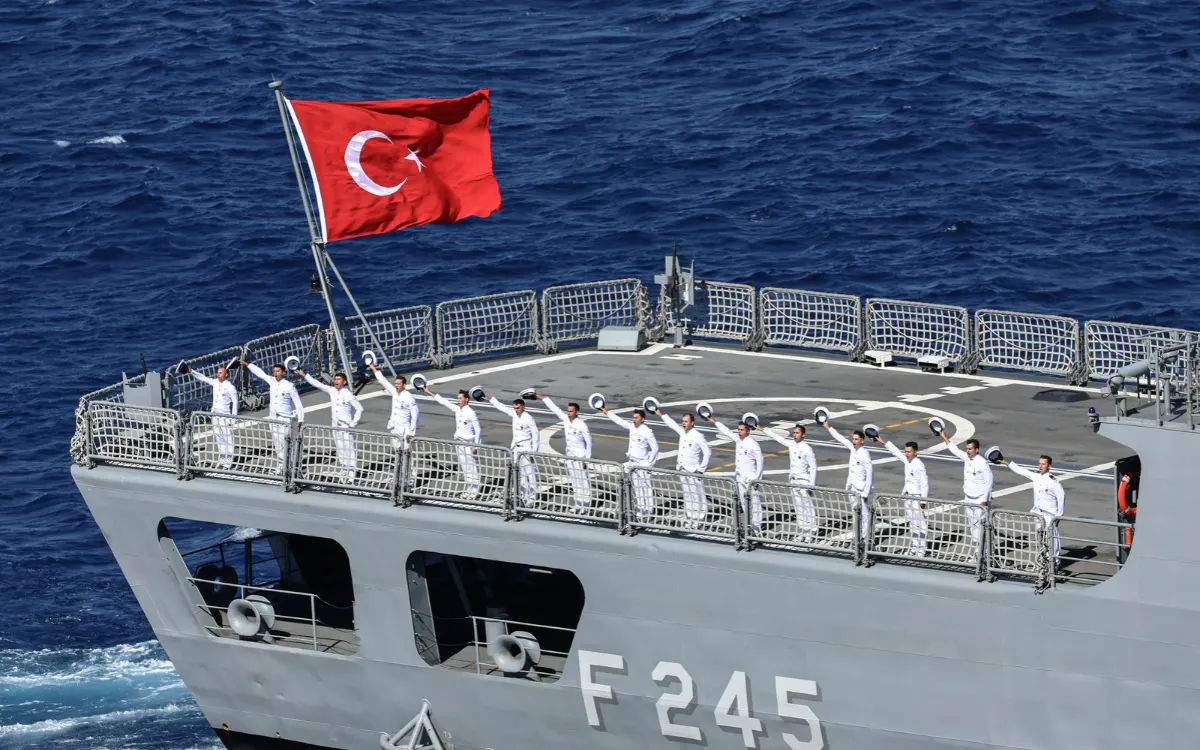
In July 2024, Turkey deployed five warships near the Greek islands of Kasos and Karpathos as the Italian research vessel Ievoli Relume conducted seabed surveys for the cable. Greece reinforced its naval presence, while diplomats worked to prevent escalation. The confrontation interrupted operations, but the vessel completed its planned surveys after diplomatic contacts helped defuse the crisis. The incident showed how Turkey could disrupt the project without blocking it outright.
At the heart of the disagreement are competing interpretations of maritime jurisdiction. Turkey challenges the extent of the continental shelf generated by Greek islands and insists on coordination before activities take place in waters it claims. Greece maintains that only Greek authorities can authorize surveys in areas under its jurisdiction.
Ankara also invokes its 2019 maritime agreement with Libya to support its claims in the Eastern Mediterranean. Libya’s House of Representatives ratified the deal on October 20, reversing its earlier rejection. Athens disputes the agreement, arguing that it disregards the maritime rights of Greek islands and cannot determine the rights of third states. Although it does not settle the legal status of the interconnector’s route, the agreement forms part of Ankara’s broader challenge to Greek maritime claims.
Ankara has acted on its maritime claims around Cyprus before. In February 2018, Turkish warships prevented the Saipem 12000, a drilling vessel contracted by Italy’s Eni, from reaching its intended location in Block 3 of Cyprus’s exclusive economic zone. Diplomatic efforts failed, and Eni withdrew the vessel.
Turkish drilling operations subsequently took place in areas claimed by the Republic of Cyprus. The European Union established a sanctions framework in November 2019 and, in February 2020, imposed restrictive measures on two officials of the Turkish Petroleum Corporation. The drilling continued during 2020.
Hydrocarbon exploration and submarine cable surveys involve different legal rights, and the earlier incidents do not establish Turkish authority over the interconnector. They nevertheless show both Ankara’s willingness to use naval pressure and the limits of diplomatic measures to change its conduct.
The next test concerns the Abeille Marengo, which is preparing for surveys that could eventually extend into areas of overlapping Greek and Turkish claims. By October 31, the Greek committee that grants marine research permits had been instructed to convene, with a navigational warning, known as a NAVTEX, expected in early November. As of November 3, the vessel remained in Heraklion, Crete’s main port, pending the necessary procedures.
Earlier, on October 1, Turkey’s Ministry of Defense warned against unauthorized activities on what it considers its continental shelf. Turkish Foreign Minister Hakan Fidan struck a less confrontational tone on October 21. He said his country did not oppose the cable but expected written advance notice of the surveys, including their coordinates. Greek Foreign Minister George Gerapetritis has maintained that Greece alone can authorize the surveys, although it could share advance information without making a request for permission. On November 3, he told Greek lawmakers that any Turkish attempt to obstruct the work would meet an operational response.
Recent reports have described a possible arrangement in which the contractor would obtain Greek authorization and notify Turkey and Cyprus of the planned operations. Ankara could issue its own navigational warning, followed by a Greek counter-warning. The vessel could proceed while both governments maintained their respective positions on maritime jurisdiction. Diplomacy has since moved out of public view. On November 2, Cypriot President Nikos Christodoulides cited an informal understanding with the Greek and French leaders to say as little as possible in public.
NAVTEX warnings provide navigational information; they do not establish jurisdiction over the continental shelf. Yet repeated objections to survey coordinates or demands for renewed consultations could delay operations even without a naval confrontation. For contractors, such interruptions could disrupt vessel schedules, increase costs, and complicate investment decisions.
Fidan has also suggested that Cyprus could obtain electricity directly from Turkey rather than through the planned connection with Greece. Such a connection would give Ankara a role in Cyprus’s electricity supply, whereas the Great Sea Interconnector would connect the island to the European grid through Greece. Although this does not establish Turkey’s motives for challenging the surveys, it shows that Ankara favors a different arrangement for regional energy connectivity.
Similar tensions have emerged around other infrastructure projects. In late October, Greece and Turkey issued competing maritime warnings over surveys by the Kobi Ruegg southeast of Crete. The vessel was mapping the route of the East to Med Data Corridor, a fiber-optic cable linking Saudi Arabia to Greece. No naval confrontation was reported, but the incident showed that the dispute was not limited to the Great Sea Interconnector. The greater risk is that repeated consultations could become standard practice, allowing Ankara to influence when and how future infrastructure projects move forward.
The greater risk is that repeated consultations could become standard practice, allowing Ankara to influence when and how future infrastructure projects move forward
Caught Between Two NATO Allies
The dispute also tests Washington, which supports the interconnector but must balance that commitment against its security cooperation with Turkey. The United States has long supported closer energy cooperation among Greece, Cyprus, and Israel. The Eastern Mediterranean Security and Energy Partnership Act of 2019 provided a framework for regional cooperation. In 2024, the first U.S.–Cyprus Strategic Dialogue cited the interconnector among the means of ending Cyprus’s energy isolation. At a ministerial meeting in November 2025, the four countries reaffirmed their support for regional energy infrastructure. In August 2026, members of Congress urged the State Department and the U.S. International Development Finance Corporation to prioritize the project.
Turkey, however, remains an important NATO ally. Its military capabilities, Black Sea position, and involvement in regional security make cooperation with Ankara valuable to Washington, despite disagreements over defense procurement and regional policy.
Ankara may calculate that Washington is unlikely to jeopardize this relationship over a seabed survey. Sanctions or restrictions on defense cooperation would cost both sides, making such threats hard to sustain. Turkey’s ability to complicate survey operations without openly rejecting the project also makes a forceful American response harder to justify.
Turkey’s ability to complicate survey operations without openly rejecting the project also makes a forceful American response harder to justify
Another naval confrontation would carry costs for Ankara as well. Interference could further strain relations with Washington and encourage closer coordination among Greece, Cyprus, France, and other European partners. Fidan’s remarks on advance notification suggest that Ankara may be willing to discuss a way forward without abandoning its maritime claims. Whether it would accept such an arrangement without imposing further conditions remains uncertain.
A Diplomatic Opening, Not a Settlement
Despite these constraints, Washington still has room to act through diplomacy. Secretary of State Marco Rubio could raise the interconnector directly with Fidan and seek assurances that Turkish naval vessels will not obstruct the surveys. Their discussions could focus on avoiding incidents at sea, including the proximity of Turkish warships to research vessels, the handling of competing navigational warnings, and arrangements for advance notification.
Washington could publicly support uninterrupted surveys while pursuing an operational understanding through private diplomacy. Such an understanding could allow the immediate surveys to proceed without settling the jurisdictional dispute.
But preventing a confrontation during one survey would not guarantee that subsequent operations could proceed without fresh negotiations with Ankara. Washington’s more important objective is therefore broader: securing assurances from Turkey that the entire survey program can continue without fresh consultations at every stage. Washington could work with Athens and Paris to agree on a procedure for communicating changes to survey coordinates. It could also encourage direct contact between Greek and Turkish maritime authorities to manage incidents at sea. Greece would remain responsible for authorizing the surveys, while Turkey could maintain its maritime claims without using them to delay each new stage of the project. The aim would be to prevent a temporary diplomatic compromise from giving Ankara a recurring role in decisions over future operations.
European support would strengthen these efforts. France has a direct commercial interest in the project through Meridiam, the French investment group that holds a controlling stake, and Nexans, which manufactures and installs the cable. Paris has already taken a leading role in the search for a compromise. The European Union’s funding and its priority listing of the interconnector also give Brussels a reason to support efforts to prevent further delays.
The United States could also raise the cable in its wider talks with Ankara, where Turkey’s interest in resolving outstanding defense disputes adds another dimension. Ankara has sought relief from U.S. sanctions over its purchase of Russian S-400 air defenses and a resolution of the F-35 dispute, although legal constraints limit Washington’s flexibility. Progress on less contentious issues might encourage restraint. Washington should nevertheless avoid offering concessions elsewhere in exchange for unobstructed surveys. Such a bargain could encourage Ankara to use future infrastructure projects to extract further concessions.
Washington should avoid offering concessions elsewhere in exchange for unobstructed surveys. Such a bargain could encourage Ankara to use future infrastructure projects to extract further concessions
Ultimately, Washington’s influence has its limits. It cannot resolve the competing maritime claims or persuade Turkey to abandon its regional ambitions. What it can do is help ensure that these disputes do not repeatedly disrupt the project and that advance notification does not become a requirement for Turkish consent.
The Stakes Beyond the Surveys
Even if Greece and Turkey reach an understanding that allows the surveys to proceed, the future of the Great Sea Interconnector remains uncertain. The project faces significant financial and construction challenges. Greece and Cyprus have disagreed over financing, cost allocation, and the distribution of financial risks. Cyprus has linked a planned €25 million payment to the issuance of a Greek NAVTEX and demonstrable progress on the project.
The original €1.9 billion cost estimate is under pressure, and the expected completion date has moved to January 2031. Nexans has indicated that cable production may not resume before 2028. These difficulties could delay the project even if the maritime dispute is temporarily resolved.
Washington cannot settle the financial disagreements between Athens and Nicosia or guarantee that the cable will be completed. It can, however, use its relationship with Ankara to reduce the risk of further disruptions at sea.
The Great Sea Interconnector is therefore a test of whether American support can shape outcomes in the Eastern Mediterranean when a NATO ally pushes in the opposite direction. The immediate question is whether the current surveys can proceed without obstruction. The larger one is whether Turkey acquires a recurring role in decisions over critical infrastructure in waters it claims. If advance notification to Ankara becomes a requirement for Turkish consent, it could give Turkey a de facto veto over regional infrastructure without any change in maritime law.
If advance notification to Ankara becomes a requirement for Turkish consent, it could give Turkey a de facto veto over regional infrastructure without any change in maritime law