
American voters Tuesday delivered to President Donald Trump a stinging rebuke that will reshape the domestic agenda in Washington. By Wednesday morning, his own vice president had named the reason: the war in Iran. But equally explicit changes in American foreign policy are unlikely.
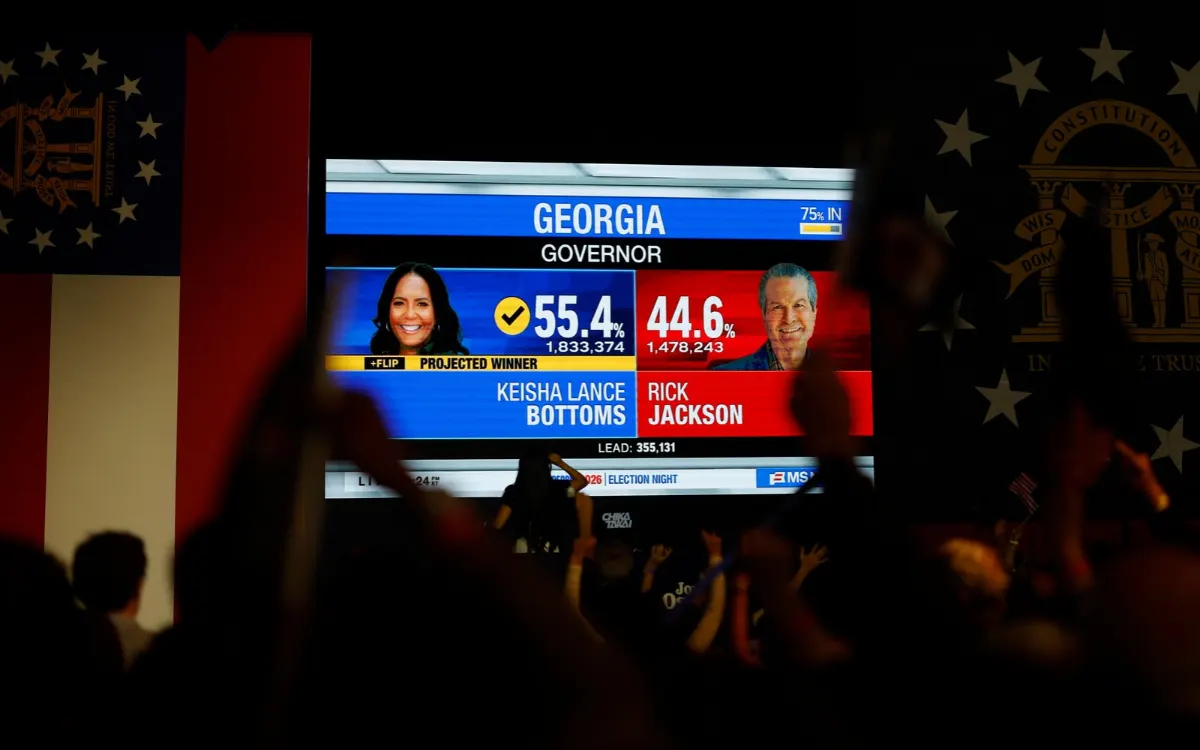
Democrats routed the Republican-controlled Congress that rubber-stamped the president’s agenda for the past two years. Texas elected a Democrat to the Senate for the first time since 1988. Kansas did it for the first time since 1932. Maine voters ended Republican Senator Susan Collins’s three-decade congressional career. South Carolina elected a Democrat to the seat Lindsey Graham held until his death in July, a seat Republicans had controlled since Strom Thurmond switched parties in 1964. Georgia made history: voters there elected Keisha Lance Bottoms, the first Black woman governor in U.S. history.
By early Wednesday, projections showed Democrats winning about 258 House seats, a majority the party has not held since 1993. Democrats had won 54 Senate seats, with races in Alaska and Mississippi still too close to call.
Trump blamed the Republican candidates, many of whom he had hand-picked. “President Trump was not on the ballot,” a White House official said, though Trump had urged voters to pretend he was. Trump campaigned relentlessly in the final weeks to energize his base. The effort fizzled. Democrats surprisingly flipped seven Republican Senate seats, five of them in states Trump carried by double digits two years ago: Ohio, Iowa, Kansas, Texas, and South Carolina.
Rout Prompts Vance to Break Ranks
Voters repudiated Trump on a scale not seen since 1974, when Democrats gained 49 House seats and the Watergate class arrived in Washington. As results flashed across the screens Tuesday night, pundits reached for comparisons with 2006 and 2018. Those midterms were course corrections. This was a rout.
But a rout poses a harder question than a narrow win. Come January, Democrats will run Congress, but they will lack the votes to override a presidential veto. Trump vetoed 10 bills in his first term, and Congress overrode him only once. Overriding him now requires Republican votes in both chambers. Will the Republicans who survived Tuesday read the scale of the defeat as license to break with Trump? That question, not the gavel count, will decide what Tuesday bought.
A rout poses a harder question than a narrow win. Come January, Democrats will run Congress, but they will lack the votes to override a presidential veto
The first answer came from the second-highest office in the government. On Wednesday morning, Vice President JD Vance posted a lengthy statement on X that blamed the defeat on Operation Epic Fury, the Iran war Trump launched on February 28. “The reason we lost is the war,” he wrote. He challenged anyone to openly argue that the war justified losing the Senate for six years. He then cited four demands from Trump voters who defected: end the war, attack the cost of living, put America first, and change the U.S. relationship with Israel. It was the most consequential break with Trump inside the Republican camp since the war began.
Voters backed him up. A survey of more than 100,000 voters found that about one-third called the war crucial to their vote.
Vance had largely kept his doubts about the war to himself since February, a strange posture for a politician known as Trump’s most pugnacious defender. Vance reportedly led a White House faction urging a deal with Tehran and warned privately that the war could cost Republicans the election. Trump did not slap him down. He called the post largely true, pinned the damage on wartime gasoline prices, and said he would do it again.
Hegseth Could Become Fall Guy
What Vance didn’t say was just as important as his startling comments. He did not call for a war powers vote, a funding cutoff, or the head of Defense Secretary Pete Hegseth, who looks like the likely fall guy for the rout. Vance broke with Trump on the politics of the war, not its prosecution. The man most Republicans expect to seek the 2028 nomination has decided the war is a liability he will not carry, and others have moved fast behind him. Sen. Ted Cruz, a longtime Iran hawk, said on his podcast that the war should have ended quickly and decisively. Outgoing Sen. Thom Tillis promised a reckoning for Hegseth.

Vance’s delicate balancing act matters for foreign policy. He has given Republicans permission to distance themselves from the war without attacking Trump directly. Any new escalation now puts Trump at odds with his own heir apparent. But a vice president casts no vote except to break a Senate tie. Breaking ranks in a statement is not the same as a vote to override.
Vance has given Republicans permission to distance themselves from the war without attacking Trump directly. Any new escalation now puts Trump at odds with his own heir apparent
What the Landslide Vote Buys
When the 120th Congress convenes on January 3, Americans will see a legislature vastly different from the one that deferred to Trump during his first two years back in office. Democrats will hold every committee gavel in both chambers, along with the subpoena power, staff, and budgets that come with them. Operation Epic Fury, launched without a declaration of war or an authorization for the use of military force, will likely draw the first hearings.
Democrats have spent months accusing the Pentagon of keeping Congress in the dark. The Pentagon has since sent lawmakers unclassified cost figures, $47.1 billion through October 16, but it keeps its estimate of damage to U.S. bases classified. With gavels in hand, the Armed Services committees can demand that estimate, along with the casualty records and munitions data the administration has kept under wraps. The House Financial Services Committee can dig into the Trump family’s business ventures.
A subpoena demands information. It convicts no one. It builds a documentary record that outlives the news cycle, and Trump has spent decades fighting subpoenas, all the way to the Supreme Court in Trump v. Mazars.
The House majority matters, but the Senate matters more. With 54 seats, Democrats no longer need perfect attendance to control the floor. Every judge and cabinet replacement will pass through a chamber Trump does not control. So will every ambassador. If a Supreme Court seat opens before January 2029, the Democratic majority decides whether the nominee even gets a hearing.
With 54 seats, Democrats no longer need perfect attendance to control the floor. Every judge and cabinet replacement will pass through a chamber Trump does not control
The margin also kills a scenario that alarmed constitutional scholars before the vote. Former federal judge J. Michael Luttig warned that Speaker Mike Johnson could replace House Clerk Kevin McCumber with a loyalist who would leave certified Democratic winners off the roll when the new Congress convenes. That gambit works only against a narrow majority. With Democrats projected to hold 40 seats more than the 218 needed for control, a rogue clerk would have to throw out dozens of certified winners in plain sight. Luttig’s nightmare now looks improbable.
The Arithmetic That Now Matters
Overriding a veto takes two-thirds of both chambers: 290 votes in the House and 67 in the Senate if every member is present and votes. Before Tuesday, that wall looked unscalable. In the House, it no longer does.
House Democrats would need about 32 Republicans to override. The Iran war could supply some of them, but the record suggests caution. When the outgoing House voted 215 to 208 in June to order an end to hostilities with Iran, only four Republicans crossed over. Democrats would need eight times that number. Still, every Republican who survived Tuesday watched colleagues in supposedly safe seats lose, and each will reach a private verdict on whether standing with Trump helps or hurts in 2028.
The Senate gap runs wider. Democrats would need about 13 Republicans. In June, only four Republican senators voted to end the war, and one of them, Susan Collins, lost on Tuesday. Senate Minority Leader Chuck Schumer claimed Wednesday that Democrats already have Republicans ready to cross over on war powers. He named none. Schumer could be adopting a negotiating posture. An actual roll call will tell the story. Impeachment runs into the same math. The House can impeach, but conviction takes 67 senators, and nothing about Tuesday puts that number in reach.
Money is where the landslide bites hardest. Democrats will write the defense appropriations bills, and the Pentagon wants about $67 billion in supplemental money for the war. Democrats have a mixed record of standing up to a wartime president. In 2007, a Democratic Congress that swept in on antiwar anger sent President George W. Bush an Iraq funding bill with a withdrawal timetable. Bush vetoed it, Democrats backed down, and the troop surge went ahead. In 1975, Congress refused President Gerald Ford’s request for $722 million in emergency military aid to South Vietnam. A 258-seat majority gives Democrats the 1975 option. Whether they have the backbone to use it while American troops remain in harm’s way will test the durability of Tuesday’s mandate.

A Majority Is Not a Foreign Policy
Democrats can agree on starving the war with votes against funding. They cannot easily agree on what replaces it, especially where Iran meets Israel. The party split the morning the bombs fell. When the strikes began February 28, many Democrats demanded that Congress reconvene to vote on war powers, while others praised the strikes and asked only for better briefings. The rift widened over the summer. In July, 103 House Democrats backed Republican Rep. Thomas Massie’s failed amendment to strip $3.3 billion in military aid to Israel. Tuesday hardened both camps. Michigan elected Abdul El-Sayed to the Senate, and he used his victory speech to reject sending American money to what he called apartheid and genocide. At the same time, a slate of pro-Israel Democrats won their races, and the sheer size of the majority lets leaders outvote the party’s left flank when they choose. Progressives already plan to push the Block the Bombs Act, which would bar a wide range of offensive weapons sales to Israel.
Democrats can agree on starving the war with votes against funding. They cannot easily agree on what replaces it, especially where Iran meets Israel
Ending the Iran war will likely hold the caucus together. The next questions will not: arms sales to Israel, the terms of any nuclear deal with Tehran, and what Washington does if Iran rebuilds its program. Democrats won Tuesday as the antiwar party. They have not yet shown they can govern as anything more.
Where It Still Changes Nothing
The landslide leaves Trump’s core powers untouched. He remains commander in chief. He can order new strikes on Iran, and Congress can only cut off the money afterward. It cannot recall a bomber.
On trade, the Supreme Court did what Congress would not. In February, the justices ruled 6 to 3 that the International Emergency Economic Powers Act didn’t grant Trump the authority for his sweeping global tariffs. Trump invoked Section 122 of the Trade Act of 1974 the same day to impose a uniform 10 percent tariff. When that 150-day authority lapsed on July 24, the administration replaced it with Section 301 duties of 10 or 12.5 percent on goods from about 60 countries. Section 301 requires no vote of Congress, and repealing those duties would take a veto-proof majority. Few Republicans have shown the appetite to defy the president on trade.
The executive branch has largely escaped congressional checks, and a new majority cannot change that alone. Congress cannot rescind a pardon. It cannot, on its own, rewrite a presidential memorandum on national security, and it cannot order the Justice Department to open or close a case. Trump’s controversial immigration crackdown runs largely on multiyear money Congress already appropriated in last year’s budget law. Trump governs by proclamation and executive order, and neither depends on who holds the gavel. He said he accepted the results of the vote, but he is widely known for changing his mind.
Pressure Without a Vote
Political pain moves Trump even when Congress cannot. On Election Day morning, he said on television that the United States would cut off about $4 billion in annual aid to Israel at the end of the year. He offered no details on how. He offered a political reason: Republicans should not have to absorb attacks from candidates like El-Sayed, the first Muslim American elected to the Senate. Israeli officials, caught off guard by the timing, scrambled to work out what it meant. No vote of Congress forced that announcement. An election did.
The same pressure now bears on Iran. Trump threatened repeatedly before the vote to resume strikes, then told reporters on election night he had no immediate plans to order attacks. By Thursday, U.S. officials said the military was finishing preparations for possible renewed strikes, while Qatari mediators pushed a draft deal. One former adviser told a reporter that Trump doesn’t want to look like a loser twice. Such an impulse from a notoriously unpredictable president could cut both ways. It could push him toward a deal he can sell as victory or toward strikes that let him claim Iran never beat him.
History offers a template. The day after Democrats won Congress in 2006 on anger over Iraq, Bush announced Defense Secretary Donald Rumsfeld’s resignation. On Wednesday, sources said Trump had asked advisers whether Hegseth should stay. Publicly, Trump said Hegseth was doing a very good job. A Pentagon fall guy would cost Trump nothing in formal power and buy him political room. It would not necessarily end the war. Bush dumped Rumsfeld and then ordered the surge.
A Pentagon fall guy would cost Trump nothing in formal power and buy him political room. It would not necessarily end the war
How the World Could Read It
The scale of the Democratic victory gives allies room to recalibrate. Seoul, Berlin, and Tokyo have spent two years absorbing tariffs and basing demands. The Gulf states have suffered Iranian strikes on American bases they host, in a war they did not choose. A narrow Democratic win would have told them to wait Trump out. A rout tells them American voters have rejected much of what Trump champions. Few would be surprised if they slow-walk their dealings with this administration and start planning for the next one.
Adversaries will read it differently. Tehran read it first. Mohsen Rezaei, Secretary of Iran’s Supreme National Security Council, said in a social media post that Iran had handed Trump a political defeat in Washington. Iran’s chief negotiator, Mohammad Bagher Ghalibaf, also warned that Washington will face a “nightmare” if the administration ignores American voters. Yet a statement attributed to Iran’s supreme leader dismissed expectations that U.S. policy would shift.
Even Tehran is not betting that the vote ends the war. Beijing and Moscow have watched American presidents lose midterms before. They know a president in trouble at home often turns abroad, where he can act alone, and that can mean pursuing an agenda at odds with their goals. Trump, 80, now faces a hostile Congress and a party that has already started looking past him. This year alone, he ordered the raid that seized Venezuela’s president and launched a war with Iran, and he asked Congress first neither time.
Who Holds the Votes
Tuesday restored a check that congressional Republicans refused to exercise for two years. It did not restore the war, trade, and spending powers Congress surrendered to presidents of both parties long before Trump arrived. A 258-seat majority can try to claw back that power, but it will still need Republican votes. It will get them only when those Republicans decide their own futures matter more than Trump’s. JD Vance just told them his does.
Voters handed Democrats the gavel. Republicans still hold the votes.