
Germany’s economic and military power rests on two dependencies it can neither comfortably sustain nor readily escape. China dominates its critical industrial inputs, while the U.S. presence underpins its security. Yet as Beijing exploits China’s economic leverage and doubts grow about Washington’s reliability, Berlin faces a fundamental strategic dilemma: building greater resilience requires European support, yet EU industrial policies risk undermining the very partnerships Germany seeks to strengthen.
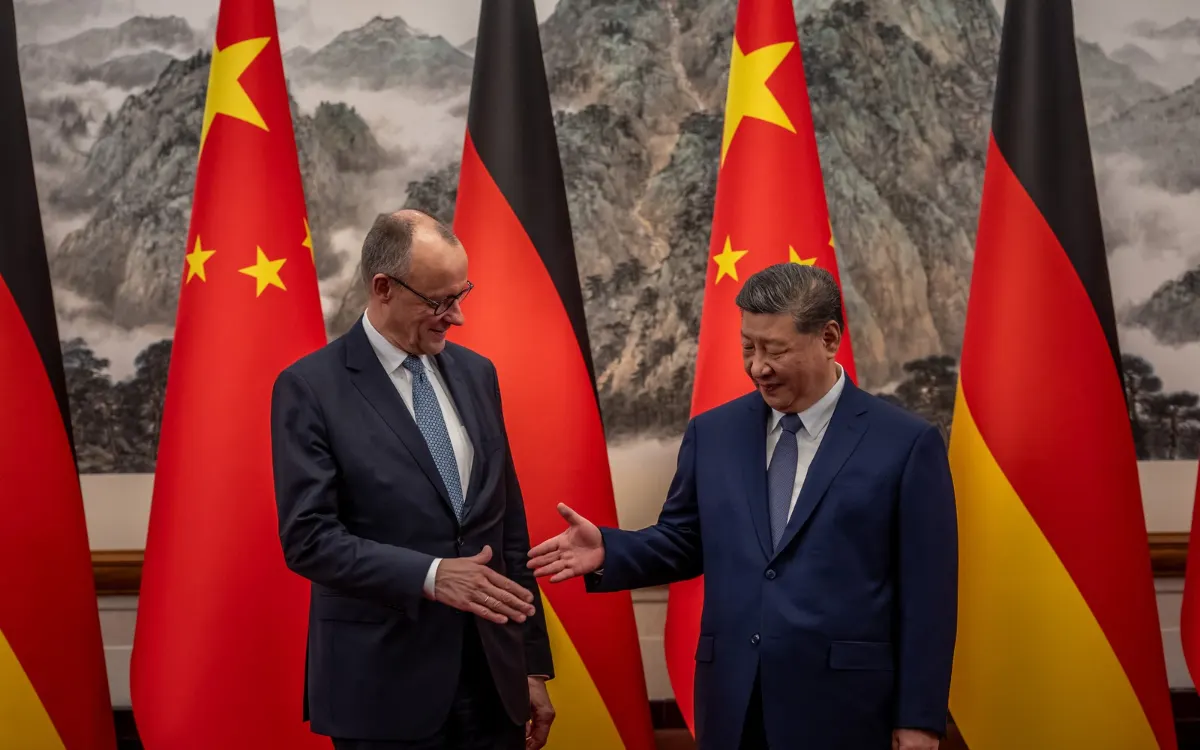
Chancellor Friedrich Merz spent the last week of October in Singapore, Tokyo, and Seoul arguing for open trade. Less than a fortnight earlier, Berlin and Paris had proposed EU car rules that would deny subsidies to vehicles made in Japan and South Korea. The tour still yielded economic-security and raw-materials declarations in Tokyo, an upgraded partnership with Seoul and German interest in a British–Italian–Japanese fighter program.
Those gains diversify Germany’s suppliers and partners without substituting for either of its core dependencies: Chinese critical-minerals processing and America’s nuclear guarantee. Japan and South Korea share both. Diversification can reduce Germany’s vulnerability, but achieving more durable resilience depends as much on European policy as on partnerships with Asian capitals. In Brussels, however, Berlin’s efforts to deepen Asian partnerships collide with European industrial policies designed to protect domestic producers.
In Brussels, Berlin’s efforts to deepen Asian partnerships collide with European industrial policies designed to protect domestic producers
Two Dependencies, Two Logics
Germany’s two dependencies differ in kind. For two decades, its model rested on Russian gas, Chinese demand, and American protection. The first pillar collapsed in 2022. The other two are changing shape, and Merz’s tour was Berlin’s response to both.
The chancellor framed his aim in Tokyo as reducing “one-sided dependencies,” a phrase covering two strategies. Diversification adds alternative sources, lowering the cost of a disruption and limiting a supplier’s leverage. Substitution replaces what a dependency provides, potentially removing that leverage altogether. Diversification can strengthen resilience without achieving substitution, but strategic autonomy requires reducing dependencies to the point where external pressure no longer dictates policy choices.
The China dependence is shifting from demand towards supply. Imports rose 8.8 percent to €170.6 billion in 2025 while exports fell 9.7 percent to €81.3 billion, according to Destatis, the federal statistics office. China now ranks only sixth among German export markets. China’s share of Germany’s rare-earth imports by volume fell from 65.4 percent to 55.4 percent in 2025, Destatis reports. Yet China still supplied two-thirds of the value of pure rare earths, the highly processed grades. Volumes diversified; processed grades did not.
Lithium batteries went the other way. The government’s 2023 China strategy flagged them as critical. China’s share of German lithium-battery imports by weight nonetheless rose from 49.7 percent that year to 66.5 percent in 2025. Dependence deepened where policy sought to reduce it.
The American dependence concerns deterrence, which no market can supply. Even the nuclear cooperation Merz agreed with France’s president, Emmanuel Macron, on March 2 will “add to, not substitute for” NATO arrangements anchored in American weapons. In May, days after Merz criticized Washington’s conduct of the Iran war, the Pentagon announced the withdrawal of about 5,000 troops from Germany. The episode suggested that a long-standing security guarantee had suddenly become conditional.
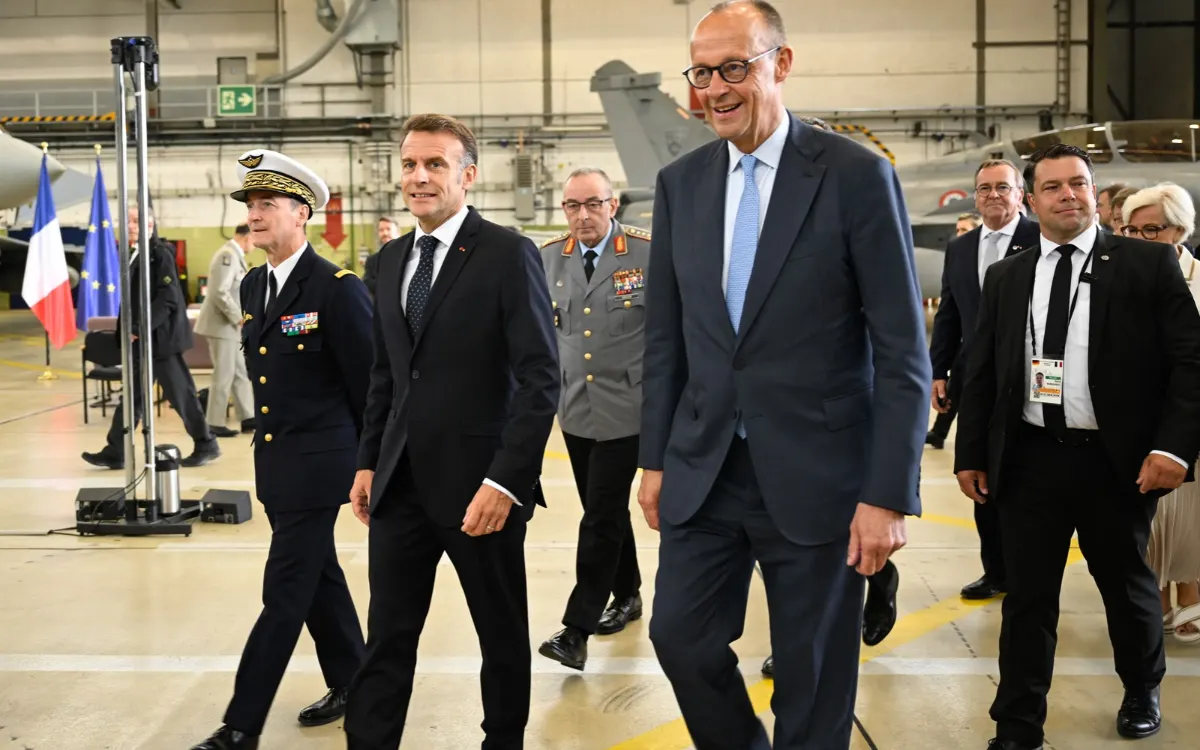
Washington, meanwhile, is applying trade pressure to every economy on Merz’s itinerary. Its Section 301 tariffs, imposed in July over forced-labor enforcement, hit the EU, Japan, and South Korea. A pending probe into “structural excess capacity” names all three, as well as Singapore.
The remedies differ. Supply risk yields to new sources, stockpiles and trade defense; security dependence yields only to European rearmament. Berlin must shield Europe from Chinese overcapacity while keeping it open to Asian partners and rebuild defense without losing an American guarantee it cannot yet replace. The dilemma is that both tasks increasingly run through Brussels, where common European instruments can reinforce Germany’s Asian partnerships, but industrial preferences can also limit their benefits.
The dilemma is that Germany’s efforts to shield itself from Chinese overcapacity and rebuild its own defense run increasingly through Brussels, where common European instruments can reinforce Germany’s Asian partnerships, but industrial preferences can also limit their benefits
What Tokyo and Seoul Offer
The Japanese and Korean legs produced substance in technology, components and defense industry. In Tokyo, Merz and Sanae Takaichi, Japan’s prime minister, issued joint statements on economic security and future technologies. One of them warned against “arbitrary export restrictions” without naming China or the United States, a criticism that can nonetheless be read as aimed at both. They welcomed a raw-materials declaration of intent and announced plans to widen the supply base for their carmakers’ rare earths.
Japan offers experience Germany lacks. After China throttled rare-earth exports to Japan in 2010, Tokyo spent 15 years building alternatives, including financing for the Australian producer Lynas. By the start of this year, Chinese supply had fallen to around 60 percent of Japan’s rare-earth imports. That record offers Berlin a tested toolkit of stockpiles, recycling and magnet designs that use fewer heavy rare earths.
South Korea offers industrial depth in batteries, semiconductors and defense production. Merz and Lee Jae Myung, South Korea’s president, signed an Economic and High-Tech Partnership Framework and agreed closer cooperation on critical minerals and energy security. They also pledged to conclude swiftly an agreement protecting classified military information, the institutional basis for closer defense-industrial work.
Korea’s arms makers are rivals as well as prospective partners. Hanwha Aerospace and Korea Aerospace Industries, whose howitzers and light fighters equip Poland’s forces, sent senior executives to the official dinner in Seoul. Since 2022, Polish orders for Korean tanks and artillery have turned Seoul’s defense industry into a competitor of German suppliers in Europe’s rearmament.
The boldest signal concerned air power. In June, France and Germany abandoned the fighter at the core of the Future Combat Air System (FCAS), their flagship defense project since 2017. Merz now says Berlin is examining a role in the Global Combat Air Programme (GCAP), led by Japan, Britain, and Italy. GCAP could fill the gap FCAS left, though Germany would arrive late to workshare talks Merz called well advanced.
Partners With the Same Exposure
Shared exposure limits the extent to which Tokyo and Seoul can reduce Germany’s underlying vulnerabilities. China’s ban on dual-use exports for Japan’s military, imposed on January 6 over Takaichi’s November remarks on Taiwan, formalized a squeeze that was already under way. Chinese customs data showed no dysprosium or terbium oxide shipped to Japan from November to May. Beijing’s pressure has been selective and sustained. China’s exports of seven controlled rare earths to Japan fell 51 percent in the first half, against a 16 percent decline worldwide. Moreover, Japan-bound shipments were still near zero in September, eight months after the formal ban.
Japan’s own record shows the limits of diversification. Its gains came mainly in light rare earths, and its magnet makers remain overwhelmingly reliant on China for heavy ones. South Korea’s most acute exposure lies in batteries, with more than nine-tenths of its graphite coming from China. In February Seoul sought a hotline with Beijing to speed rare-earth imports, a sign that it prefers accommodation to confrontation.
Cooperation among three import-dependent manufacturers can improve their ability to withstand disruptions, but it leaves a common source of vulnerability in Beijing. None of the three can replace China’s heavy rare-earth processing at the volumes their industries consume. Joint stockpiles and supply-chain monitoring can shorten a disruption and reduce its costs but cannot eliminate the leverage Beijing has recently used against Tokyo.
Joint stockpiles and supply-chain monitoring can shorten a disruption and reduce its costs but cannot eliminate the leverage Beijing has recently used against Tokyo
Closer alignment with Tokyo also carries political risk. In Singapore, Merz reaffirmed Germany’s One-China policy, signaling distance from the quarrel that triggered Beijing’s pressure on Japan. Courting Japanese industry while staying out of Japan’s dispute with China is a balance Beijing may yet test.
Takaichi said in Tokyo that Euro-Atlantic and Indo-Pacific security are inseparable, and Lee drew the same link in Seoul. North Korea’s troops and munitions for Russia’s war in Ukraine have made that link concrete. Both theaters rest on the same American guarantor, which could leave them competing for finite U.S. defense-industrial capacity in a crisis.
Singapore’s Distinct Function
Singapore’s contribution lies in trade architecture. The city-state carries industrial weight, and its Economic Development Board says it makes one in ten of the world’s chips. Yet it cannot replace Chinese refining or American deterrence. Its standing rests on membership of the Comprehensive and Progressive Agreement for Trans-Pacific Partnership (CPTPP) and the Regional Comprehensive Economic Partnership, which includes China.
Singapore combines close security ties with Washington and deep commerce with Beijing, approximating the posture Merz now advocates. Merz used the 49th Singapore Lecture for the tour’s most doctrinal statement, arguing that “wise China policy begins at home.” He rejected decoupling as a mistake and called for remedies where overcapacity distorts competition.
Merz proposed an interregional agreement between the EU and the CPTPP. By his estimate, the two together account for more than a third of world trade. He urged the EU to align its separate bilateral agreements in the region as well. Both proposals fall to Brussels, because trade policy is an exclusive EU competence and Germany cannot join the CPTPP alone.
Lawrence Wong, Singapore’s prime minister, renewed the bilateral strategic partnership with Merz and welcomed Germany’s growing engagement with the Association of Southeast Asian Nations (ASEAN). Merz named Indonesia and Vietnam among the partners Berlin is cultivating. But Brussels sets the terms there too: it has a trade agreement in force with Vietnam and concluded one with Indonesia in 2025.
Singapore’s careful hedging has not spared it American pressure. Washington’s overcapacity probe named the city-state even though, on U.S. figures cited by Singapore’s trade ministry, America runs a goods surplus with it. For an exporter caught between American tariffs and Chinese overcapacity, influence over Asia’s trade rules still matters. Singapore is Berlin’s obvious partner in that effort; the industrial content of the hedge lies in Tokyo and Seoul.
For an exporter caught between American tariffs and Chinese overcapacity, influence over Asia’s trade rules still matters
Complement or Undercut Brussels
The instruments that could make the hedge durable belong to the EU, starting with its trade agreements with all three hosts. The Critical Raw Materials Act aims, by 2030, to limit any third country to 65 percent of EU consumption of each strategic raw material, at every processing stage.
Defense cooperation runs through Brussels too. Tokyo and Seoul have applied to associate with Security Action for Europe (SAFE), the EU’s €150 billion defense-loan facility. Until then, their firms’ content falls within SAFE’s 35 percent cap on components from non-associated countries.
Bilateral cooperation does not inherently undermine European integration. It can reinforce EU objectives by bringing additional suppliers and industrial capacity into European initiatives. The tension arises when common European rules restrict access for the very partners Berlin is seeking to cultivate.
Berlin’s own conduct exposes that tension. On October 16 it agreed with Paris on a joint position on cars for the EU’s draft Industrial Accelerator Act (IAA). Vehicles would need 70 percent of their non-battery component value made in Europe to receive subsidies or win public contracts.
Berlin had argued for a wider circle of trusted partners but accepted one reaching at most Britain, Norway, and a few other European neighbors. In return, France backed German calls to soften the EU’s 2035 phase-out of combustion engines. The trade-off indicates that domestic industrial interests outranked partnership diplomacy.
Merz heard complaints at every stop. Japanese officials objected to the exclusion of Japanese-built cars, and Lee sought equal treatment for Korean cars, batteries, and steel. Merz promised to carry their fear of “a new wave of European protectionism” back to Brussels. Their most pointed requests concerned EU rules, which suggests they value Berlin chiefly as an advocate inside the Union.
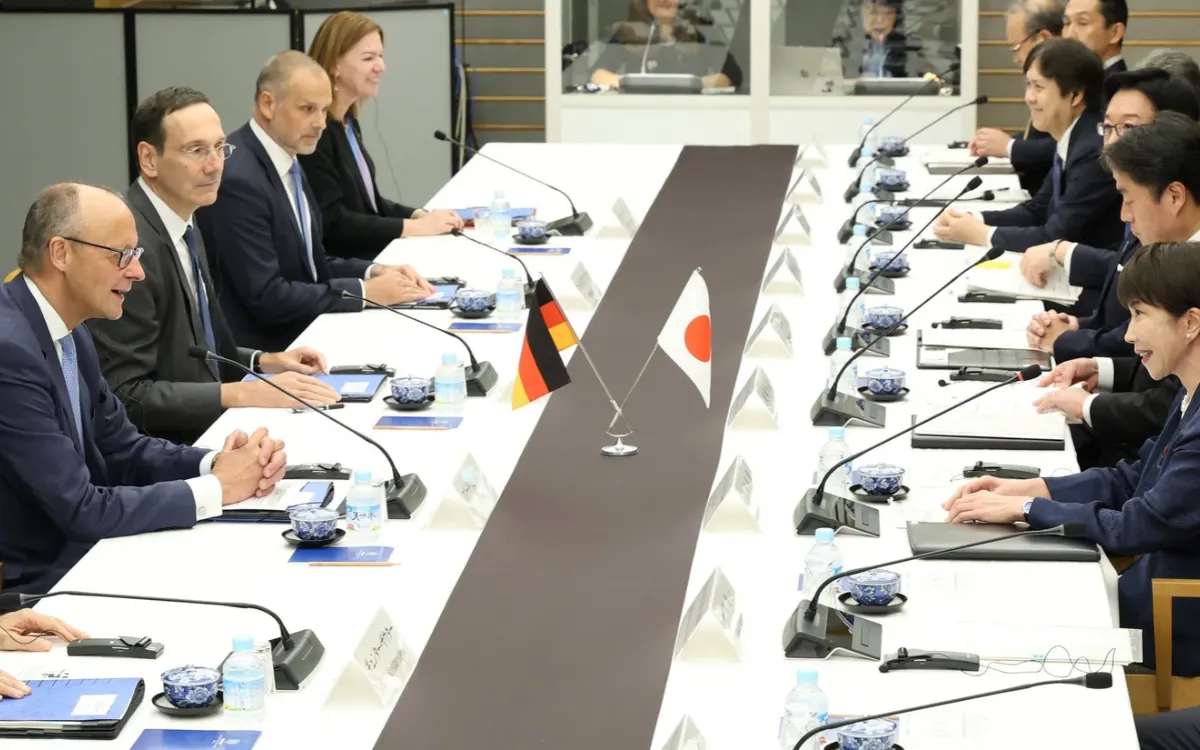
The bilateral track complements EU policy in particular when it expands the Union’s options, as the CPTPP proposal and raw-material cooperation serving the 65 percent benchmark could do. It creates tensions when European industrial preferences exclude trusted partners or when competing national projects fragment collective defense efforts. GCAP is the hardest case: joining could leave Berlin and Paris in rival fighter projects, since Dassault Aviation is weighing a French-led successor.
Europe’s coercive leverage comes from the single market, which no bilateral declaration can supply. On October 5, Merz and Macron proposed an instrument to restrict market access, “up to an immediate cut-off.” It would apply unless a qualified majority of governments blocked it.
The design marks a shift for Berlin, which voted against EU tariffs on Chinese electric vehicles in 2024 and warned against a trade war. A default of action would leave less room for such hesitation. Past practice counsels caution: the EU has never used its Anti-Coercion Instrument, in force since December 2023.
Markers for the Months Ahead
Four decisions in the coming months will show what the hedge is worth. The first belongs to Beijing, whose suspension of its October 2025 rare-earth controls is due to lapse on November 10. Its September extension of a wider truce with Washington omitted them. Reimposition would bring parts of Japanese and Korean supply lines into Germany under Chinese licensing, because the rules reach foreign-made goods containing Chinese rare earths.
The second is the IAA, on which Ireland—which holds the rotating Council presidency—is seeking agreement by mid-November, with final approval due next year. The timetable will test Merz’s promise to relay Asian concerns. Japan and South Korea are likely to judge Berlin by the outcome, since a narrow definition of European production would limit the practical industrial benefits of the new partnerships.
The third is the European Commission’s response to calls for new trade instruments, which EU leaders backed at their mid-October summit. The Commission is preparing a diversification package for December. The fourth is GCAP, where Tokyo wants a German decision by early 2027, and Merz has signaled it may take longer. Joining would bind German procurement for decades, outlasting every other result of the tour.
Beyond these decisions, the likeliest outputs are incremental: joint magnet research, coordinated stockpiling, and defense-industrial agreements with Korean firms. These measures could reduce Germany’s exposure to disruptions, but they are unlikely to fundamentally alter its reliance on Chinese processed inputs or American nuclear deterrence before the end of the decade. Berlin’s Asian partnerships could thus strengthen resilience without delivering strategic autonomy. But their longer-term value depends on whether Germany can translate bilateral cooperation into European capabilities and collective economic leverage.
Berlin’s Asian partnerships could strengthen resilience without delivering strategic autonomy. But their longer-term value depends on whether Germany can translate bilateral cooperation into European capabilities and collective economic leverage
Economically, that means balancing industrial protection with meaningful access for Asian partners and backing EU trade instruments even at a cost to German industry. On defense, closer cooperation with Asian partners could expand capacity, but reducing reliance on Washington requires a substantial strengthening of Europe’s own military capabilities. Without progress on both fronts, the hedge may improve Germany’s ability to withstand external pressure while leaving the underlying dependencies largely intact. Ultimately, the problem is qualitative, not merely quantitative. Berlin cannot diversify its way out of strategic dependence.