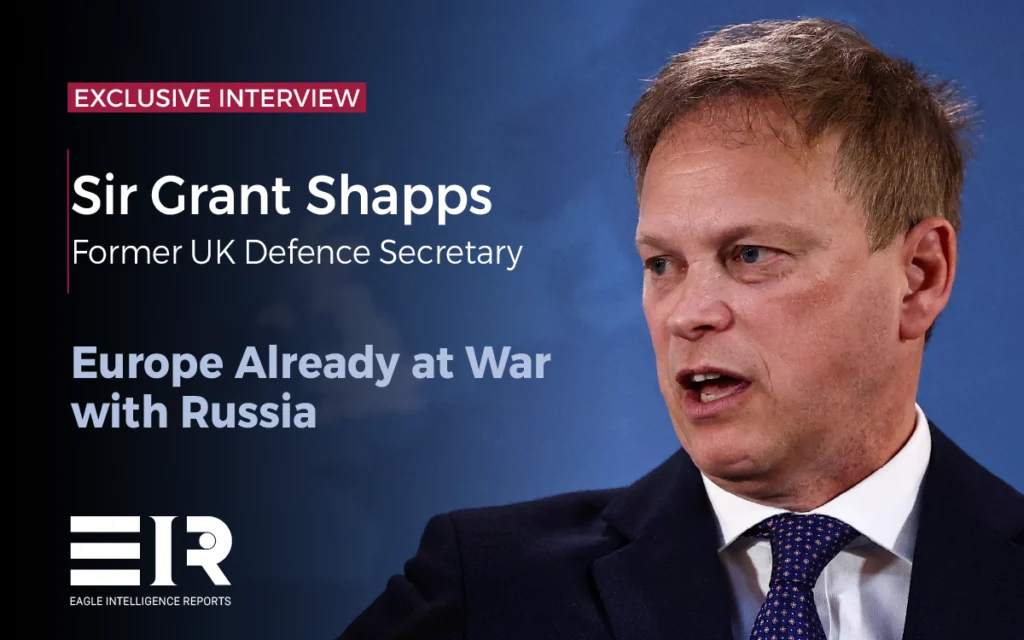

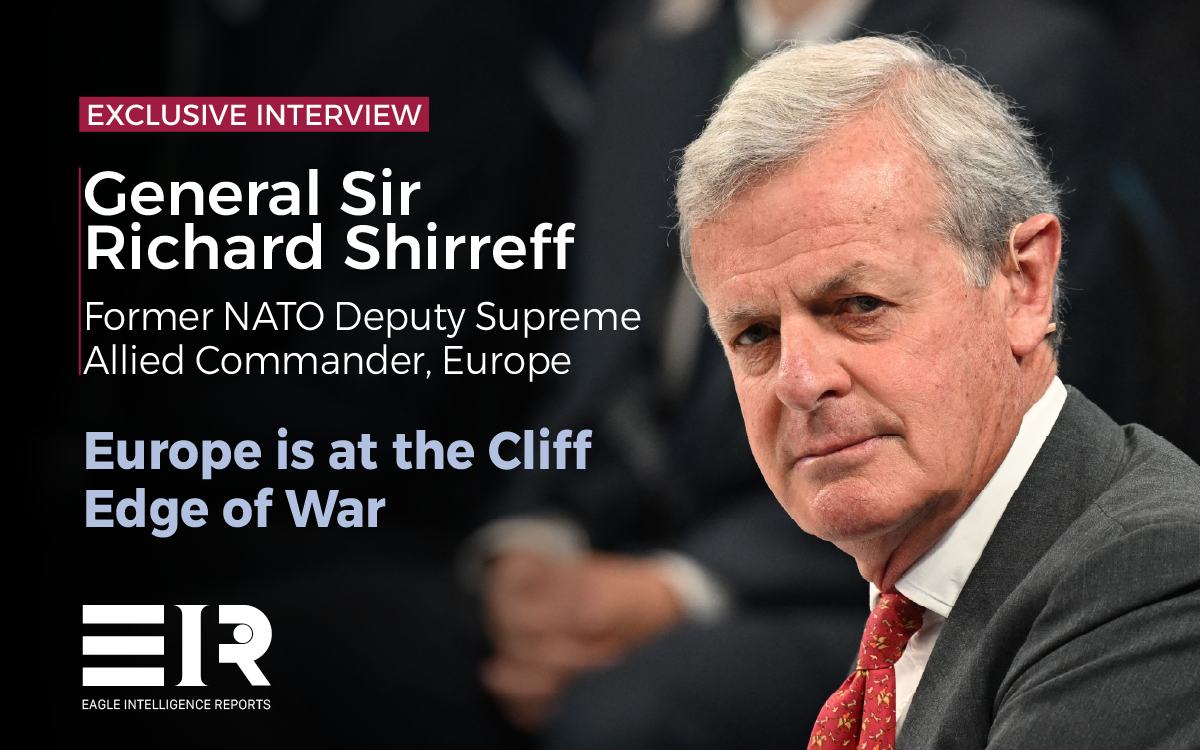
Former NATO Deputy Supreme Allied Commander, Europe, General Sir Richard Shirreff has warned that Europe is on the cliff edge of war and is dangerously unprepared to defend itself against Russia without American support. In an exclusive interview with Eagle Intelligence Reports, Shirreff argued that although NATO countries possess substantial military capabilities, they are held back by political indecision, equipment shortages, and inadequate defense spending. Collectively, he argued, these undermine Europe’s ability to respond to an attack.
Shirreff said Europe has sufficient combined military strength to defend NATO territory if its governments coordinate their efforts. However, he identified air defense and intelligence, surveillance, and satellite capabilities as critical areas of dependence on the United States. He argued that European governments have failed to translate their commitments to Ukraine into the military assistance necessary to defeat Russia. This reflects a wide gap between political declarations and actual defense readiness.
Shirreff cautioned that Russia is more likely to test NATO’s cohesion through a limited provocation or hybrid operation than launch a full-scale invasion of Alliance territory. He described a possible Russian intervention in Norway’s Arctic territory of Svalbard as one scenario that could expose disagreements over NATO’s collective defense obligations. Such an operation, he suggested, would seek to undermine the Alliance’s political unity rather than defeat its military forces.
Addressing the first 72 hours of a potential confrontation, Shirreff warned that cyberattacks, sabotage, disinformation, and provocations involving Russian-speaking minorities could create confusion and delay NATO’s response. He questioned whether all 32 member states could reach the rapid consensus necessary to respond decisively, emphasizing that the speed of political decision-making could prove as important as military readiness.
Shirreff also questioned Europe’s ability to sustain a prolonged conventional conflict without substantially expanding its reserve forces or introducing some form of compulsory service. Contrasting Britain’s limited military manpower with Finland‘s extensive reserve system, he argued that European governments have failed to recognize the scale and immediacy of the threat. He warned that the conflict already unfolding through hybrid warfare could escalate rapidly into conventional war, making continued political inaction increasingly dangerous.
The following is the first part of Eagle Intelligence Reports’ exclusive interview with General Sir Richard Shirreff, conducted by Jonathan Sherry and Andra Maciuca.
Interview Excerpt
Jonathan Sherry: Welcome to Eagle Intelligence Reports. Today we are joined by General Sir Richard Shirreff, former NATO Deputy Supreme Allied Commander, Europe.
General, thank you for joining us.
Gen. Richard Shirreff: Thank you for having me. Very good to be here.
Jonathan Sherry: Let me begin with the question at the heart of your former command and perhaps Europe’s most uncomfortable security question today. If Russia attacked a NATO country tomorrow, could Europe defend it without American help?
Gen. Richard Shirreff: That is the million-dollar question. I think, on the face of it, Europe has the combined military capability to defend a country if attacked by Russia. It would clearly lack really key capabilities, which currently are provided by America. And we’re seeing that very clearly shown by the slowdown or stoppage of Starlink, for example, over Ukraine and the consequent impact on Ukrainian cities.
But nevertheless, Europe has got really significant military capability, particularly our interdiction capability, if it brought it together and it concentrated effort. The issue, of course, is political. And I mean, I feel really conflicted here because I know that Europe could do it if it put its mind to it. But what we see is a Europe—and frankly, for the last four years—we have seen a Europe that talks the talk but hasn’t been prepared to really walk the walk. All the talk of we’re foursquare behind Ukraine, but actually what is being done to really give Ukraine the means to defeat Russia, not just to defend itself? I’ll stop there and let you ask more questions.
Jonathan Sherry: What would be the first capability Europe would discover it cannot do without?
Gen. Richard Shirreff: I think two things, actually, I’m going to say. One is air defense, and the other is intelligence support and surveillance support of the kind provided by Starlink. That satellite capability that knits together the battlefield allows the defending country—in this case Ukraine or another European country, if attacked—to have the necessary warnings and therefore to be able to strike back. So it’s intelligence and air defense, I would say.
Jonathan Sherry: NATO’s Supreme Allied Commander Europe has presented a “block, blunt, and break” concept designed to deny an attack against the Alliance. You know the difference between planning and real readiness from inside NATO’s command structure. How close is today’s NATO to delivering on that promise?
Gen. Richard Shirreff: If it had to defend, it would be what I would describe, it would be very much a “come as you are” party with what is available here and now. And that is going to be lacking. I mean, military readiness has four components: it’s manpower, equipment, logistics and sustainability, and training. Now, in all four areas, all four components, NATO, if you break it down, probably doesn’t score too badly. If you look at the change in approach to training, for example, NATO troops are now actively and regularly conducting exercises over Eastern Europe, surrounding Kaliningrad by air, for example, demonstrating real capability. We’re seeing major European exercises by land, sea, and air demonstrating the capability to respond and to bring reinforcements to bear.
But when I look at equipment, I see some countries with really swept up capabilities, notably the Eastern European countries of Finland, the Baltic states, Poland, Sweden, and the Nordics. But I look at the UK, I look at France, I look at Germany, and there are major gaps. And you know, this would be a real challenge. Manpower, similarly. So there’s a balance between the best being the enemy of the good. I would naturally go for the best. But I would be happy to accept the good. But I’m afraid I would have to conclude that Europe doesn’t quite come up to the good yet. But nevertheless, I still think that Europe could respond.
And the other point is: What type of attack are we talking about? The reality is you’ve got to consider the enemy forces here. The reality is Russia is fixed in Ukraine, four and a half years of war, one and a half million casualties, hundreds of thousands killed. It’s gone backwards in this summer offensive. The Russians are never to be underestimated, but they’re not that good. And they are going to find it really difficult to mount a sustained, committed, determined invasion of a NATO country that is going to threaten that country.
That said, what they can do is a pinprick, an embarrassment, a move to get NATO off balance, to go for the heart of the center of gravity for NATO, which is the alliance cohesion. Let me give you an example. There are Russian coal miners in Spitsbergen, that little Arctic island way north of Norway inhabited mainly by polar bears. The Russians have had coal miners there for years, decades. Could Russia launch an attack against Spitsbergen, claim that its coal miners are being harassed and bullied by the Norwegians and need to be defended, and call on Mother Russia to defend them? Absolutely it could.
That would constitute an Article 5 call because Norwegian territory is being attacked by Russia. How would that measure up in the North Atlantic Council? Are the NATO countries really going to accept that they’re going to go launch World War III for the sake of a tiny Arctic island way, way out of the European continent? I wonder. So it’s the political that Russia will go for. And therein lies, of course, the vulnerability that NATO faces.
Andra Maciuca: Take us into the first 72 hours of a Russian attack on NATO territory. What would matter most in determining whether collective defense worked as intended?
Gen. Richard Shirreff: The first 72 hours will be confusing. It will not be a major military assault across a NATO border, say in the Baltic states or Poland or Romania, for example. It will be a ramping up of the war that Russia has been waging for, frankly, the last 12 years: the hybrid war, the covert war, the war designed to undermine the integrity of Russia’s adversaries—either as countries or as allies—a war conducted by cyberattacks, by manipulation of minorities, by assassination, by subversion, by sabotage, by espionage. In the maritime sphere, it will be the cutting of cables.
So this will be confused. It’ll be, for example, a false flag attack, a demonstration of Russian speakers in one of the Baltic states coming up against alleged police brutality. Maybe a couple of demonstrators get shot. The minority call for Russian support to help themselves. Russia agrees to send humanitarian relief and peacekeepers. And before we know where we are, you know, it’s the proverbial boiling frog. You put the frog in cold water, it thinks it’s fine. And then gradually the heat is turned up, and before it knows where it is, it’s cooked.
So I think that’s the thing. And of course, this plays to NATO’s challenge. How does it make decisions quickly and form consensus? Because the North Atlantic Council, the governing body of NATO, is a consensus organization. It can’t overrule one member state if it vetoes a course of action. It has to have all 32 members agreeing. Are all 32 members going to agree to launch a decisive defense of a NATO country if attacked in those first 72 hours? It’s going to require really quick decision making.
Now, I am sure that NATO is thinking through these potential scenarios. If it isn’t, it should be. It should be, frankly, wargaming potential scenarios to build the intellectual muscle memory needed to be able to respond quickly when the time comes. So all of these will produce confusion. 72 hours will be confused, and I’m afraid it could be indecisive. But nevertheless, I’m a fan of NATO. I’ve seen how NATO can come together and make decisions relatively quickly. But are they going to be quick enough to take the necessary action to gain the edge?
Andra Maciuca: You mentioned the speed of response as well as Romania and the Baltic states, which leads me to wonder, would you expect the response to be equally swift and robust if Romania were attacked rather than Estonia or, say, Lithuania?
Gen. Richard Shirreff: That’s a very good question. On the face of it, I’d say the answer is yes. But it will all depend on how quickly the reinforcement options can be put in place. Now, as you would expect, this is an open-source interview, and I am not privy to NATO’s deep secrets. And even if I were, I wouldn’t announce what I think about them. But the key is a combination of in-place forces capable of holding and the ability to reinforce really quickly.
Romania is, in terms of geography, more difficult. It is much further away from Western Europe than, say, the Baltic states or the Nordics. It is further away from countries which have got significant forces. And that is going to be the key. And of course, the fact is that it’s got to be Europe alone here because we are assuming that America is not part of this particular party.
Andra Maciuca: If Washington delayed, where would Europe feel the consequences first?
Gen. Richard Shirreff: Well, I think we have to assume Washington will delay. I mean, the political scene at the moment is—we have to see things as they are, not as we’d like to see them. What we see is an American president who is effectively allying himself with Putin. And we see this with the diesel deal. We see this with the about-turn on the sanctions bill. And we see it in the fact that here is an American president who has last year threatened to attack the territory of a NATO ally. So I think Europe has to assume that it is on its own, with Canada, of course.
Andra Maciuca: But where exactly do you think Europe will be affected the most? Is there a specific country?
Gen. Richard Shirreff: The first requirement, of course, is the strategic enablers. It is the air defense, the interceptor missiles. It is the long-range precision missiles. It is the intelligence that is provided by American assets and satellite assets. But it’s also in air and troops, I think. Those are shortfalls that Europe could begin to make up.
But the challenge Europe faces is that it is being innovative. It is building its own capabilities. But that’s going to take time. It’s not happening yet. And of course, Europe has been so slow to recognize the reality from Washington. This became 100 percent clear last January–February, when Secretary Hegseth and Secretary of State Rubio and Vice President Vance said very clearly in Munich and at the Brussels Defense Ministerials for NATO that America was not going to support Europe’s conventional defense. But there has been a clinging on to America—a desperate attempt to try to avoid the really tricky question that Europe has got to go in alone and develop NATO as a Europe-led alliance, desperate to keep America in. And of course, this has put Europe completely on the back foot.
Jonathan Sherry: European allies have pledged to invest 5 percent of GDP in defense and security by 2035, as you know, including at least 3.5 percent for core defense. Does that military danger allow Europe that timetable?
Gen. Richard Shirreff: No. No. Frankly, show me the spreadsheet which shows how a number—I won’t say all—let’s just look at the positives first. The real positives in countries like Poland and Finland and the Baltic states, Estonia, Latvia, Lithuania, Denmark, Nordics, Norway, Sweden—they are knuckling down. They are delivering capability. Germany, for example, absolutely has committed to spend 5 percent of GDP. And 5 percent of German GDP is a massive amount.
But the UK? The reality is, as we heard on the floor of the House of Commons last month or the month before, a British Prime Minister stating that he was not prepared to fund national security at the expense of social security. There is no clear plan to get to 3.5 percent on core defense and 1.5 percent on defense- and security-related infrastructure by 2035. There is no clear plan to increase defense spending significantly above about 2.7 percent. And the same, you then have to look at France—in turmoil, deeply in debt. So there’s good and bad, and the bad, I’m afraid, is in Western Europe. And you’re not going to see any signs that the Spanish or the Italians are going to significantly increase defense spending.
So to answer your question, firstly, it is a complacent assumption to assume that we’ve got 10 years in which to increase defense spending to 5 percent. But it’s also a dangerous assumption to assume that there is any plan to do it. And all that says to me is that there is a real gap now. And this brings us back to where we started—that if this thing kicked off in the next year, this is going to be one heck of a “come as you are” party, with desperate attempts.
You may ask, what is going to change it? I think the only thing that is going to change it is fear itself. It is when European countries like Britain and France are terrified and recognize that they are absolutely on the cliff edge of war. And we are a long way short of that. Although the reality is that I think we are at the cliff edge, but there is a degree of almost complacent dishonesty and myopia among the political class that refuses to do what needs to be done because of short-term political expedience.
Jonathan Sherry: Which single political decision would shorten that gap or reduce that gap between ambition and actual readiness?
Gen. Richard Shirreff: The single political decision which would shorten that gap is a decision by President Vladimir Putin to launch some form of clear offensive operation against a NATO country, by which time it’s probably almost too late.
Andra Maciuca: Could European governments field and sustain enough troops in a prolonged conflict without major reserve mobilization or some form of compulsory service?
Gen. Richard Shirreff: No. I can’t see how that could happen. I mean, take the British. You know, the British Army is on 70,000. I know the British Army would fight absolutely like tigers. But I feel, like the First World War, it’ll be the regular army that is lost in the first winter of the war, as happened at the first Battle of Ypres. And it’s the reserve army that is going to have to pick up the baton, but there is no effective reserve army. That’s Britain. The positive side is Finland, for example. There you have a country of just under 6 million, which could deliver reserves of 900,000 and a fighting army of 280,000 at short readiness, with 200 of the latest variant of Leopard 2 tanks deployed also to fight at very short notice. So there’s a mix.
Until countries like Britain and other Western European countries—and it plays into the piece about the we’ve just been discussing about funding—until they recognize the reality of the war, and understand, to sort of misquote Clausewitz, it is the duty of statesmen and politicians to understand the nature of the war in which they are engaged. And I don’t think our politicians and statesmen and leaders really understand the nature of the war in which they are engaged, because it’s a war that is happening now. And it is a war that can go conventional and hot very, very quickly. Maybe they do understand it. But if they do understand it and don’t do anything about it, that is gross negligence.