
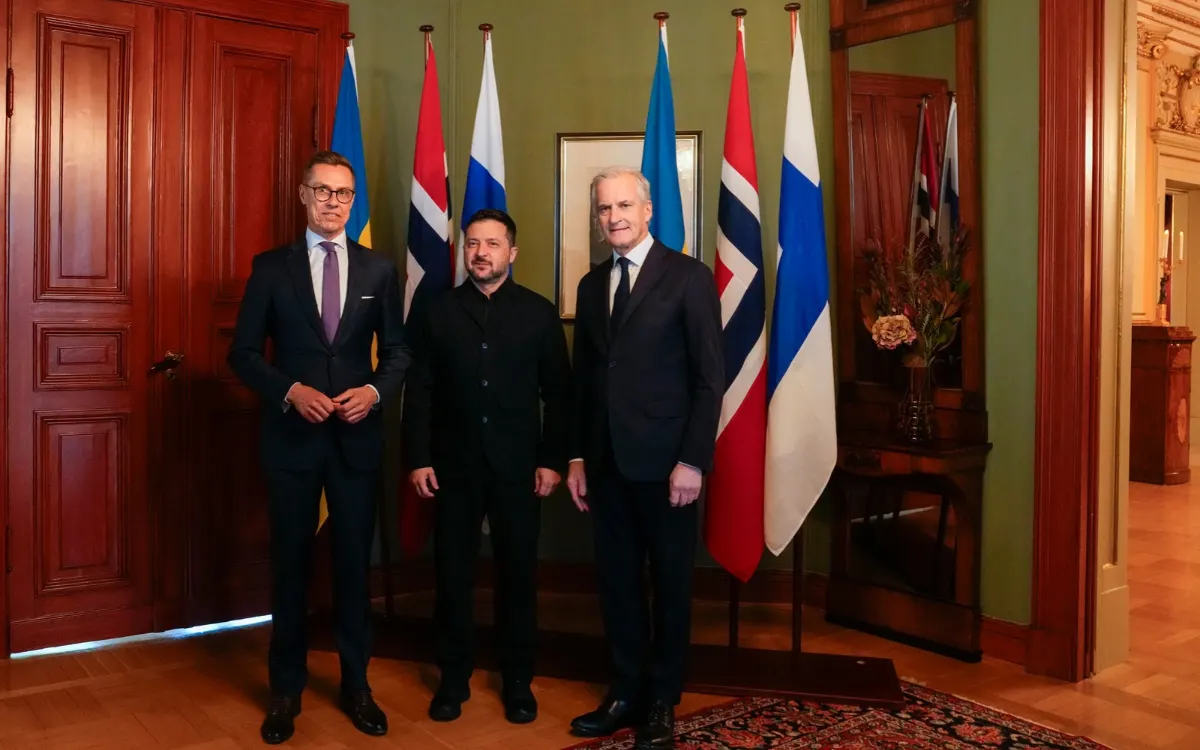
Finnish President Alexander Stubb and Norwegian Prime Minister Jonas Gahr Store spoke by phone with Russian President Vladimir Putin on October 27 about ending the war in Ukraine. Denmark criticized the initiative, exposing divisions over how Europe should engage Moscow.
Stubb and Store initiated the call, which they said was made in consultation with Ukraine. It followed an October 20 meeting in Oslo with Ukrainian President Volodymyr Zelensky and U.S. envoy Steve Witkoff. President Donald Trump’s son-in-law, Jared Kushner, joined the Oslo talks remotely, and Witkoff later met Putin in Saint Petersburg. Zelensky said negotiators from Ukraine, Russia, and the United States had agreed to hold technical-level talks in Abu Dhabi in the first half of November. The Nordic leaders emphasized that they were acting on behalf of their respective countries rather than representing Europe collectively.
“The outcome of this war will have a direct impact on our and the broader European security. Ending the war requires direct discussions,” Stubb said in a joint statement. He characterized the conversation with Putin as “frank and substantive,” while Store emphasized the conflict’s immense human and material costs. The Kremlin offered a contrasting assessment, accusing EU and NATO countries of pursuing a “confrontational” policy that was extending the fighting. Moscow nevertheless confirmed that the three leaders had agreed to maintain direct telephone contact.
Danish Prime Minister Mette Frederiksen criticized the decision to approach Putin independently, saying the talks had not been coordinated with other regional partners. The effort comes amid strains between Washington and Kyiv after Trump announced a deal on October 9 for Russian diesel supplies, backed by a temporary easing of U.S. sanctions. Zelensky called it “a weak decision by strong partners.” After the call, Zelensky spoke with Stubb and Store about their exchange with Putin.
Finland and Norway are both NATO members that border Russia, and both have pledged to keep supporting Ukraine. Their call gives two frontline states a direct channel to Moscow as Washington pursues its own. Denmark’s objection shows how hard a common European line remains, and the Kremlin readout indicates that Moscow still blames Western policy for prolonging the war. (AFP+EIR)