
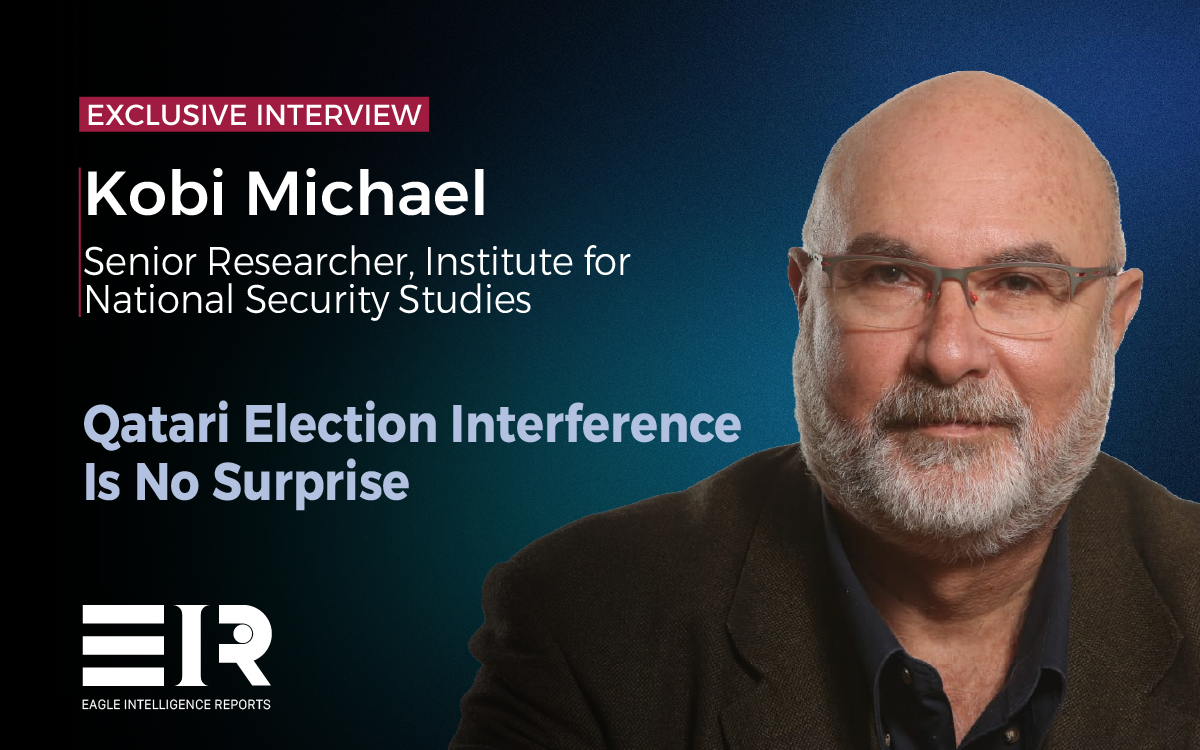
Israeli security researcher Kobi Michael said there was little reason to be surprised by claims of Qatari involvement in Israeli elections, arguing that Doha’s influence runs deep within Israel and extends to the office of Prime Minister Benjamin Netanyahu.
“Qatar is so deeply involved here in Israel,” Michael said, pointing to an ongoing investigation and alleging that Netanyahu’s closest adviser “is a Qatari agent, and he doesn’t deny it.”
Michael, a professor and researcher at Israel’s Institute for National Security Studies (INSS), also described Qatar’s extensive influence across the United States, Australia and Europe, particularly in academic, political and sporting circles, questioning why its involvement in Israeli elections should come as a surprise.
The whole idea of being surprised by Qatari involvement is something that does not correspond with reality. Qatar is so deeply involved here in Israel
In an interview covering Israeli politics, foreign interference and regional security, Michael also raised the possibility of another Israeli election campaign in February or March 2027, as political parties face the challenge of establishing a stable governing coalition.
Michael levelled sharp accusations against former Israeli lawmaker Azmi Bishara, whom he described as the closest adviser to the Qatari emir. He claimed that Bishara exercises extensive political influence across the Middle East and beyond from Qatar.
He also repeated allegations that Bishara had collaborated with Hezbollah during the Second Lebanon War, accusing him of betrayal and espionage, and referred to his role in founding the Balad party.
Funding Arab Parties and Influencing Voters
Michael said Qatar, and possibly Turkey, had provided substantial funding to Arab political parties to help them organize and encourage voter turnout. He nevertheless played down the potential impact of such interference on the final election results.
He said he was not convinced that the funding he described necessarily amounted to a serious legal violation, acknowledging that he was not a legal expert and that investigations and interrogations were still underway.
Any impact on the election outcome would have been marginal, he argued, citing the structure of Israel’s electoral system, which relies on paper ballots rather than digital voting and includes multiple layers of verification.
The investigations, the interrogations, are still taking place, and we have to wait and see what the outcomes of these investigations will be. But at the end of the day, this interference, if it influenced anything, influenced it in a very marginal manner
Michael described the most recent election as a demonstration of the strength of Israeli democracy and its electoral process. He also suggested that some of the controversy surrounding foreign interference amounted to political manipulation.
At the same time, he criticized attempts to single out or stereotype the entire Arab electorate over allegations of interference, warning that such efforts raised concerns about the fundamental principles of Israeli democracy.
Even if the investigations produce further findings, Michael said their impact would be marginal, involving very few ballots, and would not significantly change the election results.
Russian, Iranian and American Interference
Michael said Qatar was not the only foreign actor seeking to influence Israeli politics, pointing to Turkey, the Palestinian Authority, Iran, Russia and the United States.
He accused Russia and Iran of conducting influence campaigns and what he described as “cognitive warfare”, primarily through social media, in an attempt to deepen divisions within Israeli society, destabilize the political system and shape voters’ decisions.
Such campaigns may have persuaded some voters to change their preferences or stay away from the polls, he said, although he acknowledged having no findings establishing their actual impact.
He stressed that these foreign actors lacked the ability to interfere directly with paper ballots or manipulate the voting process on election day.
Michael also cited American involvement in Israeli politics, pointing to President Donald Trump’s repeated public endorsements of Netanyahu.
He said Trump had twice called on Israeli voters to support Netanyahu and, on one occasion, had warned that he would be reluctant to intervene against Iran if Israelis failed to elect the prime minister.
Looking ahead, Michael suggested that Trump could again intervene in Israel’s political affairs if he concluded that American interests required the formation of a unity government.
In that scenario, he argued, Trump would have sufficient leverage to push Netanyahu towards such a political arrangement.
Michael nevertheless doubted that Iran, Turkey, Russia or other foreign actors could significantly shape Israel’s forthcoming political developments, arguing that the next phase would largely be determined by domestic Israeli politics.
I don’t see the Iranians, the Turks, the Russians or any others being able to influence the political developments in a very significant manner
Another Election Campaign Possible in 2027
Turning to Israel’s political outlook, Michael said the immediate priority would be to establish a stable coalition and government, although he saw several possible configurations, not all of them favorable.
His preferred option would be a unity government bringing together Likud and the Yashar party led by Gadi Eisenkot. He acknowledged, however, that such an arrangement would be difficult to achieve, citing lingering concerns over Netanyahu’s past political conduct, particularly his dealings with Benny Gantz.
The only good option is to have a unified government, where the two major components will be the Likud and the Yashar party, which is led by Gadi Eisenkot. It is not so easy
Michael did not rule out the possibility of Israel finding itself in another election campaign in February or March 2027.
Despite the political uncertainty, he said domestic turmoil was unlikely to significantly affect Israel’s security priorities, particularly its approach to Iran.
Michael argued that another military campaign against Iran would enjoy broad political and public legitimacy in Israel, citing widespread support among mainstream Zionist parties and much of the Israeli electorate.
A Third Military Campaign Against Iran
On regional developments, Michael predicted that a third military campaign against Iran could be approaching, arguing that Israel and the United States had reached a stalemate in dealing with the Iranian regime.
“Everybody in Israel understands that eventually we will have to attack Iran,” he said, adding that “there is no other resort, there is no other choice” when it comes to the current Iranian regime.
The central question, he argued, was one of timing and what would need to be different in a third military campaign compared with the previous two to ensure the desired outcome.
He stressed that Israel and the United States would need to plan any attack carefully and in close coordination.
Michael linked his assessment to the American military presence in the region and what he described as Tehran’s unwillingness to negotiate an agreement even close to Washington’s terms.
He referred to a memorandum of understanding that he said the United States and Iran had signed in June 2025, describing it as heavily biased in Iran’s favour. He accused Tehran of subsequently breaching the arrangement, arguing that this had prompted Trump to adopt a more determined position.
The June ’25 MOU that was signed between the US and Iran was a very bad one, and it was completely biased towards the Iranians
Michael said the Iranian leadership still believed it had the upper hand and could withstand another military attack. He argued that Tehran also believed it could exert pressure on Washington, the global economy, the international community and Gulf countries by threatening to strike civilian infrastructure and oil facilities.
According to Michael, Tehran was also counting on the US midterm elections to constrain Trump’s ability to take military action.
He said Iranian leaders appeared to believe that a future US administration, whether Republican or Democratic, would have little appetite for resuming a war against Iran, encouraging Tehran to resist compromises and concessions.
Michael argued that these calculations left Trump, Netanyahu and Israel with no option but to attack Iran, with the aim of bringing the regime “to its knees”, toppling it, or weakening it dramatically enough to force an agreement on American terms.
Michael: Israel Could Attack Iran Independently
Michael said Israel would prefer Iran to remain a global problem rather than an issue for Israel to confront alone, with the United States continuing to take the lead.
He described deeper and broader strategic cooperation with Washington, including joint military action, as Israel’s preferred course.
At the same time, he stressed that Israel must be prepared to defend itself independently if the United States and the wider international community were unwilling to share the burden.
Should Washington decide against military action while Israel concluded that Iran was successfully rebuilding its nuclear and military capabilities and approaching what Israel considers a red line, Michael said Israel would launch an independent attack.
Such a move could create friction with the American administration, he acknowledged, but he noted that disagreements of this kind would not be unprecedented.
Michael pointed to what he described as exceptionally close cooperation between the Israel Defense Forces and US Central Command (CENTCOM), as well as between the Pentagon and Israel’s Ministry of Defense.
He also highlighted the close understanding between Trump and Netanyahu, saying the two sides were “on the same page”.
Nevertheless, Michael acknowledged that American and Israeli priorities could diverge if Trump managed to reach an agreement with Tehran that would open the Strait of Hormuz, ease pressure on oil markets and bring prices down, while establishing mechanisms to monitor and constrain Iran’s nuclear activities.
Israel, he said, does not trust the current Iranian regime and does not believe any agreement with it can resolve the underlying problem.
Such an agreement could therefore create a clash between Washington and Israel.
For now, however, Michael said developments were moving in the opposite direction, adding that Trump did not trust the Iranians either.
Michael concluded that Israel would respond to any development it regarded as threatening, potentially alongside the United States, and that domestic political uncertainty would not fundamentally alter that position. He ended with a warning that another military confrontation could be only weeks away.
“It looks like the winter is coming, that the attack is coming, that it is a matter of weeks,” he said.