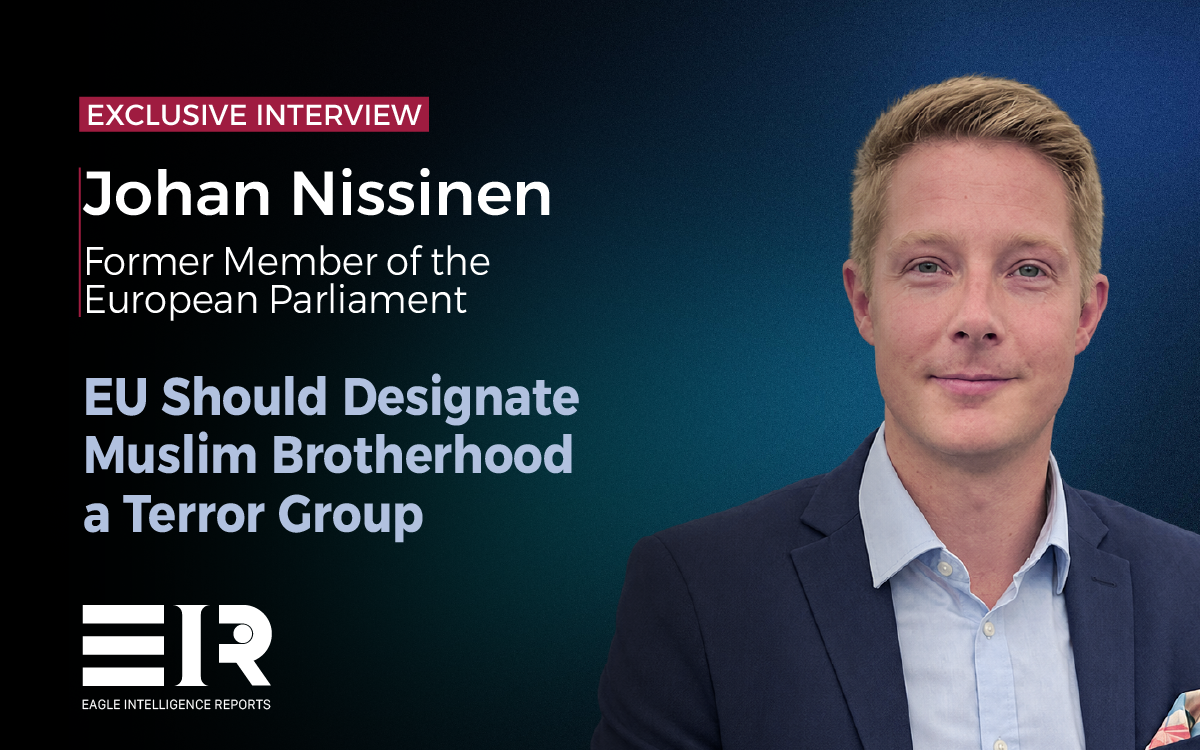
Former European Parliament member Johan Nissinen has called on the European Union to designate the Muslim Brotherhood as a terrorist organization, warning that European governments risk acting too late to address what he sees as the movement’s growing political and ideological threat.
In an exclusive interview with Eagle Intelligence Reports, Nissinen welcomed the European Parliament’s recent resolution addressing the Muslim Brotherhood’s influence, describing it as an overdue response to concerns about political networks, foreign funding, and the potential exploitation of Europe’s democratic freedoms.
Asked directly whether the EU should designate the Muslim Brotherhood a terrorist organization, Nissinen answered:
“They should, because it’s a threat,” adding that European authorities should take warnings seriously while they still have an opportunity to act.
His position goes further than the European Parliament’s resolution, which calls for greater scrutiny of funding, transparency, and institutional partnerships involving organizations suspected of connections to the movement.
His position goes further than the European Parliament’s resolution, which calls for greater scrutiny of funding, transparency, and institutional partnerships involving organizations suspected of connections to the movement
The resolution is nonbinding and does not itself designate the Muslim Brotherhood a terrorist organization or impose sanctions. Its practical consequences will depend on whether the European Commission and member states adopt further measures.
EU Funding Under Scrutiny
One of Nissinen’s principal concerns is whether European public funding has reached organizations suspected of connections to the Muslim Brotherhood and whether existing oversight mechanisms are sufficient to identify such links.
“We still lack a sufficiently clear picture of the scale,” he acknowledged, noting that Parliament had requested an overview of EU funding awarded to individuals and organizations suspected of Brotherhood links.
Nissinen argued that public funding can provide both resources and institutional credibility. He called for an independent audit to establish the facts, the exclusion or recovery of funds where breaches are proven, and criminal prosecution where individuals have broken the law.
He also advocated stronger funding controls, closer cooperation between national authorities, and greater scrutiny of institutional partnerships. A practical measure, he suggested, would be tracing public money through partner organizations and subcontractors rather than examining only the initial recipients.
Nissinen acknowledged that the Brotherhood’s precise influence remains difficult to measure and that he could not substantiate individual suspected connections during the interview. Asked to distinguish documented links from suspected ones, he said further documentation would be required to establish them.
He also advocated stronger funding controls, closer cooperation between national authorities, and greater scrutiny of institutional partnerships
Is Europe’s Democratic Openness Being Exploited?
Beyond financing, Nissinen raised concerns about the possibility that organizations with political objectives could use Europe’s democratic institutions and civil society structures to acquire legitimacy.
“I believe the movement has sought to use Europe’s openness and institutional access to advance an illiberal political agenda,” he said, warning that civil society organizations can gain credibility without sufficient scrutiny of their objectives and connections.
The former MEP also criticized what he sees as a longstanding tendency among European governments to react only after security concerns become more serious. He recalled raising concerns about radicalization and foreign funding of Islamic institutions at the Parliamentary Assembly of the Council of Europe in 2018.
France Could Lead Europe’s Response
Asked which European country might be best positioned to lead a stronger response, Nissinen identified France, pointing to its historical relationships with countries with substantial Muslim populations and its experience debating political extremism.
He suggested that France could take a leading role if its political leadership made the issue a priority. Nissinen said that Marine Le Pen, leader of the French right, would probably raise the issue, but he questioned whether she would be able to resolve it effectively.
Britain could also influence European policy despite having left the EU, particularly if it developed approaches that other countries considered effective.
Nissinen cited the British government’s 2015 review of the Muslim Brotherhood as evidence that concerns about the movement’s activities and organizational relationships are not new.
Migration, Political Influence, and Religious Freedom
Asked whether recent migration waves could have contributed to the Muslim Brotherhood’s influence in Europe, Nissinen acknowledged that he lacked the data needed to establish a direct connection. However, he argued that political and ideological beliefs can persist when people move between countries.
Nevertheless, Nissinen emphasized that concerns about the Muslim Brotherhood should not translate into collective suspicion toward Muslim communities.
“Muslim citizens are entitled to the same religious freedom, dignity and protection from discrimination as everyone else,” he said, stressing that Muslim communities must never face collective blame and that no organization should automatically be accepted as speaking for them all.
“Muslim citizens are entitled to the same religious freedom, dignity and protection from discrimination as everyone else,” he said, stressing that Muslim communities must never face collective blame and that no organization should automatically be accepted as speaking for them all
Nissinen Criticizes European Political Complacency
Beyond the question of migration, Nissinen delivered a broader criticism of European political leadership, arguing that governments have repeatedly failed to recognize emerging problems and acknowledge their own policy mistakes.
He described European politics as having been “very naive and too open-minded,” criticizing politicians for failing to take responsibility when their policies prove inadequate.
He argued that Europe needed to take potential threats seriously, examine the funding and affiliations of organizations more closely, and enforce existing laws where criminal conduct is established.
For now, he said, the European Parliament’s resolution remains a recommendation. Whether it produces any meaningful change will depend on what the Commission and national governments decide to do next.