
A decade ago, an international court ruled unambiguously in favor of the Philippines and against China’s claims in the South China Sea. Although the arbitration no longer constrains China, it remains strategically important as the legal foundation through which states legitimize and coordinate balancing against Beijing. That importance holds amid declining U.S. reliability, China’s growing power, and the regularization of warfare.
China still fully rejects the Arbitral Award. In July 2026, to mark its tenth anniversary, Chinese think tanks hosted an event in Hong Kong on South China Sea security and released a report restating its rejection of the ruling. China and the Philippines cannot reach a common understanding over the Award, which now risks becoming a purely symbolic victory for Manila.
However, understanding just how much has changed in the intervening decade since the arbitration helps to explain why the ruling still matters. Not because it compels China to alter its behaviors or aims in the South China Sea, but because it helps coordinate diplomatic and deterrence strategies.
The ruling still matters — not because it compels China to alter its behaviors or aims in the South China Sea, but because it helps coordinate diplomatic and deterrence strategies
This was clear in a joint statement issued by the Philippines’ international supporters to mark the tenth anniversary. “We reaffirm the Arbitral Tribunal’s decision that there is no legal basis for China’s expansive maritime claims in the South China Sea,” said the joint statement. Its wording was unambiguous: “We reaffirm that the Award rendered ten years ago by the Arbitral Tribunal is… final, legally binding, and definitive between China and the Philippines…”
The list of the states that were signatories to this joint statement tells its own story: Australia, Canada, Estonia, Germany, Italy, Japan, Latvia, Lithuania, New Zealand, the Philippines, Romania, Slovenia, the UK, and the United States. This list includes the key states involved in balancing against China’s ambitions in the Asia-Pacific. Only one ASEAN state, the Philippines, signed. The rest manage their relations with China carefully, unwilling to anger a power whose economic rise benefits them. Malaysia and Vietnam also have claims of their own in the South China Sea.
That reticence reflects how China’s economic weight now works. Beijing rarely needs to win the legal argument. It can shape the economic calculations of the capitals that might otherwise sign. China’s weight in trade, investment, and market access does much to shape their choices. For most of Southeast Asia, exposure to that leverage weighs more heavily than a decade-old ruling.
The inclusion of key Eastern European states shows how energized they have become by the bitter precedent of Russia’s invasion of Ukraine. There, historical claims of ownership, based on particular readings of history, became a prelude to war. A short recap of the Arbitral Tribunal’s key rulings underscores the relevance of this concern.
The Award’s Three Findings
The Arbitral Award declared China’s self-declared “nine-dash line”—which is based on its historic right to claim the South China Sea—to have no lawful basis. Within the “nine-dash line,” China produced historical maps based on such points as ancestral Chinese fishing rights, to claim roughly 80 percent of the South China Sea.
The second key ruling from the Award was to reassert that the United Nations Convention on the Law of the Sea (UNCLOS) has primacy over sovereignty claims. The tribunal concluded that any historical claims made by China were extinguished if they were incompatible with UNCLOS. Both the Philippines and China have previously signed and ratified UNCLOS, which sets 12 nautical miles as the maximum breadth of a coastal state’s territorial sea.
The third key ruling from the Award was that certain reefs and features claimed by China were defined as “low-tide elevations” or rocks that did not generate their own Exclusive Economic Zones (EEZs). The tribunal also placed Second Thomas Shoal firmly within the Philippines’ EEZ. The wrecked Philippine ship Sierra Madre still sits there, manned and resupplied by the Philippine Navy—a flash point of its own between China and the Philippines.
What Has Changed Since 2016
Then as now, the South China Sea dispute remains one of the world’s critical and complex flashpoints because it threatens to bring China into spiraling confrontations with other countries in the region. Three key things have changed since 2016. The overall security situation around the South China Sea has further declined. China’s military power has grown markedly. And the authority of international law and multilateral institutions has weakened more generally.
Then as now, the South China Sea dispute remains one of the world’s critical and complex flashpoints
Taking these three trends in turn, the Philippines and China have in recent years skirted a delicate line between tense coexistence and open violence in the South China Sea. In a clash that took place on June 17, 2024, Chinese Coast Guard personnel rammed, boarded, and used knives to slash at Philippine rubber inflatable boats involved in a resupply mission. A Philippine Navy sailor lost his thumb in this confrontation, making it especially notorious, but it is only one incident in a series of clashes. The Chinese Coast Guard now routinely uses water cannons and pursues passing ships from other nations. It does so to enforce China’s claim to most of the South China Sea, even where that claim covers other countries’ EEZs.
Numerous littoral states have competing claims over the South China Sea’s features and resources, including Vietnam and Malaysia. But it is the specific dispute between China and the Philippines that has proven the most tense. In many respects, the Philippines is a linchpin state in the South China Sea, a place where several critical issues meet.
This is because the Philippines has also become the vital bridging state regarding the security of Taiwan. Due mainly to its geographic location, the Philippines finds itself the most proximate of the Southeast Asian countries to Taiwan. The United States has invested substantially in its defense relationship with the Philippines, exemplified by their largest-ever joint military exercise, Balikatan, which ran in April and May. In the event of a war over Taiwan, the Philippines would prove to be a vital staging ground for military operations to support Taiwan, for receiving refugees, for resupplying Taiwan, and so on.
Today, to a far greater extent than in 2016, this makes the nature of the Philippines–China dispute even more incendiary. Should the Philippines ever find itself fighting China in the South China Sea, it is unclear whether the United States would try to de-escalate the confrontation or openly support the Philippine military.
Should the Philippines ever find itself fighting China, it is unclear whether the United States would try to de-escalate — or openly support the Philippine military
International Law’s Standing Declines
It would be far better to manage the China–Philippines dispute peacefully, through the mechanisms of international law. But other overarching trends give a pessimistic reading of how manageable it is becoming.
In the decade since the Philippines secured the favorable Arbitral Award, the very standing of international law has degraded: in part because of the United States’ abdication of its buttressing role.
The standing of the Arbitral Award mirrors the overall decline in global affairs into a more dog-eat-dog world. It seems almost quaint to salute a legal ruling when the facts on the ground—or in this case on the seas—are being altered.
When the Award was issued on July 12, 2016, the world was a very different place. Donald Trump was still months away from his first presidential term and Britain had voted for Brexit only weeks earlier. This is relevant not because of the United States and the UK in particular, but because of the more general populist backlash from the so-called upholders of the rules-based international system. In his second term, Trump has further dismantled the United States’ role in key multilateral institutions. He has flouted international law in Venezuela and Iran, and repeatedly threatened to annex Greenland from its own NATO ally, Denmark.
China has by comparison burnished its global credentials as a paragon of stability and an upholder of international order, consistent economic partnerships, and the multilateral system. China has published a White Paper spelling out its ambitions for its own Global Governance Initiative this year, while seeking greater direct influence in the UN’s institutions. No less important is the growth of Chinese economic and diplomatic power over the past decade, which gives Beijing greater room to reward accommodation and discourage defiance by economic means. China can now plausibly paint the United States as a violator of international rules. Against that backdrop, any invocation of U.S. support for the Philippines on legal grounds looks deeply hypocritical.
China can now plausibly paint the United States as a violator of international rules — so that any invocation of U.S. support for the Philippines on legal grounds looks deeply hypocritical
Chinese Military Power Grows
If this was limited to an argument over principles it would be less concerning, but the military buildup between China and the United States in the Asia-Pacific has intensified in recent years. China’s military has become so much more powerful than it was a decade ago while war has returned to prominence in the international system.
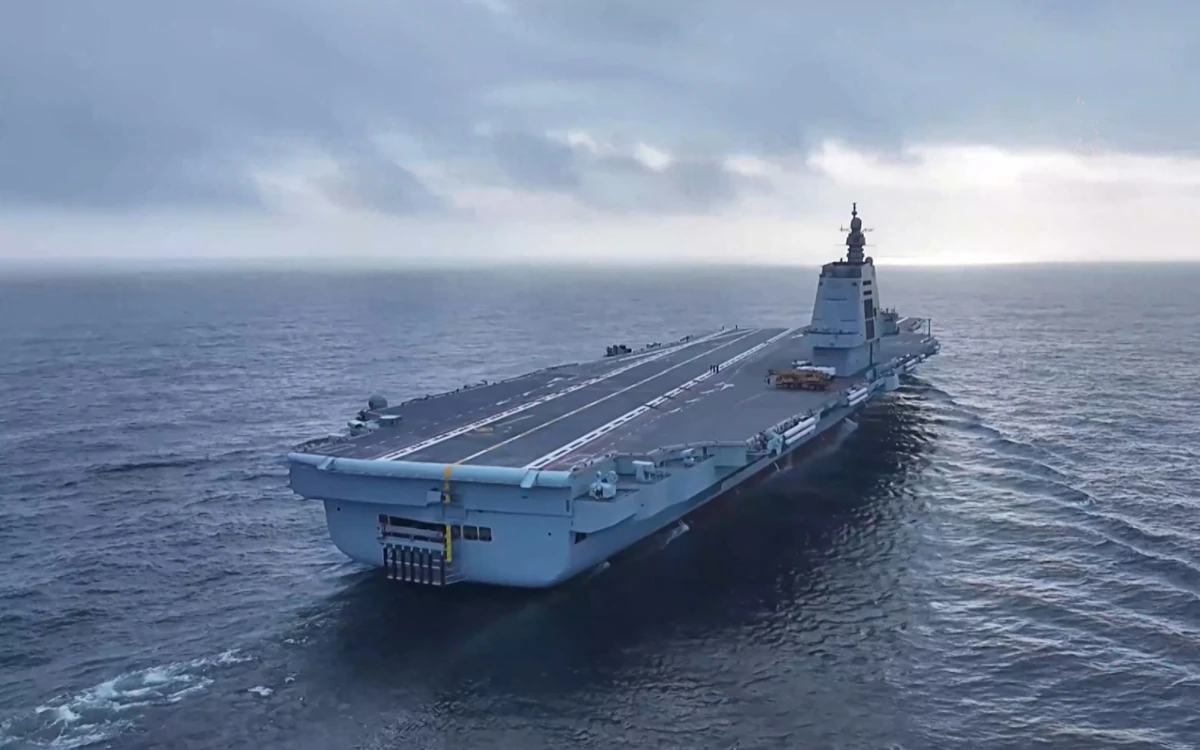
China has modernized and expanded its navy from roughly 300 warships in 2016 to nearly 400 today. Its carrier force has grown from one, the Liaoning, to three, with the addition of the Shandong and the Fujian. The numerical advantage China’s navy holds over the U.S. Navy in the Pacific has widened even further this year. So much U.S. attention and resources have had to be redirected to the Middle East to manage the war against Iran.
The Philippines meanwhile has also enhanced its relationship with Japan, as the United States realizes that it cannot alone deter China in the Indo-Pacific. Japan’s Official Security Assistance program has provided the Philippines with coastal radar systems. More defense support may follow, given Tokyo’s recent relaxation of its ban on becoming a defense exporter. Japan and the Philippines now also have agreements for greater military cooperation. Earlier this year they opened talks to delimit their overlapping EEZs—a move that drew a sharp reaction from China.
So far, China’s aggressive action in the South China Sea is only one of two clear and overt outliers in its declared behaviors, the other outlier being its increasingly assertive military exercises around Taiwan. China is behaving more assertively in its immediate regional waters while presenting a far more stable presence at the level of its global relations. This contradiction is in itself not very surprising for a rising superpower that wants to first exert greater dominance in its backyard, but it leaves the Philippines in a tricky position.
Rallying Around the Arbitral Award
It is against this backdrop that the ruling reenters the picture. One thing is clear: the Arbitral Award probably could not have been secured afresh today. The Philippines first tried to manage its dispute with China through international law. There is much evidence that this approach has now been overtaken by events. However, for as long as the dispute and its escalatory potential can be managed, the Award still serves a purpose. Military deterrence alone loses its value without a legal narrative to explain why it is necessary, even if the connection is indirect.
Even if the world is a more dog-eat-dog place than before, the ruling still matters. Not as a relic of a vanished order, but as an active component of a wider system of conflict management in the Asia-Pacific. China’s ambition is to expand its control of the South China Sea through an expanding naval presence—one that may one day prove more powerful than what it achieves through Coast Guard patrols. Short of a war over Taiwan, China’s growing naval power may well render the Arbitral Award moot.
The ruling endures not as a relic of a vanished order, but as an active component of a wider system of conflict management in the Asia-Pacific
For all that, the legal lines drawn in these waters still matter. The 2016 ruling remains part of the South China Sea equation, but ever less, as military and alliance-based calculations now shape the contest. China’s maritime disputes may yet be managed in ways that avoid further fighting, but doing so is unquestionably far more difficult than it was a decade ago.