
Science and technology leadership is now an American national security objective in its own right. The National Security Science and Technology Strategy, published by the White House Office of Science and Technology Policy on August 17, 2026, says so directly. It is the first document to carry that title since 1995.
Treating technological leadership first and foremost as a security objective inverts a long-standing American convention, under which strategic advantage arrived as a by-product of commercial dynamism. Washington historically combined public investment in science and technology with an innovation ecosystem in which firms and markets determined which technologies attracted capital and achieved strategic commercial scale. The new NSST Strategy shifts that balance.
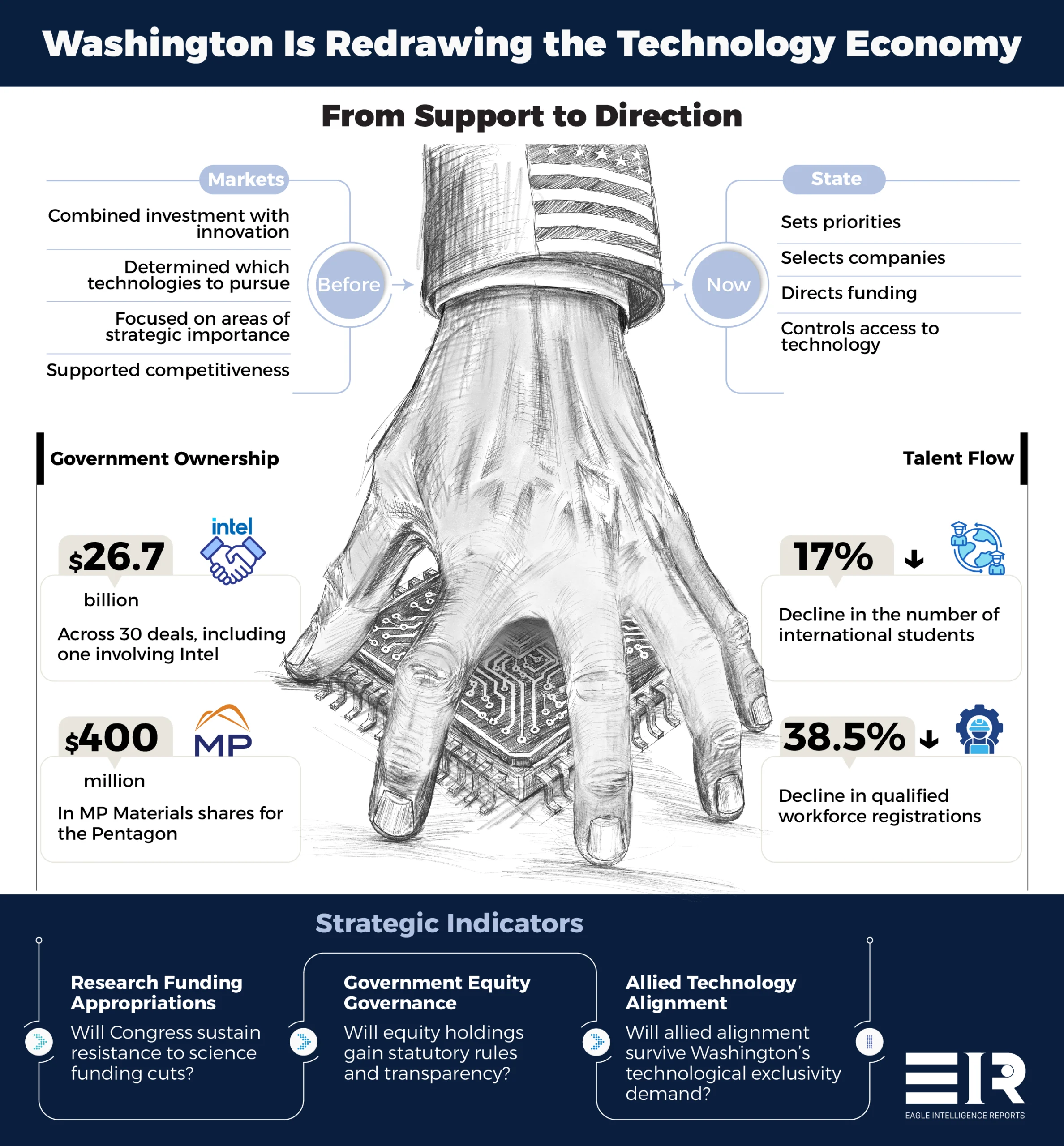
While the document still describes the innovation ecosystem as a key American strength to be leveraged, its instruments point elsewhere. Washington is moving from stewardship of that ecosystem toward a more explicit techno-industrial strategy in which the state ranks fields, selects firms, and prices access to technology. The ranking comes first, because everything else the strategy does depends on the list.
Washington is moving from stewardship of the innovation ecosystem toward a more explicit techno-industrial strategy in which the state ranks fields, selects firms, and prices access to technology.
Washington’s Hierarchy of Priorities
The strategy organizes federal effort around four pillars: focused, resilient, agile, and secure. It names three priority areas for battlefield dominance, undersea, space, and AI with autonomy, placing air superiority, long-range strike, and C5ISR one tier below. A further 12 enabling technologies follow, and Appendix A updates the official list of critical and emerging technologies to 14 areas. Focused prioritization, the document argues, is what makes the approach affordable as well as effective.
The ranking carries the substantive change. Earlier critical-technology lists were inclusive and functioned as signals. This one assigns rank order and connects it to the fiscal 2028 research and development budget priorities memorandum. The Office of Science and Technology Policy and the National Security Council are to write technology-specific plans at the next level of detail. Ranking, budget linkage, and sequenced sub-plans together form a planning architecture.
The instruments have precedent. A Science and Technology report to President Obama in January 2017 diagnosed Chinese industrial policy in semiconductors and prescribed innovating faster. The Biden administration kept the diagnosis but changed the response. It appropriated $52.7 billion through the CHIPS and Science Act, restricted advanced computing exports in October 2022, and opened outbound investment screening in 2023. Each measure named a sector.
Two things are new. Systematization extends the logic across 14 technology areas and ties it to a budget memorandum. Securitization changes the authority under which it operates. Support once justified by competitiveness is now justified by security, and $5.7 billion of Intel’s undisbursed CHIPS award now forms part of a 9.9 percent federal stake. Enforcement arrived alongside doctrine. On the same day the strategy appeared, the Pentagon notified 30 universities that they must audit their foreign research collaborations or lose eligibility for federal funding.
One placement shows the ranking’s logic and its cost. Biotechnology appears among the transformative fields the United States intends to lead. It is tied to countering biological weapons but is absent from the enabling technologies listed for battlefield advantage. A field of high strategic consequence is ranked chiefly by its threat profile.
The prioritization rests on an implicit claim: that the state can identify which fields will matter over the course of a decade. The document does not set out how the ranking would be revised if it proved wrong, nor which authority would revise it. The ranking also assumes that one set of instruments will work across every field on it.
Markets of Unequal Shape
The strategy applies one governance logic across technologies whose market structures differ fundamentally. That uniformity is a central analytical weakness. Artificial intelligence sits at one extreme. Private capital dominates, capability is set by firms whose balance sheets exceed the relevant federal programs, and public leverage is marginal. Direction adds little; restriction changes outcomes.
The new U.S. technology strategy applies one governance logic across technologies whose market structures differ fundamentally. That uniformity is its central analytical weakness.
Undersea capability sits at the other. There is one buyer, a shallow supplier base, and no commercial market. The strategy ranks undersea first and ties the effort to work with Australia and the United Kingdom on the submarine industrial base. Here the state is the market, and directed investment is the only available route.
Space complicates the argument, in Washington’s favor. Commercial and military demand have converged, and the Pentagon buys from firms whose civil businesses already fund the capability. Space Systems Command awarded SpaceX $2.29 billion in May for the Space Data Network backbone and $4.16 billion days later for an airborne-target tracking constellation. Both ran through other transaction authorities. This is the techno-industrial model working: fast contracting, commercial cost structures, scale.
The same case exposes two failure modes. Supplier concentration is one: both awards went to a single company. Fiscal fragility is the second. Golden Dome leans on reconciliation: over $17 billion is sought that way for fiscal 2027 against $400 million in base funding. The Congressional Budget Office assesses a comparable architecture at $1.2 trillion over 20 years.
Quantum computing occupies an unstable middle. The strategy calls it potentially transformative while its appendix marks most security implications as still on the horizon. Commercial revenue is thin, and the government has taken stakes in quantum firms ahead of the market. The fiscal 2027 request would nonetheless cut quantum information science at the National Science Foundation by 37 percent, from $365 million to $231 million.
Procurement doctrine bridges these differences. The document pushes agencies toward other transaction authorities and milestone-based fixed-cost contracting, and endorses lower-cost, sometimes attritable platforms fielded in numbers alongside smaller quantities of exquisite systems. That preference favors new entrants over incumbent primes, and may reshape the defense-industrial base more than any single funding line.
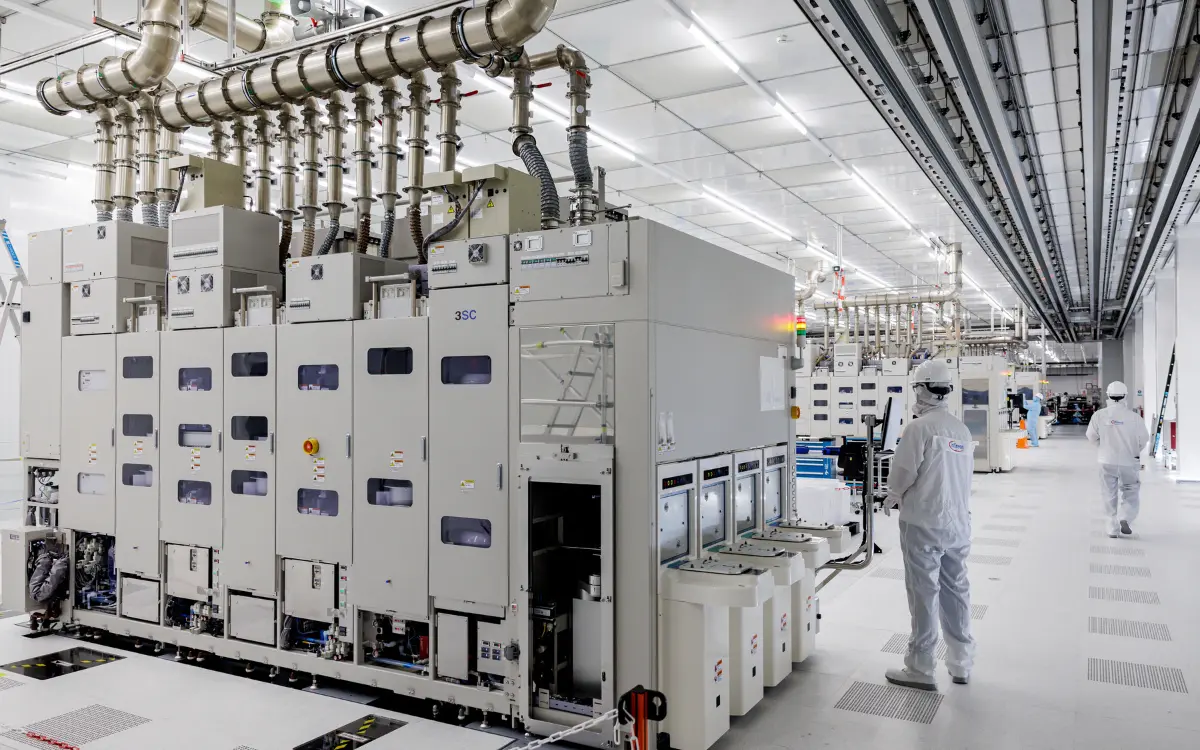
Semiconductors are the one sector where every instrument applies at once. The list runs to subsidy, a federal stake in the largest domestic producer, licensed and priced exports, outbound screening, research vetting, and a workforce the same policies are shrinking. No other field carries the full set, which makes it the clearest test of whether the apparatus works as a system or merely accumulates.
From State Subsidy to Shareholder
Of those instruments, ownership has moved furthest and fastest. The strategy arrives against a materially altered relationship between Washington and American firms. As of late July, the administration had committed roughly $26.7 billion across 30 equity or quasi-equity deals, the largest in Intel. The Pentagon holds $400 million of preferred stock in MP Materials, with a warrant that would make it the company’s largest shareholder. No consolidated register of the holdings has been published. Subsidy leaves capital decisions with the firm; ownership creates a claim on them.
Subsidy leaves capital decisions with the firm; ownership creates a claim on those decisions.
Advanced manufacturing shows the instruments used together. China holds roughly 90 percent of global rare earth refining, and the binding constraint is processing rather than discovery. Alongside its equity, the Pentagon lent $150 million for heavy separation and guaranteed a ten-year floor of $110 per kilogram, roughly double the prevailing price when the deal was struck.
Washington also backed a competitor, signing a non-binding letter of intent with USA Rare Earth in January for up to $1.6 billion. By May the two firms were in a Texas court over magnet technology, on allegations that remain unproven. Ownership, credit, price, and demand are set administratively, and a guaranteed floor removes the demand risk that normally disciplines capacity decisions.
There is, however, a strong case for greater state direction, given how such dependencies arose. China’s refining dominance was built by ordinary commercial logic, as Western firms shed a low-margin and environmentally costly process. The Dutch semiconductor maker Nexperia followed the same route when it was sold to China’s Wingtech in 2018 for about $3.6 billion. Where private incentives concentrate a strategic input in one jurisdiction, the dependency is a market product, and correction is not obviously anti-market.
Capital controls have moved in parallel. The Comprehensive Outbound Investment National Security Act of 2025 cemented the Outbound Investment Security Program. The document directs Treasury to strengthen it and to widen it across areas implicated by China’s military-civil fusion strategy. The strategy also seeks to monitor certain greenfield investments and to expand the jurisdiction of the Committee on Foreign Investment in the United States over critical technology.
Export Control as Toll
Export policy completes the position. The President approved sales of Nvidia’s H200 accelerator to China in December 2025, with the government taking 25 percent of proceeds. The Bureau of Industry and Security issued the licensing rule in January. Chips made in Taiwan route through the United States for screening before delivery. About ten Chinese firms were cleared, among them Alibaba, Tencent, and ByteDance, each capped at 75,000 units.
Beijing then took control of the opening, stalling deliveries for seven months while steering buyers toward Huawei. ByteDance and Tencent each received roughly 10,000 units in recent weeks, a fraction of their licenses. Every further order is gated case by case, and most licensed volume is directed to Hong Kong instead of the mainland. Nvidia is reported to hold some 500,000 of the chips built for Chinese customers. TrendForce projects domestic suppliers taking close to 90 percent of China’s high-end AI chip market this year.
Two consequences follow. Control has migrated from prohibition to a licensed and taxed channel, converting a security measure into a revenue stream. And the buyer now sets the terms of a sale the seller’s government has already priced. Both states are directing outcomes against market signals in the same segment, and the smaller flow of chips is the result.
The premium being defended is also narrowing. Stanford’s AI Index put the leading American model ahead of the best Chinese model by 2.7 percent in March 2026, down from double-digit gaps in 2023. A toll works only while the taxed good remains hard to replace.
The Protection Trade-Off
The same logic governs what stays inside the country. The secure pillar addresses protection. It proposes tracking direct and indirect recipients of federal research funding, and barring fundamental research awards to high-risk entities on the Section 1260H list. It also calls for automated vetting of proposals and continuous monitoring of funded projects.
The university audits show the approach in practice. They cover 130 foreign institutions, 88 of them in mainland China, together with bodies linked to rebranded Confucius Institutes. Findings are due by August 31. The two-week window to audit and report is the operative detail. It sets a compliance tempo that precludes case-by-case assessment and pushes institutions toward blanket withdrawal. Several listed Chinese entities are prominent civilian universities with extensive international research partnerships, so the cost falls on ordinary work alongside the channels the policy targets.
Talent presents the same trade-off in sharper form. The strategy commits the United States to attracting and retaining top-tier global talent in critical fields. The 2025 National Security Strategy had warned against invoking global talent to open the American labor market. Supply is moving the other way. New international student enrollments fell 17 percent in the fall of 2025, and H-1B registrations for fiscal 2027 dropped 38.5 percent. That trend will likely deepen under the newly proposed $100,000 H-1B fee.

The Office of Science and Technology Policy names workforce as a means of implementation while controlling none of the levers that determine it. Its domestic substitute, expanded Advanced Placement access and apprenticeships in AI infrastructure and microelectronics, matures over a decade. The capability timelines in the same document run shorter.
The cost falls on the mechanism that produced the advantage. Openness has served as an intake channel as much as a leak. The visa and enrollment measures that reduce exposure also reduce recruitment. Continuous monitoring adds an administrative load to the same universities the strategy asks to take more technical risk. The agile and secure pillars issue opposite instructions to the same research managers. No published assessment establishes which flow is larger.
Openness has served as an intake channel as much as a leak. Visa and enrollment measures that reduce exposure also reduce recruitment.
The Sematech Benchmark
Washington has attempted a techno-industrial turn before, and the precedent sets a standard the current approach does not meet. Fourteen chipmakers formed Sematech in 1987 to answer Japanese competition. DARPA contributed about $100 million a year, roughly $870 million over a decade. The consortium was barred from designing or selling chips, and members provided at least half the annual budget.
Three design features explain its reputation. Scope was narrow and pre-competitive. Industry carried the majority of the cost, which disciplined selection. And it sunset: the board voted to proceed without federal funding after a final payment in fiscal 1996.
Even so, the record is contested. The Government Accountability Office judged in 1992 that Sematech would reach parity with Japan without surpassing it, and that its credit for the recovery was unclear. Irwin and Klenow later found members cut private research spending by roughly $300 million a year, three times the subsidy.
Current practice inverts each feature. Scope spans 14 technology areas, industry cost-sharing is not a condition of the equity being taken, and no sunset is specified. Selection error therefore has no built-in check.
The fiscal base is also contracting. The fiscal 2027 request seeks a 55 percent cut at the National Science Foundation, taking it to $4 billion. The Department of Energy’s Office of Science would fall 15 percent and the National Institutes of Health 12 percent. Congress rejected comparable reductions for fiscal 2026, settling NIH at $48.7 billion and NSF at $8.75 billion. The House Appropriations Committee has already declined the deepest fiscal 2027 proposals.
Where new activity has appeared, it has come through redirection. The Genesis Mission, launched by executive order in November 2025, was expanded in July 2026 with more than $5 billion in commitments across 15 federal agencies. Businesses fund about three-quarters of American research and development, and federal money supports most academic research performance. Concentrating a static budget on designated missions therefore magnifies the consequences of selection error.
Europe Inside the Perimeter
The protective perimeter extends outward. The strategy would lead allies toward similarly rigorous research security practices and treat adoption of comparable outbound investment restrictions as evidence of distance from adversaries. Washington also commits to deliberate participation in international standards bodies.
The vehicles exist. Washington signed technology prosperity deals with the United Kingdom in September 2025 and with Japan and South Korea in October 2025. They are non-binding and commit no funding. Pax Silica opened in December 2025 with seven signatories and had 25 by August, according to the Information Technology and Innovation Foundation.
Informal enforcement has now begun. A State Department draft reported by Reuters on August 14 addresses the 35 signatories of the June AI Opportunity Statement. They cannot also join the World Artificial Intelligence Cooperation Organization that Xi Jinping launched in July. Kazakhstan, a significant critical-minerals supplier, belongs to both. The text avoids naming China and warns that belonging to every framework amounts to belonging to none.
Brussels is building in parallel. The Commission proposed a European Technological Sovereignty Package on June 3, 2026. Its Chips Act 2.0 targets $140 billion of investment by 2035, with demand accelerators linking European producers to industrial buyers and priority for an advanced foundry inside the bloc. It remains a proposal, and adoption is not expected before late 2027.
That demand alters what alignment costs. Prosperity deals and Pax Silica declarations bind no signatory, while American export controls and entity listings reach European firms extraterritorially. Members are now asked to forgo optionality as well, in exchange for commitments that remain unenforceable against Washington. Alignment on denial is politically easier than alignment on industrial policy, where European demand accelerators and American equity stakes pull on the same firms.
Nexperia has already shown the cost of acting on chokepoint logic without matching resilience. The Dutch government took temporary control of the chipmaker in late September 2025 on national security grounds, using a Cold War-era law. Beijing blocked exports of finished chips from its Dongguan plant, European carmakers warned of imminent stoppages, and The Hague suspended its order weeks later. Disruption ran into 2026 regardless.
A Partial Transformation
The model Washington is converging on is already visible in Beijing. The 15th Five-Year Plan, covering 2026 to 2030, codifies technological self-reliance as a core priority, and SMIC’s capital expenditure follows policy logic instead of demand signals. Controls have bitten: indigenous production remains years from global competitiveness, with yields at advanced nodes poor. They have also prompted a state-backed self-sufficiency drive that has delivered results, while reducing the ability of Western firms to observe that industry from inside.
The risk facing Washington is functional. Selection criteria drift toward political salience when no legislative test constrains them, and that drift is how directed systems misallocate capital. A state apparatus smaller and less continuous than China’s, applying the same method without the same duration, would carry the costs of direction without its compensating scale.
A state apparatus smaller and less continuous than China’s, applying the same method without the same duration, would carry the costs of direction without the compensating scale.
Much of the strategy remains unwritten. The technology-specific plans beneath it will decide which firms, laboratories, and fields receive support. The framework sets the method, with the allocations that test it still to come.
Three markers will indicate the direction of travel: whether the fiscal 2027 appropriations that emerge from Congress hold the line the House committee has drawn; whether the equity holdings acquire statutory rules and a published register; and whether allied alignment survives an exclusivity demand that European governments have not yet answered.
On the present trajectory, the likely outcome is a hybrid, distinct from both the ecosystem model of the past four decades and a planned system. It would leave Washington well equipped to slow competitors and poorly equipped to accelerate itself. And allies asked to adopt the same controls will import that asymmetry with them. Such an arrangement could help America defend its technological lead for some years. But it may come at the expense of the very model that created the advantage in the first place.