
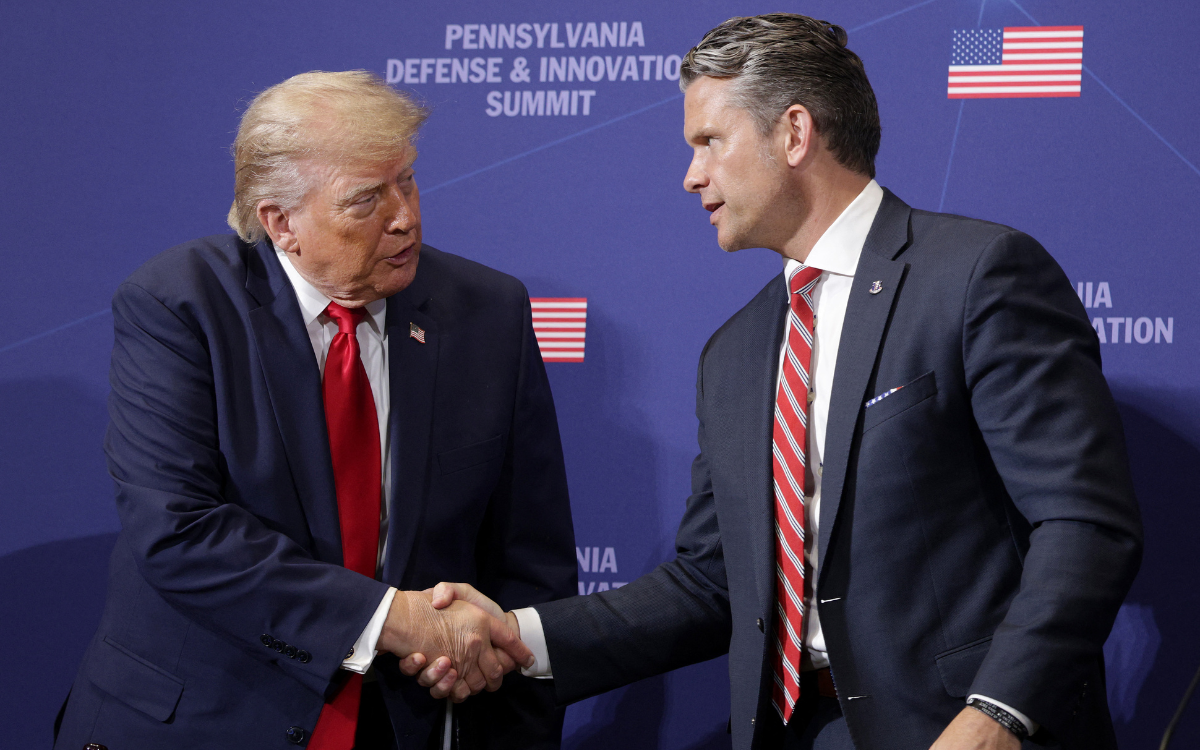
U.S. Defense Secretary Pete Hegseth and Small Business Administration (SBA) chief Kelly Loeffler launched an initiative inspired by the Second World War era that aims to deliver a “generational battlefield advantage.”
The new Smaller War Plants initiative is modeled on the WWII-era Smaller War Plants Corporation. Its goal is to steer capital and expertise toward small defense manufacturers to achieve U.S. President Donald Trump’s objective to “end America’s dependence on foreign supply chains and adversaries,” according to Hegseth.
“American battlefield readiness runs through our small businesses. It always has. The vehicles, the planes, and even rifles in our warfighters’ hands rely on a supply chain of hundreds of specialty producers. The Patriot missile depends on hundreds more. These are the local factories, the shop floors, and the labs forging the arsenal of freedom,” the U.S. Defense Secretary said.
“Our message is clear: President Trump is ending the era of dependence on foreign supply chains and our adversaries. This historic long-term commitment will reinforce the industrial depth that stands proudly behind the strongest military on Earth. When we back the businesses who supply our forces, we outbuild, out-innovate, and overwhelm any adversary. We are transforming industrial capability into a generational battlefield advantage. And, in doing so, we will deter conflict, preserve peace, and ensure that no adversary tests American strength,” Hegseth added.
The new Smaller War Plants Commission draws its name from the Smaller War Plants Corporation, a World War II-era SBA predecessor that was formed to build the defense industrial base.
We’re returning to our roots – and the era of American industrial dominance – to keep America’s… https://t.co/qGbBqdRuxi
— SBA (@SBAgov) August 25, 2026
The SBA posted on X that the new initiative draws its name from its 20th-century predecessor, which was “formed to build the defense industrial base.”
“We’re returning to our roots—and the era of American industrial dominance—to keep America’s warfighters strong,” the SBA wrote.
The initiative is strategically significant because it seeks to expand the depth and resilience of the U.S. defense industrial base by directing capital and expertise toward smaller manufacturers, reducing reliance on foreign supply chains, and strengthening domestic production capacity. Its impact will depend on how quickly funding reaches suppliers and whether smaller firms can scale production of critical components and systems. The key indicators to watch are the initiative’s initial investments, new contracts for small defense manufacturers, production increases for critical weapons systems such as Patriot, and any further measures aimed at reducing dependence on foreign suppliers. (EIR)