
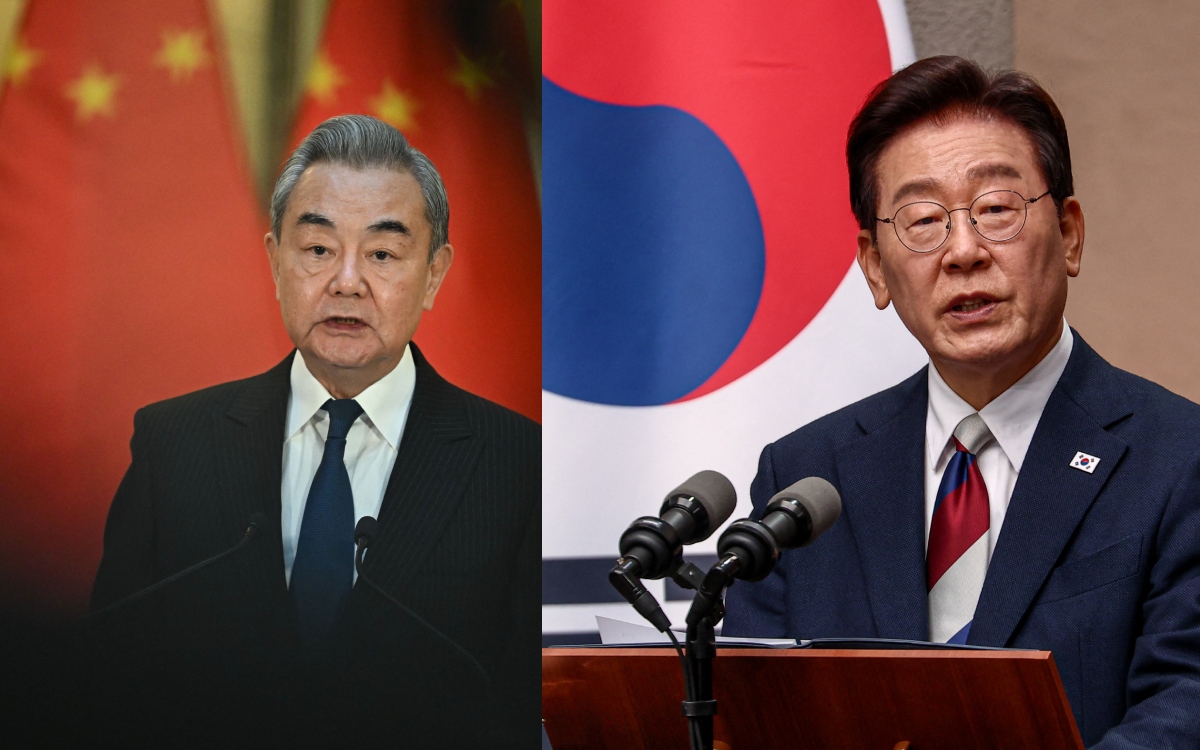
Chinese Foreign Minister Wang Yi is set to meet South Korean President Lee Jae Myung in Seoul this week, as Washington renews efforts to engage Pyongyang, one of Beijing’s key allies.
The Chinese official’s visit is set to take place over two days, on Wednesday and Thursday, after U.S. President Donald Trump claimed North Korean leader Kim Jong Un had responded to his recent overtures and praised his relationship with Kim. China, Washington’s chief geopolitical rival, is a key diplomatic and economic backer of North Korea while also remaining the South’s largest trading partner.
“President Lee will discuss the future direction of South Korea-China relations and the regional situation and convey his greetings to Chinese President Xi Jinping,” Seoul’s presidential Blue House said in a statement. Wang will also hold talks and have lunch with National Security Adviser Wi Sung-lac and meet Foreign Minister Cho Hyun, the statement said. Wang and Wi will discuss South Korea–China ties and regional and global issues, including “the situation on the Korean Peninsula,” it added. Asked by reporters about the visit, China’s foreign ministry declined to confirm any plans.
The developments come after Trump announced on Sunday he ordered the Pentagon to scale back “inappropriate and hostile” military drills with South Korea, alarming U.S. allies in the region. At the weekend, Lee proposed talks with the North to end the Korean War.
Wang Yi’s visit highlights South Korea’s increasingly delicate position between Washington and Beijing, as both powers seek greater influence over the Korean Peninsula. Trump’s willingness to reduce military drills with Seoul and his renewed outreach to Kim Jong Un could create diplomatic space for inter-Korean engagement, but it may also raise concerns in Seoul about the reliability of the U.S. security commitment.
The scheduled meeting comes amid raised tensions in the region, after Russia rebuked Japan’s ambassador for “anti-Russian statements” over Tokyo’s criticism of Russian President Vladimir Putin’s visit to the disputed Kuril Islands.
At the same time, China’s economic importance to South Korea and its influence over North Korea make Beijing an indispensable actor in any effort to reduce tensions. The timing of Wang’s visit therefore suggests that Seoul is seeking to preserve strategic flexibility by maintaining communication with both major powers, while positioning itself to play a more active role in shaping the future of the Korean Peninsula. (AFP)