
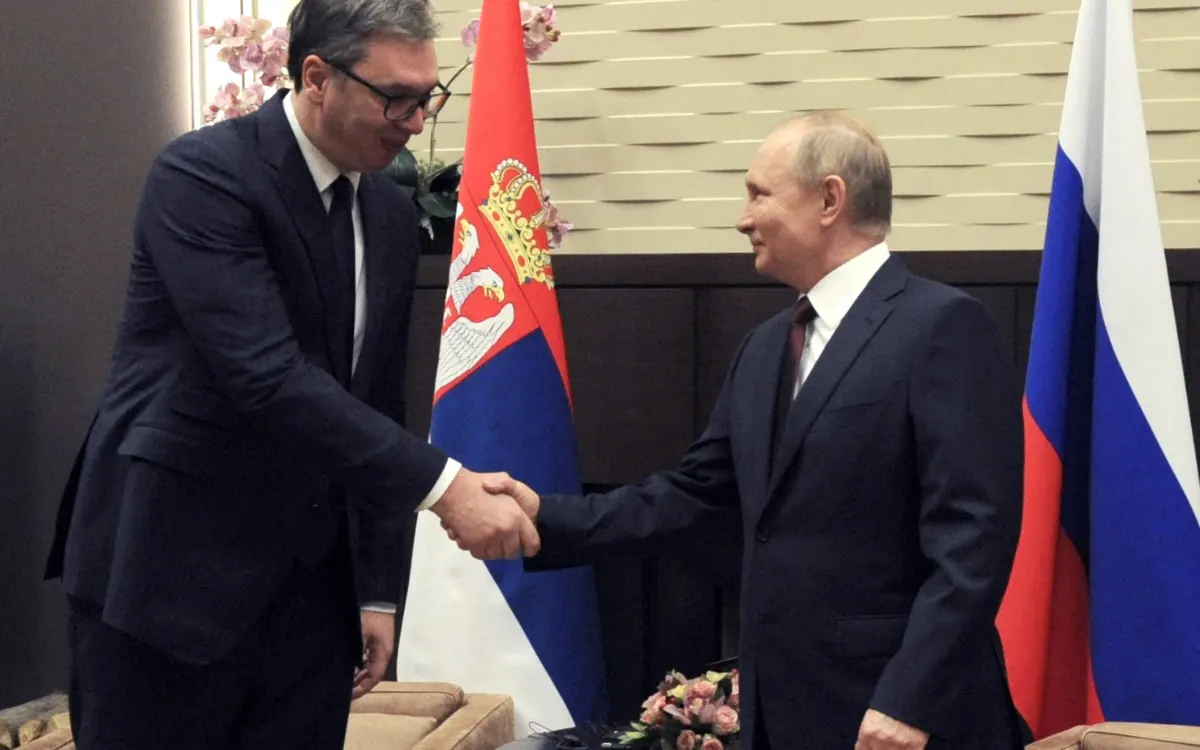
Aleksandar Vucic’s resignation on September 27 was widely read as an attempt to carry personal rule past a constitutional limit. The Serbian strongman is angling for the premiership after running out of presidential terms. The switch follows the logic of Vladimir Putin’s move into the premiership in 2008 but reverses its institutional direction. Vucic is heading back from a formally weak presidency to the office he left in 2017, where Serbia’s constitution places real executive power.
The electoral calendar is on his side. Serbians elect a parliament first and a president later, and in the interval the presidency passes to the speaker of parliament, an office Vucic’s party currently holds. If a new majority forms a government quickly, he could enter the premiership before the presidential contest produces a rival nationwide mandate.
The move carries a political risk far sharper than the one Putin faced in 2008. For nine years Vucic could leave the damage of a crisis to his prime ministers, as he did when Milos Vucevic stepped down in January 2025. The premiership would bring him greater formal executive power but strip away the political insulation the presidency provided.
The premiership would bring him greater formal executive power but strip away the political insulation the presidency provided
The closer precedent is Armenia in 2018, where an office swap attempted under street pressure collapsed within days. Serbia has not reached that point, but its protest movement now competes as an electoral list backed by much of the established opposition. The available polling is too divergent to treat the parliamentary contest as settled. Even if Vucic returns as prime minister after October 25, the presidential election due by late December presents a second institutional test.
An Office Swap in Reverse
Vucic left the presidency eight months before his second term would have ended. The constitution bars him from a third presidential term but does not bar him from heading the government. He now leads the ruling coalition’s list, “Aleksandar Vucic – United Serbia,” as its candidate for prime minister in the snap parliamentary election of October 25.
The obvious reference is 2008. Putin, unable to seek a third consecutive term, moved into the prime minister’s office while Dmitry Medvedev became president, and returned to the Kremlin four years later. Yet Putin moved from Russia’s overwhelmingly dominant presidency into a formally subordinate premiership. Vucic, by contrast, is heading back into the office that Serbia’s constitution makes the holder of executive power, with the prime minister charged with directing the government’s work. The president represents the state and commands the armed forces. He nominates the candidate for prime minister and may send a law back to parliament, but only once. The presidency, however, was never designed to run the government. After Vucic moved into it from the premiership in 2017, it became the center of Serbian politics, because political authority moved with him. Freedom House downgraded Serbia to “Partly Free” in 2019, citing, among other factors, his de facto accumulation of executive powers in conflict with his constitutional role.
The constitutional texts deepen the contrast with Moscow. Russia’s 1993 constitution barred the same person from holding the presidency for more than two terms in a row, and that qualifier carried the entire arrangement of 2008. A single term outside the Kremlin was enough to restore Putin’s eligibility, which he used in 2012. Eight years later, the constitutional amendments of 2020 reset his count altogether. Serbia’s constitution offers no such possibility. Under Article 116, no one may be elected president more than twice, a lifetime limit that closes the office to Vucic under the current constitution. Where Putin’s move into the government ultimately proved to be an interlude, Vucic’s is final. His formal power now depends on a parliamentary majority for as long as he wants to exercise it.
Where the Putin Comparison Holds
What the two cases share is a political logic. In personalized systems, authority gathers around individuals, while constitutions can only regulate offices. A term limit may therefore remove a leader from his post and leave his power largely intact.
In personalized systems, authority gathers around individuals, while constitutions can only regulate offices. A term limit may therefore remove a leader from his post and leave his power largely intact
Putin solved that problem through a loyal successor and an accepted understanding of where ultimate authority lay. Medvedev held the presidency’s considerable powers, while Putin kept his place at the center of the governing elite and took the chairmanship of United Russia, the Kremlin’s “party of power.” Vucic has built a comparable structure around the Serbian Progressive Party (SNS). Since 2012, he has served as first deputy prime minister, prime minister, and president. The name of his electoral list makes the personalization explicit. The October 25 vote is at once a parliamentary contest and a plebiscite on whether he can renew his mandate in another office.
Putin executed his maneuver from a position of overwhelming control. United Russia held 315 of 450 Duma seats after the December 2007 election, organized opposition had been pushed to the margins, and Medvedev’s succession presented little institutional uncertainty. Vucic is changing offices in the face of a protest movement that has now lasted almost two years. In November 2024, the collapse of a concrete canopy at Novi Sad railway station killed 16 people. The disaster turned accumulated grievances over corruption and accountability into the most sustained challenge of his rule. Student-led demonstrations spread across the country and made early elections their central demand. The government held out for months, but the protests ultimately forced an early vote.
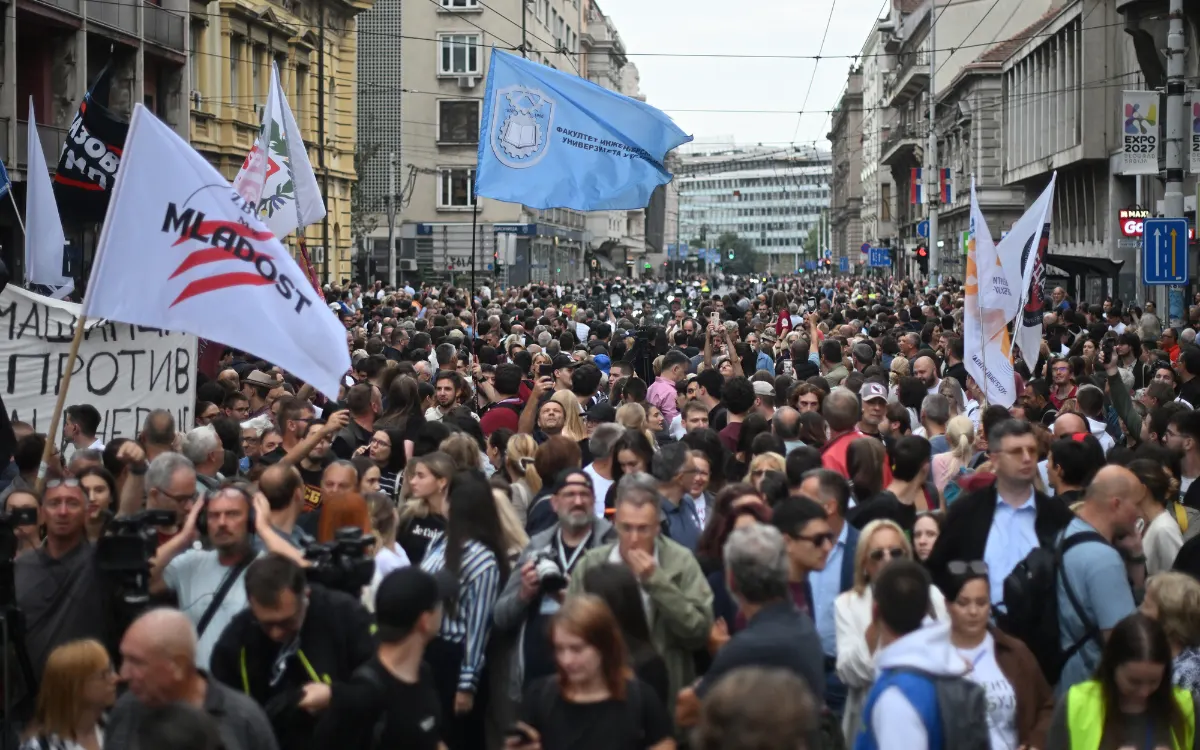
The constitution shapes that sequence in his favor. As speaker, Ana Brnabic became acting president the day after Vucic’s resignation. She may hold the office for no more than three months, and the presidential election must take place within that period. Once the new assembly convenes, its own speaker assumes the acting presidency. An acting head of state may propose a candidate for prime minister but must promulgate every law parliament adopts, without the right to return it. If the SNS and its partners secure a majority, a speaker from their ranks would nominate the prime minister, and the presidency would impose no institutional check. A swift formation of the cabinet could place Vucic in the premiership before the presidential election. Protracted coalition talks would narrow or close that window. The constitution allows 90 days from the new assembly’s first session before a failure to elect a government forces fresh elections.
Since 2017, the presidency has allowed Vucic to dominate politics while governments carried formal responsibility. When the Novi Sad crisis escalated, it was the prime minister who went, and Djuro Macut, a professor of medicine, who took over in April 2025. As prime minister, Vucic would lose that insulation. He would answer to parliament, face votes of confidence, and tie the government’s performance directly to his own office.
Serbia’s next head of state will be directly elected, and Vucic can support a loyal candidate but cannot appoint one. An opposition-backed president could not govern, but a direct national mandate would lend weight to every returned law and every nomination. Serbia would also be represented abroad by a voice the government does not control. State institutions have not competed with one another in earnest since the SNS came to power in 2012.
Serbia would also be represented abroad by a voice the government does not control. State institutions have not competed with one another in earnest since the SNS came to power in 2012
The Armenian Warning
For an office swap under political pressure, Armenia in 2018 is the more instructive comparison. After two presidential terms, Serzh Sargsyan oversaw constitutional changes that transferred much of the presidency’s authority to the premiership. Parliament elected him prime minister in April 2018. Mass demonstrations led by Nikol Pashinyan forced his resignation within a week. What had been designed as institutional continuity became the grievance around which the opposition crystallized. Unlike Sargsyan, Vucic has not rewritten the constitution for himself, and he is asking voters for a fresh mandate instead of relying on a legislature elected a year earlier.
From Protest Movement to Political Alternative
The protest movement drew its strength from rejecting established party politics, mobilizing citizens who distrusted both the government and the traditional opposition. Its list, “Student List – Students Win,” fields 250 candidates from academia, medicine, culture, and business, headed by cardiologist Ilija Srdanovic. The Democratic Party, the Green-Left Front, and other opposition parties have forgone their own lists to support it. European Serbia, a coalition led by the Party of Freedom and Justice, is running separately.
The list’s constituency spans sharply different positions on Kosovo, the EU, Russia, and China. Such breadth helps a movement defined by what it opposes but will be tested the moment it has to govern. The SNS works the other way around. It is centralized, reaches across the country through the state apparatus and the media it dominates, and has built this campaign, like every one before it, around Vucic.
Polling offers no reliable baseline. A June survey by the election monitor CRTA and Stanford University’s Democracy Action Lab put the Student List ahead of the SNS by nine points among decided voters. A Faktor Plus poll from mid-September showed Vucic’s list leading by 11.5 points.
External Constraints
Brussels has considerably more structural leverage over Belgrade in 2026 than it had over Moscow in 2008. The EU accounted for 58.3 percent of Serbia’s foreign trade in 2025 and for more than half of the foreign direct investment Serbia received between 2010 and 2024.
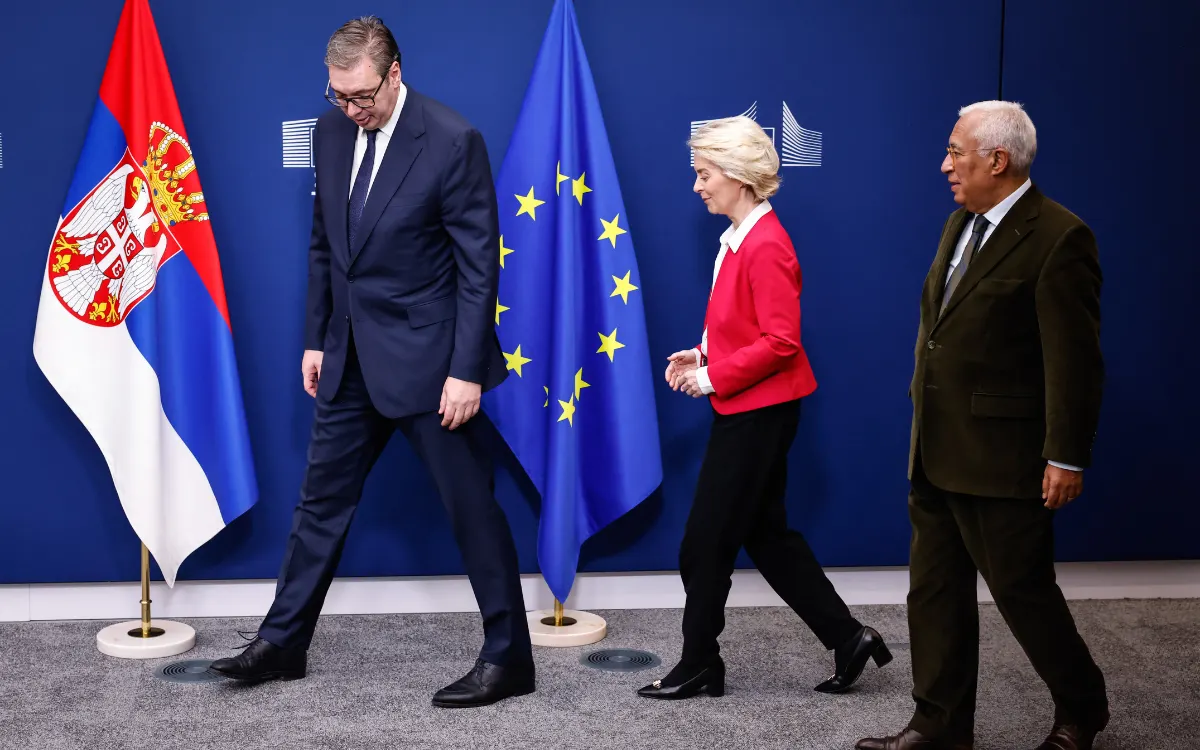
Relations have deteriorated sharply all the same. In July, eight member states blocked the opening of the next accession cluster, citing the rule of law and Belgrade’s refusal to align with EU sanctions against Russia. Ratko Mladic, convicted of genocide at Srebrenica, died in The Hague in late August. In September, a government aircraft flew his body to Belgrade, where he was buried with military honors in the presence of senior government officials. Enlargement Commissioner Marta Kos canceled her planned visit over the tributes, and Ursula von der Leyen and Antonio Costa jointly condemned the funeral images as shocking. The cluster remains blocked, and recent developments have further reduced the prospect of an early breakthrough.
Vucic’s foreign policy has long rested on balance: an EU accession perspective alongside close ties to Moscow, extensive Chinese investment, and, more recently, a strategic dialogue with Washington. The energy pillar of that balance is already giving way. NIS, the operator of Serbia’s only oil refinery, is majority owned by Gazprom Neft and a Gazprom-linked company. U.S. sanctions have effectively forced the Russian owners to seek a sale. Hungary’s MOL signed a binding heads of agreement in January to acquire their stake, but the transaction remains subject to a final agreement and U.S. approval.
Vucic’s foreign policy has long rested on balance: an EU accession perspective alongside close ties to Moscow, extensive Chinese investment, and, more recently, a strategic dialogue with Washington
Strategic Implications
Belgrade sits at the center of most of the region’s unresolved disputes, which gives the outcome weight far beyond Serbia. For the EU, it forces a choice that Brussels has put off for years. Pressure during the campaign risks being cast in Belgrade as interference and could strengthen the government it is meant to discipline. Restraint after the Mladic funeral would reinforce a suspicion, voiced by many in the protest movement, that Brussels values stability in Belgrade above democratic standards.
For the region, a consolidated Vucic would retain the freedom to use Serbia’s influence over Republika Srpska and the Serb community in Kosovo as bargaining assets with Brussels and Washington. Cohabitation would complicate that practice, since an opposition president could contest it in public. A change of government would open it to revision, although the Student List’s heterogeneous base offers no guarantee of a different line on Kosovo.
For Moscow, the sale of NIS would remove its most tangible instrument of influence in Serbia. That would raise the value of political continuity in Belgrade. Once the economic levers are gone, a government that refuses to align with EU sanctions and keeps channels to the Kremlin open matters more to Russia. Hungary gains weight in the same process. If MOL takes control of NIS, which dominates Serbia’s fuel market, it will hold a position that any government in Belgrade will have to reckon with.
Relevant Future Scenarios
Consolidation
The SNS and its partners win a majority, Vucic becomes prime minister, and a candidate from his camp wins the presidency. Formal and informal authority would again point in the same direction, now with Vucic in the office that holds executive power. The protest movement would remain capable of mobilization, but the institutions of government would stay with the governing bloc.
Cohabitation
Vucic becomes prime minister, but an opposition-backed candidate wins the presidency. Serbia would acquire a divided executive for the first time in the SNS era. The president could not dictate policy but would hold a direct national mandate and considerable domestic and international visibility. Vucic would keep the government while losing the claim to speak for the whole state.
Transition
The SNS fails to assemble a majority, and a coalition built around the Student List forms a government. Vucic’s early resignation would then have ended his presidency without securing the premiership. The new majority’s immediate problem would be governing coherence among groups united mainly by opposition to the existing order.
Contested transition
A narrow or disputed result produces credible allegations of irregularities, and neither side accepts that the contest has been settled. Much would then depend on the electoral administration and the courts, more still on police restraint and the opposition’s discipline in the streets. Brussels’ response would shape how long the crisis lasted.
Vucic’s resignation asserts control, yet it also concedes that the political arrangement of the past nine years has reached its constitutional limit. Putin rotated offices within a system already consolidated around him; Vucic is attempting the same maneuver while facing sustained domestic resistance and growing friction with Serbia’s principal economic partner.
The paradox is that returning to the premiership could give Vucic greater formal power while also making his rule more vulnerable: government failures would become his failures, parliamentary challenges could threaten him directly, and an independently elected president could acquire a competing national mandate.
The broader test is not simply whether Vucic can remain in power, but whether the political system can transfer him between institutions without exposing the weaknesses that personal rule was previously able to conceal. Putin could afford to weaken his office because his power extended beyond it; Vucic is moving into a stronger office partly because the durability of his power outside it is now being tested.
Putin could afford to weaken his office because his power extended beyond it; Vucic is moving into a stronger office partly because the durability of his power outside it is now being tested