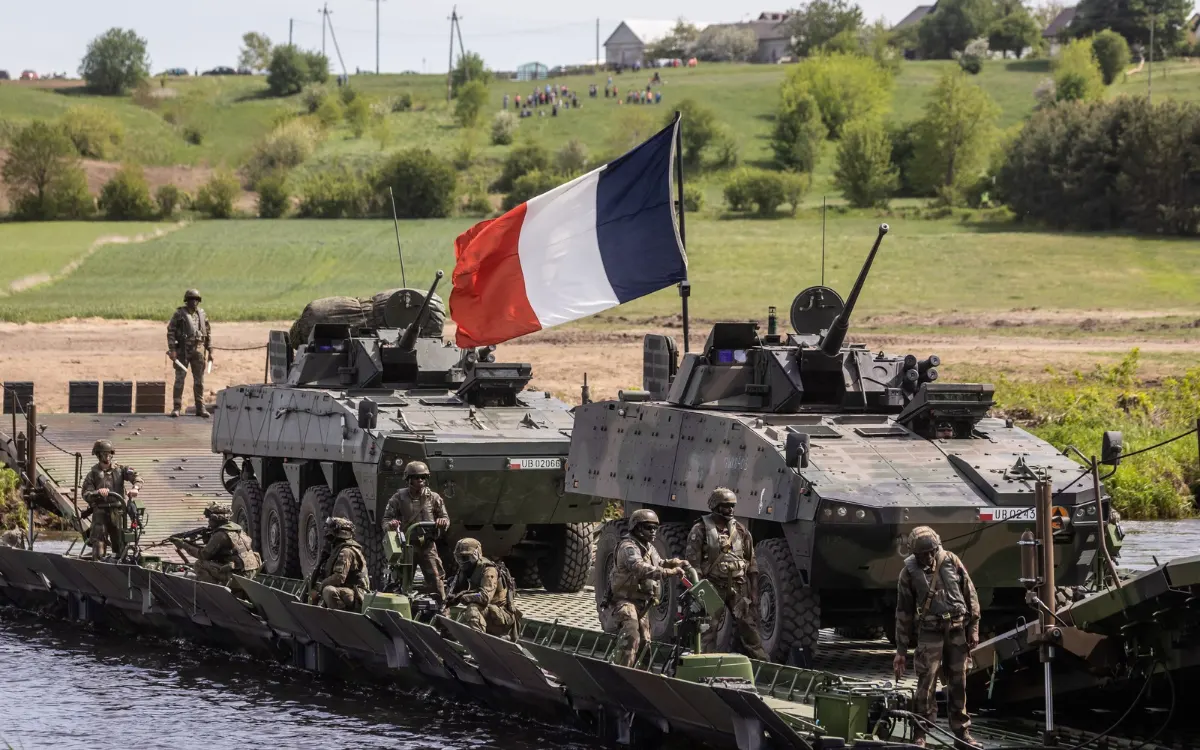
Europe’s plan to secure a postwar Ukraine rests mostly on French soldiers. When Exercise Koalicja opened in southeastern Poland on November 9, France supplied 1,100 of roughly 2,800 troops. Britain, which co-leads the Multinational Force Ukraine, sent 300. Germany sent about ten staff officers. The exercise was meant to show that the force is ready to deploy once a ceasefire holds. Its numbers also expose a weakness. A guarantee carried by one country is only as durable as that country’s next government, and France chooses a new president in April and May 2027.
Paris holds two commitments that are easy to conflate. One is its share of the reassurance force for Ukraine. The other is Macron’s offer to extend French nuclear deterrence to European partners, which critically does not cover Ukraine. No treaty anchors either, and both rest on presidential authority.
Two of the leading candidates to succeed Macron would make French troop commitments conditional on a UN mandate that Russia could veto. The front-runner, Marine Le Pen, would also tie the nuclear offer to purchases of French weapons. Moscow can read that calendar as well as anyone. Europe must now show whether its commitments to Ukraine can outlive the president who made them.
The front-runner, Marine Le Pen, would also tie the nuclear offer to purchases of French weapons. Moscow can read that calendar as well as anyone. Europe must now show whether its commitments to Ukraine can outlive the president who made them
A Security Architecture Anchored in Paris
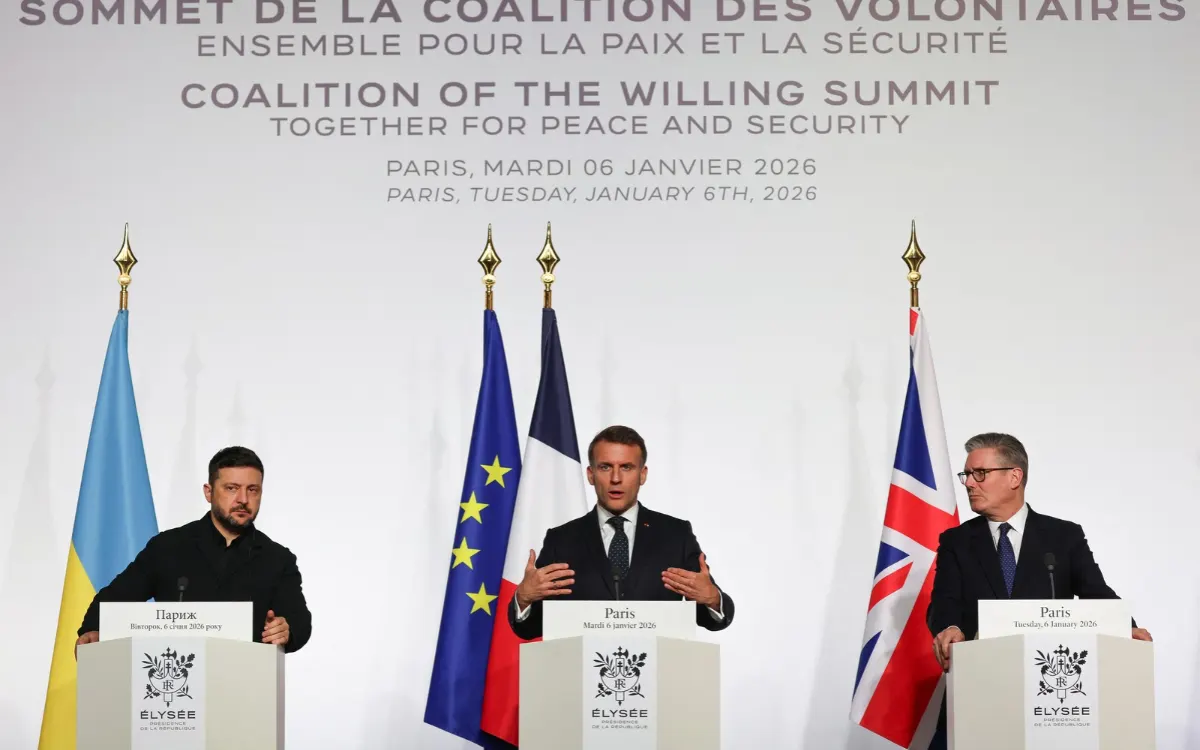
The guarantee’s military machinery is becoming institutional, but its political obligations remain personal, and the heaviest of them are French. A summit of more than 30 countries adopted its framework, the Paris Declaration, at the Élysée Palace on January 6. Its components range from U.S.-led ceasefire monitoring and support for Ukraine’s armed forces to a multinational force and assistance against any future Russian attack.
The same day, Britain and France signed a declaration of intent with Ukraine to deploy forces there, and the machinery has hardened since. Coalition leaders declared the MNF-U ready to operate at a Paris summit in July. Command of its standing headquarters rotates between the two lead nations, and Lieutenant General Tom Bateman, a Briton, took over from a French general that month.
The political obligations are thinner. Signatories declared themselves ready to commit to politically and legally binding guarantees, activated once a ceasefire enters into force and applied under each state’s constitutional arrangements. Crucially, the final text also dropped a draft clause recording a U.S. commitment to support the force if attacked. No treaty underpins the coalition, so its guarantees remain political undertakings by the governments that made them.
Kyiv has pressed for more. In 1994, it agreed to surrender the Soviet nuclear arsenal on its soil in return for the Budapest Memorandum’s assurances, which failed to deter Russia. After the summit, President Volodymyr Zelensky said only legal guarantees backed by parliaments, including the U.S. Congress, would settle what partners would do if Russia attacked again. A guarantee that depends on who wins in Paris offers Kyiv a weaker version of the assurance it already lost once.
Within that frame, France is the indispensable contributor. France hosts the headquarters and proposed the Koalicja exercise, as Chancellor Friedrich Merz acknowledged in July. Macron told party leaders on January 8 that several thousand French soldiers could deploy after a ceasefire, far from the front. Mathilde Panot, who leads the La France Insoumise group in the National Assembly, put the figure at about 6,000.
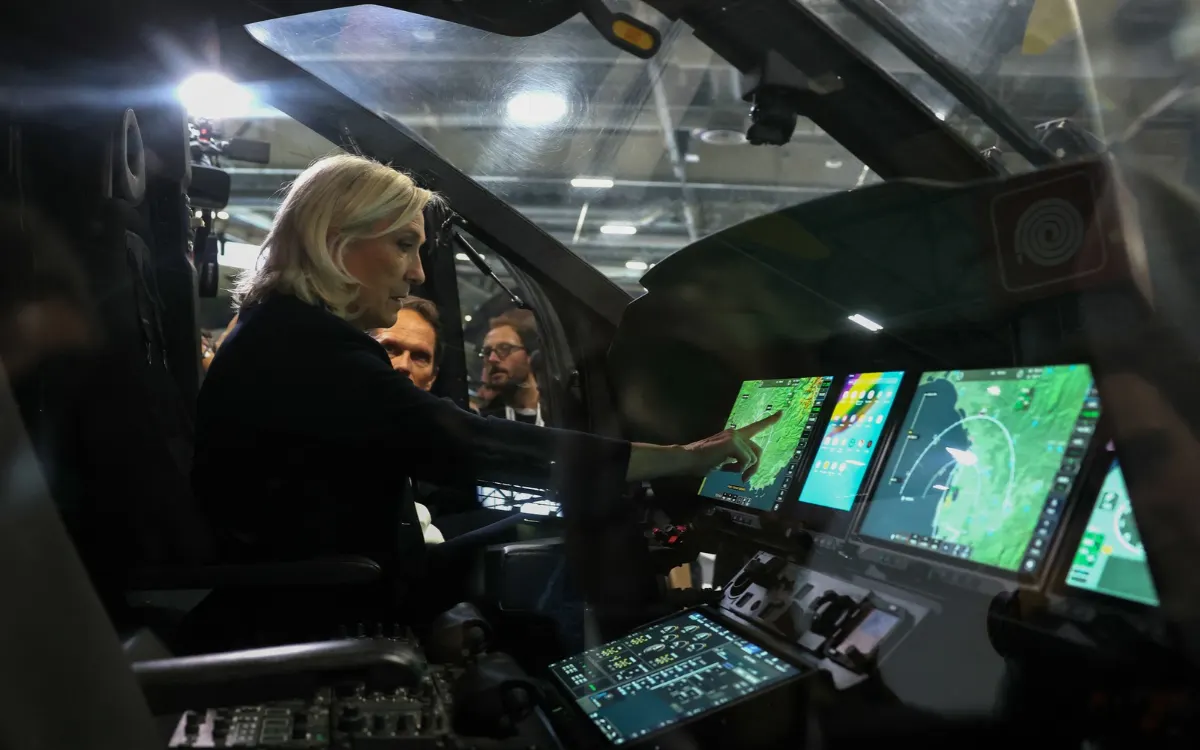
Macron’s nuclear initiative is a separate commitment, but equally personal. In a March 2 speech at the Île Longue submarine base, he offered European partners what he called forward deterrence, including temporary deployments of nuclear-capable aircraft on their territory. He excluded any sharing of the final decision, its planning, or its execution. Ten partners had joined by September. But Ukraine is not among them, and France offers no formal guarantee comparable to American extended deterrence. The guarantee concerns Ukraine’s security after a ceasefire, while forward deterrence concerns the security of France’s European partners, several of whom also took part in Koalicja. Both commitments will pass to Macron’s successor, who will be free to narrow or withdraw them.
The future of France’s security guarantees and forward nuclear deterrence will pass to Macron’s successor, who will be free to narrow or withdraw them
Unreliable Money, Revocable Mandates
France can afford its military role on paper, but a divided parliament leaves the funding and any deployment exposed. On July 1, the National Assembly passed the updated military programming law, France’s multiyear defense plan, by 375 votes to 113. It raised planned spending to €436 billion between 2024 and 2030. Yet the law binds no annual budget, and a National Rally (RN) deputy, Laurent Jacobelli, called it “a law for seven months.”
The fiscal frame is weaker still. The 2027 draft budget allocates more than €63 billion to the military, roughly double the 2017 level, but projects a larger state interest bill of €72.9 billion. The government seeks a €54 billion effort to cut the deficit from 5.4 percent of GDP to 5 percent.
On November 4, the Assembly rejected the budget’s revenue section by 458 votes to none, reviving the risk of a frozen budget. France entered 2025 and 2026 under special laws that rolled over the previous year’s appropriations.
A third special law would cap 2027 defense appropriations at 2026 levels and freeze €6.5 billion. Catherine Vautrin, the armed forces minister, says that would halt the military’s strategy for investment, readiness, and training. The guarantee’s chief contributor would be signaling retrenchment just as a ceasefire might require it to deploy.
Meanwhile, operational demand is rising. The Iran war has drawn French Rafale fighters and air-defense systems to the Gulf. In September, Macron announced soldiers and radars for Saudi Arabia’s Red Sea oil hub at Yanbu. Rotating thousands of troops through Ukraine would compete with those missions and with other aspects of France’s role on NATO’s eastern flank.
Parliament’s leverage over deployments comes later and is weaker than its grip on the budget. The 1958 constitution makes the president head of the armed forces, and only a 2008 revision gave parliament a say over operations abroad. Under the resulting Article 35, the government must inform parliament within three days of a deployment and seek its authorization to extend one beyond four months.
That sequence exposes a force meant to enter Ukraine after the fighting stops. A president can send troops without a prior vote. Once they are in place, an Assembly in which the RN is the largest group could refuse to extend the mission. Allies and Moscow alike would know that the French contingent’s mandate lapses after four months unless parliament renews it.
A UN Mandate Moscow Can Veto
The 2027 field splits over the guarantee, and its clear front-runner is a skeptic. An Ifop poll published on November 3 put the RN’s Le Pen, who was cleared to stand by an appeals court in July, at 35 to 37 percent. Jean-Luc Mélenchon of La France Insoumise was second with about 18 percent, having moved back ahead of the former prime minister Édouard Philippe.
Le Pen’s stance is the most consequential. At Macron’s January briefing, she demanded that any deployment carry a UN mandate, and in October she pledged to end French financial aid to Ukraine within six months of taking office. When Macron unveiled forward deterrence, she and party president Jordan Bardella cast the concept as dispersing the country’s nuclear assets across European territory.
She has added a commercial condition. Partners seeking France’s nuclear protection should buy its equipment, she has said, calling it a contradiction to base French nuclear weapons in countries buying the American F-35. Eight of the nine non-nuclear partners in forward deterrence fly or have ordered that aircraft. Applied literally, the condition would empty the offer of most of its participants.
Mélenchon arrives at a similar position from the opposite pole. His program would take France out of NATO altogether and confine its deployments abroad to UN-mandated operations. Le Pen would leave the integrated command but not the alliance, as Charles de Gaulle did in 1966. If the current top two reached the runoff, no candidate would be committed to the guarantee as designed.
Their shared mandate condition is the decisive detail. A UN Security Council mandate would give Moscow a veto over France’s role, and the more capable the proposed force, the less likely Russia would be to grant it.
A UN Security Council mandate would give Moscow a veto over France’s role, and the more capable the proposed force, the less likely Russia would be to grant it
By contrast, Philippe and Raphaël Glucksmann, who won the Socialist-led primary in October, are likely to keep both commitments intact. Philippe backed a European deployment after the war when he visited Kyiv in May. Glucksmann’s program would extend France’s deterrent across the EU, with the decision to use it remaining French.
Why Moscow Can Afford to Wait
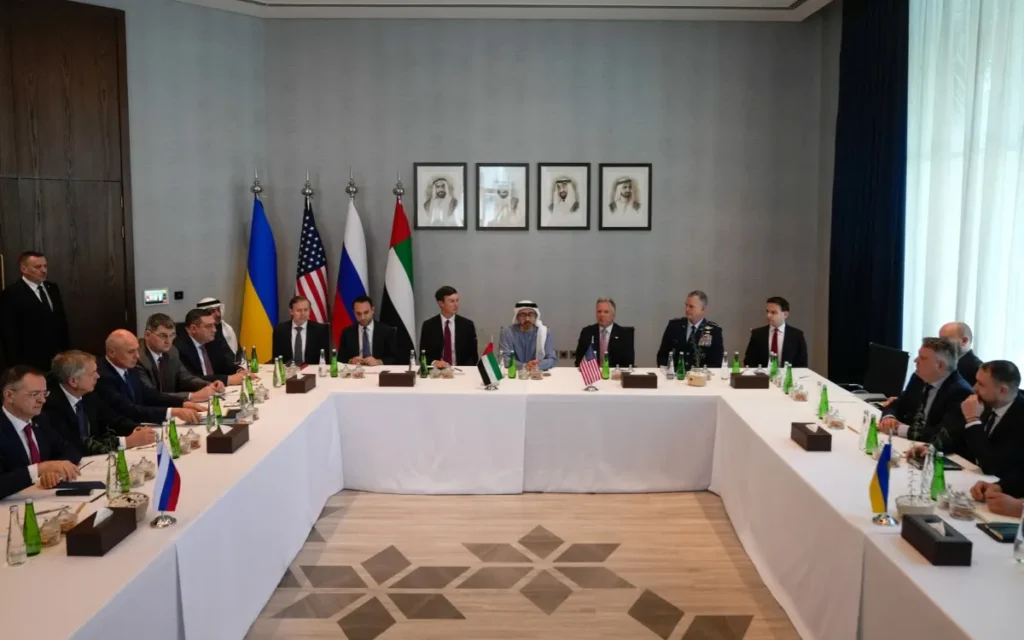
Russia has the leverage and the incentive to wait out the French calendar. Two days before Koalicja opened, its foreign ministry declared any troops sent to Ukraine a legitimate target. U.S.-brokered talks in Abu Dhabi on November 10 and 11, the first since February, yielded only an agreement on a prisoner exchange. When U.S. envoys met Vladimir Putin in Moscow the next day, he again rejected foreign peacekeepers.
The guarantee’s design lets Moscow decide when it takes effect. The MNF-U deploys only after a “credible cessation of hostilities,” which requires Russian consent. The war’s longest truce, a localized ceasefire around Oleshky in the Kherson region, ended on November 1 after Moscow declined to extend it.
That control lowers the cost of delay. If a ceasefire comes after May 2027 and a new president demands UN Security Council authorization, the guarantee loses its core without Russia conceding anything. Alternatively, the Kremlin can hold out for terms that exclude foreign troops, wagering that a different French president would accept them.
Alternatively, the Kremlin can hold out for terms that exclude foreign troops, wagering that a different French president would accept them
Russia can also try to influence the vote. France’s VIGINUM agency, which tracks foreign digital interference, attributed a February disinformation campaign against Macron to the Russian-linked Storm-1516 network. Russian-linked campaigns of limited reach have since targeted Philippe, Glucksmann, and former prime minister Gabriel Attal.
Delay carries costs, and the wager is uncertain. The talks reopened amid mounting pressure on Russia’s wartime economy. In September, Le Pen and Bardella warned Moscow that no provocation or destabilization campaign would steer French foreign policy. Le Pen has argued that ending financial aid need not stop France from training Ukrainian soldiers.
Even so, deterrence rests on expectations, and the possibility of a French reversal discounts the guarantee before any vote is cast. A force whose leading contributor may change course within months gives Moscow little reason to accept, before May, a ceasefire that admits it. Forward deterrence carries the same discount, since Moscow can treat the nuclear offer as provisional until it survives the election.
The Limits of Substitution
No partner can replace France without turning the guarantee into a smaller, different instrument. Britain, the obvious substitute, already holds the MNF-U command but has a smaller army and stretched finances. Its October 28 Budget filled a €5.6 billion gap in the Defence Investment Plan and set 2030 as the date for reaching 3 percent of GDP. How to pay for that awaits next year’s spending review.
London faces a similar exposure on a later timetable. Andy Burnham replaced Keir Starmer as prime minister in July, after John Healey quit as defense secretary over funding. A general election is due by August 2029. Nigel Farage, whose Reform UK led national polls for some 18 months before Burnham’s arrival, opposes a long-term deployment. In January, he said Britain could manage “six or eight weeks.”
Germany has fiscal depth but a different constitutional logic. Any armed deployment abroad requires a mandate from the Bundestag, Germany’s parliament, and the option Merz has floated publicly is a presence on NATO territory neighboring Ukraine. Berlin’s modest role at Koalicja, which it joined only after first signaling it would stay out, reflects that caution.
That logic mirrors France’s in reverse. Parliamentary approval is slower to obtain in Berlin than a presidential decision in Paris, but it effectively binds a majority to the mission. German troops on the ground would make the guarantee more durable, yet sending them is a choice Berlin has so far deferred.
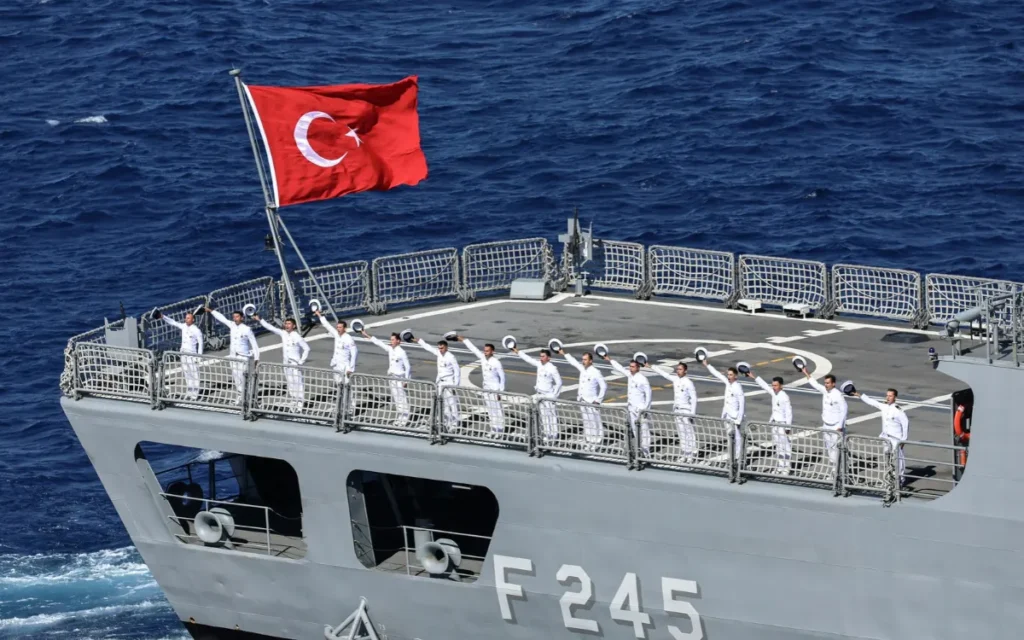
Other partners fill niches. Poland rules out sending troops into Ukraine and serves as the logistics hub. Turkey leads the maritime component from Istanbul, and the Netherlands sent several hundred soldiers to Koalicja.
Washington contributes no troops but has reopened the guarantee’s terms. After calling for a new European security framework in Abu Dhabi, its envoys floated NATO membership for Ukraine in return for the Donbas region, according to Zelensky. Russia’s foreign ministry says the idea was not discussed in Moscow. Whatever its fate, the episode shows how a U.S.-brokered bargain could redefine the guarantee before it is ever deployed.
A coalition without France could still train Ukrainian forces, police the air from NATO territory, and clear Black Sea mines. It would struggle to keep a substantial presence on Ukrainian soil, the element that gives a reassurance force its deterrent value.
The nuclear offer has no substitute at all. Britain, the only other nuclear power among France’s European allies, assigns its deterrent to NATO and relies on American-supplied Trident missiles. It cannot replicate a French offer built to work outside NATO’s nuclear planning structure.
Outlook to May 2027
The five months between the coalition’s Berlin summit on November 19 and the first round of France’s presidential election on April 18 will test whether leaders’ pledges can be institutionalized. A budget passed on time in Paris would protect France’s planned defense increase. Bundestag and other parliamentary mandates before a ceasefire would widen the guarantee’s political base. A first ratification of binding texts would show whether legislatures are prepared to own it.
A ceasefire before the French vote looks unlikely, and Washington’s NATO-for-Donbas idea runs into a Russian red line, so the force will probably face the election undeployed. A Le Pen or Mélenchon victory would most likely confine France to roles needing no UN mandate, at most training Ukrainian forces outside the country. A Le Pen presidency would also test forward deterrence, since her purchasing condition would disqualify most of its current partners. The coalition could survive, but as a smaller force led by Britain, with Berlin pressed to commit ground troops. Such a shift would weaken Europe’s claim to manage its own security with less help from Washington.
A Philippe or Glucksmann presidency would likely keep both commitments without curing their weakness, since each would remain exposed to every budget vote and change of majority in Paris. The lesson reaches beyond France. Faced with uncertain American backing, European governments have relied on national pledges, and national pledges move with national elections.
That at once makes France Europe’s anchor and its greatest exposure. Until national parliaments ratify the guarantee and France’s forward-deterrence initiative rests on more than one president’s word, both will be worth only as much as the next French vote. Europe has built the frame of a guarantee faster than the commitments needed to hold it up, and Moscow can see which beam carries the load.
That at once makes France Europe’s anchor and its greatest exposure. Until national parliaments ratify the guarantee and France’s forward-deterrence initiative rests on more than one president’s word, both will be worth only as much as the next French vote