
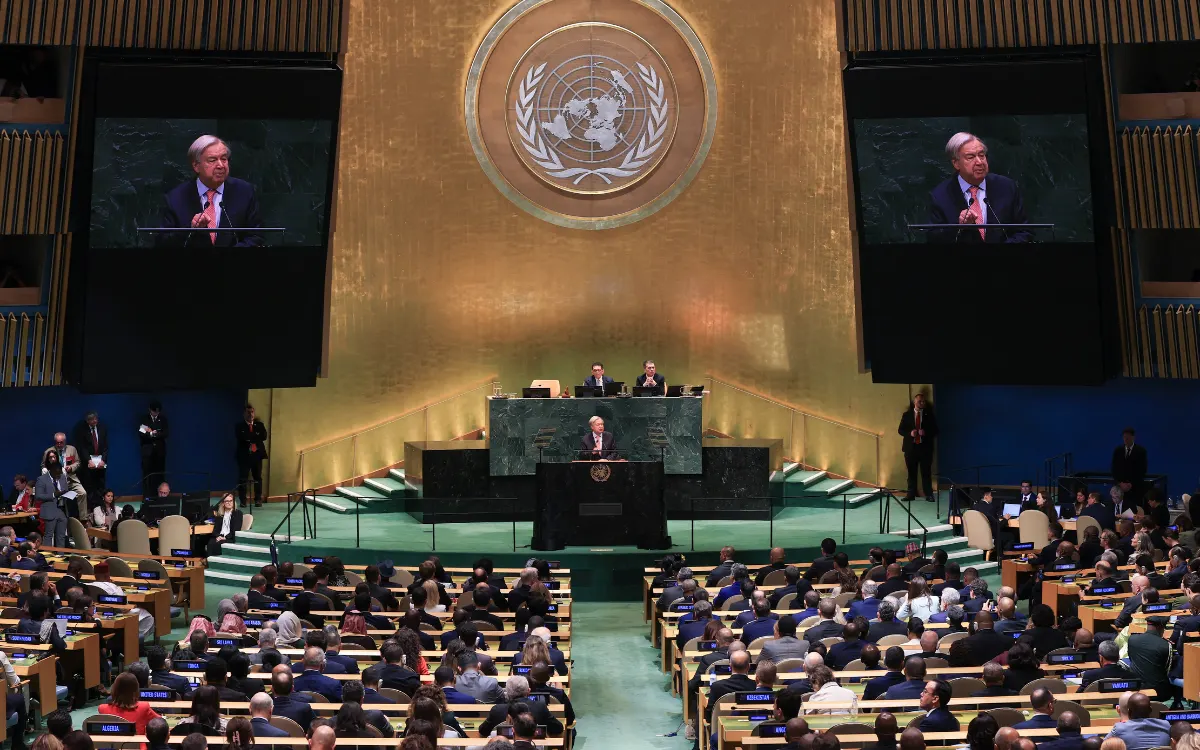
World leaders opened the United Nations General Debate in New York on Tuesday with the U.S.–Iran war and widening tensions across the Middle East set to dominate diplomacy on the sidelines of the gathering.
Nearly 130 heads of state and government are expected to attend the high-level week, with Iranian President Masoud Pezeshkian among the leaders arriving in New York. His visit makes him the highest-ranking Iranian official to travel to the United States since the war began in February, as disruption in the Strait of Hormuz and renewed fighting involving Iran-aligned Houthis in Yemen increase pressure for a diplomatic breakthrough. President Donald Trump is also due to meet leaders from the six Gulf Cooperation Council states on Tuesday, with the Iran conflict and regional security expected to feature prominently in their discussions.
“This is not 1945,” General Assembly President Khalilur Rahman said as the 81st session opened earlier this month, arguing that the international system must adapt to contemporary geopolitical challenges and shifts in power.
The gathering comes as the conflict with Iran increasingly overlaps with renewed fighting in Yemen. The Houthis have expanded their position along Yemen’s Red Sea coast and intensified pressure on Saudi Arabia, while the G7 foreign ministers used talks in New York to demand an end to Houthi attacks and call on Iran to stop supporting the group. The escalation has increased concern over shipping through Bab al-Mandab at a time when traffic through the Strait of Hormuz has already been severely disrupted.
The convergence of Pezeshkian’s visit, Trump’s talks with Gulf leaders, and diplomatic activity over the Houthis gives this year’s General Assembly an immediate test beyond the speeches in the chamber. With two critical Middle Eastern maritime routes under pressure, the meetings in New York could help establish whether the parties see room for diplomacy or remain focused primarily on managing an expanding regional conflict. (EIR)