
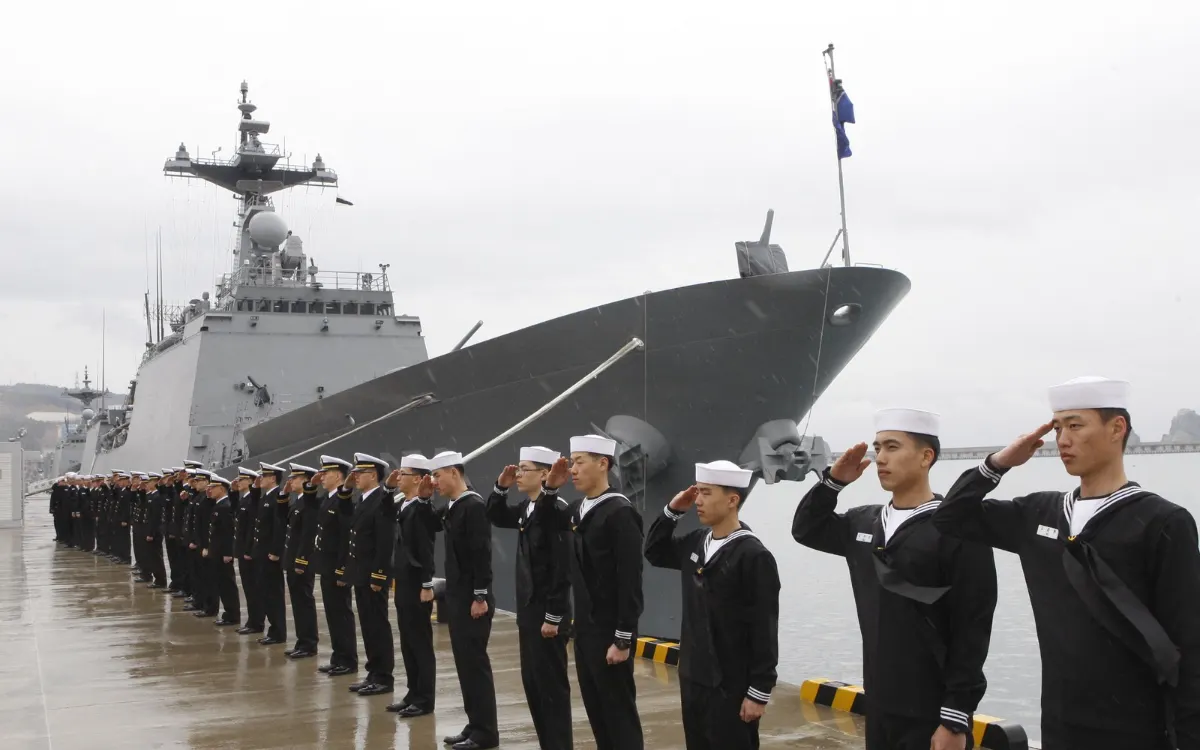
South Korea announced Thursday that it would expand its naval operations toward the Strait of Hormuz, deploying maritime surveillance and mine-disposal capabilities to protect commercial shipping without joining the U.S.–Iran war. The decision reflects Seoul’s effort to safeguard vital energy supplies while limiting its exposure to a conflict that has disrupted one of the world’s most important maritime trade routes.
The defense ministry said the operational area of its Cheonghae anti-piracy unit, currently deployed in the Gulf of Aden, would extend to international waters south of Oman. The reinforcement will include a P-8 maritime patrol aircraft, an explosive ordnance disposal team, and unmanned systems, while extending the unit’s mandate beyond December would require parliamentary approval.
“The enhancement of the Cheonghae unit’s mission is to protect our citizens and safeguard our economic interests,” a defense ministry official told reporters on condition of anonymity. The official emphasized that operations would remain noncombat and independent of allied forces, with surveillance of Iranian territory and the interior of the strait explicitly prohibited.
The U.S.–Iran war, which began on February 28, has severely disrupted traffic through Hormuz, a passage that normally carries approximately one-fifth of global oil supplies. On Wednesday, Iran said four oil tankers had caught fire after striking mines while attempting to cross the waterway, an account that was not independently verified. Earlier this week, President Donald Trump confirmed U.S. strikes on Iran’s Qeshm Island near the strait, while Tehran warned against renewed escalation. Despite the confrontation, indirect negotiations continue through Qatari mediation, with Iran indicating that reopening Hormuz remains conditional on Washington accepting its demands. South Korean President Lee Jae Myung has repeatedly ruled out military intervention, underscoring the political sensitivity of deploying forces near the conflict.
Seoul’s approach illustrates the increasingly difficult distinction between protecting economic interests and participating in regional security operations. By strengthening maritime capabilities while remaining outside the strait itself, South Korea is positioning its forces to support navigation without directly confronting Iran. However, the deployment’s proximity to a contested waterway carries risks even under a noncombat mandate, particularly as Tehran has warned Seoul against involvement. The mission’s effectiveness will ultimately depend on whether diplomatic negotiations reduce hostilities enough to permit safer passage through Hormuz. (AFP+EIR)