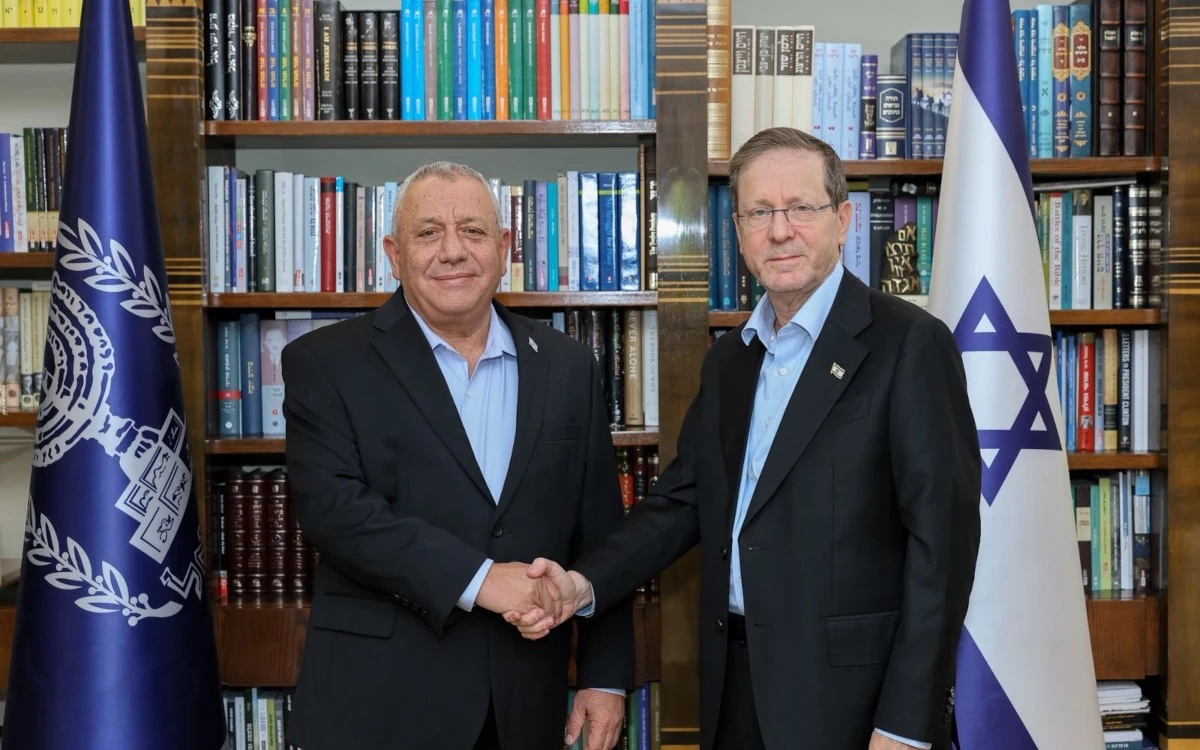
Israel‘s president announced he would task Gadi Eisenkot with forming the next government following last week’s election, in what Prime Minister Benjamin Netanyahu’s rivals see as a first step to remove the country’s longest-serving prime minister.
The opposition bloc led by Eisenkot, a former military chief and political newcomer who has tried to appeal to secular and liberal Israelis, has opened the door to a once improbable alliance with ultra-Orthodox Jews, which could give it the numbers to form a coalition.
President Isaac Herzog said that after consultations with all parties during the week, he would grant Eisenkot the first chance to form a government after the Oct 27 election, in which neither side secured a majority in a country deeply polarized by Netanyahu’s hard-right rule and worn down by three years of war.
The formal appointment would take place in an official ceremony on Sunday at the president’s residence in Jerusalem, Herzog’s office said.
Eisenkot, who later pledged to “do everything” to form a new government, was recommended by parties representing 67 lawmakers as opposed to 46 for Netanyahu’s bloc.
The recommendations for Eisenkot included members of Israel’s Arab minority – whose seat haul soared in the election on the back of anger against Netanyahu – and right-leaning segments of the opposition that are against relying on Arab votes.
Following his appointment, Eisenkot will have 28 days to come up with the 61 votes needed for a government. If he comes up short, Herzog can provide a 14-day extension before he has to offer the mandate to someone else. However, the challenge he faces lies not only in securing enough votes in the Knesset, but also in building a coalition capable of withstanding the sharp ideological contradictions among its members. If he fails in this task, the president can task another figure with forming the government, which could plunge Israel back into a cycle of negotiations and political alliances.
In this context, Israel enters a highly sensitive political phase, the contours of which may be defined in the coming weeks by Eisenkot’s ability to form a coalition that transcends the traditional right-wing, center-left divide. His success would practically pave the way for a restructuring of the political landscape and weaken Netanyahu’s dominance over Israeli politics, while his failure could strengthen the right wing’s position and reproduce the political crisis. Between these two scenarios, Israel appears to be heading towards a period of uncertainty. (AFP+EIR)