
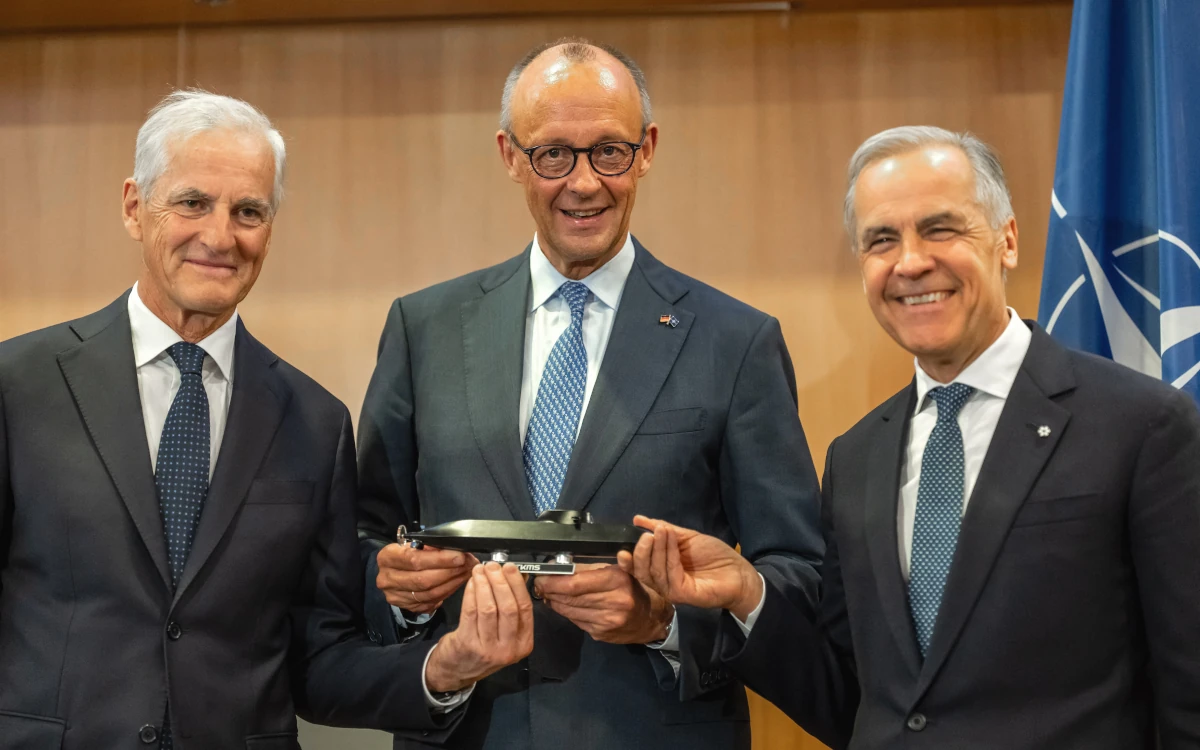
Canada just bet roughly $70 billion that the NATO alliance still matters. On July 6, 2026, Prime Minister Mark Carney chose Germany to build up to 12 submarines for the Royal Canadian Navy. He passed over a cheaper South Korean bid whose submarine was already in production and offered faster delivery. Both models could do the job. Canada picked the European ally.
Behind that decision lies a strategic dilemma common to Western middle powers. Pressed by Washington to rearm, they can buy cheaper and faster from Asian exporters outside the alliance or pay a premium to stay within it. Canada has tied its submarine fleet to NATO’s industrial base and did so deliberately. Its choice of Germany’s ThyssenKrupp Marine Systems (TKMS) layers alliance alignment on top of hard procurement logic. Ottawa kept South Korea’s Hanwha Ocean on as a reserve and a bargaining chip, in case the German deal stalls before 2027. This is a government hedging a 50-year bet while still choosing the alliance when it counts. The decision is an early verdict on whether alliance integration can still beat price and speed.
The Canadian government is hedging a 50-year bet while still choosing the alliance when it counts
What Tipped the Balance
Canada’s Request for Information for the Canadian Patrol Submarine Project (CPSP) went out between September 2024 and February 2025. TKMS and Hanwha Ocean were shortlisted in August 2025, final proposals arrived in March 2026, and Ottawa closed clarifications in late April before naming TKMS in July. That is less than a year from shortlisting to decision. Canadian authorities call it the largest defense procurement in the country’s history: an initial buy near $17 billion, rising to as much as $70 billion over the fleet’s life. The stakes are set by the fleet being replaced. Canada’s four Victoria-class submarines, bought second-hand from the United Kingdom between 1998 and 2000, retire in the mid-to-late 2030s. Up to 12 new boats would roughly triple the Royal Canadian Navy’s underwater fleet.
Vice Admiral Angus Topshee, then commander of the Royal Canadian Navy, said either submarine would serve Canada’s needs, and Carney called it a close decision between two qualified suppliers. That forecloses a simple story in which Hanwha’s KSS-III was disqualified on technical grounds. Canada’s own statements suggest instead that secondary factors—schedule risk, industrial integration, and partnership durability—ultimately decided a contest between two adequate platforms.
Delivery timing was the clearest practical trade-off. Hanwha’s KSS-III Batch II is already in production at its Geoje shipyard; the first Batch-II hull was launched in October 2025 and was toured by Carney in South Korea. Hanwha proposed delivering the first boat by 2032 and four by 2035, a schedule analysts called a structural advantage because it does not depend on a design still in pre-production. TKMS, by contrast, had to persuade Ottawa that the 212CD—whose first German hull is not due until roughly 2031 or 2032—could still meet a Canadian target.
Observers saw its early offer of four boats by 2036 as the tighter constraint. TKMS narrowed the gap by reassigning production slots committed to Germany and Norway. It also pointed to a $290 million expansion at its Kiel shipyard, including an eight-bay hall built for the 212CD line. Ottawa now expects first deliveries in 2034, ahead of that original offer. TKMS also projected as much as $61 billion in Canadian GDP over the program, letting Ottawa frame the later date as the price of a larger, longer-term industrial payoff.
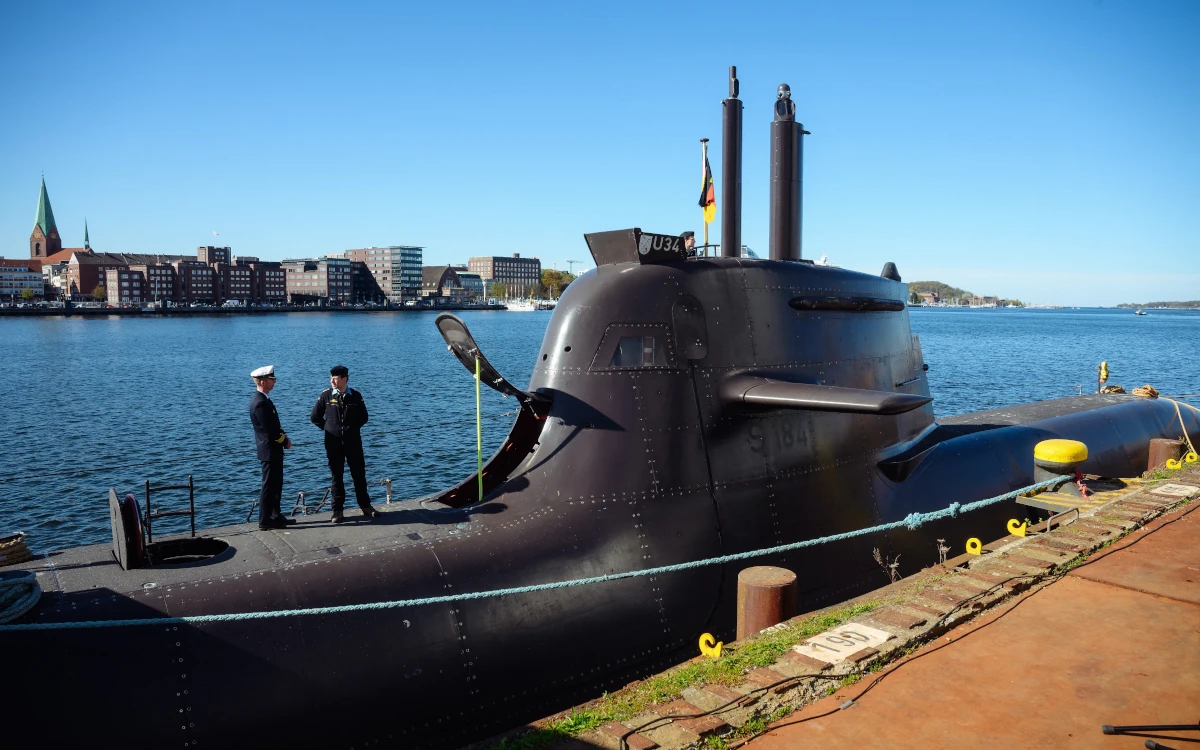
Canada’s acceptance of a slower path is where the case becomes more than a story about alliance sentiment. Europe’s shipbuilders are working inside a defense-industrial base still absorbing the demand shock of the war in Ukraine. That has pulled capital, materials, and skilled labor toward munitions and air defense. New EU financing is trying to expand capacity, including a $173 billion SAFE facility that requires 65 percent of program content to originate in Europe. The European aerospace and defense industry’s turnover reached an estimated $210 billion in 2024, up roughly 48 percent since 2021, even as officials warn demand still outpaces what factories can build. A contractor promising slot reassignments and shipyard expansion is asking a customer to accept near-term risk for permanent access to an expanding base. Hanwha’s pitch inverted the trade: a design already in the water, from a country with fewer capacity constraints, but without the decades of interoperable operations Germany and Norway share.
Canada weighed these pressures and came down, on balance, for reducing long-run risk over near-term schedule risk. The long-run risks it prioritized are to supply, sustainment, and interoperability. That is a specific, evidence-grounded judgment. It makes sense only in light of where Canada wants to sit industrially and diplomatically over a program running into the second half of this century.
Canada’s choice to reduce long-run supply, sustainment, and interoperability risk over near-term schedule risk makes sense only in light of where it wants to sit industrially and diplomatically over the second half of this century
Why Interoperability Trumped Speed
The strongest concrete argument for TKMS was interoperability. The Type 212CD is built jointly for Germany and Norway, two NATO allies with whom Canada already trains, exercises, and shares intelligence. TKMS supplies roughly 70 percent of NATO’s conventional submarine fleet, and Ottawa’s language after the announcement stressed trusted allies and European supply chains as much as the boat’s capability. The advantage is practical. Shared maintenance protocols, common training pipelines, and established doctrine lower the cost of integrating a new platform, and the savings compound over a submarine’s service life.
Hanwha’s KSS-III made a different, more novel case. The Korean Navy sent the boat itself, the Dosan Ahn Chang-ho, to Canada’s Pacific coast in May 2026 for a joint exercise with the Royal Canadian Navy. It was an unusual bid to show a submarine with no NATO service history could still operate credibly alongside allied forces. Hanwha pointed to its vertical-launch system and greater displacement: a blue-water boat for longer-range operations, against the compact, diamond-hulled 212CD optimized for littoral and northern patrol. Both arguments carried weight. Canada’s decision suggests that, when platforms are judged roughly equivalent, an established alliance relationship outweighs a demonstrated but unprecedented one. Ottawa kept the Korean offer alive, preserving Hanwha’s bid as a reserve should TKMS talks falter before the end-of-2027 deadline.
This reserve structure is itself telling. Keeping the Korean bid alive as leverage and a hedge suggests officials saw real value in Hanwha’s proposal, more than a foil to check TKMS on price and terms. Canadian outlets report the contest could formally resume if talks with Germany falter over contract, financing, or industrial terms. No government builds in a hedge like that if it is simply signaling alliance loyalty.
For a middle power, the episode illustrates a positioning problem sharpened by the shifting transatlantic order. Ottawa is trying to do three things at once. It must answer Washington’s pressure to spend more and rely less on American systems. The timing made the point. At the NATO summit in Ankara days later, Carney said the Trump administration had “won the argument” on burden-sharing. Ottawa wrapped the submarine into a week of alliance-minded deals, a Telesat satellite arrangement and a Kongsberg missile buy among them, treating procurement as alliance management. It also wants deeper ties with European allies whose industrial base is expanding but still capacity-constrained by the war in Ukraine. And it hopes to keep options with a fast-growing Indo-Pacific exporter offering quicker delivery. Choosing TKMS serves the first two. It cuts reliance on the United States for a strategic capability while binding Canada into a European industrial and training ecosystem just as Europe expands capacity. The cost is the schedule and design risk of a submarine still in its first production run.
The costs are specific: a Victoria-class fleet well past its service life by the time replacements arrive; the contract still subject to negotiation over price and Canadian industrial-benefit terms; and a shipbuilder whose timeline has already slipped once during the competition. Canada judged these costs worth accepting in exchange for deeper alliance integration. The outcome turns on execution. Both platforms can perform; only TKMS must still hold a schedule it has already adjusted under competitive pressure.
Seoul’s Hard Lesson
For Hanwha and Korea’s defense industry, the outcome reads less as a rejection of Korean technology than as the limit facing any exporter outside an established alliance network. Hanwha Ocean’s shares fell roughly 23 percent after the announcement, and Korean officials were candid about the sting even as they stressed what the bid proved. President Lee Jae-myung said the KSS-III had shown its competitiveness against the world’s leading builders. He pledged continued support for defense exports, part of an ambition to make South Korea one of the world’s four largest arms exporters. The country’s submarine was competitive; what beat it was the buyer’s weighting of years of shared alliance infrastructure, which no technical refinement could offset here.
Korea’s submarine was competitive; what beat it was the buyer’s weighting of years of shared alliance infrastructure, which no technical refinement could offset
The clearest lesson: in Western, especially NATO-adjacent, defense markets, positioning inside existing security relationships before a tender opens now matters more than the proposal filed once it does. Analysts at Seoul’s Korea Defense and Security Forum warned that Korean submarine exports may struggle for years regardless of competitiveness, because alliance-based criteria are becoming more explicit in NATO members’ major buys. That is a narrower, more falsifiable claim than “geopolitics matters,” and it points to a specific gap. Korea has built formidable capacity and a credible record, but not the government-to-government architecture European suppliers gain simply by being NATO members. That architecture means formal cooperation agreements, joint exercises predating a tender, and established maintenance and training ties.
Korea’s own recent history offers a template, and officials have pointed to it. The K2 tank was first exported to Poland in a 2022 contract worth roughly $3.4 billion for 180 units, followed by a second, $6.5 billion order for 180 more in 2025. It succeeded partly because it entered a market already primed by Poland’s post-2022 rearmament, which pushed defense spending above 4 percent of GDP. Warsaw bought after direct exposure to the platform, with no entrenched incumbent’s alliance ties to overcome. Officials on the Canadian bid hope the CPSP will work similarly, helping Korean submarines gain traction elsewhere. Hanwha says it will study the loss for future contests, including ones reportedly weighed in Poland and Australia. The distinction is instructive: Poland bought a tank it had already seen perform under relevant conditions. Canada, by contrast, was choosing a partner for half a century, a horizon where alliance ties compound in value.
The more actionable prescription now circulating in Seoul is institutional, not technical. It calls for a formal Korea-NATO defense framework, covering local production, joint development, supply-chain integration, and export financing, negotiated before a competition rather than during one. An opening may already be forming. At the Ankara summit, Korea and NATO agreed to open talks on a procurement pact aimed at a market worth roughly $9.9 billion through NATO’s own procurement channels rather than head-to-head member tenders. The lesson for Seoul is blunt. Price, delivery speed, and capability are necessary but no longer sufficient where a buyer’s alliance commitments act as an unstated qualifying criterion. Hanwha delivered all three, and on timing it arguably bettered TKMS. Recognizing that such decisions reflect geopolitical alignment as much as commercial merit is now a precondition for Korea’s next win.
Price, delivery speed, and capability are necessary but no longer sufficient where a buyer’s alliance commitments act as an unstated qualifying criterion
Scenario One: Berlin Stumbles, Seoul Returns
The trigger comes if TKMS’s terms on price, delivery guarantees, or Canadian industrial benefits fail to clear final approval. A further push would be fresh reporting that Germany‘s own 212CD program has slipped behind its 2031–2032 first-delivery window. The threshold arrives when talks lapse past the end-of-2027 deadline, or when procurement officials conclude that TKMS’s revised commitments, including reassigned slots at Kiel, can no longer be verified against actual output.
The mechanism is Ottawa formally invoking the reserve-supplier status built into the July 2026 announcement, reopening structured talks with Hanwha, and mapping Canada’s requirements and industrial-benefit terms onto a KSS-III already in serial production at Geoje. Because Hanwha’s platform has been evaluated once against the same requirements, due diligence would move faster than a fresh competition.
Constraints include the diplomatic cost of reversing a decision framed as deepening ties with Germany and Norway; the operational cost of re-planning basing, training, and maintenance around a larger, VLS-equipped hull rather than the compact, Arctic-optimized 212CD; and the exposure of unwinding the largest defense procurement in Canadian history. Watch for disclosed TKMS cost or schedule overruns, renewed Ottawa-Seoul contact, parliamentary questions about the German contract, and reporting on bottlenecks at Kiel or Wismar. Likelihood is low-to-moderate.
Scenario Two: The Alliance Rulebook
The trigger is a combination of continued U.S. pressure for burden-shifting, expanding EU content thresholds such as SAFE’s 65 percent European-content rule, and other members citing Canada’s decision as a template. The threshold arrives when several NATO members formally codify alliance-content or interoperability criteria into the scoring of their major tenders, rather than treating alliance membership as one factor among many.
The mechanism is national procurement offices writing explicit alliance-content or shared-platform scoring into tenders. With European Defence Industry Programme funding increasingly tied to intra-alliance sourcing, states gain a financial incentive to pick allied suppliers even when a non-allied bid is faster or cheaper. Over time this could harden what was, for Canada, a discretionary judgment into a structural feature of Western procurement.
Constraints include finite European shipyard capacity, already strained by wartime demand; procurement-transparency and trade-law rules that complicate explicit political weighting; and the standing incentive for buyers to hedge with faster non-NATO exporters, as Canada did with Hanwha. Watch for explicit “allied content” rubrics in later European and Canadian tenders, new EU funding-conditionality, the spread of dual-track or reserve-supplier structures, and non-NATO exporters such as South Korea seeking formal cooperation with NATO. Likelihood is moderate-to-high.
The Middle-Power Playbook
Whichever way the contract settles, the lesson is already clear. For a middle power, a purchase this large is first a strategic act and only then an economic one. Ottawa committed to an alliance without handing over the keys. It backed TKMS but kept Hanwha in reserve, declining to write Germany a blank check while making clear that Canada’s future runs through NATO’s industrial base. The reserve clause is what let it keep that autonomy.
For a middle power, a purchase this large is first a strategic act and only then an economic one
The wider signal is about NATO itself, which still shapes where the West builds its weapons. When a middle power sources a 50-year capability from inside the alliance, it strengthens Western industrial capacity just as Europe’s lines expand to meet historic rearmament demand. Canada’s hedge also warns European suppliers plainly: alliance solidarity opens the door, and executable schedules, industrial benefits, and cost controls close it. As middle powers across the coalition face the same multi-decade choices, the CPSP offers a template: use alliance ties to strengthen collective deterrence while holding the line on procurement discipline.