
Japan is entering the arms market through a narrow door. After decades of restraint, Tokyo is loosening its defense export rules—but not to become the next South Korea, China, or United States. The shift is less a bid for market share than a strategic adjustment shaped by Japan’s industrial history and built-in structural constraints. Rather than turning Tokyo into a global competitor in arms sales, it positions Japan’s defense industry as a high-end, alliance-focused supplier.
Japan’s revision to the Three Principles on Transfer of Defense Equipment and Technology, which permits transfers of lethal weapons to allied countries not in active conflicts, marks a significant shift in a defense industrial policy long shaped by its postwar pacifist constitution. Prime Minister Sanae Takaichi framed the move as necessary to strengthen Japan’s defense industrial base, deepen interoperability with allies, and respond to growing regional threats, especially from China and North Korea.
Yet easing export restrictions does not, in itself, make Japan a competitive exporter. Its entry into global markets is structurally constrained by limited production capacity, higher per-unit costs, and the absence of combat-proven systems. These disadvantages distinguish Japan’s position from China’s state-backed mass production model and South Korea’s export-oriented defense industrial strategy.
Easing export restrictions does not make Japan a competitive exporter. Its entry into global markets is structurally constrained by limited production capacity, higher per-unit costs, and the absence of combat-proven systems
Rather than competing at scale, Japan’s viable path lies in strategic positioning within high-end, technologically sophisticated niches that leverage its advanced engineering capabilities. This is particularly the case in aerospace systems, submarine technology, and integrated sensor networks. Such an approach prioritizes selective partnerships with technologically advanced allies over sales volume, positioning Japanese defense exports as premium offerings that complement rather than compete with established arms exporters.
Technological Capabilities and Market Entry Challenges
Japan’s defense industrial base possesses advanced technological capabilities in specific domains. Mitsubishi Heavy Industries’ F-2 fighter program has incorporated advanced composite materials, reducing radar cross-section and an active electronically scanned array radar that was among the first operational fighter-mounted systems when deployed in 2000. Japan’s indigenous Type 12 surface-to-ship missile system, recently upgraded to extended-range variants that reach 1,000 kilometers, demonstrates precision-guidance capabilities comparable to systems produced by established exporters. The Soryu-class submarine program showcases Japan’s advancement in air-independent propulsion technology using Stirling engines, achieving submerged endurance exceeding two weeks.
The emphasis on high-tech production is deeply rooted in Japan’s postwar development strategy, which combined high levels of R&D with strict limits on exports. The strategy prioritized technological innovation and precision engineering as pathways to national economic recovery and global competitiveness. It incentivized major conglomerates like Mitsubishi to develop advanced production capabilities. The constitutional restrictions on defense exports pushed Japanese defense manufacturers to focus intensely on technological quality and performance rather than quantity. The result is a niche, highly specialized but structurally constrained defense industrial base.
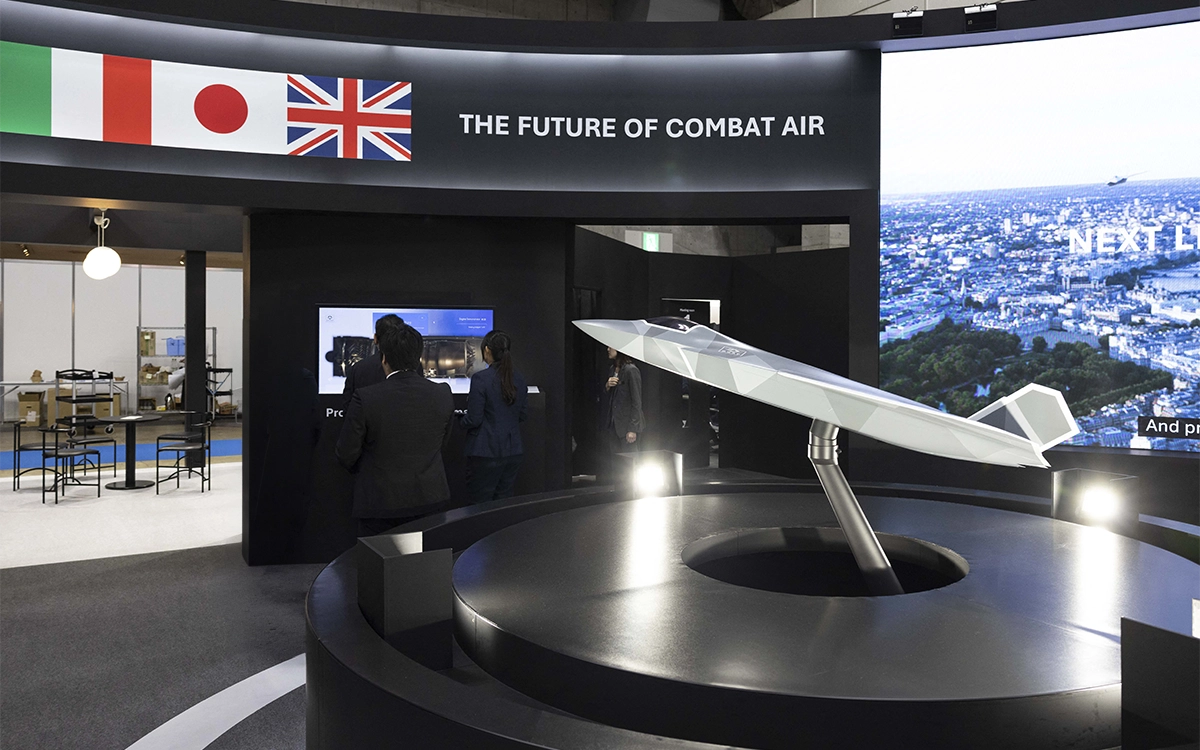
Japan’s participation in the Global Combat Air Programme (GCAP)—a trilateral sixth-generation fighter development with the United Kingdom and Italy—illustrates both the potential and the limits of this model. The program, which aims to provide a new fighter by 2035, leverages Japanese strengths in avionics, thermal management technology, and sensor systems, integrating aperture sensors and AI-assisted pilot decision-making with directed-energy weapons and wingman unmanned aerial vehicles.
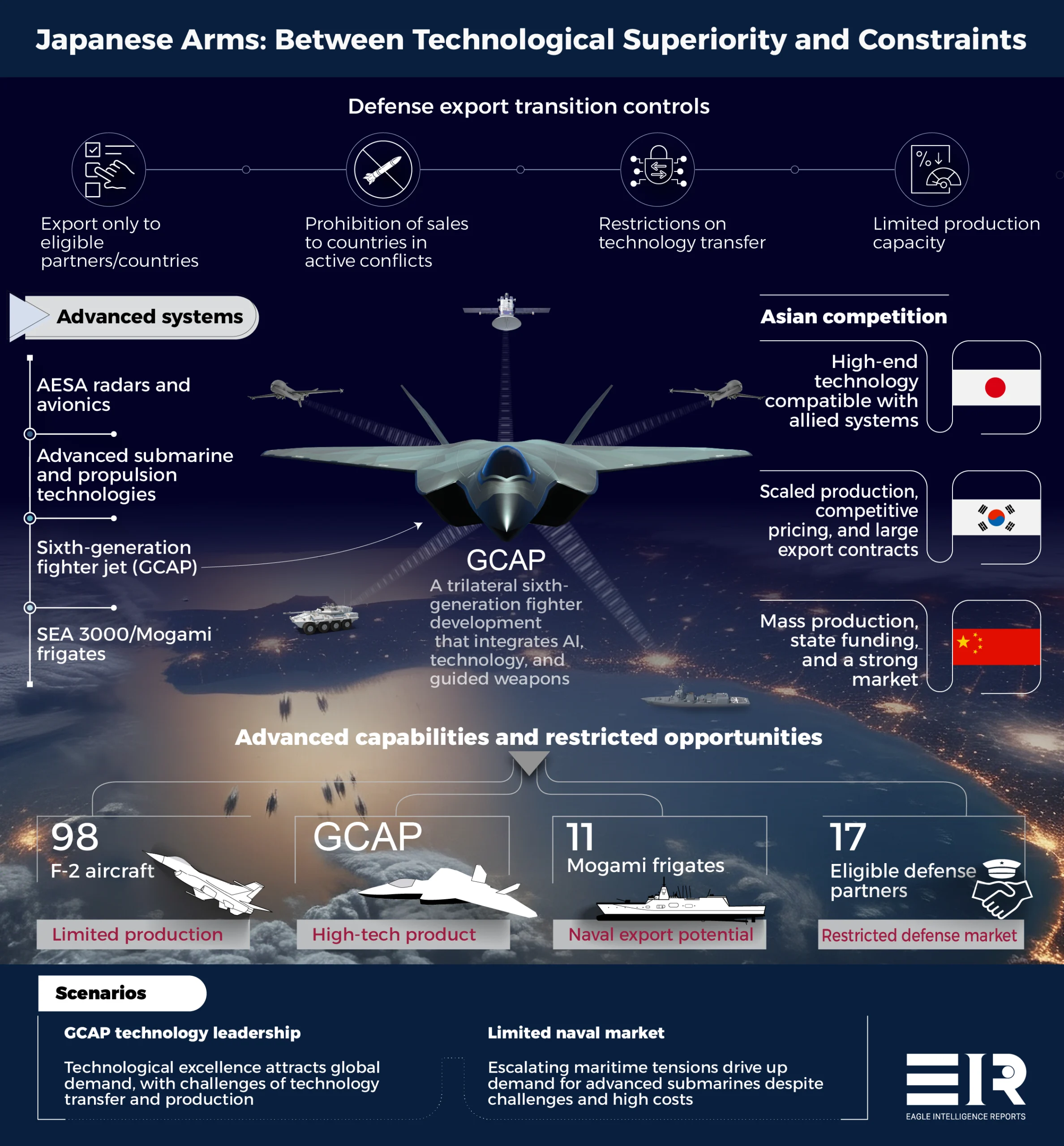
Yet the program is limited by the new regulations, which permit exports only to nations with formal defense cooperation agreements and prohibit transfers to countries in active conflict. Japan currently maintains defense cooperation frameworks with 17 nations, including key strategic partners like the United States, Australia, and India. This expands demand for Japanese-made arms, but it does not completely open the door to other major arms importers. For instance, it does not include Middle East nations, who account for over a quarter of global arms imports—a number likely to rise with the ongoing war with Iran. Only the United Arab Emirates has signed an arms transfer deal with Japan.
On the other hand, a majority of countries purchasing Japanese arms are U.S. allies or partners focused on developing high-tech capabilities and maintaining close diplomatic and economic ties with Japan, especially in Southeast Asia. This raises the possibility that Tokyo can capture the demand for interoperable systems, enhancing military cooperation with its regional partners, instead of pursuing purely volume-based market competition.
High per-unit costs represent a second major constraint. Japan’s defense industry relies on small production runs for domestic procurement, limiting its ability to spread R&D costs, reduce per-unit costs, and achieve economies of scale fit for export. The Mitsubishi F-2 program, for example, produced in fewer than 100 units, costs roughly $120 million per aircraft—well above comparable mass-produced platforms such as the $80 million F-16. Similar constraints apply to ground systems: Japan’s Type 10 tank, produced in limited numbers, remains half a million dollars more expensive than its South Korean analog, the K2 Black Panther, which also benefits from much larger production runs.
This high-cost structure also reinforces itself. Small production runs mean prices stay high, which in turn suppresses demand and discourages investment in expanded capacity. While expanded export access may ease this constraint, leading to more growth over time, it does not resolve underlying structural limitations on scale.
This high-cost structure also reinforces itself. Small production runs mean prices stay high, which in turn suppresses demand and discourages investment in expanded capacity
Combat validation is a third constraint. Contemporary procurement increasingly favors systems with proven operational combat performance. For example, South Korea’s K9 howitzer achieved export success following deployment and combat use during the inter-Korea border conflict. Likewise, Turkey’s Bayraktar TB2 UCAV leveraged high-profile combat success in Nagorno-Karabakh, Libya, and Ukraine—where it suppressed advanced Russian-made air defense systems—to boost export contracts. This battle-proven reputation has made Turkey the world’s largest exporter of armed drones. It has also paved the way for NATO members like Poland, Romania, and Croatia to integrate the system into their national defense architectures as a cost-effective alternative to traditional manned air power. Japan’s systems, by contrast, have not been employed in combat since 1945, creating uncertainty for potential buyers and limiting their appeal in competitive export environments.
Structural Constraints and Competitive Differentiation
These limitations place Japan in a fundamentally different position than China and South Korea—its primary competitors—which operate under distinct industrial and financial models. China’s export industry—the fifth largest globally at a 5.6 percent share—relies on production at scale. It leverages massive domestic military procurement—the PLA operates over 5,000 modern main battle tanks and 1,500 modern fighter aircraft—to amortize development costs and offer competitive pricing. The VT-4 tank exports at $4.5–5.5 million per unit compared to Western equivalents priced at over $12 million. China’s JF-17 fighter exports at up to $35 million, compared to comparable Western systems with a $65 million price tag.
Critically, Chinese systems are not only competitive on price but also on financing terms—an advantage unavailable to Japan’s privately structured defense sector. Large-scale deals, such as Pakistan’s submarine procurement, illustrate how production capacity, state backing, and financing mechanisms operate together to sustain export growth.
Critically, Chinese systems are not only competitive on price but also on financing terms—an advantage unavailable to Japan’s privately structured defense sector
However, Beijing’s arms export ambitions also encounter geopolitical limits. Western-aligned countries refrain from purchasing Chinese arms for lack of interoperability with Western-standard weapons already in operation. In the context of U.S.–China competition, buyers are also cognizant of the signaling effect of moving toward Chinese systems, which could lead to restrictions on provisioning. Hence, China’s arms exports have so far been targeted at Global South countries such as Pakistan—which accounts for 60 percent of Chinese arms exports—and other countries in South and Southeast Asia, Africa, and the Middle East, mainly those not explicitly aligned with the West.
South Korea has also emerged as a major arms exporter, ranking among the top ten globally between 2021 and 2025. It offers Western-standard systems across Europe, the Middle East, and Southeast Asia through a deliberately export-oriented industrial policy. Firms like Hanwha Defense operate production facilities scaled for export volumes—K9 artillery output exceeds 100 units annually—far above comparable Japanese procurement levels. Moreover, South Korea’s model is supported by a regulatory framework under the Defense Acquisition Program Administration that integrates government-backed financing, licensed production, and technology transfer into major contracts. Even after the relaxation of export regulations, Japan’s framework remains more restrictive. It still lacks specialized export-focused structures, and it explicitly prohibits technology transfers that could compromise indigenous or U.S.-origin technologies.
However, while South Korea leads in production volume and market penetration, it continues to lag behind Japan in foundational areas such as material science, undersea stealth, and aerospace engine sovereignty. This divergence reflects differing strategic imperatives. Japan’s insular geography mandated a greater technological advantage in air- and sea-based platforms as the deterrence model. South Korea, by contrast, required a total-war arsenal focused on faster procurement and more attritable ground-based weapons.
While South Korea leads in production volume and market penetration, it continues to lag behind Japan in foundational areas such as material science, undersea stealth, and aerospace engine sovereignty
As a result, Japan has leveraged its strength in commercial material science and aerospace R&D to cultivate high-tier, sovereign technologies such as specialized stealth composites and the world’s first operational lithium-ion submarine power systems. This technology functions as qualitative a force multiplier. Meanwhile, South Korea’s defense industry evolved through a fast-follower model, optimizing for mass production and system integration.
High-End Niche Markets and Alliance Integration
Given these structural constraints, Japan’s defense export strategy is likely to center on high-end technological niches that align with its core engineering capabilities and strategic alliance networks. Rather than competing on volume, this model prioritizes selective market entry, targeting procurement environments that value technological sophistication and interoperability over cost.
GCAP represents the best example of this strategy. Rather than a mass-market product, the sixth-generation fighter functions as a high-end system through which Japan can leverage its strengths. The program’s emphasis on interoperability among its trilateral partners also effectively creates a limited but reliable market of nations predisposed to procurement. At the same time, estimated production targets of around 400 aircraft across partner nations provide sufficient scale to achieve meaningful cost amortization while maintaining technological exclusivity.
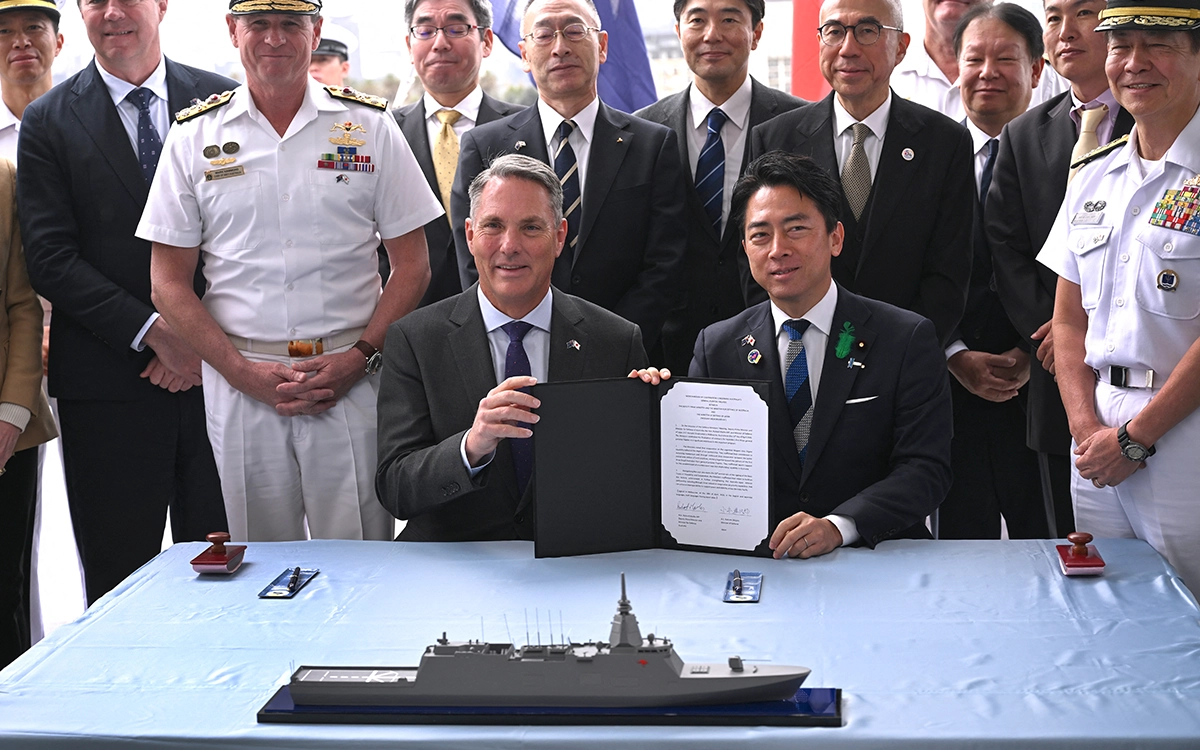
The Mogami-class frigate illustrates a similar dynamic in the naval domain. Following the U.S. Navy’s cancellation of the Constellation-class frigate program in late 2024 due to escalating costs and performance concerns, Pentagon planners began discreet discussions with Japan about acquiring a modified variant of the Mogami-class. This follows the signing of a $10 billion contract between Australia and Mitsubishi in April to purchase an upgraded Mogami-class frigate for Canberra’s SEA 3000 program. This would procure 11 general-purpose frigates to replace the aging Anzac-class fleet, with the first Japanese-built ship expected to be delivered by 2029.
The Mogami-class’s design further illustrates Japan’s strength in high-end naval engineering. Its modular architecture, integrated electric propulsion, and advanced anti-submarine capabilities reflect a focus on technological sophistication rather than cost-driven scalability. At roughly $500 million per unit—significantly less than the cancelled Constellation-class’s up to $1.5 billion per hull—it offers a cost-effective alternative. While no formal procurement has been initiated, the discussions represent a significant validation of Japan’s high-end naval engineering ambitions and may be a significant export opportunity.
Japan’s strategic positioning in the global arms market is largely shaped by alliance dynamics rather than open competition. Its export strategy would center on high-end technology and interoperability with U.S. and NATO systems, creating added value for potential purchasers seeking seamless integration with existing alliance infrastructure. Considering that the new arms export liberalization emphasizes exports to nations with existing defense agreements, Tokyo is focusing on market entry designed to curate procurements for technologically advanced allies rather than attempting broader market-wide competition.
Japan’s strategic positioning in the global arms market is largely shaped by alliance dynamics rather than open competition. Its export strategy would center on high-end technology and interoperability with U.S. and NATO systems
This alliance-centric strategy also mitigates Japan’s production constraints. Rather than competing in price-sensitive markets that require scale, it allows Japan to sustain smaller production runs while offsetting cost disadvantages through technological sophistication and interoperability. At the same time, limiting exports to established partners reduces the regulatory and political risks associated with sales in more contested markets outside traditional alliance structures.
Scenario I: GCAP Technology Leadership
The first flight of the GCAP technology demonstrator reveals cutting-edge AI-assisted piloting capabilities and distributed sensor technologies that outperform existing fighter platforms, capturing global defense industry attention. Partner nations make substantial procurement commitments that extend beyond their initial domestic requirements, signaling the program’s potential global market appeal.
Japan strategically offers tiered technology licenses for advanced sensor and AI systems, creating a multilateral development ecosystem that allows partners to develop complementary technologies while maintaining core proprietary systems under Japanese control. Significant challenges include limited production capacity at Mitsubishi, complex U.S. technology transfer approval processes, potential security concerns surrounding AI and sensor fusion technologies, and budgetary limitations in partner nations.
Scenario II: Niche Maritime Defense Market
Escalating maritime tensions with China in the South China Sea create an urgent demand for advanced conventional submarine technologies among Southeast Asian nations. Nations lacking access to advanced U.S. weapons systems due to technological security risks initiate formal procurement discussions for advanced submarine capabilities. They increasingly view potential acquisitions as a critical part of their maritime defense strategy.
Japan presents a comprehensive package featuring cutting-edge maritime platforms and a technology transfer program, including extensive training for technical and operational personnel and potential joint maintenance infrastructure. However, significant challenges remain, including complex international negotiations, Japan’s limited submarine production capacity, potential U.S. restrictions on technology transfers for key subsystems, high unit costs compared to alternative suppliers, and the absence of combat validation.
Ultimately, Japan’s defense export opening is unlikely to transform it into a volume-driven competitor in the global arms market. Its strategic significance lies instead in the emergence of a selective, alliance-centered model built around advanced technology, interoperability, and trusted partnerships, while structural constraints in production scale, cost, regulation, and combat validation continue to define the limits of Japan’s defense export potential.