
Germany is not merely rearming, nor is it seeking the role of an autonomous great power. It is redefining the function of the Bundeswehr as an enabling instrument for European deterrence within NATO. In this framework, military power is measured not by size alone, but by the capacity to make collective defense operational—through logistics, infrastructure, readiness, and command.
Germany’s 2026 military strategy—its first standalone document since the Second World War—does more than expand scope; it redefines national military purpose. It positions the Bundeswehr not as an autonomous military power, but as the structural backbone of European collective defense—less oriented toward force size than toward enabling the alliance’s warfighting system.
Germany’s 2026 military strategy positions the Bundeswehr not as an autonomous military power, but as the structural backbone of European collective defense
Germany’s New Military Logic
Germany’s military strategy, unveiled by Defense Minister Boris Pistorius on April 22, marks a substantive break in the country’s postwar security posture. Berlin released the framework alongside a new capability profile, a personnel growth plan, a revised reserve strategy, and a major administrative reform package. Much of the primary document remains classified. The publicly available material is nonetheless sufficient to establish both the direction and the internal logic of the intended change.
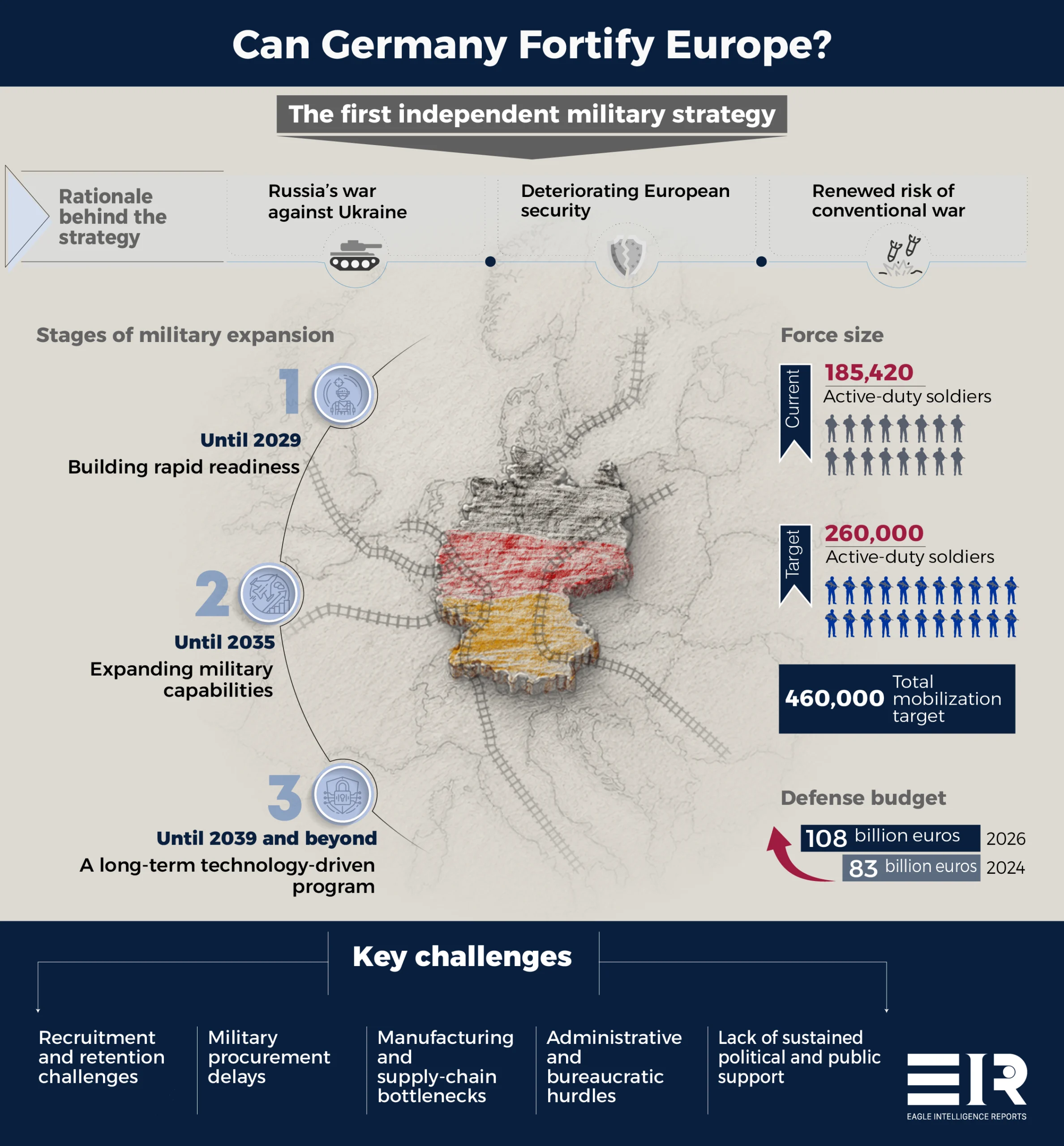
The immediate contextual drivers are clear. German officials link the strategy to Russia’s war against Ukraine, the deterioration of European security, and the return of large-scale conventional military risk to the continent. Russia is identified as the principal threat. Alongside conventional military dangers, the document places growing emphasis on hybrid coercion—sabotage, cyberattacks, and disinformation.
At the descriptive level, this is a response to a harsher strategic environment. That framing is accurate but incomplete. The more consequential development is conceptual: Germany is now articulating, in explicit military terms, what institutional role it intends to perform within NATO. The emphasis falls on readiness, reinforcement, infrastructure protection, and operational support across the alliance. These represent a defined set of military functions. The strategy is therefore less a budget statement than a functional redefinition of national military purpose.
The distinction between rearmament and functional redefinition is not semantic. Classical rearmament focuses on quantitative expansion: larger budgets, more platforms, and greater personnel numbers. A functional redefinition specifies what role those resources are meant to perform. Here, the indicators are clear: an effects-oriented planning model, a definition of Germany’s contribution in alliance-level outputs, and a restructuring of reserve forces around homeland security tasks. These are architectural choices, not spending decisions.
The central question is not whether Germany should build a larger military—that political debate has effectively been settled. It is what kind of military Germany is choosing to become, and how that choice aligns with the structural requirements of European deterrence. Read in those terms, the document signals a shift away from force size as an end in itself and toward deployable capability, rapid readiness, logistical integration, and operational effect at the alliance level.
Function Before Mass
The publicly available force structure goals are ambitious. Germany has set targets of 260,000 active-duty personnel and a minimum of 200,000 reservists—a combined mobilizable total of 460,000. The expansion runs across three phases: a rapid readiness buildup through 2029, broader capability expansion through the mid-2030s, and a technology-intensive program extending to 2039 and beyond.
Pistorius has described this trajectory as an effort to build Europe’s most capable conventional land force over time. On the surface, this resembles classical rearmament: more personnel, larger budgets, expanded procurement. That interpretation, however, misses the most significant feature of the package. States pursuing traditional military mass typically prioritize national force size and platform accumulation. Equipment quantities and headline personnel figures become proxies for strategic credibility. The German package is organized around a different logic. Its most operationally significant elements concern not size, but function.
The central focus is on how the Bundeswehr will enable theater mobility, reinforce allied positions, sustain operations over time, and underpin NATO-wide resilience. This is pivotal, as Germany’s strategic geography assigns it a distinctive and non-substitutable military role.
Germany occupies the central operational corridor through which allied forces, logistics, and materiel must move in any serious European contingency. That geography makes German infrastructure—rail networks, ports, storage facilities, communications nodes, and air defense coverage—a structural precondition of deterrence, not merely a national military asset.
Whether this orientation reflects a deliberate strategic choice by Berlin or an outcome shaped by structural constraints is an important distinction. Geography, postwar political culture, and persistent domestic limits on military ambition all narrow the range of plausible roles. The enabling function is, in that sense, also the role most consistent with Germany’s structural position. The new strategy recognizes this function with greater explicitness than any previous German defense document. The key question is not whether Germany is enlarging its military inventory, but whether it is genuinely reorganizing that inventory around alliance-level operational requirements. A state that secures reinforcement corridors, sustains alliance logistics under pressure, and provides command continuity can shape the operational balance more decisively than one that simply accumulates platforms.
From Inventory to Effect
The doctrinal language of the strategy is particularly revealing. German officials indicate that the Bundeswehr will move away from rigid hardware quotas toward an effects-oriented planning model. The relevant measure of adequacy is no longer how many tanks, ships, or aircraft Germany should possess in the abstract. The question instead becomes what military effects the force must be capable of generating in crisis and in war. That reorientation has significant downstream consequences for procurement and force design.
The relevant measure of adequacy is no longer how many tanks, ships, or aircraft Germany should possess in the abstract. The question instead becomes what military effects the force must be capable of generating in crisis and in war
Under an inventory-driven planning model, the platform is treated as the primary measure of progress. Force tables, equipment ratios, and procurement targets become the dominant metrics of readiness. Under an effects-oriented model, however, the platform matters only insofar as it contributes to a defined operational outcome. What matters is not the formal existence of a brigade or missile battery on an order of battle, but whether that unit can generate deep strike, sustain air defense, enable maneuver, or maintain command continuity under operational stress.
Once operational effect becomes the standard of adequacy, the less visible foundations of combat power become much harder to systematically deprioritize. Maintenance pipelines, munitions depth, logistics chains, and digital interoperability all gain analytical weight. Preparedness in this framework is measured by whether the force can generate sustained warfighting output across a theater over time.
Germany’s acknowledged capability gaps are instructive here. Officials have been candid that deep precision strike remains underdeveloped. The Taurus cruise missile, with a range exceeding 500 kilometers, is currently the primary long-range strike system and sits at the lower end of the deep-strike spectrum. Broader theater-level strike capacity requires substantial further investment. Germany is also planning procurement of the JASSM-ER cruise missile for the F-35, which would extend reach to approximately 1,000 kilometers. That capability, however, remains in the acquisition phase.
That candor is significant. The strategy does not simply reallocate emphasis within an already mature force; it identifies structural warfighting gaps and treats their remediation as urgent requirements. The same logic applies to layered air and missile defense, drone warfare, and data-driven command architectures—all shaped by the operational lessons of the war in Ukraine.
The strategy is best understood as both a consolidation and an acceleration of trends that began after Russia’s invasion in February 2022. The Zeitenwende announcement of that year initiated the political shift. What this document adds is institutional architecture: specific force functions, a defined role within NATO, and a planning logic organized around effects rather than inventories.
The shift is therefore not a sudden rupture but a formalization and deepening of a trajectory already underway. Its significance lies in the degree of structural commitment now attached to that trajectory.
The One-Theater Doctrine
Germany’s military strategy introduces what it describes as a “one-theater approach”—a conceptual framework that treats NATO territory, the Middle East, and the Indo-Pacific as interconnected security spaces rather than discrete theaters requiring separate planning frameworks. Russia remains the principal threat, and European collective defense remains the organizing frame for German force planning. Within this one-theater framework, however, Iran and China are implied as secondary security concerns—a notable development for a German foundational military document.
Germany’s military strategy introduces a “one-theater approach”—a conceptual framework that treats NATO territory, the Middle East, and the Indo-Pacific as interconnected security spaces rather than discrete theaters
European security is conditioned by variables beyond the continent’s borders: industrial supply chains for air-defense systems, the allocation of U.S. strategic attention, access to critical technologies, and the cascading effects of adjacent crises on alliance cohesion and resource availability. A crisis in the Middle East can compress global air-defense production and redirect alliance attention. Sustained Indo-Pacific tension can alter U.S. strategic prioritization and reshape the assumptions underpinning extended deterrence in Europe. By integrating these dynamics into its planning rather than treating them as peripheral, Germany is operating with a wider strategic aperture than previous defense documents suggested.
The strategy correspondingly treats German infrastructure—ports, rail, communications, fuel storage—not as background support, but as an active component of the theater itself. That is a structural recognition with direct implications for how Germany defines its own security requirements.
The framework marks a departure from treating European defense as a largely self-contained continental problem. It is not a claim about German operational reach beyond Europe but about the range of variables that German strategic planning must now account for.
Reserves as Strategic Depth
The reserve strategy may prove the most consequential element of the entire package, yet it has received comparatively limited attention. Pistorius has described the reserve as the hinge between military and civil society. The public outlines assign reservists a primary role in homeland defense and infrastructure protection—a marked departure from prior assumptions that treated reserve forces as secondary capacity. The strategic reasoning is straightforward. A major conventional conflict in Europe would not be decided exclusively at the line of contact. It would also be shaped by the integrity of logistics, the continuity of medical chains and communications infrastructure, and protection against systematic sabotage of enabling systems.
In such a conflict, rear-area security is not a logistical afterthought but a structural condition of sustainable warfighting. Germany’s elevation of reserve forces reflects a growing official recognition that the Bundeswehr’s contribution to alliance deterrence extends across the full operational depth of the theater. The reserve is now formally positioned on par with the active force—a deliberate doctrinal elevation, not a simple administrative adjustment.
The legislative dimension reinforces the strategic intent. Germany’s modernized military service law entered into force on January 1, 2026. Service remains voluntary, but male citizens turning 18 must now provide information on their fitness and willingness to serve. Full conscription was not restored, and reactivation would require separate parliamentary action. The legal architecture nonetheless preserves broader mobilization options should voluntary recruitment prove structurally insufficient.
The more fundamental question is whether Germany can embed a sustained defense posture within peacetime society. Infrastructure protection, mobilization support, and territorial resilience require a broader political and administrative culture—one Germany has not maintained for decades. The reserve strategy is therefore also a test of institutional adaptation: whether strategic reorientation has been absorbed into the organizational habits of the state or remains at the declaratory level.
NATO Priority and the EU Dimension
The document’s functional categories are defined in alliance terms. That orientation is explicit. The strategy retains Germany clearly within the Atlantic framework, with NATO as the primary institutional vehicle for German defense planning. The EU defense dimension receives considerably less detailed treatment in the publicly available material. This absence requires careful interpretation but does not indicate that Germany is disengaging from EU defense structures. In January, Chancellor Friedrich Merz signed a strategic cooperation protocol with Italy, committing both countries to jointly achieving European defense readiness and strengthening the European pillar within NATO. Germany has also proposed a two-speed EU defense model designed to accelerate capability development among willing member states.
The strategy also reflects a clear prioritization in planning terms. When Germany defines its military role with precision, it does so within the NATO framework. The EU dimension is operationalized differently—less through a unified planning doctrine and more through bilateral agreements, capability coordination, and efforts to reform EU decision-making structures. These are complementary tracks, not competing ones, but NATO retains clear primacy in German strategic architecture.
The strategy also reflects a clear prioritization in planning terms. When Germany defines its military role with precision, it does so within the NATO framework. The EU dimension is operationalized differently
That distinction has practical consequences. Germany may simultaneously strengthen NATO’s operational core while generating friction over how European defense should be organized, financed, and industrially integrated. Disagreements over the pace of FCAS and MGCS—the Franco-German next-generation fighter and tank programs—illustrate the enduring tensions in European defense cooperation.
The strategy is clear on Germany’s NATO role. The political method through which that role will be coordinated with European partners remains less fully developed.
Ambition and Its Constraints
The constraints are equally real and directly relevant to whether the enabling role Germany has defined for itself can be performed in practice.
Each category of constraint maps onto a specific component of the enabling function. Personnel shortfalls directly threaten the reserve model and the rear-area security tasks on which theater-level deterrence depends. Procurement delays constrain the force’s ability to generate the effects required by an effects-oriented planning model. Administrative inefficiency slows the conversion of political decisions into operational capability. Political durability determines whether the infrastructure investments and reserve expansion needed for the enabling role can be sustained over the required timeframe.
On personnel, Germany currently fields approximately 185,420 active-duty soldiers. Applications have reportedly increased by 20 percent, and recruitment is running around 10 percent above the previous year’s pace. These are positive indicators, but they do not resolve a fundamental structural problem. Reaching a target of 260,000 active personnel will require sustained recruitment, expanded training capacity, competitive retention, and sufficient administrative throughput over the better part of a decade.
Industrial and procurement constraints may prove more intractable. The 2026 defense budget and special fund together exceed 108 billion euros, but funding alone does not eliminate production bottlenecks, supply-chain constraints, or global demand pressure. Heavy competition for air-defense systems—driven in part by active conflict demand in the Middle East and Ukraine—is already compressing available supply.
Pistorius has acknowledged this directly: funding has been committed and procurement initiated, but Germany does not control all relevant variables. The binding constraint is the industrial system’s capacity to convert resources into fielded capability at the required tempo. Administrative reform is therefore a first-order readiness issue. The EMA26 package contains 153 measures and 580 implementation steps designed to streamline procurement, digitize workflows, and build automatic expiry into internal rules.
Germany’s defense establishment has a long record of identifying structural inefficiencies without resolving them at the necessary pace. The critical question is whether this iteration of reform generates materially faster operational outcomes.
Political durability presents a distinct constraint as well. Polling in early 2026 indicates majority public support for a stronger Bundeswehr and expanded defense capability. However, broad support for the general principle does not translate automatically into durable acceptance of its practical implications: sustained above-trend spending, visible militarization of infrastructure planning, a larger reserve apparatus, and renewed debate over selective service.
Germany’s Emerging Role
Germany has made a considered choice not to pursue classical great-power military status. The more coherent interpretation is that Berlin seeks to become the indispensable framework power of European conventional defense within the Atlantic alliance. That means it aims to be the country whose infrastructure, logistical depth, reserve capacity, and geographic centrality make alliance deterrence operationally coherent rather than merely declaratory. It is a form of strategic ambition less concerned with autonomous military stature than with making the collective system function.
Germany aims to be the country whose infrastructure, logistical depth, reserve capacity, and geographic centrality make alliance deterrence operationally coherent
That ambition is shaped by both deliberate intent and structural constraint. The two are not in tension: Germany is choosing a role that its geography and political history make both necessary and available.
Germany’s vision is also best read as a consolidation rather than a complete rupture. It formalizes and deepens a trajectory that began with the Zeitenwende. The significance lies not in the novelty of the direction, but in the degree of institutional commitment now attached to it: defined functions, specified roles, and a planning logic organized around effects rather than inventories.
The coming years will provide reasonably clear indicators of whether that commitment translates into operational reality. The relevant criteria are concrete. On readiness: whether the first phase, running through 2029, produces demonstrable improvements in force readiness and reserve integration at the required scale, rather than incremental gains or temporary trends. On procurement: whether air-defense systems, long-range strike capacity, and logistics enablers are fielded within declared timelines rather than continuously deferred.
On infrastructure: whether rail, port, and communications networks are hardened and certified for alliance use at the scale required for reception and onward movement of reinforcing forces. On operational effect: whether Germany can demonstrate, in NATO exercises and planning processes, the ability to receive, sustain, and enable the movement of allied forces through its territory under simulated pressure.
If those criteria are met by the end of the decade, Germany’s position within NATO will have changed in ways that materially affect European security. If they are not, the strategy will stand as a significant marker of conceptual change that outpaced actual institutional capacity.
Germany’s military strategy reflects serious engagement with the structural requirements of European deterrence. Whether its institutions can match that seriousness in execution remains the central question yet to be answered.