
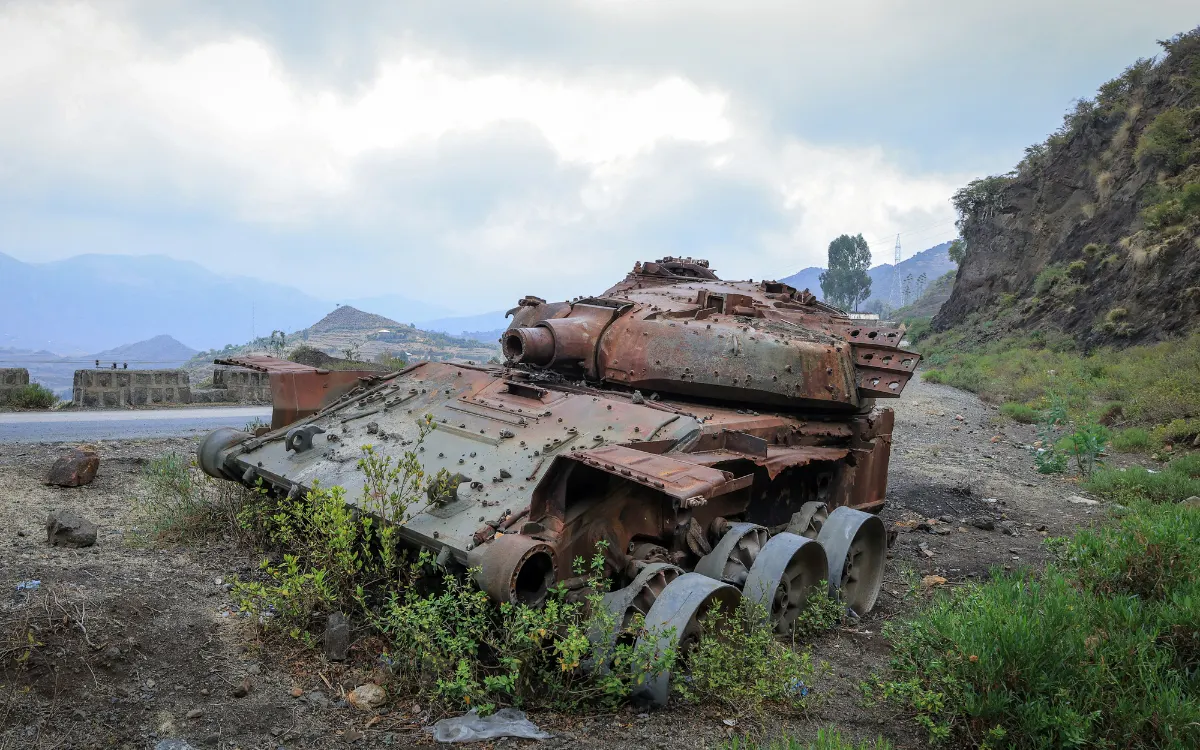
Nearly four years after Ethiopia’s federal government and the Tigray People’s Liberation Front signed an African Union-brokered agreement intended to end one of Africa’s deadliest recent wars, the settlement faces its most serious test yet. Renewed fighting in northern Ethiopia, combined with an extraordinary alliance of armed movements once divided by bitter rivalries, is turning what had been a deteriorating peace process into a broader challenge to Prime Minister Abiy Ahmed’s government. The immediate danger is no longer simply the collapse of the Pretoria Agreement, but the possibility that Ethiopia’s separate regional conflicts could converge into a multi-front challenge to federal authority.
The escalation accelerated on Wednesday, September 23, 2026, when Tigrayan forces seized the airports at Mekelle, Axum, and Shire, while fighting spread across several locations involving federal forces. Tigray’s authorities described their action as a “defensive war,” while federal officials accused the Tigray People’s Liberation Front (TPLF) of mounting an offensive extending into neighboring Afar and Amhara. By September 24, TPLF Vice President Amanuel Assefa was describing the confrontation as a “full-blown war.” Ethiopian Airlines suspended flights to Tigray. Fighting across all three regions suggests the confrontation is already moving beyond a narrowly defined Tigray dispute.
Just days earlier, the TPLF joined six other armed and opposition movements to create the Ethiopian Peoples’ Forces Alliance for Survival, whose declared objective is to remove Abiy’s government and establish a transitional administration. The coalition brings together the TPLF, the Amhara Fano National Movement, and the Oromo Liberation Army (OLA), alongside groups from Afar, Somali, and Benishangul-Gumuz areas. Most strikingly, Tigrayan forces and Fano were enemies during the 2020–22 war. Their willingness to cooperate now reflects how opposition to Addis Ababa is temporarily overriding some of Ethiopia’s deepest political and territorial divisions. The groups accuse Abiy’s government of centralizing power and marginalizing Ethiopia’s regions.
That does not necessarily make the alliance cohesive. Fano and the TPLF retain profound disagreements, including over contested territory, while the seven movements have different political objectives and operate across widely separated areas. International Crisis Group analyst Magnus Taylor told the media that cooperation could be constrained by the weakness of some members, geographical distance, and political differences. Yet the immediate significance lies less in whether the coalition can operate as a unified national army than in whether it can force Addis Ababa to confront simultaneous and increasingly connected insurgencies.
Yet the immediate significance lies less in whether the coalition can operate as a unified national army than in whether it can force Addis Ababa to confront simultaneous and increasingly connected insurgencies
Why Pretoria is Breaking Down
The crisis also exposes the weaknesses embedded in the November 2022 Pretoria Agreement. The accord stopped large-scale fighting, but several of its central provisions were never fully implemented. Disarmament remained incomplete, displaced populations were unable to return to some contested territories, and disputes over political authority and territory persisted. Neither Eritrea nor Amhara forces, two important actors in the previous war, were signatories.
The settlement deteriorated further after divisions inside the TPLF and the reassertion of control by the faction led by Debretsion Gebremichael. In May, the TPLF restored Tigray’s pre-war regional council and installed Debretsion as regional president, undermining the political arrangements created under Pretoria and creating competing claims to authority in Tigray. Clashes followed near the Sudanese border in August, while the European Union has subsequently reported several Ethiopian National Defense Force drone strikes.
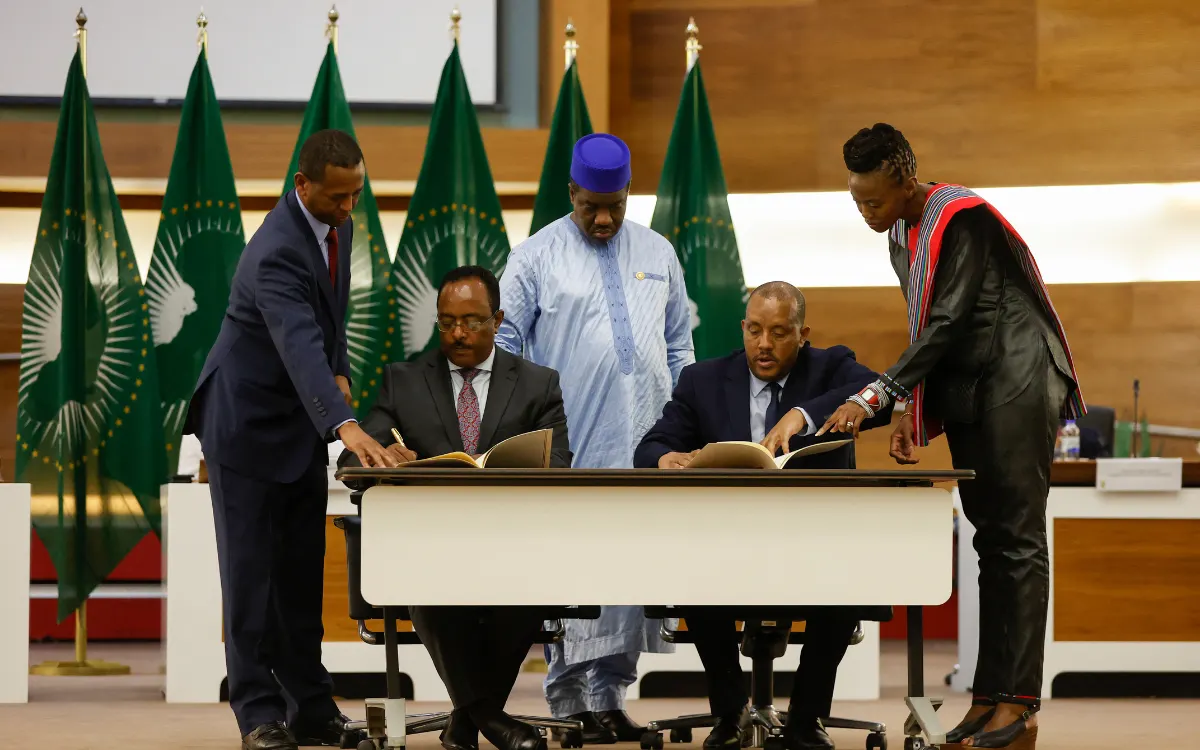
The timing of the latest escalation therefore reflects more than the sudden resumption of battlefield hostilities. Pretoria’s political framework had already been eroding, while the emergence of a cross-regional anti-government alliance gave the TPLF a potentially more favorable strategic environment in which to confront Addis Ababa. The September fighting represents the militarization of a political breakdown that had been developing for months.
Pretoria’s political framework had already been eroding, while the emergence of a cross-regional anti-government alliance gave the TPLF a potentially more favorable strategic environment in which to confront Addis Ababa
The agreement therefore risks becoming operational more on paper than on the ground. A TPLF spokesman has declared it no longer valid, although the African Union insists Pretoria remains the “cornerstone” for peace and has called for immediate de-escalation. The distinction matters: formally, the agreement has not disappeared; practically, military developments are overtaking mechanisms designed to implement it.
A Government Facing Several Fronts
Abiy’s government retains significant advantages, including the federal military, control of national institutions, and a large parliamentary majority following the 2026 election. But its security burden is substantial. Federal forces have already been confronting Fano in Amhara and the OLA in Oromia, while renewed war in Tigray would create another major theater. The new alliance could therefore test Addis Ababa less by defeating the federal military outright than by stretching its forces, finances, and political attention across several regions simultaneously.
The central question is consequently one of state capacity as much as battlefield strength. Federal forces retain superior national military resources, including air power, but simultaneous operations across Tigray, Amhara, and Oromia would require Addis Ababa to sustain manpower, financing, and administrative control across widely separated theaters. Politically, the government must also prevent tactical cooperation among groups with otherwise incompatible agendas from hardening into a more durable anti-federal coalition. The alliance does not need a unified national command to impose costs on the government if its members can maintain pressure on several fronts at once.
The external dimension makes that challenge more dangerous. Addis Ababa accuses Eritrea of financing armed groups in the new alliance; Asmara has repeatedly denied such allegations. Relations between the former allies have deteriorated sharply since Pretoria, particularly amid Ethiopian demands for reliable Red Sea access and discussion of Eritrea’s strategically important Assab port.
Eritrea is therefore the most consequential external variable: it fought alongside Ethiopia against the TPLF during the previous war but remained outside the Pretoria settlement, and any material support for Addis Ababa’s opponents would represent a significant reversal of the earlier regional alignment. At present, however, allegations of Eritrean support do not amount to evidence that Asmara is directing the current fighting or that Eritrean forces have entered the conflict.
The wider environment is equally combustible. Sudan is already at war, while Ethiopia’s relations with Egypt remain strained over the Grand Ethiopian Renaissance Dam. Eritrea has cultivated ties with both Sudan and Egypt. These relationships create potential channels through which the conflict could acquire a broader regional dimension, but there is not yet evidence that those states are directly involved in the present escalation.
The immediate question, therefore, is no longer simply whether Pretoria can be fully implemented. It is whether diplomacy can restore its authority before Ethiopia’s separate conflicts merge into something larger. The seven-group alliance remains internally fragile, but Wednesday’s fighting demonstrates that coordination between some of its members is no longer theoretical.
The immediate question, therefore, is no longer simply whether Pretoria can be fully implemented. It is whether diplomacy can restore its authority before Ethiopia’s separate conflicts merge into something larger
Without rapid de-escalation, Ethiopia risks moving from an unfinished peace toward a multi-front conflict whose consequences would extend well beyond Tigray and across the region.