
Israeli Prime Minister Benjamin Netanyahu’s confrontational UN General Assembly address sharpened a widening diplomatic divide over Gaza, the West Bank, and Palestinian statehood, days after Jordan’s King Abdullah II delivered one of the assembly’s strongest criticisms of Israeli policy.
Abdullah argued that Gaza and the West Bank should not be viewed as separate crises, accusing the Israeli government of pursuing policies intended to make a viable Palestinian state impossible. He described developments in the West Bank as “forced displacement” and a “war crime,” while accusing Israel of attempting to impose a new territorial reality in Gaza. The king also warned that Israeli actions beyond the Palestinian territories were becoming a regional security concern.
Israel’s Foreign Ministry responded publicly, rejecting Abdullah’s criticism and invoking Jordan’s 1988 disengagement from the West Bank. Netanyahu separately accused Jordan of having “slandered Israel from the UN podium,” although he did not issue a detailed response to the substance of the king’s allegations. Despite the increasingly bitter rhetoric, Israel and Jordan continue to cooperate on water, borders, and other areas under their 1994 peace treaty.
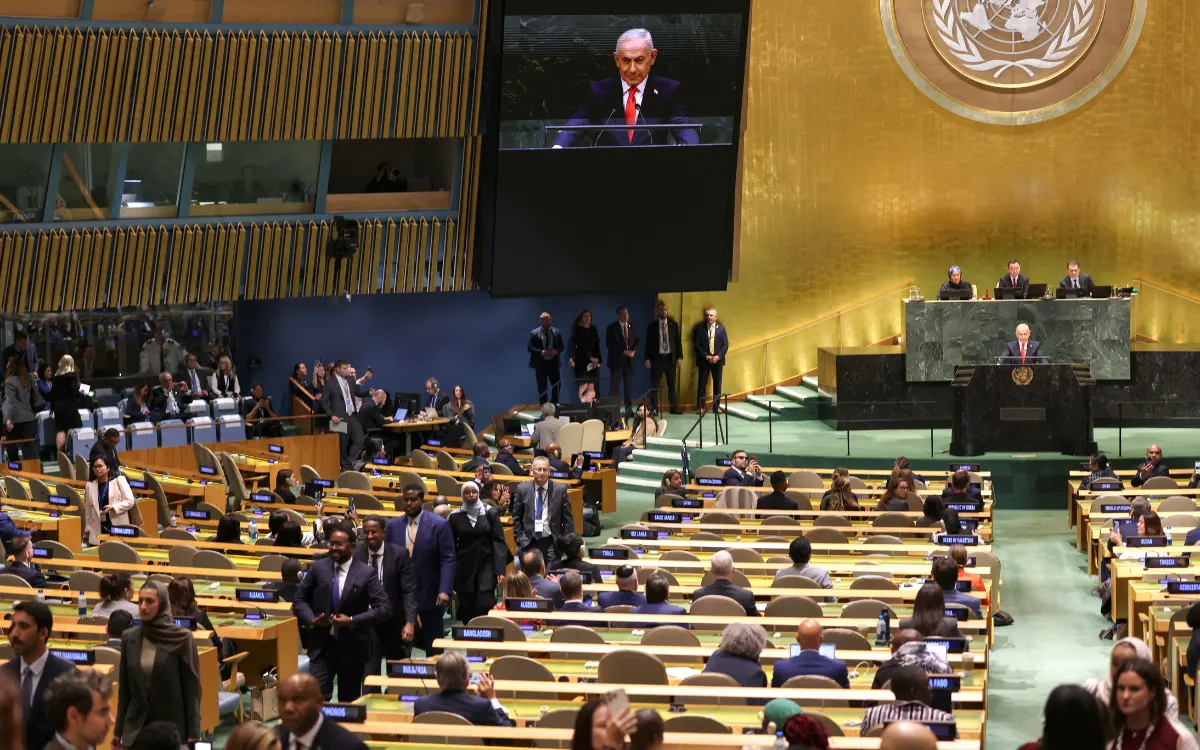
Netanyahu then used his own UN address to confront a broad range of critics, including Iran, Turkey, Britain, France, and New York Mayor Zohran Mamdani. Dozens of diplomats walked out as he spoke, some booing, while members of his delegation stood and applauded.
“If there are any other moral cowards who haven’t left this hall, please do so now,” Netanyahu said in reaction to the departures.
Netanyahu criticized Britain and France, longstanding Israeli partners that have become increasingly outspoken over Israeli policy and intensified his attacks on Turkey. He accused Ankara of supporting Hamas and lashed out at President Recep Tayyip Erdogan, prompting the Turkish presidency’s communications director to describe the accusations as “baseless.” Netanyahu also defended the war against Iran, saying Israeli and U.S. attacks had prevented Tehran from developing nuclear weapons, and suggested that the fall of Iran’s leadership was not “far.”
The contrasting UN addresses demonstrate how disagreements over Israel are increasingly moving beyond criticism of the Gaza war toward a broader dispute over the future of the Palestinian territories and regional security. Abdullah presented Gaza and the West Bank as interconnected parts of the unresolved Palestinian question, while Netanyahu defended Israel’s wartime policies and confronted governments challenging them. The increasingly public Israel–Jordan dispute is particularly significant, illustrating the growing tension between Israel’s established regional relationships and widening political disagreements over Palestinian statehood and the territorial future of Gaza and the West Bank. (AFP+EIR)