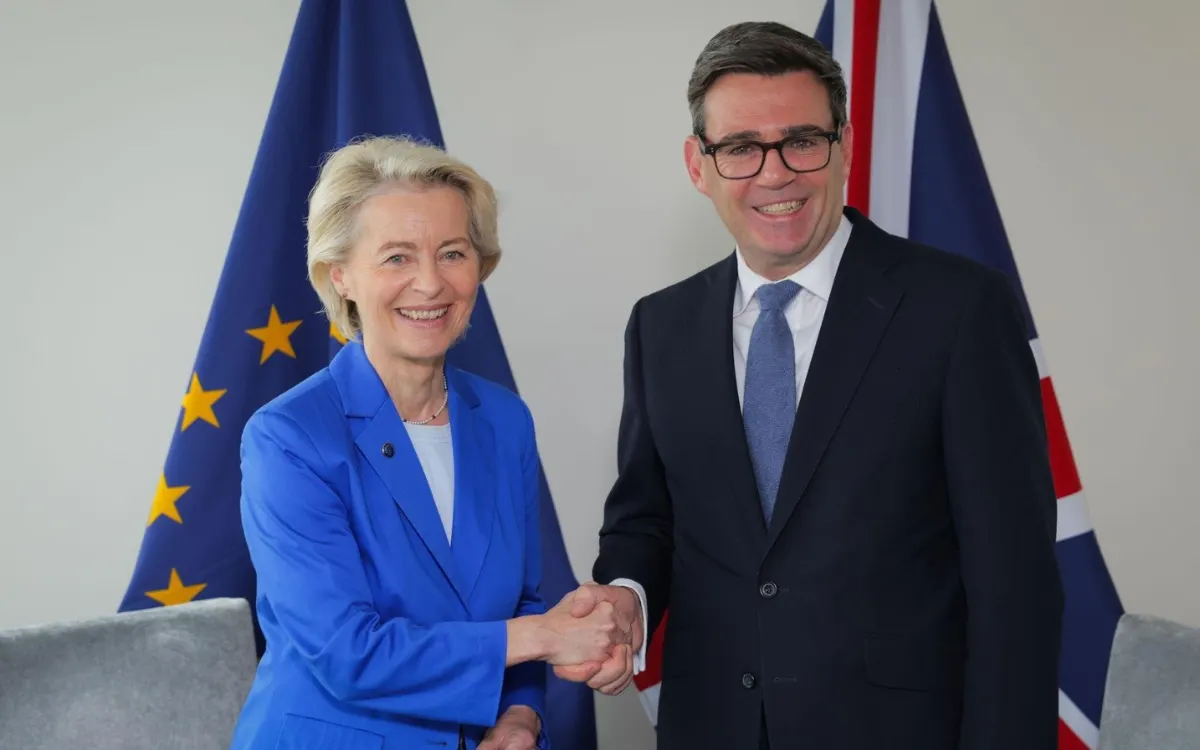
British Prime Minister Andy Burnham will meet European leaders in Dublin on Thursday as London and Brussels prepare to finalize agreements aimed at strengthening relations after Brexit. The talks come ahead of a November 20 UK–EU summit expected to deliver three agreements designed to boost economic cooperation.
Burnham will attend the European Political Community meeting before traveling to Brussels next week for talks with European Commission President Ursula von der Leyen and European Council President Antonio Costa. The anticipated agreements would reduce barriers to food exports, link British and EU emissions-trading systems, and establish a youth mobility scheme, although details remain under negotiation.
“There could be a significant prize next week if we successfully secure practical agreements that make the country better off,” Burnham told his cabinet Tuesday, according to the British government. A senior EU diplomat told French media that the three agreements appeared largely settled, although negotiations over their presentation and implementation were continuing.
The diplomatic effort builds on the rapprochement initiated by Burnham’s predecessor, Keir Starmer, following Labour’s 2024 election victory. Burnham has signaled openness to exploring closer integration with the EU, potentially including eventual membership, but disagreements remain over university tuition fees for EU students and Britain’s participation in the bloc’s “Made in Europe” industrial initiative. An earlier draft summit statement would allow young people to live in each other’s territories for up to three years for work, study, or travel. Thursday’s Dublin gathering will also focus on Ukraine, with President Volodymyr Zelensky seeking European support for security guarantees amid renewed U.S.-mediated negotiations with Russia.
The November 20 summit will test whether Britain and the EU can translate their political rapprochement into tangible economic benefits while navigating unresolved disputes. The scope of the final agreements, particularly on youth mobility and industrial cooperation, will indicate how far both sides are prepared to deepen relations without reopening the fundamental question of Britain’s EU membership. (AFP+EIR)