
As Washington continues military operations against Iran, the debate over the campaign is shifting from the scale of the damage inflicted to the question of what would follow if the Islamic Republic’s ruling structure were to collapse.
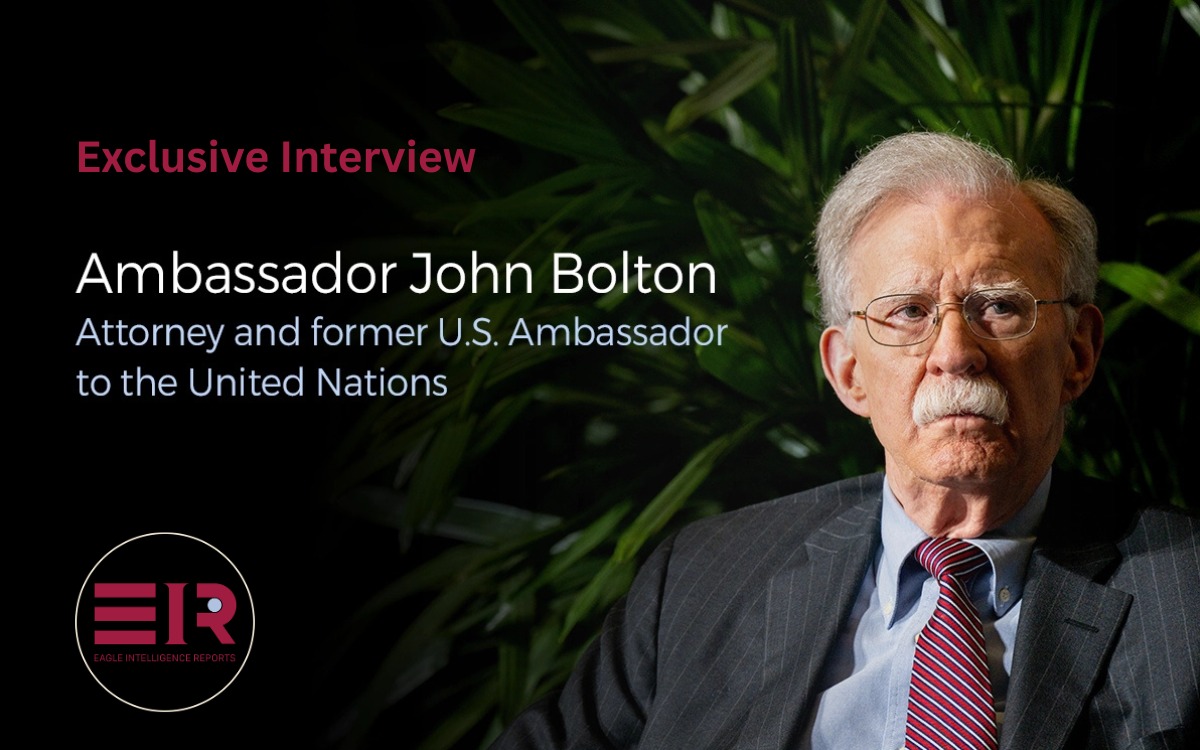
In an interview with Eagle Intelligence Reports, former U.S. National Security Adviser John Bolton said the “most benign outcome” could be a military government led by elements of Iran’s conventional armed forces rather than the Islamic Revolutionary Guard Corps.
Bolton distinguished between the two institutions, saying the regular military was responsible for defending the country while the Revolutionary Guard defended the regime. “If the IRGC survives as the most powerful force,” he said, “it will simply spend every effort to recreate the regime.”
By contrast, he said elements of the conventional military might be capable of restoring internal order and establishing a constitutional process through which Iranians could decide what form of government they wanted.
“I’m not saying that’s a fountainhead of Jeffersonian democracy,” Bolton said. “I’m just saying they would have the capability to restore order internally.”
Who Governs?
His answer addressed one of the central questions surrounding any effort to remove the Iranian regime: who could exercise authority the next day, particularly if the country’s most heavily armed institutions remained intact.
Bolton did not argue that the regular military was prepared to assume power, nor did he describe such an outcome as inevitable. He presented it as the “most benign outcome,” in a scenario in which the Revolutionary Guard and its Basij militia were weakened to the point that they could no longer operate as effective forces.
He also acknowledged that the danger of instability would not disappear with the regime. Iran, he said, has been governed by an oppressive system for 47 years, and there would be “scores to be settled.” He pointed to ethnic tensions involving Kurds, Balochis, and other groups as possible sources of internal fragmentation.
Bolton nevertheless argued that questions about Iran’s eventual political structure could not be resolved while the existing regime remained in power. In his view, removing the regime would have to come first, with the debate over the country’s future political shape following afterward. “You have to get past this regime to have that debate in a rational fashion,” he said.
The former national security adviser also criticized the Trump administration for failing to prepare adequately for regime change. He said the administration had not completed the necessary preliminary work before military operations began and had not done enough to organize, equip, or engage the Iranian opposition.
Bolton described that lack of preparation as a “conceptual failure” that continued to affect the campaign. He argued that involving the opposition had always been a critical prerequisite for any serious attempt to change the regime.
What Is Victory?
Asked what an American victory in Iran would look like, Bolton said the answer was difficult to determine because President Donald Trump’s objectives had apparently changed several times over the course of the conflict.
What are Donald Trump’s objectives? I can’t answer that question. I don’t know what his objectives are. I’m not sure he does either
Bolton said that at the beginning of the campaign, he believed Trump was aiming at regime change but that the administration had not prepared for such an outcome. He said Trump and his advisers later referred instead to degrading Iran’s military forces, damaging its nuclear weapons program, and weakening other elements of state power.
“Since the objectives keep changing,” Bolton said, “it’s hard to have a metric that can give you an answer to the question.”
He said American strikes had inflicted substantial damage on Iran’s military-industrial complex, critical elements of its defense forces, and other institutions of state power. But he stopped short of describing the campaign as a victory. “Successful, but not victory,” he said.
Bolton also said the destruction of Iran’s nuclear and terrorist capabilities would be beneficial but would not necessarily remove the long-term threat. Referring to the Israeli expression “mowing the lawn,” he warned that periodically degrading Iran’s capabilities could eventually fail if Tehran succeeded in acquiring nuclear weapons.
Trump’s Hormuz Blind Spot
The interview also addressed Washington’s handling of the crisis at the Strait of Hormuz. Bolton said the Trump administration did not appear to have anticipated that Iran might attempt to close the waterway, even though previous American administrations had treated that possibility as a foreseeable risk.
“There is no chance,” Bolton said, “that the Pentagon didn’t tell him multiple times that it was possible that Iran would try and close the Strait of Hormuz.”
There’s no chance that the Pentagon didn’t tell him multiple times that it was possible that Iran would try and close the Strait of Hormuz
He said he was surprised that Congress was not examining the matter in hearings and asked what had happened inside the decision-making process that allowed the United States to be caught by surprise.
Bolton also discussed the possibility of a prolonged naval operation in the Gulf. He said a strategy aimed at blocking Iranian oil sales while restoring commercial traffic and energy exports from the Arab Gulf states could require a sustained, long-term military presence, particularly if the Revolutionary Guard survived. “We can suppress the threat from the Iranian side,” he said, “but we can’t eliminate it.”
There could be a need for a very long-term, sustained operation, particularly if the Revolutionary Guard survives. We can suppress the threat from the Iranian side, but we can’t eliminate it
He argued NATO members participating in such an operation would have to be prepared to use force. “If the Europeans think that the naval force in the Gulf would be like a UN peacekeeping operation, where the participants are authorized to use force only in self-defense,” Bolton said, “that’s not going to cut it against the Revolutionary Guard.”
Bolton also suggested that Ukraine’s experience using naval drones against Russia’s Black Sea Fleet could be relevant to Western maritime operations in the Gulf.
Trump, Netanyahu, and Strategic Objectives
On Israel, Bolton said Prime Minister Benjamin Netanyahu’s objective had been regime change in Iran from the outset. The Israeli government, he said, viewed it as a prerequisite for eliminating Tehran’s support for “terrorist proxies like Hamas, Hezbollah, and the Houthis.”
He said Netanyahu had held the same position during Trump’s first term and rejected the argument that, as he put it, “sweet-talking Bibi Netanyahu conned Trump into launching military action.”
“I don’t know what Bibi would say in the second term that was any different than what he said in the first term,” Bolton said. He added that Israel had learned to adjust to Trump’s stop-and-start approach to military action while maintaining its own strategic objectives. “Attack for six weeks, then stop, then now we’re attacking again,” he said. “Their objectives don’t change. They are thinking strategically even if we are not.”
Bolton also gave a broader assessment of Trump’s approach to national security. He said the president did not have a philosophy, a national-security grand strategy, or a conventional approach to policymaking. Trump, he said, tends to focus on the issue immediately before him, make a decision, and then move to the next one. Bolton described that approach as transactional and based on what Trump believes to be in his own interest.
People say Trump’s thinking is not linear and that’s a good thing. Well, sometimes, being able to move a train down a set of railroad tracks is a good thing to do. That’s not the way he operates
He cited Trump’s short-lived proposal to charge a toll of 20 percent of the value of cargo moving through protected Gulf shipping lanes as an example. Bolton said the proposal reflected Trump’s instinct to ask what share he could obtain from a particular arrangement.
NATO, Ukraine, and the War in Iran
Bolton also addressed NATO and Europe’s response to the Iran conflict. He criticized Trump for failing to consult European allies, Gulf Arab states, major Asian energy importers, or the American public before launching military operations.
At the same time, he described the initial European refusal to support the campaign as “petulant” and “childish,” arguing that European governments had misread their own strategic interests.
The European reaction was petulant—sort of childish—in saying, “Well, the war in Iran is not our war. We’re not affected by that.” That’s just a misperception of their own strategic interest
He said European states would be affected by higher global oil prices, were geographically closer to Iran and were more vulnerable to Iranian intermediate-range ballistic missiles. He also argued that Iranian-backed terrorism had affected Europe at least as much as the United States in recent years.
Bolton said European governments did not necessarily have to support every American military action outside NATO in order to preserve U.S. support for Ukraine. But he argued that Europe’s initial reaction to the Iran campaign had been a mistake and said more European leaders were beginning to recognize their interest in preserving freedom of navigation.
He also repeated his criticism of Trump’s attitude toward NATO, saying the president had a fundamental aversion to the alliance and did not understand how alliances operate. Bolton said the immediate objective should be to protect NATO from further damage during the remainder of Trump’s term and attempt to repair the alliance under a future president.
Defense Spending and Great-Power Strategy
The interview then turned to the strain on American military power. Bolton rejected the argument that commitments in Iran, Ukraine, and the Indo-Pacific should lead the United States to retreat from strategically important positions.
He said the United States and its European allies had allowed defense spending to decline after the end of the Cold War, reflecting what he described as 35 years of misapprehension. He argued that Washington should return to spending levels comparable to the Reagan administration, amounting to approximately 5 to 6 percent of GDP.
Although Bolton described the wars in the Gulf and Ukraine as the most urgent current conflicts, he said the larger strategic challenge of the 21st century remained China and its hegemonic ambitions in the Indo-Pacific and beyond. “There’s a saying in government: Don’t let the urgent crowd out the important,” he said.
There’s a saying in government: “Don’t let the urgent crowd out the important.” And the big conflict in the 21st century is China and its hegemonic aspirations worldwide
He also warned that China’s growing nuclear capabilities and its partnership with Russia were pushing the international system toward a tripolar nuclear order in which existing theories of deterrence would no longer be adequate.
The following is the full transcript of the interview, edited lightly for clarity and style while preserving the substance of Ambassador Bolton’s remarks.
Q: We’d like to start with Iran. The U.S. has launched a new wave of strikes today, while Tehran claims it struck targets in Bahrain, Kuwait, and Jordan. What would an American victory in Iran look like?
Bolton: Well, that really raises the question: “What are Donald Trump’s objectives,” and I can’t answer that question. I don’t know what his objectives are. I’m not sure he does either. At the beginning of the campaign, at the end of February this year, I thought—and I think many others did as well—that Trump was aiming at regime change. If that was his objective, he didn’t prepare for it. He didn’t do the necessary preliminary work. I could go on at length about that, but suffice it to say there were many things he didn’t do that he should have done.
Subsequently, Trump has said, “Well, we did achieve regime change. The people who were there then are not there anymore.” But really, that’s not true either. I think we decimated the top level of the government. I think what’s left is really not functioning as a government. That’s one reason why negotiations over the Memorandum of Understanding were probably doomed from the start.
But in other senses, Trump and his advisors have said, “No, it really wasn’t regime change that was our objective. It was to degrade Iran’s military forces, its nuclear weapons program, and other things.” Since the objectives keep changing, it’s hard to have a metric that could give you an answer to the question. I would say, as of today, the U.S. and Israeli strikes did very substantial damage to Iran’s military-industrial complex and critical elements of its defense forces and other institutions of state power. Successful, but not victory. The position we’re in now is because the Trump administration apparently did not anticipate that Iran might close the Strait of Hormuz. And I can’t answer why they didn’t anticipate it. Every other American administration has anticipated it, including Trump 1.0.
Q: Yeah. And certainly he received security briefings that said as much.
Bolton: There’s no chance that the Pentagon didn’t tell him multiple times that it was possible that Iran would try and close the Strait of Hormuz. This is a big question. I’m surprised Congress isn’t addressing it in hearings. What happened that allowed us to be caught by surprise?
Q: If the nuclear program is destroyed and degraded and the Revolutionary Guard is destroyed and degraded, should Trump then call it quits, even if we don’t have full regime change?
Bolton: If I thought that the Revolutionary Guard, the Basij militia, the Quds Force were really destroyed, then I would think there was a chance perhaps for the regular army, which is charged with the defense of the country, as opposed to the Revolutionary Guard, charged with defense of the regime. You might get a military government. It might not be too bad. It might have military leaders with enough understanding that they would create a constitutional process for Iranians to decide what kind of government they actually wanted.
I think the Revolutionary Guard is a very tough nut to crack. I think that’s why pulling the regime apart at the top is so important, and why involving the Iranian opposition was always a critical prerequisite to any real shot at regime change. There’s no doubt that doing damage to Iran’s nuclear capabilities and its terrorist capabilities is a good thing. But, you know, the Israelis call this “mowing the lawn.” You can do it every couple of years, but one of these times you’re going to make a mistake. You’re going to find Iran actually now has nuclear weapons, and mowing the lawn isn’t going to be much of a possibility.
Q: It seems that the war so far has really fragmented Iran, if we think about it as one unit. You recently wrote in The Wall Street Journal that there’s no real single authority to deal with, to negotiate with, and that that’s the problem with talks. If that’s true, what could additional military pressure do? What could it produce? Who’s it influencing?
Bolton: I think the cumulative effect of military action to date really has decimated the top leadership. I think there are a lot of people in Iran who can see that the regime is sinking and who might well be persuaded they don’t want to go down with the ship. The country’s economy was in terrible shape before the war began. The pounding that it’s taken has worsened the economy in the military production fields. A lot of factories and assembly facilities were destroyed. The blockade that is now back in force against the export of Iranian oil means the country is not earning any revenues.
The situation is growing grimmer and grimmer inside the country every day. And I think, hopefully, at some point, somebody inside says, “This can’t go on any longer.” And we can find somebody to negotiate with. I don’t know who that is, and I think that our lack of preparation in advance to deal with the opposition—to help get them better organized and better equipped—really was a conceptual failure that haunts the operation to this day.
Q: Who governs Iran the next day? What institutions should be preserved during a potential regime change, and which should be eliminated?
Bolton: I think the kind of base level functions of government—the collection of trash and that sort of thing—that probably goes on, because those institutions are not really decided upon at top levels of government. But the problem is the regime itself has functioned more for its own preservation than for anything having to do with the people. My feeling, as I’ve mentioned, is that, ultimately, the most benign outcome is a military government—not by the Revolutionary Guard certainly, but by elements of the conventional military.
I’m not saying that’s a fountainhead of Jeffersonian democracy. I’m just saying they would have the capability to restore order internally and to give the people of Iran who are—it must be said—very substantially intimidated by what the regime has done to them. When you massacre 40,000 people—as most reports indicate, that may be a minimum figure—but when that happened in January, people were afraid to express opinions. And it’s not easy to give them assurance that they can come out and begin to participate in any kind of political life until this regime is gone. As long as the shadow of the regime lasts over Iran, it’s very difficult to see any way to progress.
Q: Let’s say that there’s a transition. The power is going to fall presumably to those who are most heavily armed, so the IRGC. Wouldn’t that spread a great deal of instability throughout Iran and possibly spill over into the neighboring states, perhaps across the Gulf, across the region?
Bolton: I think if the IRGC survives as the most powerful force, it will simply spend every effort to recreate the regime. I think it’s the IRGC that’s the main problem. My hope in terms of restoring stability inside Iran is that the regular military will step in—that we will so degrade the IRGC and the Basij militia in particular, that it is not a functioning force anymore. There is some danger of instability inside Iran. Look, people have been under this oppressive regime for 47 years. There are scores to be settled. And I think we have to look at it with open eyes.
And there are ethnic forces inside the country that want to split off. I think that’s where the risk of instability is: the Kurds, the Baluchis, others. That might be managed in the short term to focus on eliminating the regime itself, because until you get rid of the regime, there’s no point talking about what the shape of Iran looks like going forward. You have to get past this regime to have that debate in a rational fashion. And I think it could be contentious down the road, but the U.S. objective—and I really think for the good of the people of Iran—their objective should be to get rid of the regime and then worry about what comes next.
Q: Do Trump and Netanyahu have the same objectives in Iran? Do they still have the same objectives, or is there a contradiction there?
Bolton: Because we don’t know Trump’s objectives, I can’t really answer it. But I think I can say with confidence that the objectives of the Israeli government under Bibi Netanyahu were regime change in Iran. And they see that as a prerequisite to eliminating the regime’s terrorist proxies like Hamas, Hezbollah, the Houthis, and others. This was the same view that Netanyahu took in the first term. I certainly did my best to persuade Trump to adopt regime change as the objective. Obviously, in the first term, we failed.
And it’s also one reason why I don’t think that it’s accurate to say that somehow sweet-talking Bibi Netanyahu conned Trump into launching military activity. I don’t know what Bibi would say in the second term that was any different than what he said in the first term. There must have been some other factor that persuaded Trump to act. And I think it’s been uncomfortable for Israel to see Trump stop and start approaching things: attack for six weeks, then stop, then now we’re attacking again. But I think they learned to adapt. Their objectives don’t change. They are thinking strategically, even if we are not. And they will simply adjust the tempo of their activity based on whatever Trump’s mood was in any given hour of the day or night.
Q: Let’s talk specifically about Trump as an individual. You’ve known him through close government service. What is it that actually influences him the most? Is it oil prices, American casualties, avoiding the image of weakness? What do you think?
Bolton: Well, he doesn’t have a philosophy. He doesn’t have a national security grand strategy. He doesn’t really even do policy the way most people understand that term. His attention span is relatively short, and he thinks primarily in terms of what issue is before him at any given moment. A lot of his supporters say he plays this very complex game of three-dimensional chess. That’s not it at all. He makes decisions and then moves on and makes the next decision. People have called it transactional. I think that’s probably a pretty good description. And it applies for what is it that he thinks of is in his best interest.
So, for example, we have the recent case where Trump says, “We’re putting a blockade back on Iran. We’re going to open the Gulf Arab side for commerce. I think that’s the right thing to try and do.” And then he says, “And we’ll charge 20 percent of the value of all cargo as a toll,” which is Trump’s mind at work. “What can I get out of this? What piece of the action am I going to get? How about 20 percent?” That lasted less than 24 hours.
And instead he’s got billions of dollars of new investment in the United States from the Gulf Arab countries. I don’t know how you measure that. What’s the delta between what they were going to do anyway and what they may do now? But that’s how he sees things. And it’s a good example of that quick turnaround—that quick reversal—as to how unfocused his thinking really is. People say it’s not linear, and that’s a good thing. Well, sometimes, being able to move a train down a set of railroad tracks is a good thing to do. That’s not the way he operates.
Q: Let’s talk about NATO for a moment. Recently you’ve said that Europe’s refusal to join the operation in Iran could possibly lead to Trump abandoning other initiatives like that in Ukraine. Is that still your position?
Bolton: I think Trump made a big mistake before launching military operations not to consult with Europe and our allies in NATO. Of course, he also didn’t consult with the Gulf Arabs, who are directly affected by it. He didn’t consult with our allies like Japan, South Korea, Taiwan, and the Indo-Pacific that get a lot of their oil from the Gulf. He didn’t consult with the American people. He didn’t really consult with anybody.
But I think the European reaction especially was kind of petulant—sort of childish—in saying, “Well, the war in Iran is not our war. We’re not affected by that.” That’s just a misperception of their own strategic interest. Oil prices are set globally. When the price of oil goes up because of war in the Gulf, their price of oil is going to go up too. They are closer to Iran than we are and more vulnerable to Iran’s intermediate-range ballistic missiles, and there’s been as much, if not more, Iranian-backed terrorism in Europe in recent years than in the United States.
I think many European leaders now recognize this. Secretary General Mark Rutte of NATO said at the Ankara summit that he supports Trump’s activity in Iran and thinks that other Europeans will come along. I hope they do too, because they have a huge interest in preserving freedom of the seas on a worldwide basis and making sure that what’s left of the regime in Iran doesn’t continue to threaten not only the Middle East, but themselves in their own homes.
Q: In a scenario where European countries begin to join the effort in Iran, does that mean that Europe must support an American war outside of NATO in order to preserve American support for the defense of Ukraine?
Bolton: Not necessarily. I think the way the Ankara summit came out turned out very beneficially for Ukraine. At least we can hope so. We’ll see how long it lasts. But I think the knee-jerk European reaction against what Trump was doing to Iran in February, March, and April was a mistake on their part. And I think more and more of them are coming to see that.
Look, Trump has a fundamental aversion to NATO. He doesn’t understand how alliances work. He particularly still doesn’t understand NATO. I’m glad we got through the Ankara summit. Our goal should be to get through the next two and a half years with as little additional damage to NATO as we can accomplish and then try and fix things. Trump may have ups and downs in his perception of NATO, but his fundamental unease with it I don’t think will disappear.
Q: Let’s say that the Europeans begin to follow along with this operation. They begin to defend the Strait of Hormuz. What does that look like after two months, three months?
Bolton: If what Trump is going to do is something along the lines of what I and others recommended—block Iranian sales to squeeze them financially, but get commerce coming from the Gulf Arab side to get total production of oil from the Middle East into global markets, roughly equivalent, or at least just a little bit less than what it was prewar—I think there could be a need for a very long-term, sustained operation, particularly if the Revolutionary Guard survives. We can suppress the threat from the Iranian side, but we can’t eliminate it.
So having other NATO members with naval components who could form part of a naval force in the Gulf is important. What we need from the Europeans is a commitment they’re willing to use force. If they think that the naval force in the Gulf would be kind of like a UN peacekeeping operation, where the participants are authorized to use force only in self-defense, that’s not going to cut it against the Revolutionary Guard. We need stronger deterrence against what the Iranians did in taking over the Strait. But they have to recognize that if they try it again, they will regret doing it. And that means, I think, commitments to use force from people who participate in a naval force. So we’ll see how that discussion goes.
It would be in the Europeans’ interest to do that, frankly, to get a little bit of practical experience, hopefully in a not very dangerous environment. I think this is also a way to help work with Ukraine, which again demonstrates now capabilities with naval drones against the Russian Black Sea fleet that could be very useful to us and our drone capabilities at sea in the Gulf.
Q: What would you say to internal differences within the NATO alliance and their posture on the Iran operation—Spain, for example, with Pedro Sanchez, and complicated politics with Kier Starmer in the UK and the use of bases?
Bolton: Again, these are countries reacting in a petulant kind of way, not thinking of their own strategic interest. And it means we need to do more of what George Shultz, Secretary of State for Reagan, used to call “gardening”—alliance management, to try and get past some of these disputes.
I would say to the Europeans, regardless of the specific treaties, bases, access agreements, and so on we have on our bases around Europe, every one of those bases in every one of those countries was built on the understanding that it was not just for NATO, but it was in aid of America’s global transportation networks and our ability to project force beyond Europe. They all knew it, and they all accepted it at the time. They welcomed it.
And if some countries aren’t willing to accept that anymore, then we have to have some hard conversations with them because that capability is critical to us. And, ironically, even countries like Italy, as we saw, that said, “Well, no missions against Iran were flown from Sigonella or other bases in Italy”—that’s true. But plenty of other planes on their way to the region went through those bases, and they thought that was OK. So it’s complicated, but I think this is part of the damage to the NATO alliance that needs to be fixed under the next president.
Q: On the global American force and American capabilities around the world, many would argue that the United States seems overstretched—Iran, Ukraine, a possible scenario with Taiwan. What would you say?
Bolton: I think we’re suffering from 35 years of misapprehension that resulted from the end of the Cold War and the collapse of the Soviet Union. When some people said we had reached the end of history, others were saying that we were going to get a peace dividend—that globalization would take care of everything. That was obviously naive at the time, and we’ve suffered from it in many respects.
In the U.S., for 35 years, we’ve missed two generations of political leaders who can address people and explain why a vigorous American presence in the world is in their interest. A lot of other countries benefit from it, but we’re not doing this as an act of charity. We’re doing it because it benefits us. And part of the burden to bear is we have to be prepared. And we’ve let defense expenditure slide not just among European NATO members, but in the United States as well.
We need to get to Reagan administration levels of defense spending, 5–6 percent of GDP, and we need to do it soon. So I think there may be a short-term constraint. But for those who say, “My goodness, we’ve got constraints. I guess we have to withdraw from strong positions around the world,” the answer to that is of course not. You build up your capabilities. You don’t retreat from positions that are in our advantage to hold.
Q: Let’s say that the U.S. is stretched between these different strategic fronts. Which are the biggest priority for the administration or perhaps an incoming administration?
Bolton: I think simply because we’re engaged in hot wars in the Gulf and Ukraine, those are the two most pressing. But, you know, there’s a saying in government: “Don’t let the urgent crowd out the important.” And the big conflict in the 21st century is China and its hegemonic aspirations along its Indo-Pacific periphery and worldwide, the axis that Xi Jinping and Vladimir Putin are forming—what they themselves have called a “partnership without limits.”
All this needs urgent attention. And in particular, given China’s increase in its nuclear capabilities, we are very rapidly approaching in nuclear terms a tripolar nuclear world in which all of our deterrence calculations are going to be out of date. All of our deterrence theories are based on essentially a bipolar nuclear world. And those don’t apply when we have two potentially hostile nuclear peer competitors that are threatening us.