
The greatest risk facing shippers, importers, and exporters is not the blockade of the Hormuz Strait but rather its normalization under conditions of weak deterrence and asymmetric dependence. The Hormuz crisis is one episode—albeit of great significance—of a broader pattern of maritime coercion, the targeting of critical infrastructure, and economic and trade coercion. In isolation, these threaten the global trade system; together, they could paralyze it.
The wars in Iran and Ukraine have disrupted the global economy, but it is their longer-term significance that is central. The issue is not that the old system has yet collapsed, but that such disruptions are increasingly used as tools of statecraft to build the new one. Together, they suggest a future move toward protectionism, the normalization of targeting civilian terrestrial and maritime infrastructure, and increasing pressure on the norms that underpin freedom of navigation.
The wars in Iran and Ukraine have disrupted the global economy. Such disruptions are increasingly used as tools of statecraft to build the new system
Maritime Coercion Across Theaters
These patterns are not confined to a single region. Across multiple theaters, states are increasingly threatening civilian infrastructure, free trade, and freedom of the seas. These dynamics overlap in real time, reinforcing one another’s international impact and compounding at strategically significant moments.
Iran is carrying out in Hormuz an intensified version of what we have seen from the Houthis in the Red Sea: the use of threat and intermittent maritime disruption to exert influence over trade and transit without full control. Such actions may create a precedent for more assertive maritime behavior, though their applicability remains uneven. Beijing, for example, may interpret these developments as expanding the range of options available. It may calculate that its ambitions for Taiwan and broader control in the South China Sea have been implicitly legitimated by the actions. Indeed, for some time now China has been cutting undersea cables around Taiwan. Still, any attempt to replicate such actions in East Asia would be constrained by China’s dependence on maritime trade.
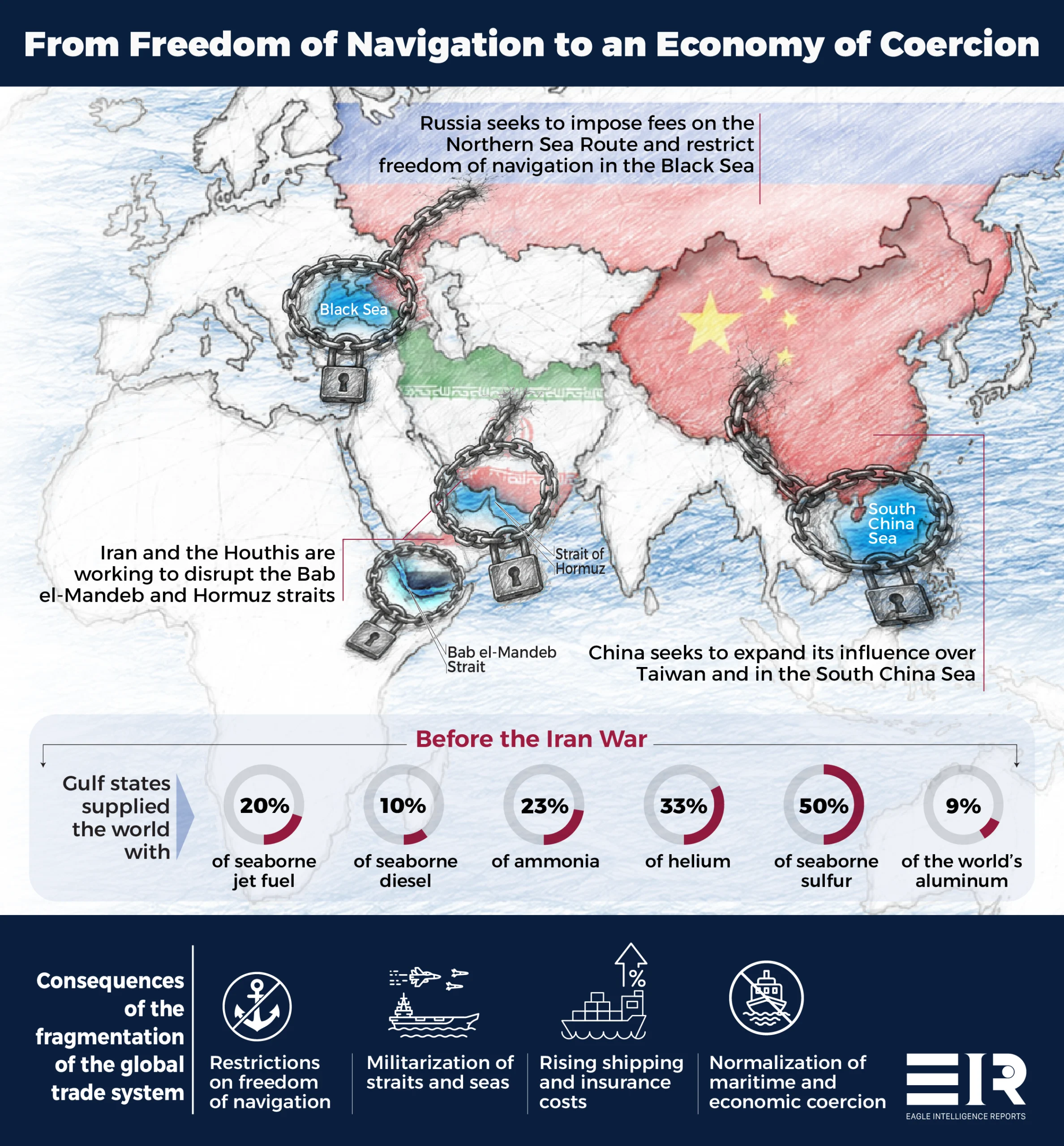
In the maritime domain, Russia provides one of the clearest examples of the shift towards constricting freedom of navigation, and not only in reference to its attempt to cut off Ukraine from the Black Sea. Since 2014, it has deployed nuclear-capable ships in the Black Sea to intimidate the other littoral states. It has also seized Ukraine’s maritime and energy installations off Crimea in the wake of the 2014 annexation and conducted threatening overflights of offshore Romanian energy infrastructure.
Yet, Russian encroachments on freedom of navigation do not stop here. While many countries and authorities claim the Northern Sea Route (NSR) through the Arctic is an international waterway, Moscow insists that the NSR is part of its internal waters under the UN Convention of the Law of the Sea. On these grounds, it wants to charge shippers fees to use the NSR. The ensuing boycott of the NSR due to Russia’s aggression against Ukraine is costing shippers an estimated $3–5 billion annually, mostly to find alternative routes and markets.
Russia’s invasion of Ukraine in 2022 intended to seize its coastline, including Odesa, cutting off maritime trade. The reverberations of Moscow’s war extend beyond the battlefield. When the West imposed sanctions, Russia retaliated by attacking undersea infrastructure in the Baltic Sea and improvising a so-called shadow fleet estimated at between 400 and 600 ships to sell Russian oil and gas and obtain scarce goods to circumvent and defy sanctions.
These ghost ships may represent a new norm in maritime commerce that, in evading targeted sanctions and other pressure exerted by the West, may have significant commercial costs—not to mention environmental costs in the case of a spill. Such costs are passed along to European and Asian consumers because these ships are old, poorly maintained, and often lack insurance.
Ghost ships represent a new norm in maritime commerce that may have significant commercial costs passed along to European and Asian consumers
Moreover, Russia is now providing armed aerial or maritime escorts for them, mainly in the Baltic, thereby signifying potential militarization of the high seas—a potential flashpoint for escalation if they are stopped by European authorities. The response of European states to desist from stopping Russian shadow ships—as has been the case with Estonia—reinforces and justifies the credibility of Russia’s escalation threats.
Maritime Disruption Without Sustained Control
Beyond the European theater, events in the Red Sea and Gulf regions illustrate how non-state actors and regional powers can use this type of maritime disruption to exert pressure on trade, threatening the freedom of the seas without assuming the costs of sustained control. Recent Houthi threats to seize or strike Western or Israeli ships in the Red Sea are instructive. As of March 2025, these strikes were costing Egypt $800 million monthly. Likewise, subsequent U.S. military operations against them cost between $2.8–4.9 billion, including starkly asymmetrical costs such as the use of $2 million missiles to overcome $2,000 drones.
Meanwhile, U.S. officials have claimed that China is transferring satellite imagery and drone components to the Houthis, while Russia—often working through Iran if not directly—has transferred weapons, logistical support, and satellite targeting data and capabilities. Since the Houthis are aligned with Iran, their efforts to disrupt shipping in the Red Sea, attack ships, and carry out partial and intermittent blockades of Western and Israeli shipping all implicate Iran in these processes even before the current war began. Indeed, it is likely that Iran—or the Houthis acting as Tehran’s proxy—may find it strategically useful to effectively close both the Bab el-Mandeb and Hormuz Straits to international trade.
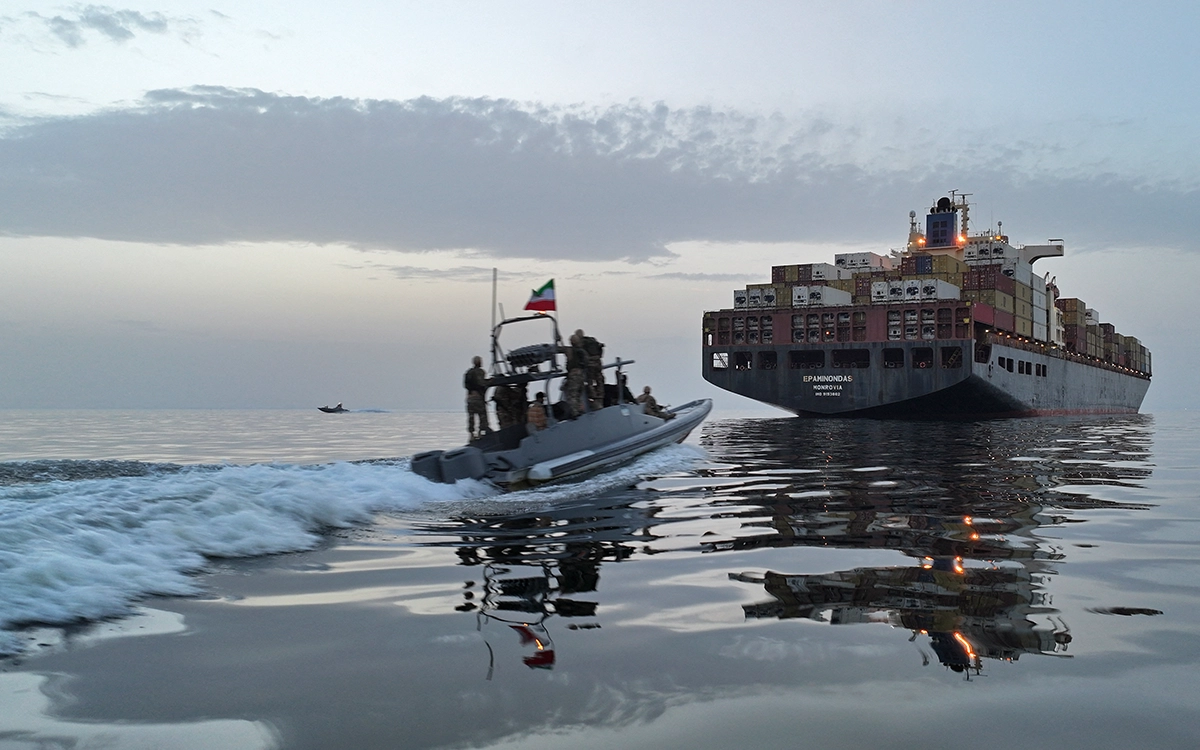
Finally, Iran and the United States have effectively militarized the Strait of Hormuz, extending this pattern. Iran claims unilateral control over it and states its intention to charge as much as $2 million per cargo ship traversing it, while the United States reactively imposed a blockade on all traffic to and from Iranian ports. The dual blockade has already had a dramatic effect on the global economy, forcing shippers and traders to find alternatives for stranded goods. As the Atlantic Council of the USA reports, before the Iran war, the Gulf supplied roughly 20 percent of global seaborne jet fuel, 10 percent of seaborne diesel, 23 percent of ammonia, and 33 percent of helium. Half of global seaborne sulfur came from the Gulf too, as did 9 percent of the world’s aluminum.
Economic Pressure and Trump’s Tariffs
Maritime disruption operates alongside and interacts with a broader context of trade and economic coercion as a tool of statecraft. Clearly, the impact of the disruption transcends trade in oil and gas, extending to all commodities that depend on energy inputs, including foodstuffs, fertilizers, and so-called dual-use goods. It also impacts transit and access to rare earths and minerals that are increasingly vital for high-tech investments like data centers for AI, environmental alternatives to fossil fuels, and high-tech weapons. Together, these dynamics fragment trade flows, increasing price volatility and reducing the resilience of global supply chains. In short, they threaten a general erosion in the U.S.-led international trade order that has sustained the global economy for decades.
President Trump has framed his recent aggressive trade policy—including the greatly expanded use of tariffs and industrial controls—as a measure designed to ensure the economic security of the United States. Yet the strategy may undermine the stability of the U.S.-led international trade regime, suggesting a retreat by Washington from a position of international primacy. Instead, the emerging era increasingly resembles one in which might makes right and protectionism is favored over free trade. In this context, both economic and real warfare are becoming pervasive, entailing serious, lasting, and persistent upward pressure on prices.
The foregoing incursions on the freedom of navigation and free trade have shown the Trump administration that it too can engage in such behavior with impunity, leading the administration to impose a full blockade on Cuba rather than the long-running embargo. But apart from this episode and its current blockade of the Iranian ports in the Gulf, Trump’s most consistent contribution to the rupture of free trade is his habitual recourse to tariffs on all manner of goods, even with long-established American partners like Canada, Mexico, and the EU.
U.S.–China Competition and Economic Coercion
China’s recent actions represent the convergence of economic and maritime coercion, driven by the intensification of U.S.–China competition and extending into critical supply chains that have until now relied on free trade. When Trump imposed tariffs on China in 2025, Beijing retaliated by imposing strong export controls on rare earths, underscoring U.S. and other countries’ dependence on them. Trump had to retreat and begin devising a U.S. industrial policy that resembles China’s state-driven plan to dominate the processing of rare earths and other critical areas.
China’s recent actions represent the convergence of economic and maritime coercion, driven by the intensification of U.S.–China competition and extending into critical supply chains
Yet, despite lifting some export controls, China has doubled down on its strategy of leveraging rare earths and critical materials. It continues to impose tight controls on critical materials like gallium and heavy rare earths, placing importing countries that rely on Chinese production, refining, and processing under increasing pressure to reassess their strategies for clean energy, defense, and technology.
Such a posture blurs the boundaries between China’s economic and security policy. It is also paired with an increasingly aggressive posture at sea. Despite China’s years-long seizure, annexation, and military buildup of disputed islands in the South China Sea, it has escaped any lasting consequences. Thus China advances while rivals or competing claimants to these islands are either distracted or too weak to resist. Having claimed much of the South China Sea, China is building a new base at Antelope Reef and has also just announced a program to build up 11,000 islands that it claims.
Given the shifting global economic-security context, a Hormuz-style disruption in East Asia would likely trigger China to follow in Russia’s path, relying on a shadow fleet to circumvent sanctions and other measures. Given its capacity to leverage vital rare earths, in any great-power conflict, China would be able to apply economic pressure at the places and times of its choosing, without necessarily escalating to open conflict.
Price Transmission Mechanisms
Together, the Hormuz crisis, protectionism, and other threats to freedom of navigation generate upward pressure on prices. Indeed, today alone (May 4, 2026) the price of Brent crude oil jumped 3.8 percent to $113.
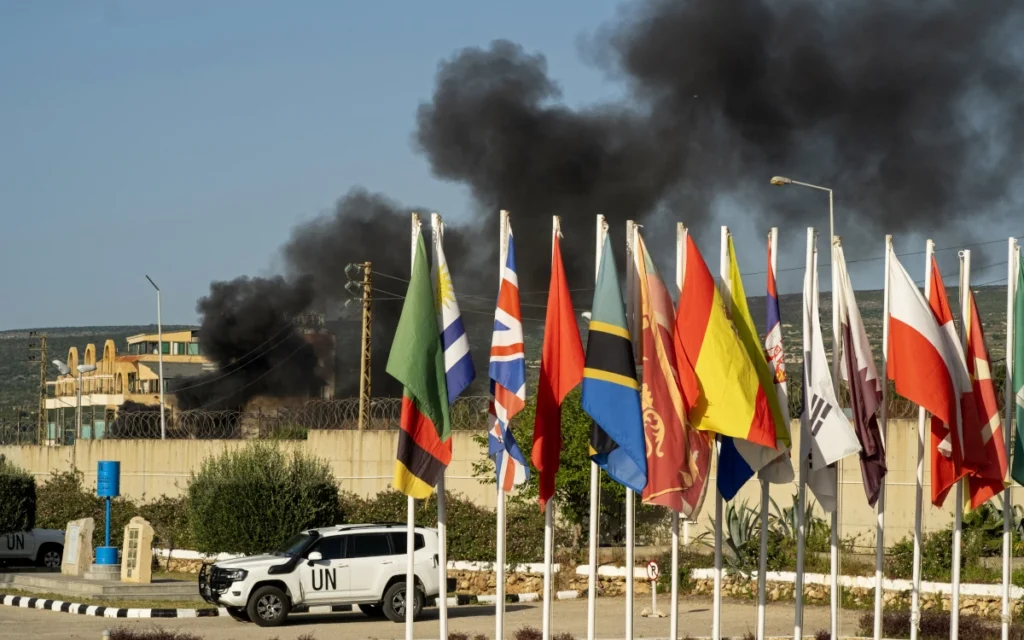
The blockade may require an international task force of naval, air, and either ground or amphibious forces to be deployed there for months or even years. Until that mission is complete, energy prices—if not others as well—will remain high. This factor, along with the blockade and Iranian missile and drone threats, forces shippers to find alternative routes and markets, especially as the Houthis retain the capacity to strike ships in the Red Sea in support of Iranian strategic goals. Meanwhile, the ongoing Israeli operation against Hezbollah in Southern Lebanon effectively rules out Haifa, Beirut, or Latakia as debarkation points.
Since shipping will take longer and be more dangerous, the already high energy and energy-related prices will likely rise further. Moreover, insurance premiums will go up as their risk factor will likely rise by an order of magnitude. Insurance prices have already surged so much that governments have been forced to intervene to replace private insurers, while Washington has also had to backstop insurance for ships traversing Hormuz.
The added costs—and thus prices—compound when you add the recent tariff wars to the equation. In fact, they had already generated global inflationary and recessionary pressures well before the U.S.–Israeli operation against Iran. All these trends, taken together—along with second-order developments and effects stemming from them—combine to raise not just energy prices but global prices for food, chemicals, transport, and insurance.
Systemic Convergence and Normalization
Across multiple regions, maritime activity is becoming increasingly entangled with broader geopolitical competition and conflict, raising the risk of escalation and further disruption. Economic coercion has led to the use of shadow fleets, military escorts, and the growing vulnerability of European undersea and land-based infrastructure. This all points to a more complex, rather than less complex, operating environment. In that context, the effects of President Trump’s unpredictable and often erratic approach to problem-solving are likely to be magnified.
Maritime activity is becoming increasingly entangled with broader geopolitical competition and conflict, raising the risk of escalation and further disruption
Iran’s control over the Strait of Hormuz has been called the equivalent of a nuclear weapon but with an inexhaustible potential. But the weapon is much more deployable than a nuclear weapon and far more likely to be used. A precedent has been established in the global trade order. Other states may follow the cue—attempting to hold the global economy hostage.
Given the broader context, it is unlikely the Sino–American summit next month will offer much relief. On the contrary, it seems clear that the tendency for states to use maritime and economic instruments of coercion that threaten the freedom of the seas and free trade is likely to persist and perhaps intensify. Rather than marking a singular rupture, the Hormuz crisis may simply be the next episode in a broader normalization of disruption and instability—as features of the global trading system rather than bugs.