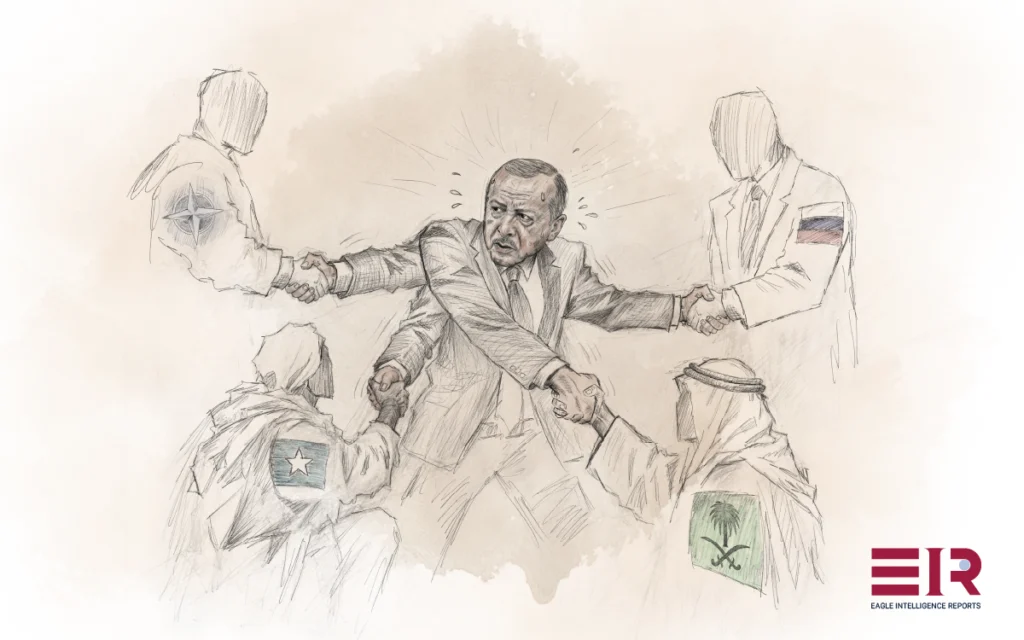


A German company’s quest for sovereign AI led it to China. In early October, the German search engine Ecosia announced it was ending its partnership with Mistral, the EU’s leading developer of large AI models, citing concerns including model performance. Five months earlier, Ecosia had left OpenAI, claiming that “partnering with European companies supports our mission for independent European tech that’s not subject to political whims.” It is now likely to move to Melious, a German platform that connects to Chinese and other open-weight models on European servers.
The case is Europe in miniature, struggling with domestic models and caught between American frontier models and Chinese open weights. It also captures a strategic dilemma. For European sovereignty, the ability to choose among models and switch between them may matter more than developing a competitive domestic model. Europe’s attempt to escape dependence on one great power may leave it leaning on that power’s chief rival.
If European governments and firms can switch readily between American, Chinese, and European models, no single company—or its home state—can easily turn technological dependence into sustained strategic leverage. But preserving that choice will not be easy. The more deeply AI is integrated into economies, the costlier switching becomes.
If European governments and firms can switch readily between American, Chinese, and European models, no single company—or its home state—can easily turn technological dependence into sustained strategic leverage
Chinese models may loosen America’s grip but bring risks of their own, from potential censorship to future restrictions imposed by Washington or Beijing. Yet beneath the model layer, the chips and cloud computing infrastructure needed to run AI remain dominated by the United States. The question is whether Europe can prevent any single power, ally or rival, from gaining decisive leverage over critical parts of its digital infrastructure.
Europe’s Sovereignty Agenda
Sovereignty is the current centerpiece of EU AI policy. The agenda blends ambitions to capture economic gains and reduce foreign dependence. Unveiling its June tech sovereignty package, the European Commission warned that “interdependence and trade-fuelled growth is turning into a landscape where asymmetric dependencies create geopolitical vulnerabilities.” Beijing’s 2025 retaliatory export controls on the China operations of Nexperia, a Netherlands-based, Chinese-owned chipmaker, and Washington’s June 2026 restriction of Anthropic’s most advanced models highlighted these vulnerabilities.
An internal tension defines the EU’s approach. As Commission President Ursula von der Leyen stated in September, “We do not need to be the ones who develop the frontier technology to… draw the greatest value from it.” To that end, the EU’s “Apply AI” strategy encourages businesses to reorganize around AI. But absent competitive domestic options, this weaves foreign technology deeper into the economy. U.S. closed models, such as those from Anthropic, Google, and OpenAI, pose especially acute risks. Access is rented continuously and, like a gas pipeline, can be cut off.
Despite domestic investment, the EU remains behind on the inputs and technologies underlying AI. Epoch AI found that 75 percent of AI supercomputing capacity is in the United States and less than five percent in the EU. Accordingly, the EU views tech sovereignty partly in functional terms: the ability to act autonomously and avoid key vulnerabilities without a complete domestic “stack” of infrastructure.
A prominent view holds that the EU should keep access to U.S. frontier models but needs, in the words of European Central Bank President Christine Lagarde, “good enough” domestic options. Mistral leads among European general-purpose providers, but its Large 4 model, due for full release in late October, trails U.S. and Chinese leaders. Germany’s Aleph Alpha, which had already narrowed its ambitions to government and enterprise users, agreed to be acquired by Canada’s Cohere. The Frontier AI Grand Challenge, Europe’s public bid to build frontier AI, was awarded only in June. The risk is that “good enough” models cannot compete on the open market and end up filling narrow roles where security outweighs performance, sustained in part by state support and public procurement.

How a model is offered also shapes user control, complicating sovereignty. Closed models, such as OpenAI’s GPT, are typically accessed remotely and run on the provider’s computers. Frontier models, the state of the art, are closed and U.S.-based. Open-weight models, such as DeepSeek, publish their parameters and can be downloaded and hosted locally, although licensing terms vary. When they are run on European-owned infrastructure, open weights can preserve European control, even if made elsewhere.
When they are run on European-owned infrastructure, open weights can preserve European control, even if made elsewhere
Sovereignty through Substitutability
The key to securing functional sovereignty may be substitutability, or the ability to swap one model for another, like substitutable goods in economics. This requires both alternatives and the means to switch.
For much of the AI supply chain, a single country or even company dominates: China for rare earths, TSMC for advanced chips, ASML for advanced lithography machines. Models are different, with multiple options available. The geopolitical upshot is that leverage from a strategic resource depends on others lacking alternatives. In 2024, the European Commission joined U.S. and UK competition authorities in a statement endorsing variety and competition between models. If users within the EU can swap and choose among models, they preserve autonomy by eliminating points of dependency, even if no models are actually European.
Multi-model approaches have already emerged as a hedge, in part through the material impacts of trade disputes. Siemens and Renault have confirmed they are pursuing multi-model strategies that include Chinese options, an approach that the June export controls reportedly accelerated. In the public sector, Germany’s KIPITZ, France’s Albert API, and even the European Commission’s GPT@EC are built to accept a range of models.
The Challenge of Moving Models
An alternative, domestic or foreign, reduces geopolitical vulnerability only if users can switch to it. Contractual obstacles, such as fees and multiyear contracts, and technical ones can drive lock-in and undermine substitutability in practice.
The EU’s strength as a large market with a unified regulatory system may prove instrumental. Its 2023 Data Act offers one template, although its original motivations were economic. It eased switching between cloud computing providers by mandating data portability to lower technical barriers and curbing switching fees, a contractual barrier. The three leading cloud providers waived data-transfer fees for departing customers in early 2024, even before the mandate became binding.
While a regulatory answer to contractual obstacles would be straightforward, AI poses distinct technical challenges. Ecosystem integration, evaluations, scripts, workflows, and tooling can all lock users into a model. In a June IBM Institute for Business Value survey, 71 percent of senior executives stated switching would be difficult. Some 56 percent asserted that moving AI systems would take at least six months. Model switching is most achievable with “model-agnostic” architecture, such as platforms built to run multiple models. Such architecture could most realistically be mandated in public procurement.
Model switching is most achievable with “model-agnostic” architecture, such as platforms built to run multiple models. Such architecture could most realistically be mandated in public procurement
The Cloud and AI Development Act (CADA), proposed in June, builds on the Data Act but focuses on underlying infrastructure. The wider tech sovereignty package gently favors European options by promoting open source and allowing non-price criteria in public procurement. No substantive provision addresses model switching. A Transformative AI Strategy for Europe, a prominent independent policy blueprint, flags the gap. It recommends portability requirements and multi-vendor terms for public AI procurement.
The challenge for Europe is time. Remedies for model lock-in would work best before AI is further integrated. Switching capacity is also fundamentally defensive. It protects European institutions and consumers against foreign leverage but does not steer them toward domestic options. Despite the Data Act, European providers’ share of the European cloud market has held steady at about 15 percent since 2022, according to Synergy Research Group.
Hedging Washington through Beijing
Without a competitive European model, general-purpose options condense into two at the state level: U.S. closed models and Chinese open weights. China thus emerges, awkwardly, as a backstop for European tech sovereignty, even as Brussels seeks, in von der Leyen’s term, to “de-risk” its relationship with Beijing.
U.S. closed models provide performance, ecosystem compatibility, and the backdrop of a longstanding alliance. However, they grant the least autonomy and control. Europe may secure stronger use agreements, but these do not overturn the underlying dependency. As for performance, whether frontier capability is worth its cost, and for which applications, remains an open question. If frontier models prove necessary for cybersecurity and defense, the EU may depend on U.S. models precisely where it would most value control.
U.S. rhetoric is unenthusiastic about EU tech sovereignty ambitions. At the Brussels Economic Security Forum in June, U.S. Ambassador to the EU Andrew Puzder stated that the EU could not catch up on its own. It “can catch up by partnering with the United States,” he added. Yet U.S. behavior has been a primary spur for those ambitions. Microsoft reportedly cut off the email account of International Criminal Court prosecutor Karim Khan, although the company denied suspending its services to the court. Washington then temporarily imposed export controls on Anthropic’s most advanced models.
China trails the closed U.S. frontier but leads in open weights, with affordable models about six months behind. Measured by token volume, a standard gauge of use, Chinese models already lead in the EU on open developer platforms. Some major models, such as DeepSeek-V4, also carry permissive licenses that let EU organizations host and modify them independently. Even unused, Chinese alternatives strengthen the EU’s negotiating position with Washington and U.S. companies.
However, Chinese open weights carry their own risks. Self-hosted models cannot be shut off, but users may still depend on the provider for updates or other services. Model training also embeds political and social values that shape how a model answers questions, including through potential censorship. China’s 2023 Interim Measures for the Management of Generative AI Services require that generative AI services “uphold core socialist values.” Such biases can carry over into European deployments. Limited auditability also makes Chinese open weights hard to use for sensitive applications.
Chinese President Xi Jinping has previously endorsed European “strategic autonomy,” at least where it concerns independence from U.S. interests. Beijing has been more protective of its own strategic levers, such as export controls on rare earths and processing technologies. Chinese indifference to European sovereignty at the model level likely reflects relative weakness against U.S. models and strength elsewhere in the AI supply chain.
Chinese indifference to European sovereignty at the model level likely reflects relative weakness against U.S. models and strength elsewhere in the AI supply chain
For now, Chinese open weights buttress EU tech sovereignty as a viable option for many uses. But this status quo faces three potential shocks: the emergence of strong U.S. open weights, a shift in China’s approach, and U.S. restrictions on Chinese open weights. The first two have seen concrete steps, while the third remains a threat.
U.S. open-weight models still trail China’s, but firms such as Reflection AI now specifically target the sovereign model market. Meanwhile, China shows some drift toward more restrictive licensing. Alibaba’s Qwen rose to prominence as an open-weight family, but most of its recent flagship models have been closed, with Qwen3.8-Max a notable exception. At the government level, Beijing’s October draft export controls would require registration and licensing for exports of models reaching performance thresholds, foreshadowing greater control over new releases. Finally, U.S. national security and intellectual property concerns over Chinese AI developers led Treasury Secretary Scott Bessent to threaten sanctions and Entity List designations in July. Sanctions in particular could hit Europe indirectly, but as of October, no sanctions or designations have followed.

Shifting Ground in the AI Stack
Within the EU, two signs are worth watching. The first is the near-term emergence of a truly competitive EU model, which remains unlikely. Mistral, the obvious candidate, has already signaled a shift toward a broader platform-based strategy. The second is the explicit inclusion of model switching in CADA. Existing multi-model strategies and the ongoing debate on model switching make this more likely.
If Europe broadly attains model substitutability, leverage within the AI stack will shift. U.S. companies stand to gain most from dominance and lock-in at the model level. However, a rival ultimately needs only a single chokepoint, while the EU needs an answer at every link of the supply chain. That answer can be domestic capacity, such as the EU’s planned AI gigafactories, counter-leverage through chokepoints such as ASML’s lithography machines, or, at the model level, viable alternatives.
Leverage will move “up” to frontier performance, where options are scarcer. Shifts in Chinese corporate strategy and the draft export controls suggest Beijing could treat a near-frontier model as a national security asset, releasing it only under tight controls. Washington, on the other hand, has already shown it will restrict models for national security.
Leverage will also move “down” to the underlying layers of the supply chain. At current demand, the EU likely lacks the capacity to run foreign open weights exclusively on European-owned infrastructure. This puts U.S.-dominated chips and cloud computing back at the center as chokepoints for autonomy at the model level.
Despite continued U.S. strength in frontier models and cloud computing, China could emerge as the short-term winner of Europe’s tech sovereignty aspirations. Its open-weight strategy secures neither direct revenue nor a kill switch. But EU use of Chinese models extends Chinese influence, and Beijing retains leadership in key areas of the technology stack.
The EU’s predicament is shared by other states pursuing tech sovereignty. Powerful models are expensive, and domestic investment risks anemic results. Carefully managed sovereignty may still be achievable at specific layers, through switchable alternatives and narrow “good enough” domestic options.
Europe may not need to win the AI race for that. It may be enough to ensure that no outside power, ally or rival, can make itself indispensable. The victory would be partial, with China emerging a short-term winner and the U.S. continuing to dominate cloud computing. The result would be protection against coercion but no third option beyond Washington and Beijing. It may not be ideal. But for other states caught in the emerging bipolar AI order, it may be the most realistic form of sovereignty on offer.
Europe may not need to win the AI race to achieve a carefully managed sovereignty. It may be enough to ensure that no outside power, ally or rival, can make itself indispensable