
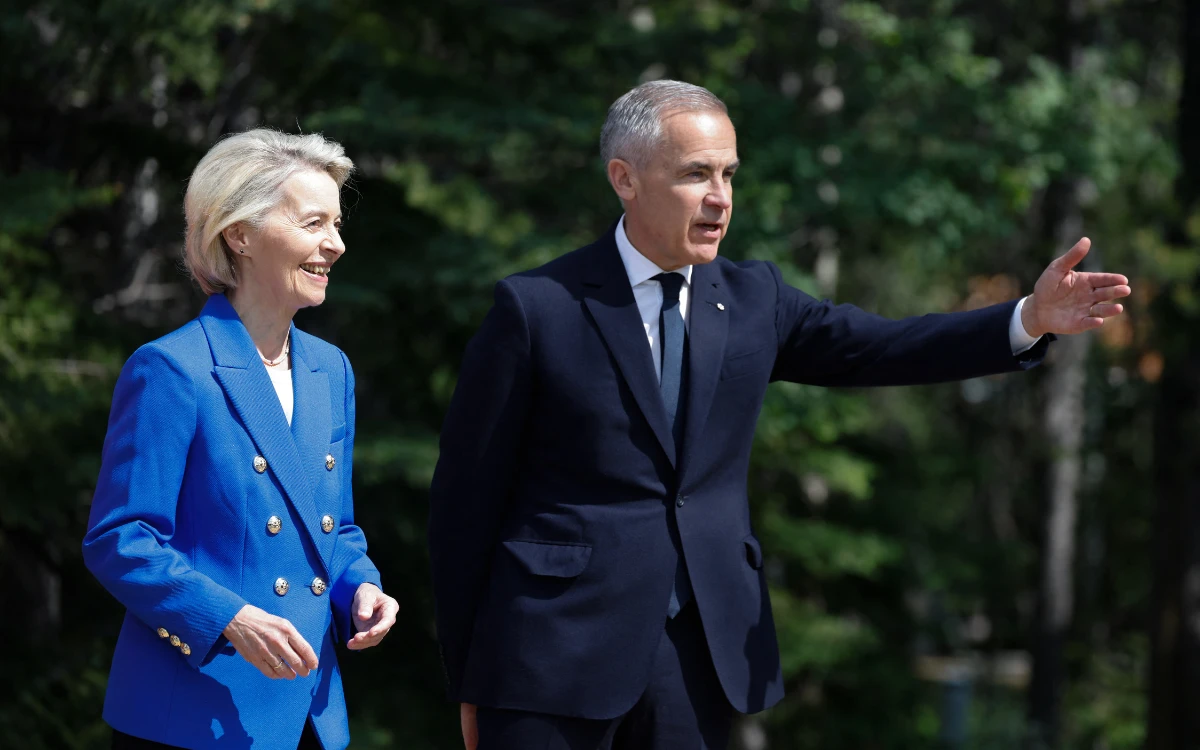
Prime Minister Mark Carney is set to travel to Strasbourg in France, where he will become the first head of government to attend the “State of the European Union” address on Wednesday.
He will also deliver his own speech at the European Parliament on Thursday before traveling to Liverpool, where he will meet Britain’s new prime minister, Andy Burnham, for the first time.
Carney, who called Canada “the most European of non-European countries,” is pursuing a “unique alliance” with the EU to reduce dependence on the United States, amid worsening relations with Washington.
Carney has already brought Canada closer to the bloc by making it the first non-EU country to join its defense procurement program. Ottawa and Brussels are closely aligned on artificial intelligence and climate and are working on a digital trade deal. These aspects, coupled with an April poll in which 57 percent of Canadians supported joining the EU, raised speculation about whether Canada could join the bloc. But Carney said on Sunday that Ottawa is not looking to become a member of the European Union. Next month, however, he will host an EU–Canada summit in Montreal, where he said discussions will begin on building “a much stronger and deeper economic and security partnership.”
Canada’s European push reflects a broader effort to reduce the strategic vulnerability created by its overwhelming economic dependence on the United States as relations with Washington become less predictable. Europe cannot replace the U.S. market—70 percent of Canadian exports still went to the United States in July—but deeper cooperation on defense, critical minerals, energy, technology, and trade could give Ottawa greater room to maneuver. Brussels has a parallel incentive to diversify its own partnerships, making closer EU–Canada ties mutually attractive even without membership. Carney’s challenge will be turning that political alignment into enough economic and security integration to meaningfully reduce Canada’s exposure to future shifts in U.S. policy. (AFP+EIR)