
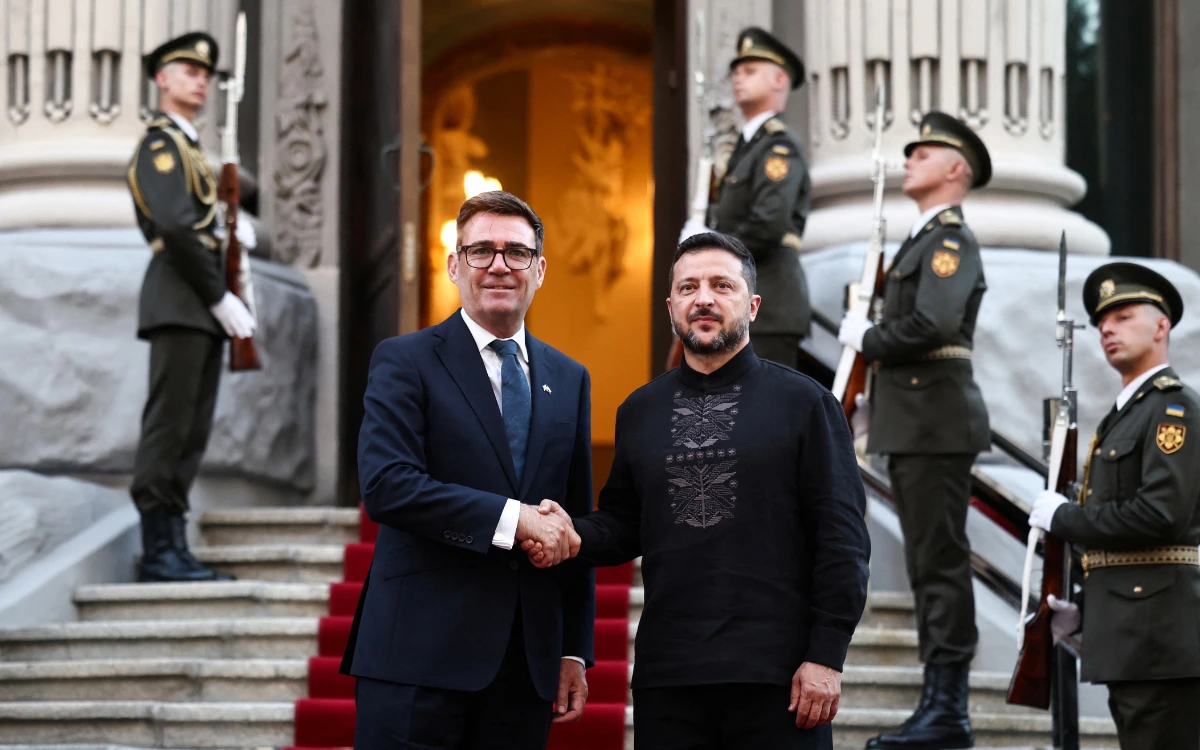
Andy Burnham made Kyiv—not Washington, Berlin, or Paris—the destination of his first foreign trip as prime minister. Arriving on August 24, Ukraine’s Independence Day, he joined European leaders in co-chairing a meeting of the Coalition of the Willing. No senior Trump administration official attended. But Burnham’s trip was more than a symbolic show of support. During the visit, Britain authorized missile maker MBDA to share information on British components in the SCALP cruise missile. The move clears the way for local assembly lines in Ukraine and marks a shift from supplying finished weapons toward transferring part of the capacity needed to produce them.
The announcement came nine days after press reporting in London named two British manufacturers whose drones had been used in Ukrainian strikes deep inside Russia. Moscow responded to that reporting on August 17. Britain, the Russian embassy in London said, was “deliberately opting for an escalation of the Ukraine crisis” and had become an “accomplice and co-perpetrator” whose conduct would “inevitably carry consequences.” The deeper Britain’s involvement, the embassy added, the higher the price it would pay. Foreign Minister Sergei Lavrov went further, arguing that British involvement in strikes on Russian territory would amount to participation in the war.
Britain’s defense ministry neither confirmed nor denied the drone reports. Asked about the Russian warning, Burnham said Britain was providing support so that Ukraine could defend itself. He added that this had been Britain’s position throughout the conflict under previous prime ministers and that it remained unchanged under his government.
What has shifted is the character of that support. London armed Ukraine first with anti-tank weapons and then with cruise missiles. It is now releasing the knowledge that allows Ukraine to build such weapons itself. At the same time, Ukraine has expanded its ability to carry out deep-strike attacks inside Russia, while the Russian military has intensified missile attacks across Ukraine. Russian missiles have struck across the whole of Ukraine since February 2022. Ukraine has been able to reach more than 1,000 miles inside Russia only in the past year. Moscow’s sharper language reflects both that change and the British drones, training, and intelligence behind it.
What Britain Supplies Ukraine
Britain is involved at several points along the strike chain. Some 63,000 Ukrainian personnel have passed through British training. Britain sent the first Western cruise missiles to reach Ukraine. It agreed in 2025 to co-produce long-range drones and has delivered more than 85,000 of all types in six months. It committed $6 billion in military aid in 2025 alone, out of $14.7 billion since February 2022. France and Germany also fund the campaign and share intelligence. President Emmanuel Macron said in January that France provides roughly two-thirds of Ukraine’s intelligence. Britain’s role includes manufacturing drones, training operators, and providing intelligence support.
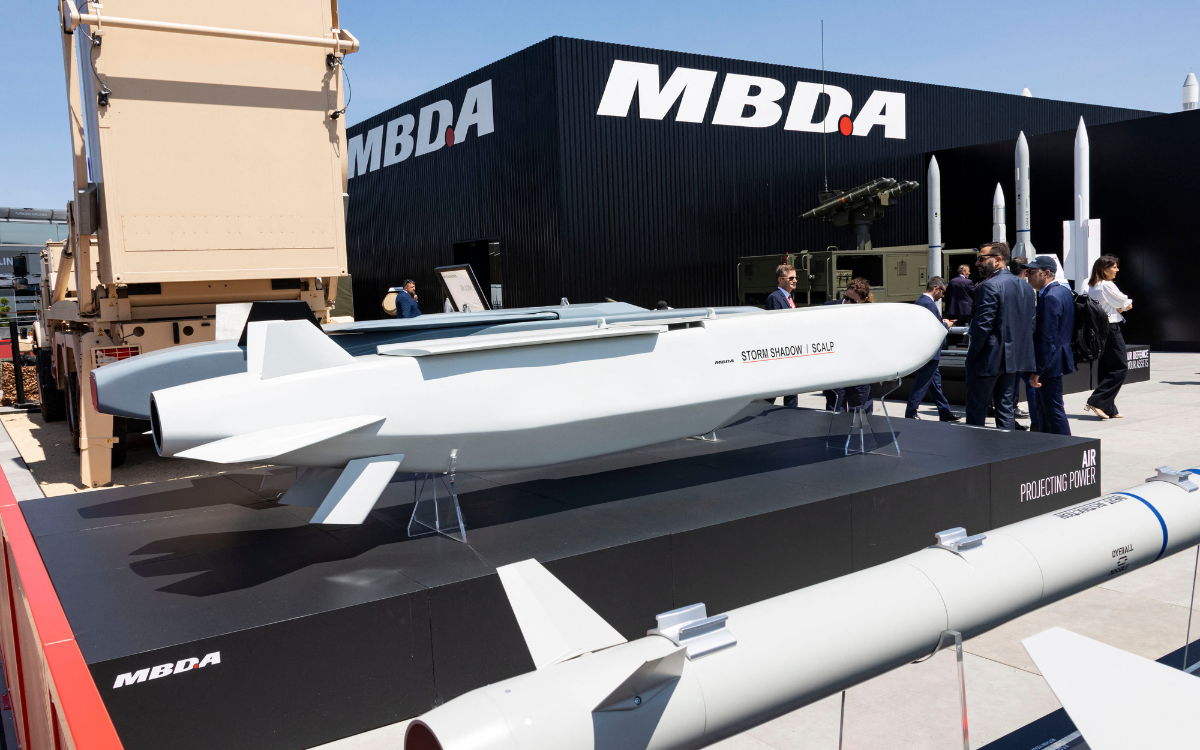
The decision announced in Kyiv adds a fourth role. SCALP is the French version of the British Storm Shadow. By lifting the classification on the British parts, London allows the missile to be assembled in Ukraine rather than shipped to it. SCALP reaches about 150 miles, well short of the drones Ukraine already flies more than 1,000 miles into Russia. The significance lies in the transfer of manufacturing rather than in added reach. A delivery of finished missiles can be halted at any point. Assembly lines inside Ukraine and the technical documentation that supports them would be harder to reverse if British policy changed.
SCALP reaches about 150 miles, well short of the drones Ukraine already flies more than 1,000 miles into Russia. The significance lies in the transfer of manufacturing rather than in added reach.
The same visit produced an agreement running in the other direction. Ukraine granted Britain access to Avengers, the database its forces use to train artificial intelligence models on battlefield data. Daylight and infrared sensors along the front supply it with images of tanks, artillery, air defenses, and drones. No country outside Ukraine has been given access before. In return, Ukraine gains access to British universities and technology firms, and the arrangement sits inside a longer-term partnership between the two governments.
A long-range drone becomes an effective deep-strike weapon only when supported by intelligence on the target, logistics, and targeting data. This means knowing where air defenses are positioned, which penetration routes offer the best chances, and which refinery components take the longest to replace. A drone may carry a serial number that identifies its manufacturer. The intelligence and targeting information behind a strike are harder to attribute. Britain provides both the drones and intelligence support relevant to their use.
The Shift to Long-Range Strikes
The war has changed shape. The front has barely moved in months. Russian forces hold close to a fifth of Ukraine and have gained little since the spring. Short-range drones have made concentration and movement too costly for ground attacks to pay, and both armies have put more weight on strikes from the air. Moscow fired over 450 missiles at targets across Ukraine in July, close to half of them ballistic. Ukraine sent more than 800 drones toward Russian territory on the night of August 15 alone, roughly 600 of them aimed at the Moscow region.
Ukrainian strikes now concentrate on refineries, fuel depots, and logistics warehouses, some of them more than 1,000 miles from the border. Estimates of the refining capacity taken offline run from 17 percent to more than 40 percent, depending on who counts. Fuel rationing has spread across several Russian regions. Kyiv has also begun striking warehouses belonging to the Russian online retailer Ozon, saying the company sells goods with military uses.
Civilians are absorbing the shift on both sides. United Nations monitors counted 437 civilians killed in Ukraine during July, the worst month since May 2022. A Russian strike on a shopping center killed at least 16 people on August 21. Russia’s foreign ministry reported 69 killed on its territory in a single week in August. Three people were killed in a Russian strike near Kharkiv in the hours before the Kyiv commemorations. Russian local officials said drone debris killed two children at a children’s center on the same day.
Moscow’s Case Against Britain
The vocabulary in the embassy statement is deliberate. Accomplice, co-perpetrator, and participation in the war are legal terms. They are intended to portray Britain as a party to the conflict rather than merely a supplier to Ukraine. Britain armed Ukraine with anti-tank weapons in 2022 and cruise missiles in 2023 yet drew a much milder response from Moscow. Moscow has protested weapons transfers before, but its latest warning is more direct. What changed is the damage the drones are now able to impose inside Russia. European governments reject that characterization, but the claim needs only to justify retaliatory measures to a domestic audience.
Moscow has protested weapons transfers before, but its latest warning is more direct. What changed is the damage the drones are now able to impose inside Russia.
Russia has withdrawn its ambassador to London, a step that emerged on August 23. Andrey Kelin left on July 21, more than three weeks before the drone reports. Kelin had publicly rejected the finding of the Salisbury inquiry, published in December 2025, that President Vladimir Putin had authorized the nerve agent attack of 2018. Moscow has submitted no replacement to the Foreign Office, leaving the embassy under a chargé d’affaires. The embassy said relations had reached an “unprecedentedly low level” and blamed British policy alone, while denying any intention to downgrade them.
What Britain Now Risks
Pressure on Britain and the other states supplying Ukraine has so far stayed below the level of open attack. On British soil, six men were sentenced in London in October 2025 for burning a warehouse holding Ukrainian aid. It is the only such case so far established in court. An explosive drone was found beside a Ukrainian cargo aircraft at a German airlift hub on August 4. On August 20, two Romanian F-16s destroyed a marine drone carrying explosives near the Neptun Deep gas platform, and Romania said Kyiv had confirmed that the drone was not Ukrainian. None of these incidents, on the evidence presented here, would engage Article 5 of the North Atlantic Treaty.
The first system to be built under the AI agreement is intended to protect a British defense site. Buried fiber-optic cable is to be used as a sensor, detecting movement by people seeking to damage or observe it. Ministers have said similar systems could later protect airports, prisons, and energy installations.
Responsibility for most of these incidents has not been established, and operations of this kind are built to be difficult to prove. Each of them involved a state that supplies Ukraine rather than Ukraine itself. Attribution is becoming harder as the same drone types are flown by both sides. Britain has moved from supplying the means to strike toward helping produce them inside Ukraine. That involves transferring design information and technical support rather than only delivering finished weapons. The AI agreement adds a flow in the opposite direction, with Ukrainian battlefield data feeding British systems built for use at home.
The greater danger is not that London or Moscow will deliberately choose a wider confrontation, but that longer-range weapons, uncertain attribution, and compressed decision times could make the decision for them.
The greater danger is not that London or Moscow will deliberately choose a wider confrontation, but that longer-range weapons, uncertain attribution, and compressed decision times could make the decision for them.