
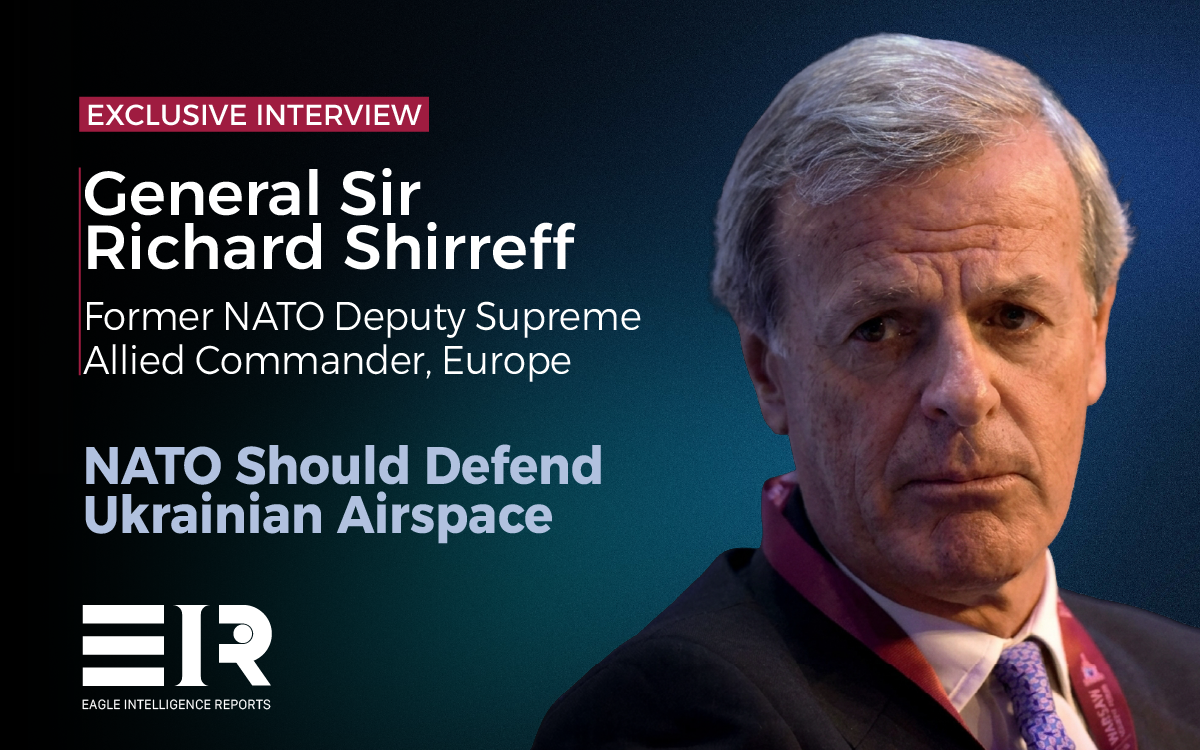
Former NATO Deputy Supreme Allied Commander Europe Gen. Sir Richard Shirreff has called for a more forceful response to Russian attacks, including deploying NATO aircraft over Ukraine, while warning that Europe must prepare to defend itself without American support. In an exclusive interview with Eagle Intelligence Reports, he argued that European governments are failing to build the military capabilities needed to deter Russia, even as instability across Africa and the Middle East places additional pressure on Western security.
Shirreff said Russia had been conducting a covert campaign against NATO since 2014 through espionage, sabotage, cyberattacks, and other operations below the threshold of conventional war. He argued that Russian drone incursions into Poland and strikes affecting Romania should prompt a stronger alliance response. Asked whether he supported deploying NATO troops into Ukraine, he clarified that he was advocating NATO aircraft operating over the country to intercept Russian missiles and drones.
“It is absolutely an escalation. But this is an escalation that is forced upon us by Russia,” Shirreff said, arguing that Moscow exploits perceived Western weakness.
He also warned that nuclear escalation remained a major risk, proposing that NATO threaten a substantial conventional response against Russian forces in Ukraine if Moscow prepared tactical nuclear weapons for use. He maintained that European allies could undertake such action without Washington.
Shirreff warned that nuclear escalation remained a major risk, proposing that NATO threaten a substantial conventional response against Russian forces in Ukraine if Moscow prepared tactical nuclear weapons for use
His central criticism was that Western European governments were postponing difficult decisions on defense spending and military readiness. “We have to be strong to maintain peace. If we are weak, we invite war,” he said.
Beyond Russia, Shirreff identified instability across the Sahel and North Africa as a significant European security concern. He pointed to the belt of coups and conflicts stretching through Mali, Burkina Faso, Niger, and Sudan, warning that further instability could drive migration and asylum movements across the Mediterranean. European defense planning, he argued, must account for threats beyond the continent’s immediate borders, including vulnerable maritime routes.
Nevertheless, he said Europe could no longer rely on the United States. Accusing the United States of bullying allies, including Canada and Denmark over Greenland, Shirreff questioned Washington’s willingness to confront China over Taiwan. Even if the United States became involved in an Indo-Pacific conflict, he argued, Europe would be left to manage its own defense. Britain, which he described as a medium-sized European power, should therefore prioritize European security over military commitments in Asia.
Britain, which Shirreff described as a medium-sized European power, should therefore prioritize European security over military commitments in Asia
Shirreff also described Russia, China, Iran, and North Korea as interconnected strategic challenges, citing their overlapping military and political relationships. But despite the links between them, he cautioned against dispersing limited Western resources across multiple theaters. Europe’s priority, he said, should remain developing the capacity to deter and, if necessary, fight Russia independently of American forces.
That did not mean abandoning the Middle East. Shirreff argued that NATO had a role in protecting shipping through the Red Sea, the Bab el-Mandeb, and the Strait of Hormuz, where Iranian and Houthi threats were disrupting international trade. He blamed Trump’s war against Iran for worsening the crisis, arguing that its consequences for regional shipping had not been adequately anticipated.
Shirreff called for Britain, Europe, and other allies to support Saudi Arabia and Yemen’s internationally recognized government against the Houthis, whom he described as a sophisticated military force capable of missile attacks and technological adaptation. Drawing on Britain’s experience in Afghanistan, he advocated military advice, capacity-building, and assistance with ground-level security rather than another large-scale deployment. Such cooperation, he argued, would have to be balanced against the overriding requirement to prepare for a possible confrontation with Russia.
The following is the third part of Eagle Intelligence Reports’ exclusive interview with General Sir Richard Shirreff, conducted by Jonathan Sherry and Andra Maciuca.
Interview Excerpt
Jonathan Sherry: What in your judgment has been missing from the Western response in the Red Sea?
Gen. Sir Richard Shirreff: Well, the purpose of NATO is to protect the land borders, airspace, and sea lines of communication of the Alliance. The Red Sea, the Bab el-Mandeb, the Strait of Hormuz are key critical sea lines of communication for the Alliance. So NATO absolutely has a role to play in opening those up and securing them because the global economy and the economies of NATO countries are coming under real pressure as we know.
However, the fact is those two straits, and the sea lines of communication, are threatened by Iran and the Houthis. But before the 27th of February, they were open. What has changed the dynamic is an utterly disastrous, hubristic, incompetent war led by Donald Trump, launching an attack on Iran without considering and war-gaming the impact on the Strait of Hormuz, or indeed the link up with Iran’s Houthi allies in Yemen.
So there’s a problem here. I cannot see any NATO government wanting to ally itself with an America led by Trump because of where Trump has led America. But the problem doesn’t go away. This means that this is a problem that has got to be confronted. It’s not going to go away. And can Europe and the NATO countries continue to accept a situation where the Houthis are threatening the Bab el-Mandeb and shipping and indeed oil supplies from the Strait of Hormuz? Answer: no. In fact, it’s more than just Europe, it’s the global community.
But it’s a really difficult one. So I think there is absolutely a role. I think it’s a role that needs to be—ultimately, this has got to be a problem solved by the Yemenis and the Saudis. But it’s a problem that Britain, America, Britain, Europe, and other allies need to work alongside and help with the Saudis and the official recognized Yemeni government. And it’s not good enough, I think, to hand off with just some refueling for American aircraft. It’s more than that. I think this is something we have to recognize.
And this plays into our early discussions. about the globalization of conflict, because this is a war that is affecting us, our day-to-day life, as much as the Ukraine war.
Jonathan Sherry: So with British participation, let’s say, in a future contingency in Yemen, how would you avoid another open-ended military commitment?
Gen. Sir Richard Shirreff: By committing yourself to supporting the resolution of the problem and accepting that there are problems that take time to solve.
I’ll give you a good example. The British Army which came out of the Defence Review of 1998 took as a number of planning assumptions: the assumption number 1, that it needed to have a capability to respond to a conflict in 30 days, and if necessary, ramp up to being able to commit a division of 30,000 with all the combat support and capabilities together with air and sea to a war–fighting operation within six months, such as happened in the first Gulf War, for example, or might happen in Europe.
But at the same time, it said we need to be able to maintain a brigade indefinitely in another conflict or an operation other than war, such as the Balkans or Bosnia or Kosovo. You need to think about maintaining those. Now you can’t do all. It’s a zero-sum gain. If you can maintain a war fighting capability in a war in Yemen or supporting a war in Yemen, you may not be able to do something elsewhere. So you’ve got to balance it.
The way I would balance it is by committing myself to supporting the Saudis with capacity building, with advice, and with special forces rather than with putting boots on the ground. Equally, I would then be able to maintain something to deter war in Europe and support to Ukraine. So it’s a question of balance. But I would also say, you talk about British— this has got to be coalition. It’s got to be alliance. It’s Britain with allies. It’s not Britain on its own.
Jonathan Sherry: You mentioned the Saudis and the Emiratis. The UAE played a key role in securing Yemen’s western coast on the Red Sea before being asked to withdraw. To what extent did its departure contribute to the Houthi’s recent territorial gains?
Gen. Sir Richard Shirreff: Well, I think if you have a force in place that is providing a degree of presence and a certain amount of security and you withdraw it, you create a vacuum. And the Houthis have clearly taken advantage of that vacuum.
And to me it points to a risk of underestimating the Houthis. These are not just wild-haired tribesmen in sandals waving AK-47s from the wild, savage hills of northern Yemen. They are pretty sophisticated. This is a group that is capable of launching ballistic missiles at Riyadh, air bases, airports. It’s capable of launching missiles across other parts of Saudi Arabia and indeed capable of using AI to develop its weaponry. This is a very sophisticated group, and it needs a very sophisticated approach to reduce the problem.
Andra Maciuca: But the Houthi challenge cannot be separated entirely from Iran’s regional role, while Saudi Arabia and Gulf partners face threats to aviation, energy infrastructure, and shipping. How should Britain balance stronger regional deterrence against the danger of a wider confrontation with Tehran?
Gen. Sir Richard Shirreff: By operating in an alliance context, by thinking strategically, and by working through a strategy that prioritizes and/or recognizes the priorities of the need to prepare for and deter a war against Russia, and if necessary, fight that, while still recognizing the need to work with allies to open up and create access through the Strait of Hormuz and Bab el-Mandeb as well as supporting allies in the region against Iranian territorial or other domination.
Andra Maciuca: And what additional defensive cooperation would make the most immediate difference for Saudi Arabia and its neighbors?
Gen. Sir Richard Shirreff: I think this is where support and advice and capacity building is needed. I think the Saudis have got a very capable swept-up defense forces and equipment. But whether they have the thinking and the planning capability to make best use of those assets, whether they are thinking too much in terms of the assumption that technology such as long-range precision strike can resolve a war and need advice in recognizing that wars of the sort of nature they face with the Houthis cannot be resolved by air power alone.
They need to build consensus. They need to work on the ground to win hearts and minds, to support the Yemeni government in doing that, and ultimately, if necessary, to fight effectively on the ground in very difficult terrain against a very capable and determined enemy. These are real challenges that the Saudis face as well as the Yemenis, and these are all areas where I think, given the experience of countries like the UK and others in Europe and the experience not least from Afghanistan, the UK can provide support with its allies.
Jonathan Sherry: Do you think western governments can treat maritime security as a separate issue from the war in Gaza, for example, where troops have been deployed, of course, and its political consequences? Or are those conflicts now reinforcing one another?
Gen. Sir Richard Shirreff: Maritime security has got to be looked at as part of overall security. And, you know, certainly for UK, as an island nation, it’s fundamental. So maritime security is part of building resilience against attack. It is about ensuring that our sea lines of communication are kept open. But it’s also about, in an island context, ensuring that the undersea cables and the like are properly protected and interference is deterred.
And so maritime security is part of the piece, but it’s got to be looked at as part of the overall resilience, building resilience. So this is one area, again, which we haven’t really talked about, where the need to build resilience against threat by air, sea, and land is fundamental. And the ability for the state to continue to operate under the exigencies of war, which again, needs to be looked at very carefully.
Andra Maciuca: If a serious crisis unfolded over Taiwan while Europe remained focused on Ukraine, how would that alter the military choices available to Washington and its European allies?
Gen. Sir Richard Shirreff: Well, I go back to my early discussion. I just don’t think Europe can depend on America, full stop. America has demonstrated, far from being an ally of Europe, it is a bully and a predator. It has been trying to bully Ukraine. It bullies Canada, has stated openly under Trump that it wants Canada or Trump wants Canada as the 51st state, and has threatened to attack Greenland, the territory of Denmark, a NATO ally. And at the same time, has demonstrated under Trump, America is effectively a de facto ally of Russia in trying to force up a capitulation deal on Ukraine.
If America faces a threat in the Far East, I think firstly, if Xi tried to recapture Taiwan—Taiwan is going to become Chinese. At some stage, it will be part of mainland China. The question is time and how. My sense is that, yes, Xi might decide to launch an amphibious operation to recapture it. That is a really difficult thing to do. Amphibious operations are the most difficult sort of operation of war. And Taiwan is not a straightforward operation.
But Xi might prefer to take a more indirect approach and a longer-term approach. I think you’d have questions as to whether Trump actually wants to confront Xi over Taiwan. There must be doubts about that given the way Trump is behaving towards Europe. But if America did find itself sucked into a war in the Far East, this merely means Europe, again, has got to think about going it alone. And it’s got to recognise that it’s got to stand on its own feet.
And this goes back to what we were saying earlier: that it is long overdue for Europe to recognize that fact, that Europe cannot depend on America and that it’s got to build the capabilities and the like to be able to conduct war on its own without America.
Andra Maciuca: So, given what you’ve just mentioned, what if any military role should Britain be prepared to play in an Indo-Pacific crisis?
Gen. Sir Richard Shirreff: Britain’s got to be realistic here. Britain is a medium-sized European power. Britain is best placed—to coin the phrase used by Prime Minister Mark Carney of Canada—to work with other middle powers to secure its principal interests. And those interests are in Europe and in our sea lines of communication.
It is questionable whether Britain has the sort of interests in the Far East and the Asia Pacific region that should take priority over Europe and closer regions. I would say Britain should be focusing on its own defense in Europe before indulging in adventures in the Asia Pacific region.
Jonathan Sherry: When you look at Russia, China, Iran, and North Korea, do you see separate challenges or a pattern of overlapping pressure on Western military resources and political attention?
Gen. Sir Richard Shirreff: Unquestionably, a pattern of overlapping and interlinked pressure on Europe. As we discussed, you see the linkage between Iran and the war in Ukraine. You see the fact that North Korean troops are fighting in a European war. That North Korea is providing huge amounts of ordinance and other ammunition and technical support and logistic support to Ukraine. You see the fact that China is underpinning Russia’s war in Ukraine as well. And meanwhile, of course, as I said earlier, Russia is supporting Iran in its war against the United States. So they are completely all interlinked.
But that, you know, going back to the previous question—his means that we should be focusing on the priorities, on the principal ones. If you try and defend everywhere, you defend nowhere. So Britain and other European countries should be absolutely focused on building up the capabilities needed to be able to deter war with Russia and, if necessary, fight war with Russia without America.
Andra Maciuca: Could Western Allies sustain meaningful military commitments in Europe, the Indo-Pacific, and the Middle East at the same time? And where would the strain show first?
Gen. Sir Richard Shirreff: No, it couldn’t. It couldn’t. Western Allies should be focusing absolutely on building up capability to deal with a wolf nearest the sledge, which is the threat Russia poses, the existential threat it poses to Europe.
But at the same time, as I said earlier, European countries cannot just focus on Europe. They have to think about their defense priorities elsewhere, such as the impact on sea lines of communication, of closures of key straits like Bab el-Mandeb and the Strait of Hormuz.
I would also add another threat that Europe faces, which is the danger of instability in the Sahel, North Africa—the so-called “coup belt” across North Africa, pretty much Mali, Burkina Faso to Niger, Sudan, and the consequent flood of immigrants and asylum seekers flooding across the Mediterranean, which is a very real security threat as well to Europe.
So Europe’s security cannot afford to be completely focused on Europe. It’s got to think more broadly at the same time. But it would probably absolutely has to draw the line in my view where the Asia Pacific is concerned.
Jonathan Sherry: The head of MI5 has warned about threats linked to Iran and Russia inside Britain. When sabotage, cyber operations, or attacks on military sites occur below the threshold of conventional invasion, how should Britain respond? How should NATO respond?
Gen. Sir Richard Shirreff: Well, firstly, the head of MI5 is absolutely right. And we need to recognize that Russia has been fighting this covert war against Europe or certainly against NATO since 2014. And as we’ve discussed, it is a war conducted below the threshold, by subversion, by espionage, by sabotage, by assassination, by cyber, by manipulation of minorities.
How should it respond? By demonstrating strength. So when Russia launches 19 drones into Poland, that is an attack against a NATO country. It is an Article 5 armed attack against a NATO country. When Russia launches drones that hit Romanian apartment blocks, injuring Romanian civilians, that is a Russian attack. NATO should be thinking along those lines and demonstrate strength and resilience.
And for my money, I’ll give you an example of how it should respond: It should absolutely be putting NATO aircraft into the sky over Eastern Ukraine and Central Ukraine, shooting down Russian missiles and drones and accept that that is something that can be done, because Russia is attacking, and therefore Europe needs to defend itself.
And the most important thing is for Europe and NATO to demonstrate strength. Where Russia sees weakness, it probes, it exploits, it takes advantage, it divides and rules. And that is what Russia is doing. Europe needs to show strength, and that strength has got to be part of deterring covert and hybrid war as much as the need to deter conventional war or indeed even nuclear war.
Jonathan Sherry: So just to be clear, if I heard you correctly, you would support the deployment of NATO troops into Western Ukraine?
Gen. Sir Richard Shirreff: I would be supporting the deployment of NATO aircraft into the skies above Ukraine to shoot down Russian missiles such as they can be shot down, cruise missiles, and drones. Absolutely, I would be supporting that. And that would demonstrate real support to Ukraine. I go back, go away from this hot air and fine words about, “We will support you all the way.” This would be demonstrating real determination to give Ukraine the support it needs.
But it needs to be tied in, as I’ve said earlier, to a proper strategy to support Ukraine in the defeat of Russia because only when there’s—
Andra Maciuca: But do you not think that would lead to escalation with NATO?
Gen. Sir Richard Shirreff: Well, it is absolutely an escalation. But this is an escalation that is forced upon us by Russia. And as I said earlier, where Russia meets weakness, it escalates, it probes, it builds, it continues. Where it meets strength, it backs off.
Andra Maciuca: You spent years urging governments to take emerging threats seriously. Looking across Europe and the wider world today, what is the one difficult decision Western leaders are postponing at the greatest risk to their security?
Gen. Sir Richard Shirreff: I’m going to qualify what I mean by Western leaders here. And I’m qualifying it by the leaders of Western Europe, whose countries are not making the sacrifices needed to build the military capabilities and the resilience to deter war. So the one decision they are ducking is to spend more on defense, to change their mindsets to prepare for war, and to change their mindsets to design and execute a strategy to support Ukraine in the defeat of Russia.
Andra Maciuca: What would you say to those who fear that rapid rearmament could itself increase the risk of escalation?
Gen. Sir Richard Shirreff: I would say that a failure to rearm rapidly is only going to make the risk of war even greater by demonstrating weakness to Russia and making Russia think that it can take advantage of Western weakness. We have to be strong to maintain peace. If we are weak, we invite war.
Andra Maciuca: If you had to identify one miscalculation that could turn a regional crisis into a much wider war, what would it be?
Gen. Sir Richard Shirreff: A failure to see Russia as it is. It would depend on the nature of the issue, but again, a failure to show strength against Russia only invites a regional crisis, which could escalate into a wider war.
Andra Maciuca: In a confrontation involving nuclear-armed states, how confident are you that a conventional war could be contained?
Gen. Sir Richard Shirreff: Well, it’s clearly a massive risk. But it is a risk that could be mitigated. If, again, let’s say that NATO, the Western Alliance, made it 100 percent clear to Russia that any indication that Russia is loading military nuclear warheads and marrying them up with delivery vehicles would precipitate an instant and massive response by the West against Russian troops in Ukraine, in support of Ukraine, and that Russia would de facto be at war in Ukraine with NATO. And I think the West could do that without America.