
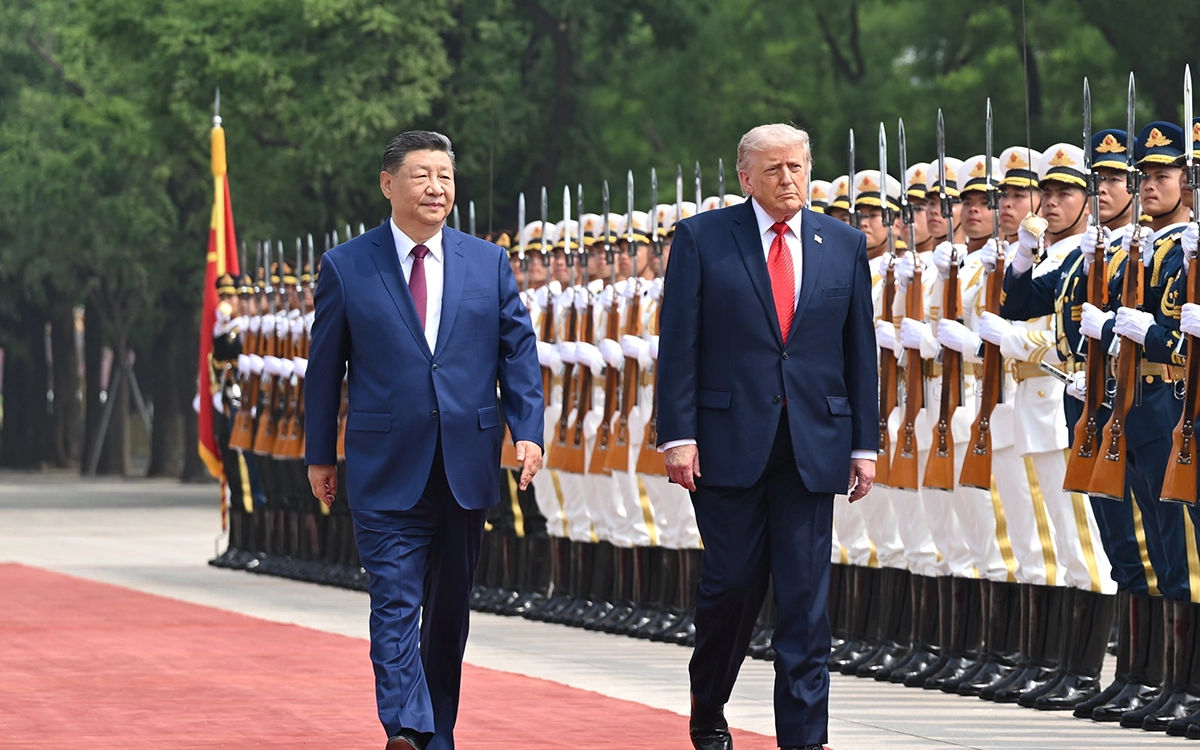
In retrospect, the Trump-Xi summit in Beijing increasingly appears to be a lost opportunity for the United States. This is not because there were few concrete achievements or deliverables from this summit. In international history, many previous summits that also produced few material agreements ultimately triggered mutually beneficial transformations in great power relations if not world politics more generally.
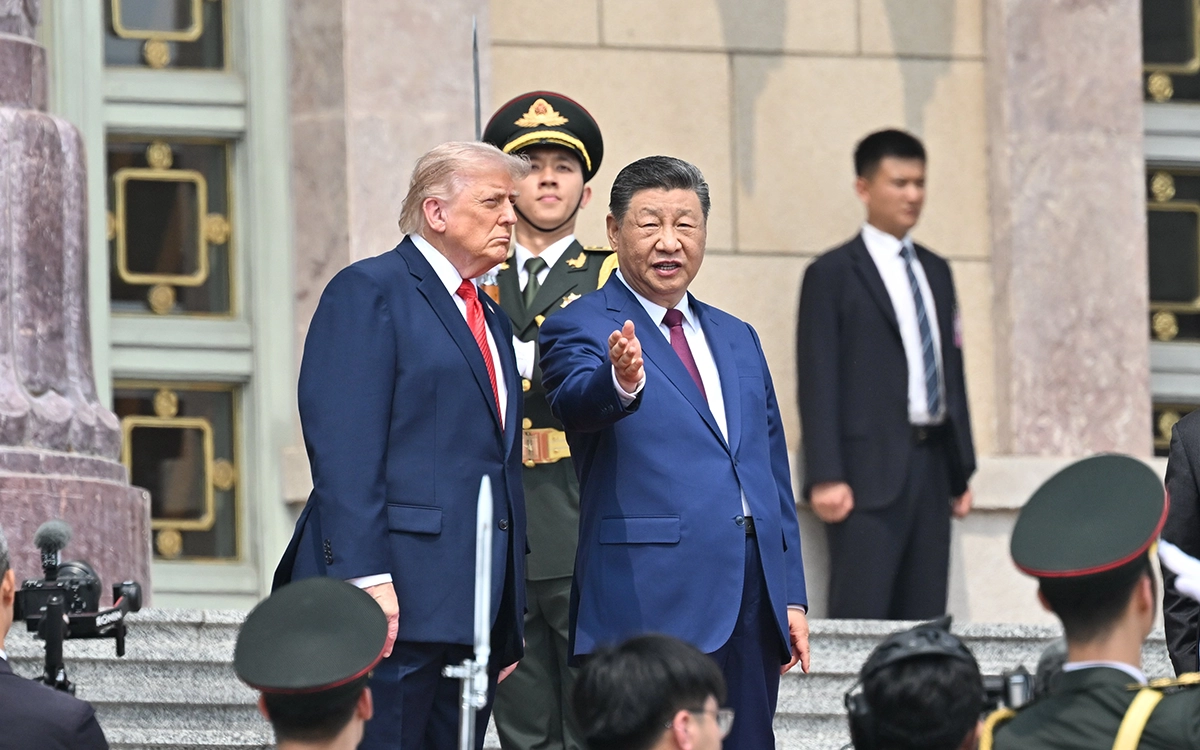
Rather, it was a lost opportunity because it did not challenge China’s elite leadership mantra that it is ascending while the United States declines. That world view, however interpreted, is a recipe for conflict even if efforts are made to keep it within manageable limits. Nothing at the summit served to contest China’s claim, and much that did occur may have reinforced it. The meeting was long on pageantry but short on substantial achievements.
Moreover, immediately after the summit, China landed coast guard and research personnel on the island of Sandy Cay, one of the Spratly Islands disputed by the Philippines, Vietnam, China, and Taiwan. Since deeds speak louder than words, the action calls the bonhomie of the summit into question.
The Trump-Xi summit was a lost opportunity because it did not challenge China’s elite leadership mantra that it is ascending while the United States declines
Taiwan, Strategic Security, and Asian Security
Admittedly, Xi Jinping and Donald Trump did agree on a new formula proposed by Xi for U.S.–China relations, which translates from Chinese to “constructive strategic stability.” This is one of those felicitously ambiguous formulae that diplomats and statesmen come up with to allow all parties to perceive difficult issues or relationships as they wish, but whose substantive meanings remain elusive. For China, it evidently means that there will be no further “Trump shocks” for the foreseeable future, since moves like the attack on Iran or the announcement of new tariffs throw bilateral, if not global, relations into disarray.
In short, for China, this formula represents an attempt, however camouflaged, to constrain U.S. behavior given Trump’s unpredictability. Indeed, Xi defined the concept as having four layers: stability—defined primarily by cooperation—should remain the main current, while competition should stay within manageable limits, differences should be managed, and peace should remain a realistic prospect. Although he also stated the two countries should be partners rather than rivals, the entire thrust of Xi’s policies and of the regime itself remains antithetical to American interests and those of U.S. allies. And China’s new moves on Sandy Cay underscore that point.

Although pointing to such behavior does not necessarily constitute an argument for a poisonous relationship, the invocation of nebulous formulae that commit neither side to concrete obligations while China continues threatening actions against U.S. allies does not augur well for this “strategic stability.” China clearly wants the United States to desist from confrontation, yet strategic confrontation is intrinsic to Leninist or post-Leninist authoritarian empires like China. So, it is unlikely that China will suddenly renounce its competitive, if not confrontational, policies.
China clearly wants the United States to desist from confrontation, yet strategic confrontation is intrinsic to Leninist or post-Leninist authoritarian empires like China
For the United States, this concept of stability apparently means no major Chinese disruptions in the relationship in trade or technological rivalry, and certainly no direct attack on Taiwan in the foreseeable future. As the move against Sandy Cay shows, this formulation allows China much room for its grey-zone tactics. It allows for the continuation of constant pressure against Asian states, from South Korea to India, and does not address China’s comprehensive military buildup that aims to eclipse U.S. military power in the Indo-Pacific. Perhaps equally troubling, from China’s perspective, it is hard to see how this framework could restrain Trump, who constantly maintains, “I can do as I want.”
Nevertheless, despite his own formula, Xi felt sufficiently emboldened to issue warnings to both the U.S. and Taiwan in his private meetings with Trump—something that would otherwise be regarded as inappropriate. It is clear that China sees Taiwan as the key issue in bilateral relations. Xi’s risky gambit appears to have been justified, as Trump has since paused a $14 billion arms sale to Taiwan, citing the demands of the Iran operation. Moreover, Trump now describes arms sales to Taiwan as a negotiating chip. And since Xi will be coming to Washington on September 24, the pause is likely to be in place at least through that summit in Washington.
Furthermore, by discussing arms sales with China, Trump broke the terms of the 1982 agreement known as “The Six Assurances,” which stated that the U.S. would not discuss arms sales to Taiwan with China. The very fact of this discussion can only confirm Beijing’s belief that continued pressure will further erode U.S. support for Taiwan. Indeed, the U.S. readout did not even mention Taiwan. Therefore, Trump’s equivocal response may have justified Xi’s warning. After the summit, Trump bluntly told an interviewer that he was unwilling to fight a war 9,500 miles away and that he opposed Taiwan declaring independence. Secretary of State Rubio’s statement that neither side changed its policies on Taiwan may represent Washington’s perception, but it is unlikely to persuade Beijing to desist from its warnings against Taiwan because, from its standpoint, this constant pressure is effective. Neither will Trump’s equivocal answers regarding Taiwan reassure anxious U.S. allies in the region.
Likewise, when Xi claimed to Trump that the U.S. was in decline, Trump, typically, did not deny this outright but blamed his predecessor while claiming, quite falsely, that under him America had revived. Such responses will not convince Beijing that its mantra of American decline is unfounded—quite the contrary. In consonance with Mao’s old adage that the East wind is rising, in addition to continued grey-zone aggression in the South China Sea, we will likely see further Chinese pressure against Taiwan and U.S. allies in the region.
The Summit Agenda and Economics
The evidence of this lost or wasted opportunity emerges clearly out of the summit’s agenda, particularly in what was not included. A proper summit agenda should have addressed China’s breathtaking augmentation of its nuclear and conventional arsenals, making AI safe for both sides, China’s support for Russia’s war of aggression in Ukraine, North Korea and Iran’s nuclear programs, and China’s escalations against Japan, Taiwan, the Philippines, India, and Southeast Asia. Trump’s delegation could have also addressed the large-scale theft of U.S. intellectual property and technology, the smuggling of Fentanyl into the U.S., China’s human rights violations, and, equally importantly, the enormous range of issues connected to China’s global mercantilism and ongoing unfair trade practices. However, from the subsequent readouts and commentary, it appears that most of these issues never arose. While there was rightly an extensive discussion of the issue of arms sales to Taiwan—the key issue for China—these other pressing issues were apparently not mentioned.
The leading role of Treasury Secretary Scott Bessent in organizing the summit highlights the priority of economics for the U.S., especially regarding tariffs, opening markets, and issues of technology sales. This agenda was thus the inverse of China’s emphasis on Taiwan. Nevertheless, Trump claimed that the acrimonious issue of tariffs never came up.
The leading role of Treasury Secretary Scott Bessent in organizing the summit highlights the priority of economics for the U.S., especially regarding tariffs, opening markets, and issues of technology sales
Two possible implications arise from this omission. First, and especially in view of the extensive discussion about Taiwan, it appears that the presidential discussions focused primarily on China’s agenda. If Trump negotiated off of Xi’s agenda rather than his own, that fact alone underscores a victory for Xi that he and his team will undoubtedly interpret as confirmation that China is ascending while the U.S. is declining. Indeed, they have some grounds for thinking this way. It is a mark of the weakness of the Trump Administration’s policy process, which has been ravaged by the severe cutbacks of key personnel, that almost up to Trump’s departure for Beijing, members of the Administration were reportedly trying to table new items for the talks’ agenda. If true, this signifies an inability to address strategic issues properly that will reinforce Chinese perceptions of the evolving correlation of forces.
The second implication arising from the omission of tariffs could be that both sides prefer to leave them as they are. Whereas America holds the whip hand regarding the vast ecosystem of advanced chips and semiconductors, China holds a superior position regarding rare earths that are vital for advanced civilian and military technologies. When Washington struck at China by implementing export controls and tariffs in 2025, China retaliated by imposing stringent export controls on rare earths, forcing Washington to retreat. The episode clearly boosted China’s confidence that it could resist American pressure successfully. The ensuing uneasy truce on tariffs holds for now, but it is clearly in a precarious condition. Indeed, just before the summit, China announced new export controls designed to restrict foreign access. The fact that these do not appear to have been discussed represents another sign of this summit’s failure to address key issues between Washington and Beijing.
Admittedly, there were modest bilateral trade deals for American farmers and aviation companies. China agreed to annual purchases of at least $17 billion of agricultural products through 2028 and to establish boards of trade and investment. These represent American gains at the summit. China also agreed to purchase an initial 200 Boeing aircraft—lower than the expected order of 500 planes—but with the potential for that commitment to grow to 750. However—and this typifies Trump’s negotiating style—major details of Boeing’s deal with China remain to be negotiated. Signifying the market’s unhappiness with the deal, Boeing’s shares fell, hardly a positive sign. While some reports opined that the deal might signify a stabilization of bilateral deals in this sector, that remains to be seen. Moreover, the deals are short-term and do not address the fundamental asymmetries plaguing bilateral trade relations. The agriculture deal also does not compensate American farmers for the soaring fuel and fertilizer costs affecting them because of the conflict with Iran.
To be sure, there were other economic deals. American financial service firms will gain access to Chinese retail and institutional markets, an opening that represents genuine revenue potential. Concurrently, Chinese clean energy companies are gaining clearer pathways into the American market. This access addresses a real bottleneck for Beijing’s industrial policy ambitions.
Yet these are modest accomplishments for a summit of such importance and expectation. Although Xi said China would open its economy more to foreign trade, here again no formal agreements emerged from the summit, and China’s new export controls hardly signify an economic opening to foreign trade and investment. Moreover, despite Xi’s remarks, it is unlikely that there is much more scope for significant bilateral economic deals. The entire thrust of Chinese economic and industrial policy under Xi is geared toward ever more state control of entire economic processes, a trend exemplified by the new controls that directly contradict the freer and less restrictive trade that Washington seeks.
Foreign trade, here again no formal agreements emerged from the summit, and China’s new export controls hardly signify an economic opening to foreign trade and investment
Iran
The elephant in the room was the war in Iran, and bilateral discussions showed the same pattern. Xi reiterated China’s opposition to the closure of the Strait of Hormuz but made no real commitment to induce Iran to open it. It is also unclear if Xi committed to stop transferring critical technologies or weapons to Iran, despite Trump’s claim that he did. According to the White House readout, Xi stated his opposition to militarizing or charging tolls in the Strait of Hormuz. However, the Chinese readout omitted any discussion of Iran or the Strait. While some interpret this omission as assent to the U.S. text, it could also represent a typical Trumpian misreading of his interlocutors. As a rule, we should not interpret Chinese silence for assent.
Furthermore, Iran will not give up its ties with China. Indeed, China is Iran’s priority relationship. Iran is currently trying both to monetize its control of the Strait by converting it into a maritime toll booth and to offer special exemptions for partners like China. Tehran is offering ships traversing the Strait and surrounding waters (Arabian Gulf and the Gulf of Oman) insurance, with payments settled in cryptocurrency. Xi also stated he would try to end hostilities, despite the fact that China likely benefits from Trump’s inability to achieve a genuine strategic victory. However, China continues to supply Iran with intelligence and coordination, enabling it to carry on combat operations. Additionally, Beijing benefits from the fact that this war is forcing Washington to move its missile defense platforms from Asia to the Middle East. This is a most welcome development for Xi and gives it ample reasons for not leaning too hard on Iran to sign a peace agreement.
Finally, no mention of human rights in any readout or report from the summit represents a victory for China and another sign that this issue does not count for the Trump Administration. The silence on human rights cannot but further undermine America’s standing in the world as it suggests an abandonment, if not betrayal, of core American values—another reason for anxiety among Washington’s partners.
The silence on human rights cannot but further undermine America’s standing in the world as it suggests an abandonment, if not betrayal, of core American values—another reason for anxiety among Washington’s partners
Overall Assessment
Given the outcome of the summit, Trump evidently negotiated on Xi’s agenda, not his own. Worse, he appears to have skated over American interests, claiming that the summit’s most important result was that he and Xi had deepened their personal relationship, another sign that Trump’s ego takes precedence over U.S. interests. Meanwhile, in his banquet toast, Xi reiterated the line he previously uttered to Vladimir Putin when they presented their “no limits partnership” in 2022, that great changes the likes of which we had not seen in a century were now occurring. This statement is not the remark of a Chinese leader who thinks the U.S. is not in irrevocable decline. Nor were the concurrent warnings toward Taiwan and the U.S. signs that Xi elevates personal diplomacy over Chinese state interests. Nor did China make any binding commitments to Trump’s narrow agenda or address other issues plaguing the relationship.
Thus, the many assessments arguing that the summit reflected China’s rise to the status of parity or equality with the U.S. are apparently on the right track. China seems to have discovered that it can openly resist, stand up to, or even issue warnings to the U.S. with impunity. Moreover, if Beijing plays its cards right, in time, the transformation in world affairs that it seeks will occur without undue risks or excessive costs. If indeed this is the main takeaway of this summit, then the “constructive strategic stability” proclaimed by Xi is likely to prove short-lived, narrowly focused, and asymmetrical. In that sense, the summit remains an insubstantial pageant whose significance lies less in what was said than in what was not.
China seems to have discovered that it can openly resist, stand up to, or even issue warnings to the U.S. with impunity