
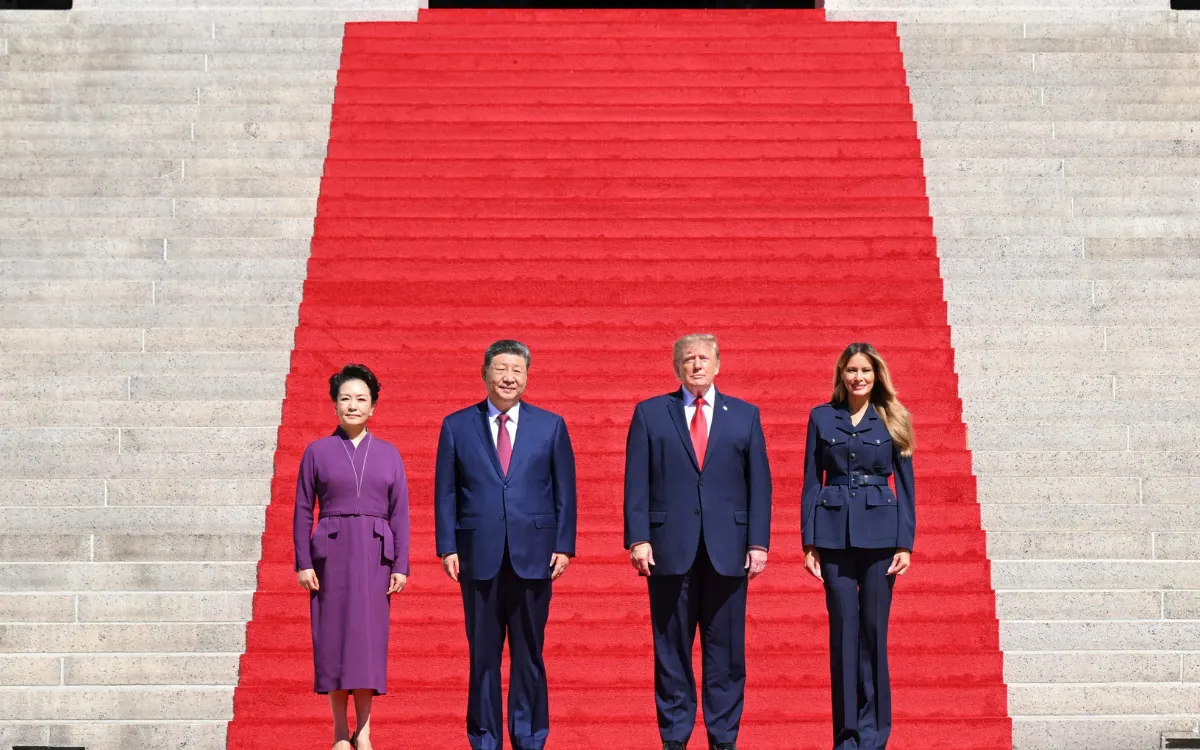
U.S. President Donald Trump asked Chinese leader Xi Jinping whether Beijing wanted to buy U.S. weapons while defending Washington’s arms sales to Taiwan, U.S. Ambassador to China David Perdue said in an interview with U.S. media.
“President Trump continues to say, ‘Hey, we sell arms to other people around the world.’ He actually asked President Xi—would he like to buy some?—at one point. There are continuing conversations about other sales, (Trump) and President Xi talk about that every time they get together,” Perdue said, adding that the issue was raised again during the presidents’ summit, which ended last Friday.
Trump administration officials denied the claim that the president offered to make an arms deal with Chinese leader Xi Jinping. During the Trump–Xi summit last week, the two leaders exchanged views on the Ukraine crisis, the Middle East, the Korean Peninsula, and artificial intelligence (AI). China’s Ministry of Foreign Affairs released a statement following the meeting, highlighting the importance of cooperation between the two countries in several areas, including AI challenges, despite the two countries competing for leadership in the industry. President Xi said that the economic and trade teams of China and the United States held a new round of consultations and reached a new arrangement, which he labeled “good news” for both countries and for the world economy.
The White House later released lists covering about $30 billion in goods in each direction that could receive reduced tariffs on a reciprocal basis, although it did not specify the rates or timetable. The arrangement covers 77 categories of Chinese goods and more than 1,600 categories of U.S. products, while Beijing also agreed to import at least 10 million metric tons of U.S. coal in 2027 and 2028.
Taken together, the summit outcomes suggest Washington and Beijing are seeking to contain strategic competition without resolving the underlying disputes. The tariff arrangement and planned Chinese coal purchases provide limited economic stabilization, while discussions on AI indicate a minimal effort to cooperate in areas where rivalry carries broader risks. Taiwan remains the most sensitive fault line: Perdue’s account of Trump raising potential arms sales to China, which administration officials deny, highlights the unusual role of weapons transfers in the bilateral dialogue. The key indicator to watch is whether these limited agreements develop into sustained cooperation or remain compartmentalized as tensions over Taiwan, technology, and trade persist. (AFP+EIR)