


After a year of political turmoil, Dutch voters have returned to the pragmatic center. D66’s win under Rob Jetten offers Europe a respite, a test of whether coalition-style politics can still deliver capable governance in an age of populism.
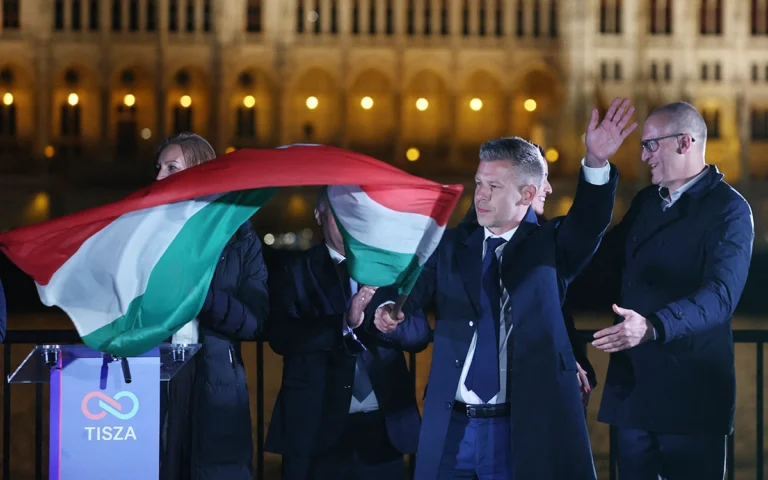
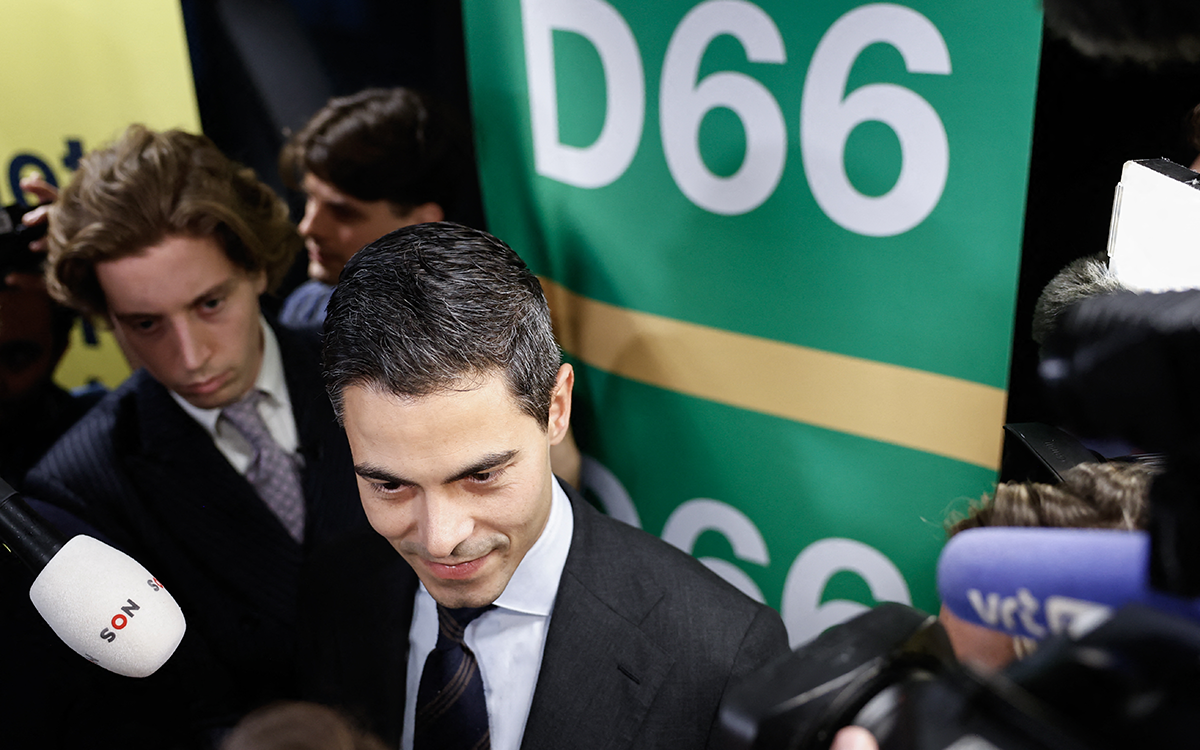
Europe’s weather vane has swung again, and this time it points back toward the pragmatic center. In the Netherlands’ snap election, the centrist-liberal Democrats 66 (D66) under Rob Jetten finished ahead of Geert Wilders’ far-right Party for Freedom (PVV). The former will now be tasked with leading coalition negotiations in a deeply fragmented parliament.
If that sounds like a local corrective to a year of chaos, it is, but it is also something larger. The Dutch result shows that the European center has not collapsed, the green transition remains salvageable if politics stop lurching, and the European Union can still make strategic choices in an age of distrust and fragmentation.
The Dutch result shows that the European center has not collapsed, the green transition remains salvageable if politics stop lurching
I. The Political Meaning
The Center Holds Narrowly, and on Probation
The Netherlands has become a compressed version of Europe’s new political math. The old duopolies are gone; no party clears 20 percent; government formation requires four-party carpentry; and the electorate swings hard when governance fails. In 2023, Wilders won big, entered power by proxy, and presided over a year that ended in implosion. In 2025, a chastened electorate turned to D66 not out of romance with the establishment, but out of fatigue with dysfunction and theatrical radicalism. The signal is unambiguous: the far right is large but not inevitable. Credible, problem-solving centrists can still win.
It might look like exceptionalism, but Europe has been here before: the Weimar lesson was fragmentation without responsibility; the post-war lesson was coalition with purpose. The Dutch result chooses the latter. It mirrors Poland’s correction in 2023, Spain’s muddled advance toward constructive compromise, and the German pattern in which voters punish chaos faster than ideology. The EU, too, can now expect a Dutch PM in Jetten to re-enter the room and shape files that matter: Ukraine, climate delivery, and defense industry policy.
II. Europe’s Fights Through a Dutch Lens
Populism’s Limits and Its Durability
The Dutch experiment reaffirms a familiar rhythm: populists surge; they approach or taste power; governance disciplines them; and voters correct. In Italy, Giorgia Meloni governs more pragmatically than she promised and is constrained by markets, NATO, and Brussels. In Sweden and Finland, right-leaning governments are tethered by parliamentary arithmetic and law. In France, Marine Le Pen thrives in opposition, precisely because she has not had to reconcile a sweeping rhetorical program with legal constraints. The Netherlands just ran the shortened version of this movie: a populist-inflected period, then a return to a workable center. The temptation has not vanished, but the political price of chaos remains high. The European electorates still prefer adults in the room when bills come due.
Climate: From Culture War to Credible Industrial Policy
No policy arena in the Netherlands has revealed the cost of political instability more starkly than climate. A succession of short-lived coalitions and snap elections produced a cycle of policy whiplash: heat-pump mandates were introduced, softened, and reinterpreted; low-emission zones were announced and then postponed; and subsidy frameworks were unveiled and then rewritten. Businesses learned to discount official targets because the rules underpinning them seldom survived the government’s full term. Investment plans stalled not on technology but on political unpredictability.
The nitrogen question made this volatility legally inescapable. In January, the District Court of The Hague ordered the government to meet its 2030 nitrogen-reduction commitments, backed by financial penalties for noncompliance. The judgment did not invent the problem; it simply clarified that failure to resolve it is no longer optional, even politically. The Netherlands is now bound by binding ecological thresholds that intersect directly with agricultural practice, housing construction, transport planning, and energy infrastructure.
This collision of ecology, economy, and legal obligation exposes a deeper structural reality. The Netherlands is a densely populated trading state with one of the world’s most intensive agri-food sectors and a legacy of nitrogen-heavy production techniques. It is simultaneously a logistics hub, a port economy, and a society accustomed to abundant, affordable energy. Any alteration in land use, energy networks, or emissions policy affects entire supply chains, not isolated industries.
Other European states have watched closely because the Dutch predicament is not peripheral but prototypical. It dramatizes tensions present across the continent: rural resistance to ecological regulations; the political consequences of judicially enforceable climate commitments; the gap between national climate targets and grid capacity; and the social backlash that follows when transition is framed as restriction rather than as construction. The Netherlands became the frontier case not because it was unique, but because its constraints were compressed and visible. What happened there is not a Dutch anomaly but possibly a preview.
What happened there is not a Dutch anomaly but possibly a preview
Migration: From Gesture to System
Europe’s migration dilemmas rarely stop at national borders, and the Dutch experience has once again shown how local politics can expose continental weaknesses.
Immigration toppled the previous Dutch coalition because it exposed the gap between slogan politics and state capacity. For years, Geert Wilders promised a hard break: a halt to asylum admissions, the closure of reception centers, the deportation of rejected claimants, and a unilateral reassertion of national control over EU migration rules. The message was blunt and theatrical, an assertion that sovereignty could be recovered simply by wanting it more than Brussels, courts, or “globalist elites.”
When Wilders’ influence increased, these promises encountered reality. There was no legal mechanism to suspend the Netherlands’ asylum obligations without withdrawing from EU law and the Refugee Convention; steps that would have triggered financial, diplomatic, and constitutional crises. Municipalities refused to enforce mandatory placement orders; some went to court and won. Deportation policy stalled on the same structural obstacles that block every European state: origin-country cooperation, documentation gaps, and capacity limits. Closing the borders turned out to be a phrase, not an instrument.
The outcome was not control but a stalemate. Asylum centers overflowed; municipalities were pitted against each other; and the state lurched from emergency decree to legal injunction. The more Wilders invoked dramatic rupture, the clearer it became that the machinery of migration governance could not be replaced by insistence alone.
Fragmentation: The New Operating System
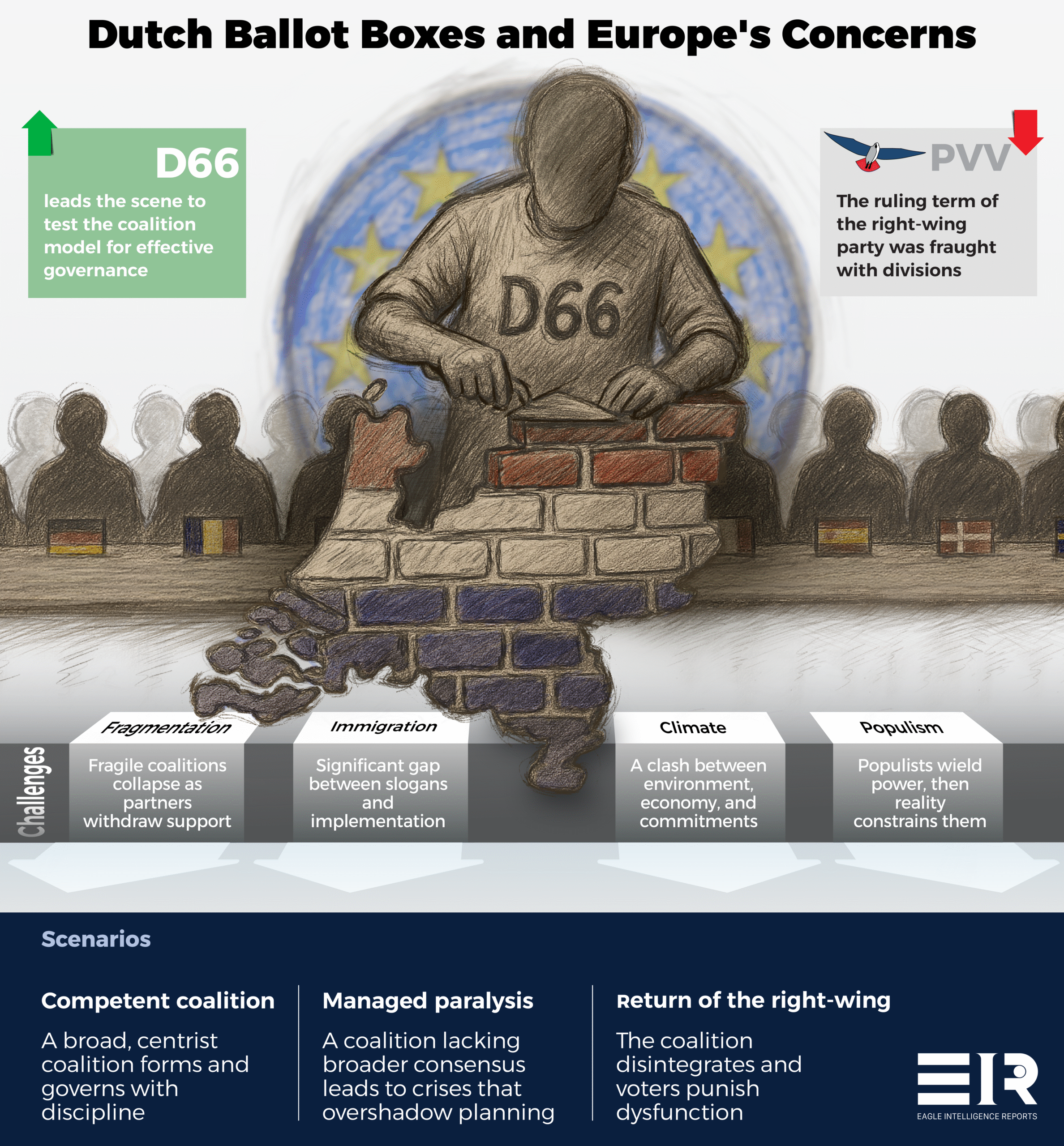
The Netherlands now stands as one of the most fragmented parliamentary systems in Europe, and not by accident. Unlike Germany, there is no electoral threshold; a party does not need 5 percent support to enter parliament. One seat corresponds to roughly 0.67 percent of the vote. This means even small, narrowly defined political projects, such as agrarian protest movements, anti-establishment vehicles, single-issue climate or pension parties, technocratic reform lists, can convert discontent into representation. The result is a chamber composed less of two or three governing blocs, than of a constellation of medium-sized parties, each claiming a distinct mandate.
This structural openness amplifies volatility, as parties rise quickly because the barrier to entry is low and fade just as quickly because durability requires sustained organization rather than momentary grievances. Fragmentation changes not only who enters the parliament but how governance works. To assemble a majority, coalitions require four or more parties, each of which must be given policy concessions to stay in the room. The resulting agreements tend toward lowest-common-denominator drafting, where the priority is preserving internal balance rather than pursuing a clear programmatic line. With responsibility dispersed across several leaders and party bureaus, decision-making slows, blame is harder to assign, and political accountability becomes diffuse rather than direct.
At the same time, multi-party coalitions are inherently brittle. Any single partner can threaten to withdraw support, triggering collapse; each party wields leverage disproportionate to its size. Coalition agreements, once the basis of stability, become bargaining documents revisited under pressure. The government is always negotiating with itself whenever public opinion shifts or a ministerial portfolio becomes politically radioactive.
III. The Election’s Implications on Europe
The return of a centrist-led Netherlands alters Brussels less through ideological swing than through the restoration of governance capacity. For the last year, the Dutch seat at the European Council table was occupied by a caretaker administration; it could react but not shape. With Jetten, the Netherlands again has a government capable of making commitments and sustaining them. That matters because the biggest European files now in motion depend on stable long-term delivery , not declarations.
The return of a centrist-led Netherlands alters Brussels less through ideological swing than through the restoration of governance capacity
Climate and Energy
What happens in The Hague rarely stays there, especially when it comes to Europe’s climate ambitions. In climate policy, the Netherlands occupies a unique position few others do: it is both a European warning and a test case. The nitrogen ruling confirmed that climate policy in Europe can no longer be postponed without legal consequences. Every major industrial, agricultural, and housing decision now intersects with that court-mandated emissions target. What has been missing is a government willing to design the transition as an industrial strategy rather than a cultural battlefield.
A functioning coalition in The Hague would place the Netherlands back in the group of states shaping the second phase of the European Green Deal, from target setting to building. That would mean long-term contracts for grid upgrades, predictable tenders for offshore wind and storage, coordinated hydrogen networks, and transition funding for the most affected regions by land-use changes. None of this is glamorous. All of it is decisive. The signal to Europe is whether climate policy materializes into infrastructure and compensation or remains an argument about identity. The Dutch case will set a precedent either way.
Security and Defense
Europe’s security is increasingly shaped by how its mid-sized states act, and the Netherlands has become one of the quiet anchors of that balance. On security, the Netherlands has for years punched above its weight, particularly in support of Ukraine. What changes now is not sentiment but political mandate. A coalition with parliamentary backing can commit to multi-year procurement schedules, joint European ammunition production, and sustained funding lines that survive budget cycles. It also means deeper interoperability with Germany and the Nordics, countries that see defense not as symbolic sovereignty but as a supply-chain and manufacturing challenge.
The more complex arena is tech security and China. The Nexperia clash, with government intervention, Chinese export retaliation, and downstream shortages in European car manufacturing, exposed the material reality behind the word ‘de-risking’. The Netherlands is now the state through which the EU will have to clarify how export controls, supply diversification, and supply-chain stability are managed in practice. That requires thorough coordination with Washington, precise enough to shield companies from surprise rule changes, yet firm enough to avoid being pulled into US-China escalation by accident. If Europe is to develop a workable economic-security plan , it will do so by following the Dutch case, not ignoring it.
Meanwhile, London and The Hague have long cooperated closely on NATO force posture, naval coordination, and energy interconnectors. A functional Dutch government strengthens the spine of northwestern European security, where British hard power and Dutch diplomatic and engineering expertise remain complementary, even in a post-Brexit institutional landscape.
Economic Integration
Economically, the Netherlands will not simply abandon its frugal instincts. But the logic of Dutch fiscal politics has shifted. The question is no longer whether Europe should spend together, but what problems joint spending is meant to solve. Defense production, raw material diversification, semiconductor capacity, and cross-border energy interconnectors are those domains in which national budget lines cannot function alone. Expect The Hague to remain tough on conditionality: money tied to measurable outcomes rather than aspirational plans, but more flexible on the scale and duration of shared instruments. This moves the Netherlands back into the group of states that shape European financing mechanisms, rather than those that merely obstruct them.
This moves the Netherlands back into the group of states that shape European financing mechanisms, rather than those that merely obstruct them
Migration
Migration is where the Dutch result may carry the most immediate institutional weight in Brussels. The past year demonstrated the limits of gesture-based deterrence: threats to close reception centers drew court challenges and municipal revolt; promises of mass deportation faced diplomatic and administrative reality; and attempts to “take back control” by fiat created neither order nor capacity. What collapsed was not the principle of border management, but the illusion that it could be reasserted without systems. A government led by the center puts the Netherlands back into the group of states that argue that migration cannot be managed through spectacle, only through administration: faster asylum processing at the border, distribution mechanisms that states actually use rather than avoid, and returns agreements tied to verifiable cooperation.
This can matter in Brussels, not because the Dutch now champion a liberal approach, but because they return credibility to the policy side of the migration debate. The EU’s migration pact, which had been advancing on paper faster than in practice, regains a key implementer. The Union has no shortage of proposed rules; what it has lacked is a major member state willing to apply them.
External Relations
Europe’s credibility abroad increasingly depends on whether its member states can align national interests with collective strategy, and the Netherlands is once again central to that test.
Externally, a Netherlands, governed by the center, moves European foreign policy away from improvisation and towards coherence. Dutch diplomacy has traditionally combined Atlanticism with institutional rigor: support for NATO paired with insistence that EU power be grounded in enforceable rules. The difference now is that the Netherlands re-enters the conversation not as a procedural referee but as a state with something at stake: chips, ports, food systems, and energy interconnectivity. The credibility of Europe’s de-risking doctrine will be judged by whether the Netherlands can manage exposure without paralysis. If it can, the EU gains a model. If it cannot, the EU gains another cautionary tale.
The Dutch shift also rebalances Europe’s political geometry. For a decade, the EU’s strategic center of gravity rested uneasily on the Paris–Berlin axis, with Germany hesitant to lead and France overreaching rhetorically without industrial backing. The Netherlands, led by the pragmatic center, becomes a third pole, not a rival to either, but a hinge between them. The Hague shares Berlin’s fiscal caution but has fewer inhibitions about reshaping industrial policy, and Paris’s sense of strategic stakes without its impulse toward grand design. In practice, this means the EU’s next phase of integration is less likely to be driven by Franco-German declarations and more by coalitions of execution in which the Netherlands plays the role of broker, translator, and enforcer.
IV. The Wider European Pattern
Across the continent, voters are not choosing between left and right, but between governance and performance. The Dutch electorate did not reject Wilders’ themes: immigration, identity, and the cost of transformation. It rejected his inability to govern. It did not embrace technocracy but demanded competence. The moral lesson? Democracies collapse not when extremists are loud, but when the center forgets how to govern.
Across the continent, voters are not choosing between left and right, but between governance and performance
Three structural facts now define Europe: Firstly, the state is back. Industrial policy, defense manufacturing, and climate infrastructure require planning, not slogans. Secondly, courts are now political actors. Climate and rule-of-law rulings shape government agendas as powerfully as elections. And lastly, fragmentation is permanent. Politics will not re-consolidate into two blocs; governing coalitions will remain broad, negotiated, and fragile. This is the environment in which the Netherlands now operates and in which Europe must learn to function.
V. Scenarios Moving Forward
1. Competent Coalition
A broad, centrist coalition forms and governs with discipline. Long-term climate and defense programs stabilize; European industrial acceleration becomes possible; migration is handled administratively rather than theatrically. Europe gains a functional anchor in the North.
2. Managed Paralysis
A coalition forms but lacks internal coherence. Policy advances in increments; crisis-response dominates; and innovation stalls. Europe muddles through, but the window for rapid industrial and strategic adjustment narrows.
3. Collapse and Return of the Radical Right
The coalition disintegrates; voters punish dysfunction; Wilders or a successor returns stronger. European climate delivery slows, defense commitments wobble, and economic security becomes reactive rather than strategic.
The Most Likely Outcome
Managed paralysis. Not because the Dutch system cannot, in principle, deliver competent governance, but because the structural conditions under which the next cabinet must operate make enduring coherence extremely hard to maintain, even if the coalition begins with seriousness and goodwill.
VI. Bottom Line
The Dutch election did not restore the center; it bought time. Voters did not reject the themes of the populist right; they rejected its inability to govern. What the Netherlands has offered Europe is a conditional reprieve: a chance to demonstrate that democratic states can still plan, build, and administer.
But that chance is narrow. The coalition that follows will be broad and internally strained. Its success will be measured not in rhetoric but in execution: unblocking housing, managing asylum procedures, delivering the green transition as infrastructure rather than identity politics, and treating economic security as a strategy rather than a crisis response. In a fragmented era, competent maintenance is not modest; it is the test of whether the system still works at all.
If the coalition manages this, it stabilizes Europe’s north and re-centers Brussels around governance rather than performance. If it falters, the far right returns stronger, claiming vindication. The cordon sanitaire is not a solution but a deadline. The Netherlands has given Europe a second chance. What matters now is whether it is used. Europe’s center has been spared collapse, but only if The Hague can turn competence into momentum.