
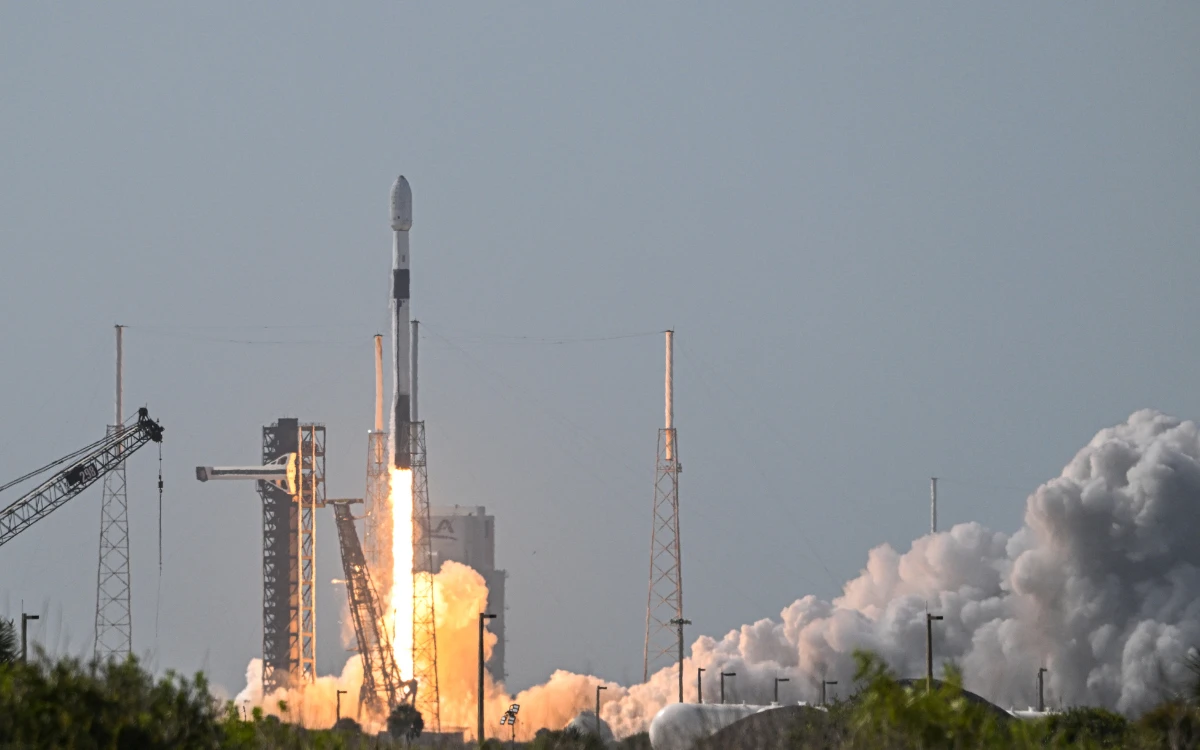
China urged the United States on Tuesday to “stop preparing for war” in space, after the U.S. Space Force confirmed it had deployed weapons into orbit for the first time.
Beijing’s reaction came after the U.S. Space Force said on Monday that it had deployed “on-orbit space control weapons capable of defending… against hostile adversary action.” China’s foreign ministry opposed the move, warning against the “weaponization of outer space, turning it into a battlefield, as well as an arms race there.”
“We urge the U.S. side to stop expanding its military capabilities and preparing for war in outer space,” said Chinese ministry spokesman Guo Jiakun.
The U.S. Space Force portrayed China as a threat in its announcement, saying Beijing “develops and operates space and counterspace capabilities as part of a military modernization strategy.” It added that Russia “views space as a warfighting domain and believes space supremacy will be a decisive factor in future conflicts.”
In 1967, the United States, the Soviet Union, and dozens of other countries signed the Outer Space Treaty, which prohibited placing nuclear weapons or other weapons of mass destruction in orbit. Since then, the United States, China, Russia, and India have explored ways to fight in space in ways not prohibited by that treaty. They included capabilities designed to target rivals’ satellites, which are key for military communications, surveillance, and navigation. The U.S. deployment marks another step in space’s transformation from an enabler of military operations into a potential arena of conflict between geopolitical rivals. That competition is increasingly unfolding under rules designed for a different era: the Outer Space Treaty restricts weapons of mass destruction in orbit but leaves many newer counterspace capabilities outside clear, binding constraints.
Satellites have also become indispensable to communications, intelligence, navigation, missile warning, and precision warfare, making attacks on space systems capable of producing consequences far beyond orbit. The Iran war has reinforced the satellites’ strategic importance by demonstrating how space-based capabilities can support military operations in real time. As the United States, China, and Russia expand their counterspace capabilities without a framework governing their use, the risk is that competition advances faster than the rules intended to contain it. (AFP+EIR)