

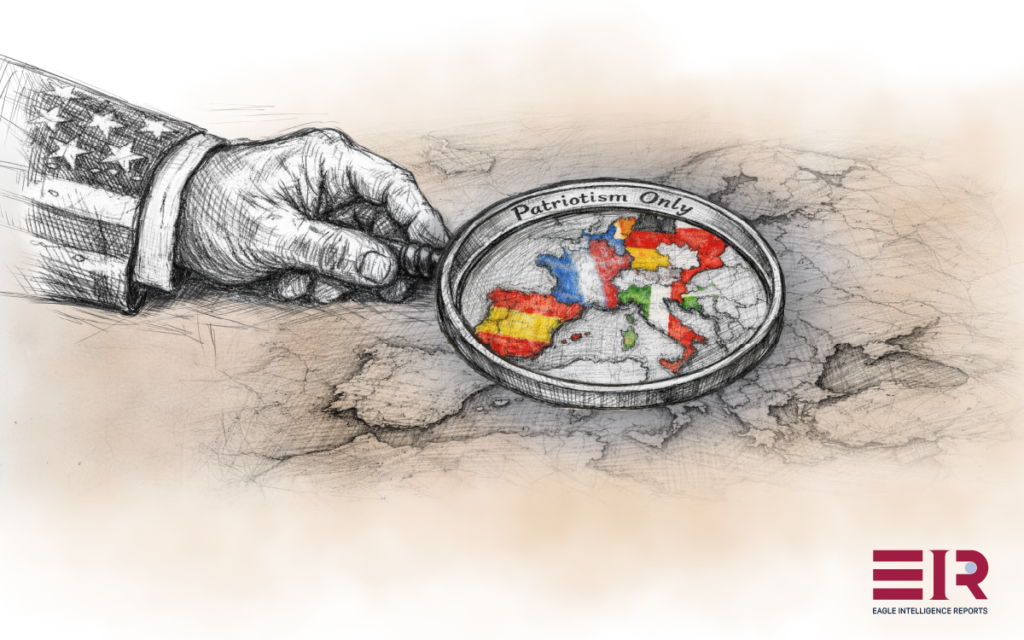
For the first time since the Cold War, the United States explicitly seeks to influence Europe’s internal political order. The Trump administration’s 2025 National Security Strategy does not merely criticize European policies or institutions but openly endorses nationalist parties as preferred partners. It thus reframes Europe’s democratic conflicts as matters of strategic alignment. Where does Europe, a continent already marked by political volatility and division, go from here?
The Trump Administration’s Vision for Europe
The European chapter of the NSS represents a departure not only in tone but also in analytical premise. Whereas earlier U.S. strategy documents treated Europe’s difficulties as functional—insufficient defense spending, energy dependency, regulatory overreach—Trump’s NSS advances a cultural explanation for strategic weakness. Europe, it argues, is constrained not by capacity but by conviction. Its vulnerability lies in the erosion of sovereignty, national identity, and political self-confidence.
The NSS identifies three interlocking sources of this erosion. First, it claims that the EU’s supranational governance dilutes democratic accountability and hollows out national decision-making. Second, it frames migration policies as transformative projects imposed without popular consent, destabilizing social cohesion and political trust. Third, the document targets Europe’s broader ideological culture, identifying its values of liberal universalism, multiculturalism, and technocratic governance as corrosive to national solidarity and strategic resolve.
It does not frame these problems as discrete policy failures amenable to reform but rather as structural defects embedded in Europe’s post–Cold War settlement. The implication is not merely that European institutions function poorly, but that they are increasingly misaligned with the societies they govern. In this view, Europe’s strategic weakness stems from a legitimacy crisis rather than an implementation gap.
Significantly, the NSS does not call for Europe to emulate the United States. Instead, it urges Europe to reclaim an “authentic” version of itself, defined by history, civilization, and national identity. In doing so, it collapses the boundary between cultural interpretation and strategic prescription. Political legitimacy, in this framing, is no longer defined primarily by institutional form or democratic procedure, but by alignment with a particular conception of national cohesion and sovereignty.
The NSS does not call for Europe to emulate the United States. Instead, it urges Europe to reclaim an “authentic” version of itself
This shift matters because strategy documents do more than allocate resources or define threats; they also confer legitimacy. By distinguishing between political forces deemed civilizationally rooted and those portrayed as ideologically corrosive, the NSS implicitly redraws the criteria for partnership. Democratic credentials alone are no longer sufficient. Instead, cultural orientation becomes a strategic qualifier. In Europe, where debates over sovereignty, identity, and integration already divide political systems, this redefinition carries consequences well beyond rhetoric.
Trump’s posture marks a clear rupture with the approach of the Biden administration. While the Biden White House was often critical of European governments on defense spending, China policy, and democratic backsliding in Hungary and Poland, it framed these concerns within a multilateral and procedural logic. Democratic legitimacy was treated as a function of institutions, elections, and the rule of law—not of cultural orientation or ideological affinity. When Washington intervened rhetorically under Biden, it did so to defend democratic processes against erosion rather than to elevate particular factions within them. Support for liberal norms was embedded in alliances, legal frameworks, and collective mechanisms, rather than expressed through preferential engagement with specific political movements.
By contrast, the Trump administration’s NSS abandons this institutional mediation. What is new, therefore, is not American criticism of Europe, but the explicit translation of ideological sympathy into strategic preference.
Ideological Alignment as Geopolitical Strategy
To grasp the significance of this shift, it is necessary to recall how the United States has historically navigated ideological diversity among its European allies. During the Cold War, Washington worked pragmatically across the political spectrum—with social democrats in Scandinavia, Christian democrats in Germany and Italy, Gaullists in France, and even authoritarian governments in southern Europe. Ideological affinity was secondary. What mattered was strategic alignment against a common adversary and adherence—however imperfect—to basic procedural order.
That restraint largely survived the end of the Cold War. Even as liberal democracy became the explicit normative foundation of the transatlantic system, the United States avoided endorsing particular political factions within allied states. Democratic consolidation in Central and Eastern Europe was pursued through enlargement, conditionality, and institutional reform, embedded in multilateral frameworks rather than bilateral patronage. The legitimacy of Europe’s internal political competition was treated as a domestic matter.
The NSS introduces ideological orientation as a strategic variable in its own right. Nationalist and “patriotic” movements are no longer treated as internal features of European democracies to be tolerated or managed. Instead, Trump’s NSS reframes them as corrective forces—vehicles through which Europe might recover sovereignty, cohesion, and strategic purpose.
This does not imply that Washington will restrict cooperation to governments led by nationalist parties. It does, however, signal a reordering of strategic sympathy. Political movements once regarded as sources of instability or democratic risk are now described as legitimate and, in some cases, necessary counterweights to Europe’s prevailing political settlement. In this respect, the NSS shifts the United States from a posture of ideological neutrality among democratic allies to one of selective validation, with implications that reach deep into Europe’s domestic political contests.
The NSS shifts the United States from a posture of ideological neutrality among democratic allies to one of selective validation
Nationalist Movements as Strategic Partners
By committing to “cultivate resistance to Europe’s current trajectory” within member states, Washington signals an intention to engage not with governments as constituted, but with political forces seeking to overturn prevailing policy settlements. In effect, the United States aligns itself with movements that define their mission in opposition to mainstream European institutions, norms, and governing coalitions.
This shift has immediate diplomatic consequences. European officials have reacted with unusual bluntness. Germany’s EU Council presidency publicly described elements of the document as unacceptable, while Chancellor Merz criticized its portrayal of Europe as culturally hollow and strategically enfeebled. What had once been dismissed as rhetorical provocation—Trump’s habitual disparagement of Europe—has now been codified as doctrine. For European governments, the distinction is decisive: what was once a tolerable insult has become actionable policy.
The deeper significance lies less in the specific parties named than in the precedent established. By designating nationalist movements as preferred interlocutors, Trump’s NSS departs from the long-standing U.S. practice of engaging European politics through institutions rather than factions. Ideological sympathy is therefore transformed into strategic alignment. From a European perspective, this is difficult to distinguish from political interference. It does not alter elections directly, but it confers external legitimacy on parties whose defining claim is that existing democratic systems are fundamentally compromised.
One might ask why this matters to the Trump administration. The answer is straightforward: Washington increasingly seeks partners abroad whose political posture mirrors its own domestic orientation. These are actors willing to privilege authority, national cohesion, and ideological loyalty over procedural liberalism. European nationalist parties, with their emphasis on sovereignty, cultural homogeneity, and resistance to supranational constraints, offer precisely this kind of alignment.
By championing forces that challenge liberal democratic norms in Europe, the Trump administration reinforces international partnerships that reflect transformations underway within the United States itself. In this sense, the legitimation of European far-right movements extends Trump’s domestic strategies, prioritizing political expedience and identity-driven cohesion over democratic procedural restraint.
External Legitimization in a Fragmented Political Landscape
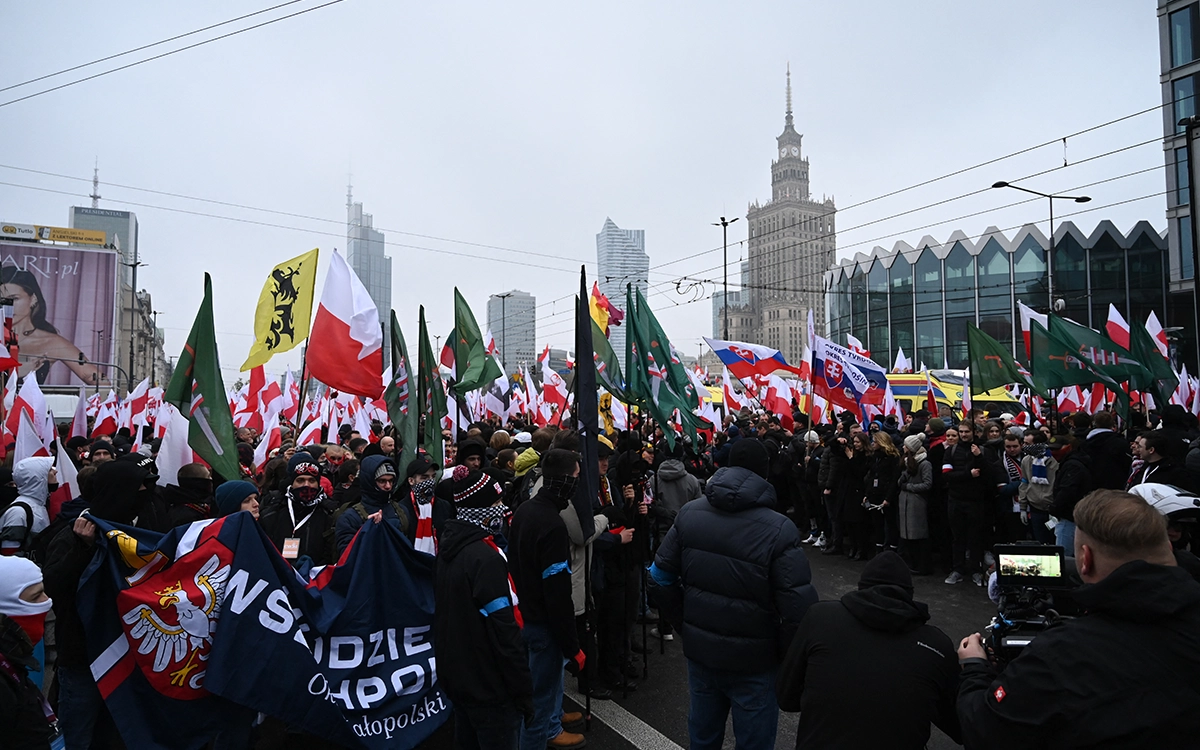
What complicates matters further is that the NSS intervenes in a European political environment already under strain. Nationalist and far-right parties have been gaining ground for more than a decade, though unevenly and for varied reasons. In France, Italy, Spain, the Netherlands, and Scandinavia, such parties have evolved from protest movements into durable electoral forces. In some cases, they have entered government or shaped governing agendas from the outside. Elsewhere—notably in Germany—they have remained formally excluded despite commanding substantial and geographically concentrated support. Their ascent has been contingent, shaped by national institutions, electoral systems, and political culture rather than driven by a single ideological wave.
These movements are united less by a coherent doctrine than by a shared repertoire of grievances. Whether articulated by the National Rally in France, the Lega in Italy, Vox in Spain, or the Alternative für Deutschland, similar themes recur: resentment toward political elites, hostility to supranational governance, and anxiety over cultural and demographic change. Migration has become the most visible rallying point. Yet it functions largely as a proxy for deeper insecurities, including stagnant growth, eroding social trust, and perceptions of lost national agency and voice.
Germany illustrates this dynamic with particular clarity, though it is not unique. The AfD has translated disaffection into durable electoral strength while remaining excluded from national government. This exclusion rests on a dense web of institutional, legal, and normative constraints. Similar firewalls have existed, with varying success, in France and Spain. In Italy, they have largely collapsed, while in Hungary and Poland they have been actively dismantled from within. Germany’s case is distinctive not because it is isolated, but because its containment strategy has relied heavily on informal consensus rather than coalition arithmetic alone.
By conferring external legitimacy on nationalist parties, the NSS weakens precisely these informal constraints. The effect is subtle but cumulative across Europe. Parties once treated as beyond the pale acquire validation from a major external power. Their claims to represent an authentic national will gain plausibility as the reputational cost of engagement diminishes. The result is unlikely to be uniform radicalization, but rather a gradual recalibration of political acceptability, particularly in systems where exclusion has rested on norms as much as law.
Parties once treated as beyond the pale acquire validation from a major external power. Their claims to represent an authentic national will gain plausibility
Germany and the European Pattern
Germany‘s approach to managing extremist politics has long relied on more than law alone. Its system of democratic containment, rooted in the concept of a wehrhafte Demokratie (defensive democracy), operates within a broader normative framework. Legal thresholds, intelligence assessments, and constitutional safeguards derive authority not only from statute but also from political consensus and external validation. Vigilance against anti-democratic forces has been understood as a democratic obligation rather than a partisan tactic.
Comparable dynamics exist elsewhere, though shaped by different historical contexts. France’s cordon sanitaire around the far right has eroded unevenly under electoral pressure. Spain’s resistance to Vox has been institutionally firmer but politically fragile. In Central Europe, by contrast, containment has given way to capture, as ruling parties have hollowed out judicial and media independence from within. Germany thus occupies a middle position: neither immune to nationalist pressure nor structurally vulnerable to rapid institutional takeover.
Crucially, Germany’s equilibrium has been reinforced by its external environment. When domestic intelligence agencies classified parties or party factions as extremist, or when constitutional lawyers debated the merits of a party ban, these actions unfolded against a backdrop of implicit endorsement from democratic partners. The United States, in particular, has historically treated Germany’s sensitivity to extremism as both understandable and prudent—a legacy of twentieth-century catastrophe rather than democratic deficiency.
When parties scrutinized by domestic security services are simultaneously validated by a key ally, moral clarity is diluted. This effect extends beyond Germany to Europe more broadly. Similar tensions now emerge wherever nationalist movements invoke international legitimacy to challenge domestic constraints. Measures once framed as democratic self-defense are more easily recast as ideological suppression, narrowing the political space for assertive institutional response.
Implications for Democratic Containment
The consequences of external legitimation do not concentrate in a single arena. They diffuse across the continent’s institutional architectures, particularly in states where democratic containment relies on informal norms. In Germany, the Federal Office for the Protection of the Constitution retains full legal authority to monitor parties and classify extremist tendencies. Yet its operational environment has changed. Decisions once evaluated primarily through domestic legal lenses now carry an international reputational dimension. Similar pressures confront judicial authorities in France, Spain, and the Netherlands, where rulings against nationalist actors increasingly invite claims of political bias amplified beyond national borders.
Courts remain bound by statute and constitutional reasoning, but context remains significant. When external partners frame a party under review as a legitimate democratic actor, critics can more easily portray sanctions as arbitrary or partisan. This perception does not alter legal standards, but it raises the political threshold for decisive action. Judges and regulators are compelled to anticipate not only appeals but narratives, narrowing the margin for institutional assertiveness.
For mainstream parties across Europe—Germany’s CDU/CSU and SPD, France’s centrists, or Spain’s Socialists and conservatives—incentives shift in similarly corrosive ways. Aggressive containment invites backlash, framed as defiance of popular will endorsed from abroad. Caution, by contrast, allows normalization through inertia. The result is not immediate capitulation, but institutional drift: a gradual movement from principled restraint toward risk-averse accommodation.
Over time, this dynamic weakens not only specific safeguards, but the democratic systems that sustain them. Institutions appear hesitant. Enforcement seems selective, and constitutional vigilance is reframed as ideological preference. The European system remains intact, but its capacity for decisive self-defense is constrained—not by legal defeat, but by accumulated hesitation across multiple national contexts.
Mainstream Party Drift and Convergence
Europe’s democratic stability does not rely solely on constitutional safeguards or surveillance mechanisms. It also depends on the behaviour and strategy of mainstream parties, which historically have functioned as stabilizers. Yet the rise and growing legitimacy of parties such as the AfD and Reform UK—now reinforced externally—has reshaped the strategic environment. This shift distorts traditional incentive structures, encouraging programmatic convergence, policy hardening, and the subtle hollowing out of pluralism.
Migration policy illustrates the mechanics of convergence. Before 2015, migration debates largely unfolded within a liberal-technocratic frame, emphasizing international obligation, human rights, and integration capacity. Far-right narratives have reframed the issue around sovereignty, cultural survival, and social order. Mainstream parties, seeking to avoid electoral erosion, increasingly adopt elements of this framing through references to controlled borders, cultural integration expectations, and security-based justifications for policy interventions.
By narrowing the parameters of legitimate discourse, this dynamic accelerates the institutionalization of nationalist claims, even when far-right parties do not attain formal power. Voters internalize these shifted norms. Political debate gravitates toward risk-averse positions, and policy innovation is constrained by the need to operate within increasingly rigid boundaries.
Implications for the European Union and NATO
The strategic effects of this shift would register first in institutional behavior rather than rhetoric. Within the European Union, the empowerment of nationalist parties would translate into more frequent vetoes, procedural obstruction, and selective non-compliance, rather than dramatic exits. Decision-making in areas requiring unanimity—sanctions, migration policy, and foreign and security coordination—would become even slower and more fragile, as governments facing nationalist pressure prioritize domestic signaling over collective outcomes. The result would not be the collapse of the Union, but its gradual conversion from a rule-driven system into a bargaining arena in which commitments become increasingly conditional and reversible.
This dynamic would also alter the internal balance of power within EU institutions. The European Commission’s capacity to enforce compliance would weaken as political backing from member states erodes. Legal mechanisms would remain intact, but enforcement would become more hesitant, applied unevenly, and vulnerable to accusations of ideological bias. Over time, this would encourage strategic defection: governments could delay implementation, challenge rulings, or extract concessions by threatening obstruction, confident that the political costs of enforcement have risen.
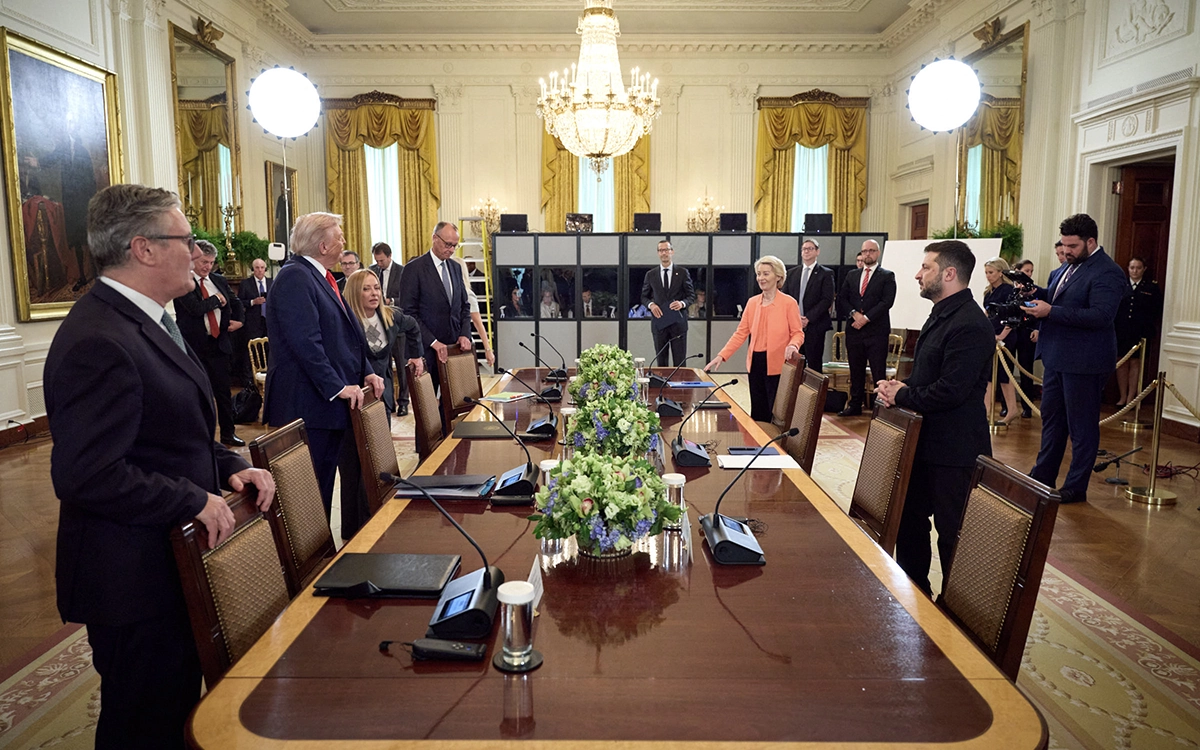
NATO would face a different, though no less destabilizing, adjustment. Its military structures would remain operational, assuming continued U.S. participation, but political cohesion would thin. If ideological alignment becomes an informal criterion for strategic reliability, security commitments risk becoming implicitly conditional. Burden-sharing debates would intensify, shifting from spending levels to political orientation and complicating force planning and long-term procurement. Allies would hedge by investing more in national capabilities or ad hoc bilateral arrangements to insure against uncertainty, thereby weakening collective integration.
Most damaging would be the erosion of predictability. NATO’s deterrent power rests less on declarations than on shared assumptions about automaticity and trust. When those assumptions fray, even without formal policy change, deterrence weakens. Adversaries do not require proof of disunity; they exploit ambiguity. In this sense, ideological selectivity would not dismantle the transatlantic system, but it would render it more brittle, more transactional, and more vulnerable to strategic testing.
Ideological selectivity would not dismantle the transatlantic system, but it would render it more brittle, more transactional, and more vulnerable to strategic testing
Where Does Europe Go from Here?
The long-term impact of Trump’s NSS will depend less on its rhetoric than on how European actors respond. Several plausible scenarios emerge.
Scenario 1: Contained Disruption
European institutions and mainstream parties absorb the shock, reaffirm democratic norms, and maintain informal firewalls against extremist movements. U.S. engagement remains largely symbolic, with limited practical effect. Nationalist parties gain visibility but not governing power. Transatlantic relations grow more strained, but institutional cooperation remains intact.
Scenario 2: Gradual Normalization
American legitimation accelerates the normalization of nationalist parties. Mainstream parties adapt strategically, coalition boundaries shift, and previously taboo positions enter government platforms. Democratic institutions endure, but with a narrower conception of pluralism. The EU becomes more intergovernmental, NATO more explicitly transactional.
Scenario 3: Institutional Fragmentation
Nationalist movements gain decisive influence in multiple member states, weakening EU cohesion and complicating collective action. Legal and constitutional defenses erode under sustained political pressure. The transatlantic alliance persists, but increasingly as a loose network of ideologically aligned governments rather than a rules-based community.
Scenario 4: Democratic Backlash
Explicit U.S. ideological intervention provokes resistance. European publics and institutions reassert autonomy, strengthen legal safeguards, and reaffirm liberal norms. Nationalist parties plateau or fragment. The transatlantic relationship recalibrates around mutual restraint rather than ideological alignment.
Which scenario prevails will depend as much on choices made in European capitals as in Washington. The NSS does not determine outcomes, but it reshapes the field on which they are contested.
It is clear that the era of ideological neutrality in transatlantic relations has ended. Trump’s NSS intervenes in European politics not as a referee, but as a source of strategic and ideological legitimation. The consequences of that choice will define the future of the Western alliance.