
The dilemma facing the United States is not one of overall firepower or operational readiness. It is whether its industrial base can scale production of the precision-guided munitions on which modern American deterrence depends. The ongoing replenishment gap threatens to raise questions about overall deterrence credibility, as the United States is tested across multiple simultaneous theaters and against new types of asymmetric and hybrid warfare.
Recently, U.S. Senator Mark Kelly commented on the American military operation against Iran, revealing that it was “shocking how deep we have gone into these magazines.” Kelly further added, “We’ve expended a lot of munitions. And that means the American people are less safe. Whether it’s a conflict in the western Pacific with China or somewhere else in the world, the munitions are depleted.”
Kelly’s warning reflects a broader concern in Washington and other Western capitals. U.S. military power is still formidable at the point of use, but the magazines behind that power are being drawn down across multiple theaters at once. Ukraine, Israel, the Gulf, and the Indo-Pacific all draw from the same arsenals. They all compete against the same industrial base, production lines, and slow-moving replenishment timelines. Although there is no crisis yet, the conditions for one are increasingly visible.
The United States is not running out of weapons; it still has plenty of “dumb” bombs and legacy munitions. The potential bottleneck lies in the “smart” weapons that make modern American power decisive: long-range standoff systems such as Tomahawks and JASSMs, precision fires such as GMLRS, and air-defense interceptors such as Patriot, THAAD, and SM-3. These are the types of weapons that would be expended in a potential conflict in the Indo-Pacific, and they are also the hardest to replace rapidly and at scale.
The United States is not running out of weapons; it still has plenty of “dumb” bombs and legacy munitions. The potential bottleneck lies in the “smart” weapons
That is why recent White House meetings with defense industrial base leaders are a significant signal. They reflect a growing recognition that the munitions expended in weeks may require years to rebuild, especially in certain high-tech categories. Stockpiles still matter, but replacement speed now determines how long U.S. deterrence can hold across multiple fronts. The battlefield clock is moving faster than the industrial clock, and that gap is shaping decision-making from Ukraine to the Arabian Gulf and across the Indo-Pacific.
The Replenishment Gap
The clearest example is artillery ammunition. Before Russia’s full-scale invasion of Ukraine, the U.S. Army produced 14,000 155mm shells per month. Production has expanded with over $6 billion of Congressional funding. However, the Army’s goal of producing 100,000 shells monthly slipped due to material delays and manpower issues, with output still only at 56,000 shells a month as of February 2026. European NATO members together still only produce around 200,000 artillery shells a month. Meanwhile, Russia has transformed artillery production into an industrial base endurance advantage while also relying on shells imported from the DPRK. Western intelligence estimates place Russian shell production at 7 million annually, with total artillery-related output likely being higher when rockets and refurbished stocks are included. The larger point is that battlefield consumption continues to outpace Western replenishment rates, and with extra munitions—even “dumb” ones like artillery—that gives more options and leverage to the Kremlin.
Precision-guided “smart” weapons are harder to scale because their bottlenecks are related to seekers, guidance systems, actuators, radar components, and specialized materials. The sharpest strain appears in air and missile defense. PAC-3 MSE, THAAD, SM-3, SM-6, and related interceptors now anchor deterrence across multiple theaters. But these systems depend on constrained supply chains for gallium, rare earth magnets, germanium, and other critical inputs. Missile defense also creates an economically punishing exchange ratio: million-dollar interceptors often destroy drones and missiles that cost far less. Even successful defenses burn through magazine depth.
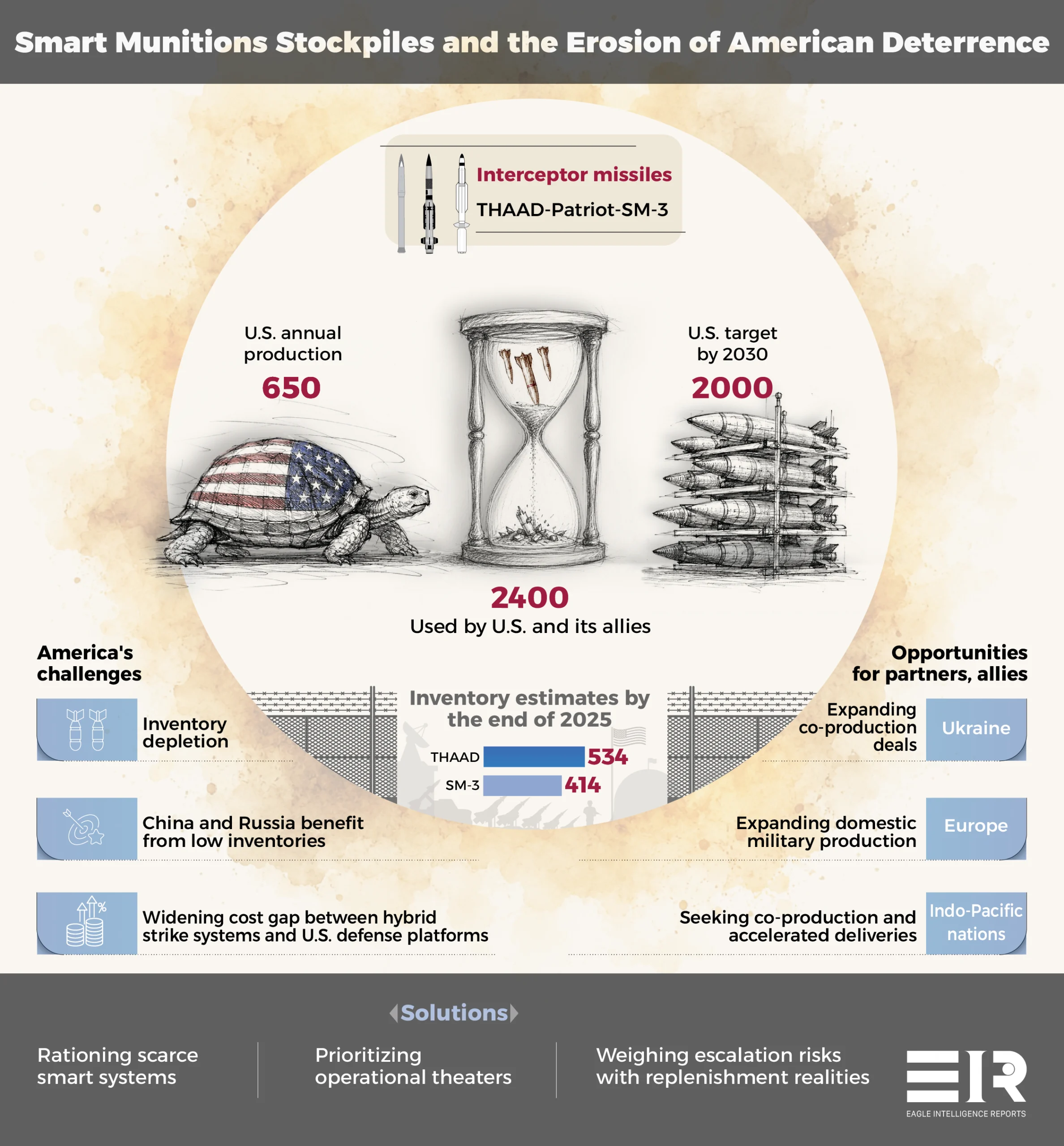
One U.S. media assessment estimates that up to 2,400 interceptors (many of them Patriot missiles) were fired by the United States and Gulf allies, against a production rate of 650 per year and a current target of 2,000 per year only by 2030. The same assessment estimates U.S. stocks at roughly 414 SM-3s and 534 THAAD interceptors as of December 2025, with up to 150 THAADs and around 80 SM-3s used during the 2025 Iran conflict. The U.S. military-industrial base will take years to reach production rates that match the pace of the Iran War, and even longer to rebuild a credible deterrent depth for other theaters.
The U.S. military-industrial base will take years to reach production rates that match the pace of the Iran War, and even longer to rebuild a credible deterrent depth
Multiple Fronts Strain the Industrial Base
Providing the same munitions for Ukraine, Israel, the Gulf, and Taiwan compresses production demands, extending delivery dates. Ukraine has consumed enormous quantities of artillery, ATACMS, Javelins, and interceptors. The Middle East now needs a scaled-up replenishment of Patriot, THAAD, naval interceptors, and precision strike systems. A kinetic China–Taiwan contingency would impose the greatest pressure of all on the Western defense industrial base, demanding exactly the systems already under strain: long-range missiles, air defense interceptors, and stand-off munitions. Unclassified war game exercises by the Center for Strategic and International Studies in 2023 already demonstrated that the United States would likely run out of its “smart” weapons within 8 days of intense conflict with China in the defense of Taiwan.
The mineral and interceptor timeline, alongside the Iran War, makes that scenario even more dangerous for Taiwan and its potential allies. The 2026–2027 period appears to be a maximum exposure window: key stockpiles depleted, China-imposed gallium restrictions impacting weapon system production, rare earth alternatives remain immature, and an interceptor production “surge” unlikely to reach a meaningful scale until 2030. A Taiwan contingency during this window would deplete the stockpiles of the “smart” weapons needed for air-defense, anti-ship, air-to-air, and standoff-strike systems—stockpiles which have already been considerably strained by the Russia-Ukraine War and the Iran War.
This creates a near-term zero-sum problem. Munitions used in one theater reduce availability in another region until production catches up. The issue is not simply funding. Congress can appropriate money faster than industry can expand output. The real constraint is time and material industrial capacity. Factories must be built, workers trained, energetics sourced, supply chains stabilized, and production lines qualified. Modern wars consume munitions in weeks while industrial systems regenerate them over years. The bottlenecks are often hidden below prime contractors: rocket motors, seekers, explosives, castings, and rare materials quietly determine how quickly “surge production” becomes reality.
The hidden chokepoint in precision-guided systems is not the missile body, but the mine-to-seeker supply chain. Dysprosium and terbium are required for high-temperature magnets in fin actuators and seeker assemblies. Samarium-cobalt magnets support precision seeker heads and inertial navigation. Gallium is essential for gallium nitride and gallium arsenide chips used in the most exquisite Ka-band seekers and active electronically scanned radars. Germanium, antimony, and tungsten also support infrared optics, armor-piercing ammunition, batteries, and penetrators. A production line can have all the money, labor, and factory space, but “surge” cannot happen because of one missing material. Such bottlenecks caused by a single component are becoming more common because of Chinese export controls on materials since 2023. Moreover, the problem is more than just which country controls the ore. It is who can refine, separate, process, and qualify the material at defense-grade scale—which, again, China dominates at a global scale.
Ukraine exposed how much of the Western defense industrial base had been optimized for efficiency and low-volume procurement rather than sustained wartime output. This is why the issue has become politically charged in Washington. Congressional debates increasingly focus not only on aid packages, but on whether the United States can sustain one major war, support a second theater, and still preserve enough capacity for a third contingency. Defense firms are right to repeatedly emphasize that industrial expansion requires multi-year procurement stability and long-term workforce growth, not temporary emergency funding. The industrial base remains highly advanced, but it is not configured to sustain a fight against a near-peer adversary.
The Western industrial base remains highly advanced, but it is not configured to sustain a fight against a near-peer adversary
Modern Deterrence as Industrial Endurance
The strategic consequence is that, in modern warfare, deterrence increasingly depends on industrial endurance as much as deployed force. The credibility of American power is now going to be evaluated based on what can be replenished after day 30 of a conflict and sustained through day 90. In the short term, Washington can manage through existing stockpiles and production surges. Over time, however, Western military planners face harder tradeoffs. Scarce systems must be rationed, theaters prioritized, and escalation risks weighed against replenishment realities. This is where the constraints of industrial capacity will begin influencing American security guarantees abroad.
Adversaries, of course, are doing the missile math. China can assess that support to Ukraine and Gulf allies reduces available “smart” weapons for a conflict in the Indo-Pacific. Russia benefits when artillery imbalances persist. Iran and its proxies exploit the cost asymmetry between cheap missiles and drones and expensive Western defenses. Allies see the same pressures from the opposite direction. European states are expanding their own ammunition production and developing their own weapon systems because they cannot assume that U.S. inventories will remain effectively unlimited. Indo-Pacific countries increasingly seek co-production and accelerated deliveries because they saw how many munitions were expended in the 39-day Iran war.
One useful way to frame this is the gap between “time to failure” and “time to function.” The former is when a constrained supply source can no longer sustain production, while the latter is when a domestic or allied alternative reaches the scale, quality, and reliability needed for defense production. Between them sits the danger window, inside of which money and urgency do not automatically create munitions. They only manage a deficit. It is why the next two years are so critical. This is the time window in which depleted interceptor stocks, Chinese mineral leverage, and a constrained industrial base overlap most dangerously.
At a minimum, Washington appears to be adapting. Ukraine and the United States appear to be nearing a deal to jointly develop and build weapons, drones, and anti-drone systems. Co-production agreements are expanding. Multi-year procurement is also finally being treated as a strategic necessity.
Yet the core challenge remains unresolved. The changes underway will improve the U.S. position, but they will not eliminate the conditions that created the strategic dilemma in the first place. China’s rare earth mineral dominance can be challenged, but only over time and with consistent investment and coordination. The United States still possesses the world’s most capable defense industrial base. But deterrence and the ability to fight even a one-front war now require that base to function as a sustained wartime production system across multiple simultaneous fronts with varying degrees of warfighting intensity.
Deterrence now depends on whether the United States can fight one war, provide arms for another, replenish stockpiles under pressure, and still credibly demonstrate to adversaries that the next conflict will not find the arsenal empty where it matters most.
Deterrence now depends on whether the United States can fight one war, provide arms for another, replenish stockpiles under pressure