
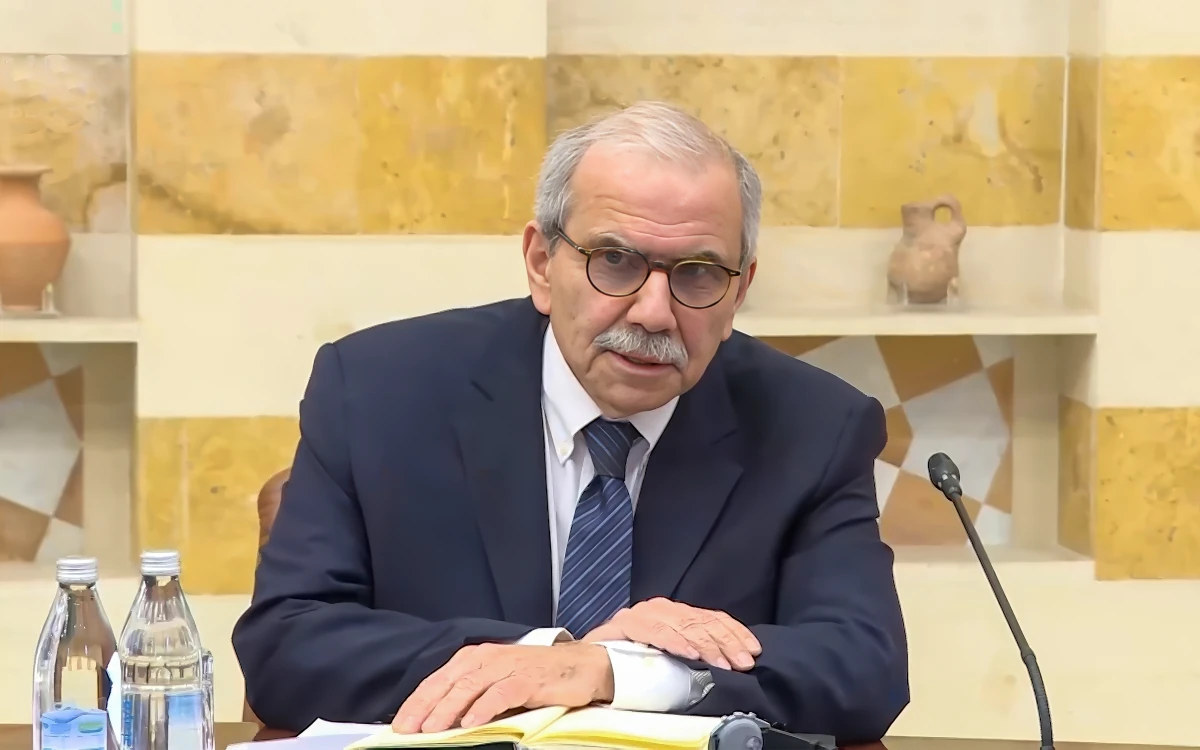
Lebanese Prime Minister Nawaf Salam affirmed on Monday that the government is striving for successive Israeli withdrawals from southern Lebanon, culminating in a complete withdrawal. This statement came on the eve of a new round of negotiations between Lebanon and Israel, hosted by the Italian capital, Rome, for three days.
Information Minister Paul Morcos quoted Salam as confirming during a cabinet meeting, “Lebanon’s pursuit of successive Israeli withdrawals from Lebanese territory, leading to a complete withdrawal from Lebanon.”
The seventh round of negotiations between the countries begins Tuesday in Rome, following six previous rounds. The last round resulted in a framework agreement stipulating the withdrawal of the Israeli military from the outskirts of the town of Zawtar al-Gharbiya, one of the “pilot zones” stipulated in the agreement, before the deployment of the Lebanese army there. The agreement also allows residents to return to the town after the completion of surveying and reconnaissance operations.
Lebanon and Israel signed a framework agreement on June 26, following five rounds of negotiations. This agreement specifically stipulates the disarmament of Hezbollah, a gradual Israeli withdrawal from the occupied territories in southern Lebanon, and the deployment of the Lebanese army, beginning with the “pilot zones.”
A U.S. State Department official said last week that “technical delegations in Rome will focus on accelerating the full implementation of the framework agreement,” noting the expansion of the “pilot zones,” to resolve outstanding border issues, and the drafting of a comprehensive peace and security agreement.
However, U.S. Ambassador to Lebanon, Michel Issa, warned on Monday against “rushing forward” with the agreement’s implementation, arguing that doing so “could endanger the civilians the very process intended to protect.”
In a statement, he added, “We believe that taking the necessary time to complete this work will enable subsequent pilot zones to operate more effectively.”
He maintained that both sides must agree on “a clear and practical mechanism before proceeding to the next phase” of the agreement.
Under the framework agreement, the Lebanese army, after deploying in the “pilot zones” is supposed to disarm Hezbollah and prohibit any military presence of any group outside the framework of the government forces, thus setting a precedent for a gradual Israeli withdrawal from other areas.
Experts say the biggest challenge will be identifying new “pilot zones” still occupied by Israel, as this will test Tel Aviv’s seriousness in implementing an actual withdrawal, as well as the Lebanese army’s ability to deploy and dismantle any Hezbollah military infrastructure. (AFP)