
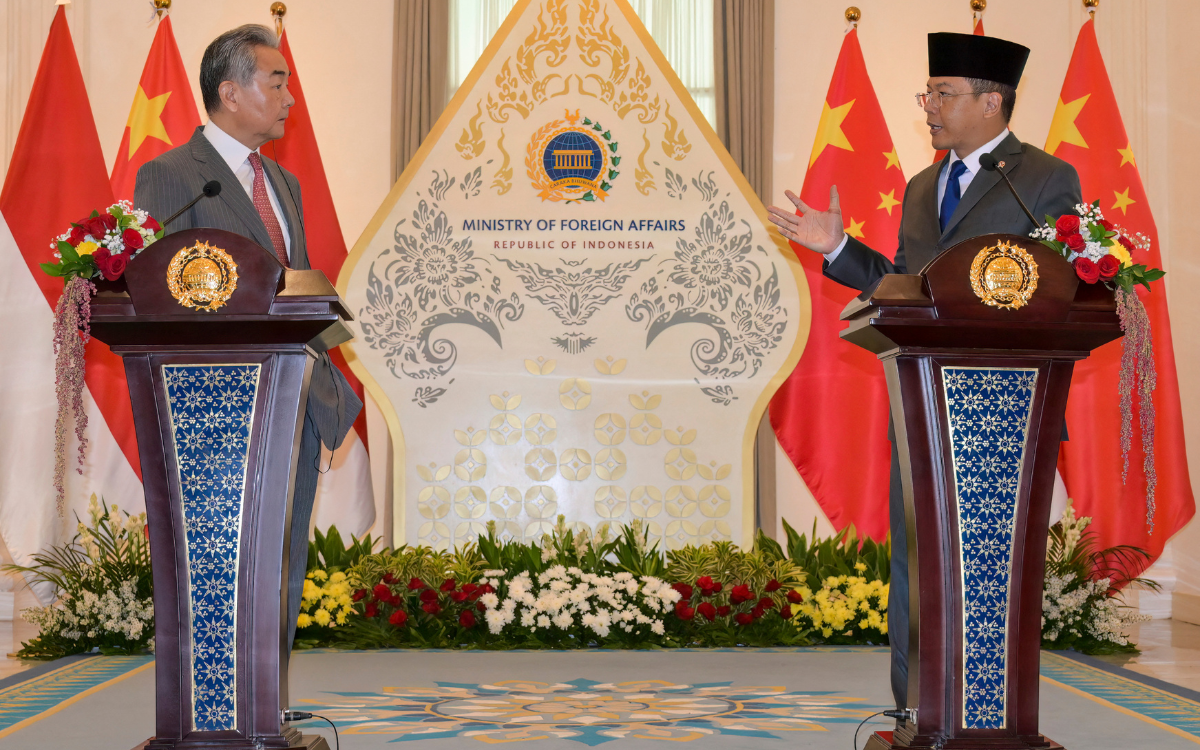
China’s foreign and defense ministers held talks with their Indonesian counterparts to strengthen their military and political cooperation after a joint navy drill Taiwan labelled as a “provocation.”
The Friday talks in Jakarta were a “forward-looking strategic platform,” guiding the two countries’ relations across the “political, economic, maritime, people-to-people, and security” pillars, Indonesia’s Foreign Minister Sugiono said.
“We are seeing unilateralism and hegemonism. They have dealt a heavy blow to this world as well as to the global development agenda,” Chinese Foreign Minister Wang Yi said, most likely referring to U.S. international dominance and American sanctions. Chinese Defense Minister Dong Jun is set to join Wang later, during talks with Indonesia on “political security and defense cooperation and international and regional situations,” according to Beijing.
Indonesia adopts a neutral foreign policy, balancing diplomatic relations with both China and the United States. Despite Taipei being a close de facto partner of Washington, Indonesia held a joint navy drill off Taiwan’s coast earlier this month. But the two countries said it was a “passing exercise” with an Indonesian frigate passing through on its return home from the Russian port city of Vladivostok. Taiwan, however, called it a “military provocation” by China.
Last year, Indonesia joined the BRICS bloc of emerging economies that includes Russia and China. But President Prabowo Subianto also signed a trade deal with U.S. President Donald Trump and joined his so-called Gaza “Board of Peace.” Friday’s talks are likely an attempt by Indonesia to expand its strategic options, rather than a realignment with China. As Southeast Asia’s largest economy and a key maritime power straddling vital shipping routes, deeper Indonesian defense cooperation would give Beijing a more influential security relationship in a region central to U.S.–China competition. But the Taiwan drill adds significance because closer operational cooperation with China—even if Jakarta characterizes it as routine—could test Indonesia’s traditional non-alignment and raise concerns in Washington and among regional partners. (AFP)