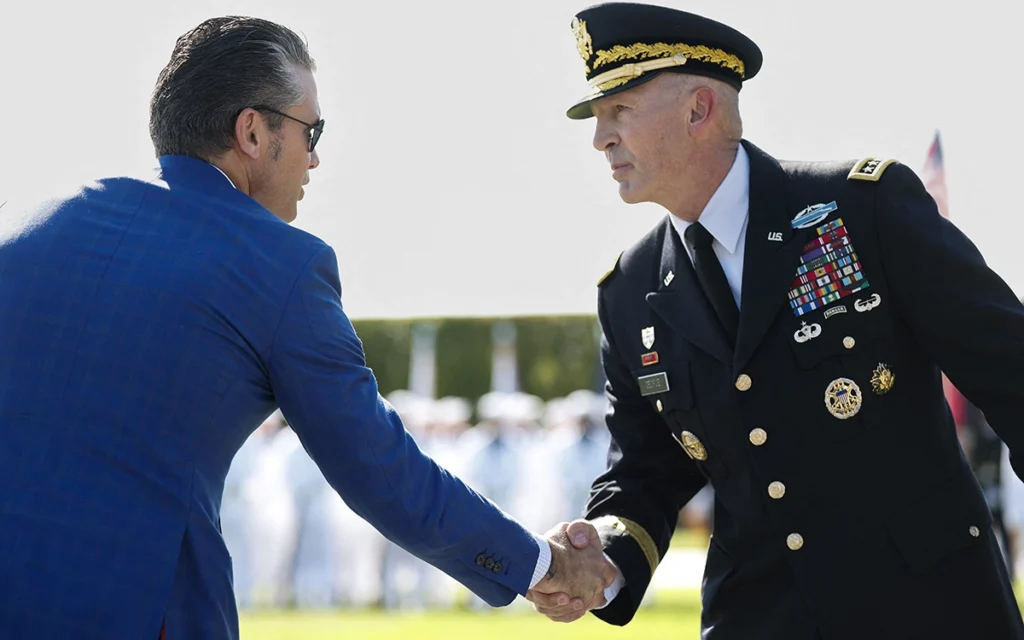


Numerous reports suggest that General Dan Keane, Chairman of the Joint Chiefs of Staff, warned in internal deliberations about the dangers of launching a major military operation against Iran. Chief among them is the risk that an attack extends into a long-term conflict that would be difficult to contain. Although President Trump has denied the accuracy of the reports, the visible hesitation surrounding any decision to strike Iran suggests extensive debate within U.S. decision-making circles.
Global political debate, meanwhile, remains preoccupied with timing and scope: would a strike be a swift operation designed to bring Tehran back to the negotiating table, or the first step toward a broader confrontation? Largely absent is discussion of the most dangerous trajectory—the possibility that a “controlled” strike evolves into a compulsory course of action that its architects are unable to reverse.
Major disasters in international politics rarely begin with an explicit decision to go to war. Rather, they emerge from a series of gradual measures designed to remain controllable, often surrounded by procedural safeguards to prevent them from spiraling out of control. History repeatedly demonstrates, however, that scenarios carefully constructed on paper can collapse with a single miscalculation or misstep.
History repeatedly demonstrates, however, that scenarios carefully constructed on paper can collapse with a single miscalculation or misstep
In the current U.S.–Iran crisis, the primary danger lies not in an intention to wage war per se, but in the structure of the approach taken by President Trump: high-stakes psychological escalation without a clearly defined idea of where to stop or what comes next. From the outset, the policy has not aimed at full-scale war but at maximum pressure—combining a large naval and air buildup with public threats and contradictory messages mixing threats of force with calls for negotiation.
The goal of this approach is to extract political concessions without sliding into open confrontation. However, when escalation is conducted publicly and linked to leadership credibility and national prestige, it carries a well-known structural risk: it can transform from an instrument of leverage into a trap.
When Escalation Becomes an Obligation
The problem lies not in military force itself, but in the framing of its use. When escalation becomes a test of will and prestige, it ceases to be a flexible political tool and becomes a psychological commitment. This is particularly the case with a president like Donald Trump, who believes that the United States is powerful enough to do whatever it wants, whenever and wherever it wants. In such circumstances, backing down—even if strategically rational—becomes politically costlier than pressing forward. This changes the nature of the decision: force is then used not because it achieves a specific goal, but because it prevents the appearance of weakness.
This dynamic is historically familiar. The logic of “preserving credibility” has repeatedly driven states into deeper commitments that were not part of an integrated strategic design, but rather measures intended to avoid losing face. The danger in the current situation is magnified by regional fragility: miscalculations would not remain confined to the two parties but would reverberate across the region, potentially spiraling out of control.
What Comes After the Strike?
A potential military strike is not the problem per se; rather, the problem is the inherent unpredictability of what comes after it. Few doubt that the United States possesses the military and technological capability needed to inflict decisive damage on the Iranian regime and establish immediate battlefield superiority. However, the fundamental question remains unanswered: what would come next?
A potential military strike is not the problem per se; rather, the problem is the inherent unpredictability of what comes after it
If Tehran interprets a strike not as coercive signaling but as open aggression warranting a substantive retaliation beyond symbolic measures, Washington would be confronted with a classic dilemma. Responding would deepen involvement in an unplanned conflict, while restraint would risk undermining deterrence credibility. At that point, escalation would cease to be a political option and become a structural necessity—a compulsory course of action. Subsequent decisions would transform from elements in a coherent strategy to reactive and unpredictable conflict-management adjustments.
From State to Power Vacuum
Here lies the deeper dilemma. Iran is not a small or homogeneous state that can be neutralized with minimal disruption. It is a large, multi-layered political entity whose cohesion rests on a highly focused political-security center. Any significant weakening of that center, absent a realistic framework for a viable alternative, would not produce an orderly transition. Rather, it would open the door to competitive fragmentation within a power vacuum.
In such cases, state disintegration does not require a total collapse. It can emerge from the erosion of central authority, elite fragmentation, conflict between institutions, and prolonged low-intensity but long-lasting internal unrest. Recent regional experience demonstrates that dismantling state structures is far easier than managing the vacuum that follows. The post-collapse Iraqi state remains a cautionary example of this dilemma.
In a country the size of Iran, such fragmentation would not remain internal; it would spill over into neighboring countries.
Recent regional experience demonstrates that dismantling state structures is far easier than managing the vacuum that follows
Disaster Scenario: When the Slide Widens
Here we arrive at what could be called a “disaster scenario.” This scenario does not assume an intention or total war, nor a central decision to destroy a country. It is rooted instead in the interaction of cumulative miscalculations within an already fragile regional environment, whereby escalation begins as a tool of psychological pressure, transforms into a credibility contest, and triggers a series of reciprocal responses beyond any party’s control.
The danger of this scenario is that it does not stop at Iran. Iraq’s incomplete state coherence and Syria’s fragmented state authority would amplify instability. At this point, we would not be facing isolated crises in two countries, but rather a synchronized destabilization arc stretching across the Gulf to the Mediterranean, a geographical area roughly half the size of the European Union.
In such an environment, contagion spreads simultaneously, not sequentially. Long, poorly controlled borders, transnational armed networks, and war-fractured economies already create conditions in which such shocks can trigger explosions rather than simply be a source of pressure. What was previously managed in capitals transforms into networked conflicts without a control room. Centralized deterrence becomes less effective; containment becomes nearly impossible.
Structural Costs to Stability and Energy
Escalating tensions excessively without a credible post-strike framework risks transforming chronic instability into systemic breakdown. It poses a great danger to countries in the region that already suffer from chronic instability, porous borders vulnerable to arms smuggling networks, entrenched militias, sectarian fragmentation, armed non-state organizations, and unresolved confessional divisions and sovereignty disputes. Weakening a central state like Iran would act as a flashpoint, accelerating and exacerbating all of these factors.
Yet the “disaster scenario” goes beyond security, extending to the global economy. Chronic turmoil in the Gulf region would bring sustained increases in insurance and shipping costs, threats to energy facilities and routes, and the transformation of the risk premium into a pricing standard. Such effects are cumulative, cannot be contained with ease, and are difficult to reverse. They create an environment of long-term instability that can only manage crises rather than provide durable solutions.
The central danger of a possible U.S. escalation toward Iran is not deliberate war-making per se, but rather the possibility of inadvertent entrapment in a war to defend credibility. When force is used to preserve image rather than to achieve a defined political goal, risk scenarios become open-ended and strategy dissolves into momentum. In a Middle East already burdened with structural fragility, the outcome may not be a limited military confrontation, but a cascading, region-destabilizing, “catastrophe scenario” with no center of control. Such a trajectory would come at great human, security, and economic cost that neither the region nor the world can bear.
The central danger of a possible U.S. escalation toward Iran is not deliberate war-making per se, but rather the possibility of inadvertent entrapment in a war to defend credibility
The most dangerous wars are not those entered out of conviction, but those begun under the assumption of control—only to discover too late that the most critical questions were never resolved: where does this end?