

Donald Trump’s second term has not restored the familiar rhythm of transatlantic cooperation. Instead, it has accelerated a shift that began during his first presidency, where security, diplomacy and economic power increasingly moved away from a shared strategic framework and toward a model defined by negotiation and conditional commitments.
Europe now faces a United States that treats support, access and guarantees as matters of exchange shaped by political and financial incentives. The ongoing negotiations in Geneva over Ukraine reveal this new landscape. What once operated as a predictable alliance has become a bargaining arena in which Washington and Europe advance competing ideas about leadership, responsibility and the nature of post-war stability.
Geneva as the New Fault Line
The latest round of negotiations in Geneva has crystallized the structural realignment of transatlantic relations.
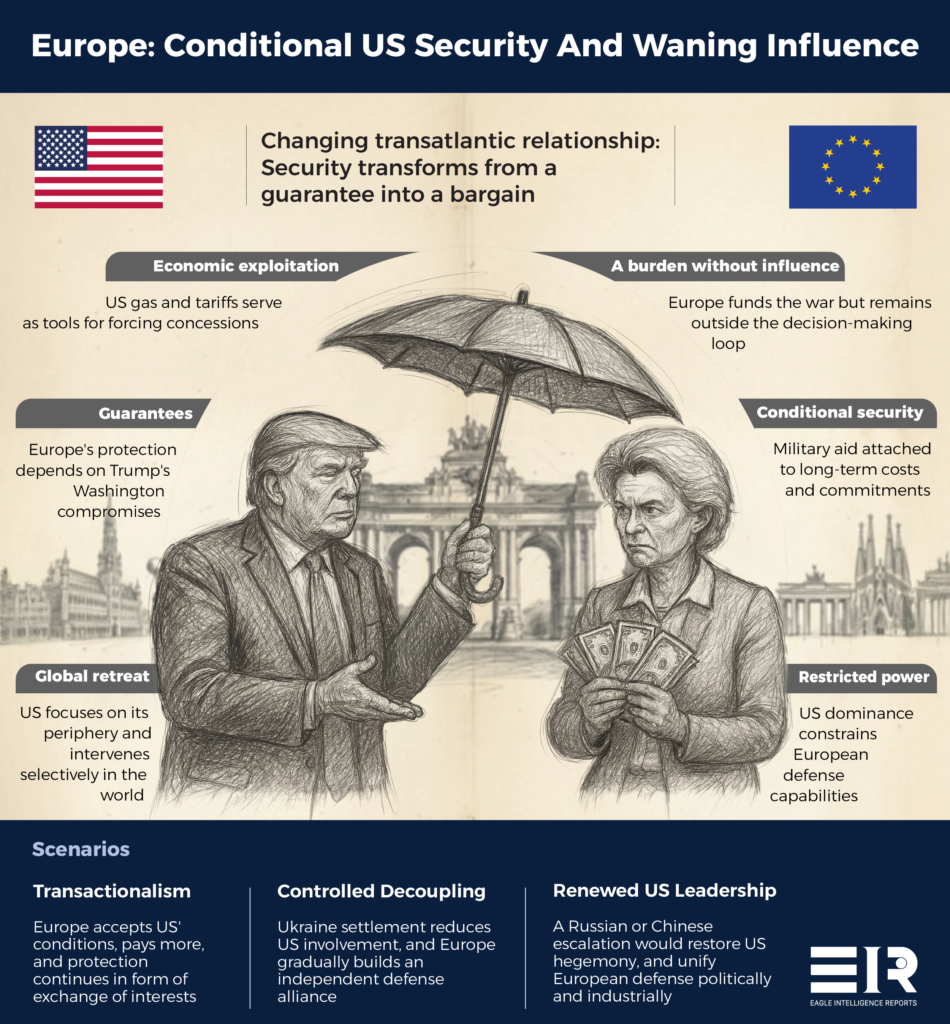
Washington’s 28-point proposal for ending the war in Ukraine, drafted unilaterally and presented to Europe and Kyiv as a near-final framework, has produced the clearest expression yet of Trump’s second pivot. The plan’s logic is unmistakably transactional: US security support is framed as conditional, reversible, and tied to cost-sharing arrangements, resource concessions, and long-term commitments from European states.
Europe’s counterproposal, delivered after an intense night of consultations among EU member states, shifts the emphasis away from territorial concessions and US-controlled enforcement mechanisms. It prioritizes European oversight over security guarantees, insists on Ukrainian agency in the negotiation of any ceasefire line, and introduces a European-led monitoring structure that would remain operational, even if Washington reduces its involvement.
This divergence reveals a deeper structural tension. Geneva has not only become the venue for negotiations on Ukraine; it has become the stage on which Washington and Europe test their competing visions of the post-war order.
Geneva has not only become a platform for negotiations on Ukraine, but also a stage for Washington and Europe to test their competing visions of the post-war order
Trump’s negotiators insist that the US will continue to “provide leadership” but only under conditions that, in their view, rectify decades of “imbalanced burden-sharing”. European diplomats, for their part, warn that a settlement built on conditional US guarantees risks collapsing the moment political winds in Washington shift. Both sides claim strategic responsibility. Neither side hides the fact that a fundamental recalibration is underway.
A Recalibrated Transatlantic Order
Trump’s return to the presidency has not restored the transatlantic balance that existed before 2021. It has instead produced a strategic pivot that replaces the logic of collective security with a model wherein defense guarantees, energy leverage, and industrial access function as instruments of negotiation rather than pillars of an alliance.
This structural shift turns the transatlantic relationship into something more fluid, contingent, and explicitly transactional than at any point since the end of the Cold War. The ideological underpinnings of “America First” persist, yet their second-term application is more deliberate. Trump governs with the memory of his 2020 defeat, the expectation of resistance within the US bureaucracy, and a political environment shaped by domestic confrontation rather than consensus. His foreign policy is neither isolationist nor multilateral, but aggressively bilateral, often personalistic, and explicitly revanchist.
Robert C. O’Brien, chairman of American Global Strategies and Trump’s National Security Adviser from 2019 to 2021, captures this shift in a single, revealing formulation, arguing that Trump has “positioned himself as the indispensable global statesman”.
Ivo Daalder, former US ambassador to NATO and senior fellow at Harvard University’s Belfer Center, offers a diametrically opposed reading, warning that “abandoning the global order without considering what will take its place is the height of folly”. The tension between these interpretations’ frames Europe’s current dilemma.
Security as a Negotiated Commodity
The most significant transformation lies in the repoliticization of NATO’s core logic. Washington’s demand for five percent defense spending may appear as a bold strategic awakening in Europe, yet the underlying driver is defensive caution rather than shared threat perception. The fear that the US might scale back commitments or withdraw them altogether shapes European decision-making more strongly than the war in Ukraine itself.
Washington’s demand for five percent defense spending may appear as a bold strategic awakening in Europe, yet the underlying driver is defensive caution rather than shared threat perception
Trump’s Ukraine policy exemplifies this shift. The suspension of US military and economic assistance, followed by the conditional reintroduction of weapons deliveries, has transformed the Western approach into a cost-sharing mechanism governed by US stipulations.
Europe now finances most of Ukraine’s support, while Washington controls access to critical capabilities and reserves the right to withdraw assistance unless cost agreements are met.
According to publicly accessible data from the European Parliament’s in-house research department (EPRS) briefing, the Kiel Institute and official government reporting, Europe, defined here as EU member states, EU institutions, the United Kingdom, and Norway, has provided by far the largest share of state-level support to Ukraine since the beginning of Russia’s full-scale invasion in February 2022.
At the same time, reports from SIPRI (Stockholm International Peace Research Institute) and the Financial Times confirm that most of the major arms supplied to Ukraine originate from the United States or depend on US export licensing. SIPRI’s arms-transfer data indicate that the US accounted for roughly 45 percent of the major arms delivered to Ukraine during this period. The attempt to pressure Kyiv into considering resource-linked concessions further underscores that security assistance is no longer grounded in alliance logic, but in negotiated exchange.
Daalder interprets this dynamic as the behavior of a state that treats alliances as protection arrangements rather than expressions of strategic solidarity. Regardless of the normative judgement, the structural reality is clear: US guarantees must now be continually justified, continually purchased, and continually renegotiated.
Trump’s second pivot transforms NATO into a platform where commitments are neither automatic nor unconditioned. Defense obligations are increasingly tied to financial contribution, political alignment, and industrial compliance. Energy policy and trade instruments function as extensions of American bargaining power. Europe’s response remains reactive, fragmented, and constrained by structural dependencies.
Energy, Tariffs, and Defense-Industrial Dependence
Trump’s second pivot reshapes transatlantic bargaining by fusing energy policy, trade pressure, and defense-industrial relations into a cohesive strategy of leverage. The prioritization of US LNG exports has reconfigured European diversification strategies, pushing them to align more closely with American commercial interests. Tariffs function not only as economic instruments but also as geopolitical tools used to extract concessions, influence European industrial policy, and compel alignment.
Energy-market data indicate that US-sourced LNG accounts for almost 50 percent of Europe’s LNG imports in 2024–2025, up from roughly 20 percent in 2021. In the defense sector, procurement decisions since 2022 show a clear preference among European NATO members for US platforms, above all the F-35, although no publicly accessible dataset provides a consolidated percentage for total combat-aircraft orders.
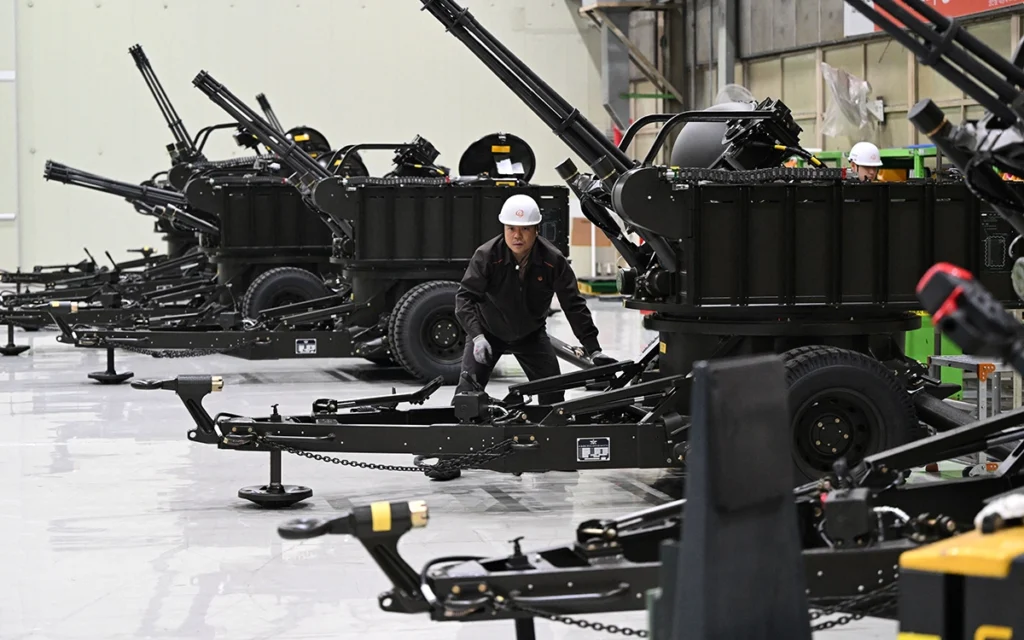
At the same time, Europe’s rising defense budgets have deepened dependence rather than reducing it. Despite record-high spending, critical capabilities remain tied to US platforms, supply chains, intelligence systems, and command-and-control architectures.
Europe’s rising defense budgets have deepened dependence rather than reducing it. Despite record-high spending, critical capabilities remain tied to US platforms
Defense spending by NATO’s European members and Canada has reached its highest nominal level since the end of the Cold War. The United States continues to account for the overwhelming share of NATO’s total defense expenditure, contributing close to two-thirds of the alliance’s overall military budget. Meeting the frequently cited 5 percent of GDP benchmark would require European states to increase defense spending by several hundred billion dollars annually, an expansion broadly viewed as fiscally and politically unachievable under current conditions.
Washington determines export clearances, production schedules, and delivery timelines. The result is a form of asymmetric reindustrialization: Europe pays more but gains neither strategic autonomy nor proportional influence over the direction of US policy.
This dynamic was fully visible in Geneva. European negotiators entered the talks seeking greater control over the political and industrial architecture of long-term support for Ukraine. Washington emphasized financial commitments and procurement guarantees. The two approaches are not incompatible, but they are fundamentally misaligned.
Europe’s Strategic Ambiguity
Europe’s political response reveals a persistent absence of strategic cohesion. The rhetoric of sovereignty and autonomy contrasts sharply with operational dependence on US capabilities. Defense planning remains fragmented, and industrial consolidation is more a slogan than a strategy.
Even where Europe has increased its financial commitments, it has not gained influence over Washington’s negotiation strategy vis-à-vis Moscow or Kyiv. The gap is most evident in Ukraine policy. European leaders publicly champion Ukraine’s sovereignty yet privately acknowledge that the political endgame remains largely shaped in Washington.
Even the European counterproposal in Geneva, which is more cautious, more sovereignty-oriented, and more resistant to enforced concessions, depends on US support for implementation. Strategic autonomy has become a declaratory ambition rather than a guiding principle. The result is an asymmetry of influence deeper than at any point since the early 1990s.
European leaders publicly champion Ukraine’s sovereignty yet privately acknowledge that the political endgame remains largely shaped in Washington
A World of Spheres, Not Systems
Trump’s second term marks a departure from the zero-sum competition that defined his first term in office. Rather than seeking influence everywhere, Washington prioritizes the Western Hemisphere, applies selective pressure in Eurasia, and increasingly relies on coercive economic measures to manage great-power relations. This approach reflects a tacit acceptance of a world structured by spheres rather than systems.
Daalder’s warning that dismantling the post-war order without constructing a replacement creates strategic vacuums has acquired new urgency. Trump has not articulated an alternative architecture. Instead, he relies on short-term deals, provisional ceasefires, and tactical bargains. These measures can halt violence (as seen in the Middle East, Central Africa, and South Asia), but they do not resolve underlying conflicts. Temporary quiet is often mistaken for durable peace.
The Geneva negotiations themselves reflect this logic: the US seeks a ceasefire that reduces American exposure; Europe seeks a settlement that preserves Ukrainian sovereignty; Russia seeks a settlement that consolidates territorial gains and at least gives partial control over the European security architecture. None of the three approaches currently converges.
Three Scenarios for Transatlantic Bargaining
The Geneva process points to three plausible medium-term trajectories:
Managed Transactionalism (60 percent)
Europe largely accepts the new price tags, securing continued US guarantees through higher payments, long-term LNG contracts, and co-production agreements. The alliance persists but increasingly resembles a protection-with-benefits. This is the path of least resistance and currently the most likely outcome absent a major crisis.
Controlled Decoupling (25 percent)
A 2026–27 Ukraine settlement sharply reduces direct US exposure, followed by a drawdown of American forces in Europe to below 50,000. Europe responds with an accelerated “coalition of the willing” (led by France, Poland, the Baltics, Scandinavia and the UK) and embryonic European nuclear-sharing arrangements. Formal NATO structures remain, but the center of gravity shifts east of the Atlantic.
Reconsolidation under Renewed US Leadership (15 percent)
A major Russian or Chinese miscalculation (offensive against the EU or NATO or a Taiwan crisis) forces a rapid US return to traditional hegemony, giving Europe a narrow window to consolidate its defense-industrial base under American political cover.
Which path ultimately prevails will depend less on ideology than on the war’s trajectory in Ukraine, the scale of Chinese challenges in the Indo-Pacific, and Europe’s ability to convert financial commitments into genuine political and operational influence. Until then, Geneva remains the laboratory of a transatlantic relationship no longer anchored in trust, but in continuous negotiation.
Whatever one thinks of Trump’s approach, the foundations of transatlantic cooperation have shifted. Security is no longer presumed, but from negotiated. Influence no longer derives from alignment, but payment, leverage and the ability to shape American political incentives. Europe plays a central role in financing the emerging order, yet it continues to find itself peripheral in defining it.
The future of transatlantic bargaining will be determined not by declaratory commitments or institutional memory, but rather by price, leverage and conditionality, the defining features of Trump’s second pivot, and the forces that are now shaping the Geneva process now unfolding.