

Intensified competition and distrust among the great powers—manifested in regional wars and a stalled arms control environment—have increased the possibility of renewed nuclear testing. There are indications that China, Russia, or the United States might resume yield-producing tests of their nuclear weapons—or have already done so—despite the collective self-imposed moratorium on such tests.
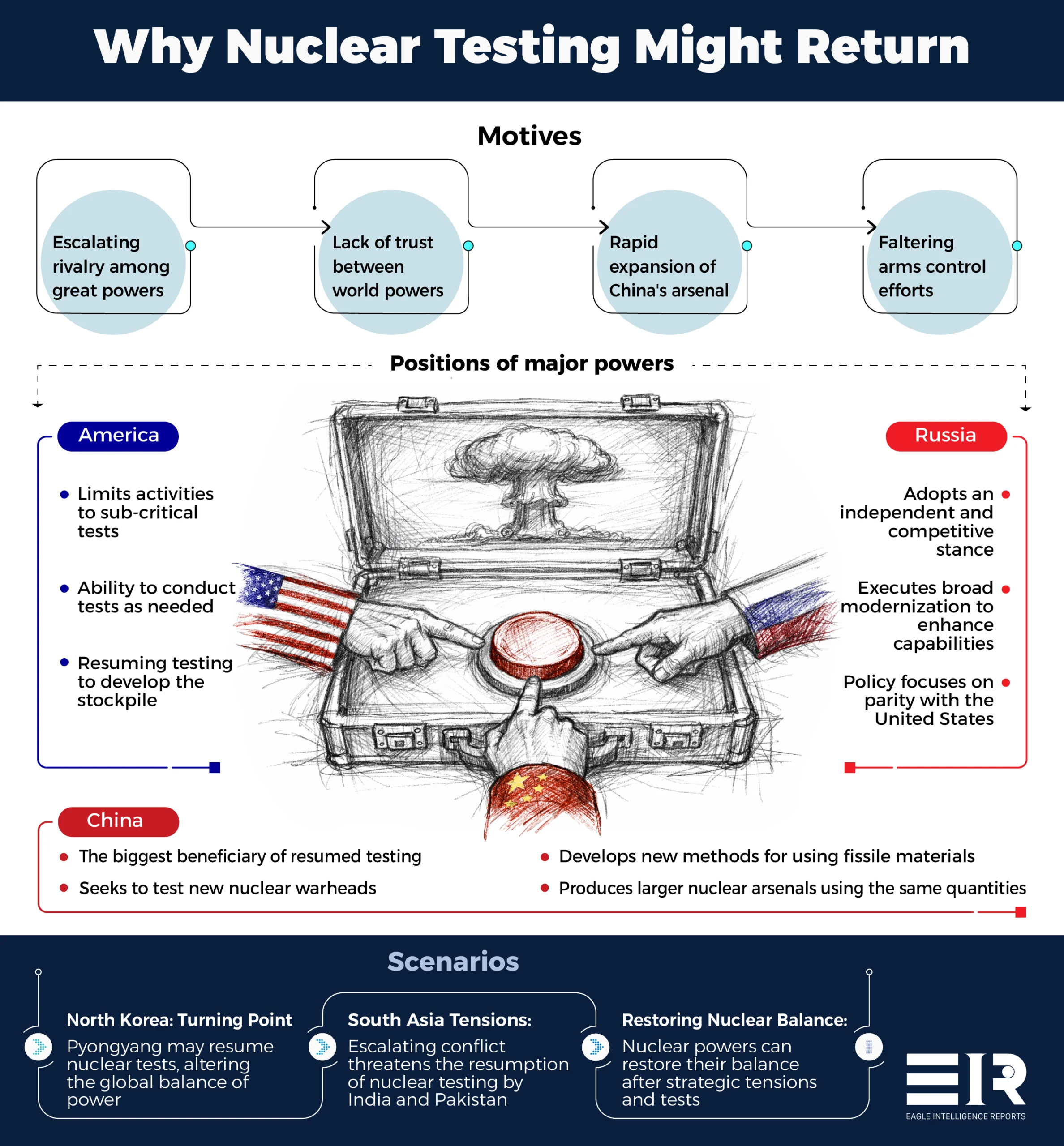
The growing likelihood of renewed testing reflects structural shifts in the international system. The collapse of Cold War arms control architecture has weakened both institutional constraints and normative taboos surrounding explosive tests. At the same time, China’s rapid nuclear expansion and modernization create incentives to validate new designs. These dynamics are reinforced by the uneven distribution of historical testing: states with extensive testing histories generally retain confidence in their arsenals, while rising powers with fewer validated designs have stronger incentives to modify the testing status quo.
The PRC is engaged in a rapid buildup of its nuclear capabilities but has conducted far fewer explosive tests than the United States or Russia. Renewed testing would make it easier for the Chinese military-industrial complex to validate new weapons designs for production at scale, building confidence within the People’s Liberation Army that warheads will have their intended technical effects. Beijing seeks the status of a co-equal great power in the global nuclear order alongside the United States and Russia, and loosening the existing testing freeze at the current moment of technological transition would help advance that end.
Renewed testing would make it easier for China to validate new weapons designs
Previous U.S. administrations generally assessed that maintaining the status quo would most advantage the United States by locking in the technical gains accumulated during the Cold War. However, the current U.S. government wants to signal, through President Trump’s openness to consider resumed testing, determination to sustain U.S. strategic preeminence in the face of rapid Chinese advancements. Trump envisions of the threat of renewed testing as a way to reinforce U.S. strategic credibility while pressuring Beijing to engage in a broader strategic arms control format with Washington and Moscow.
Russia, by contrast, would arguably gain the least from resumed testing since the Russian nuclear establishment maintains confidence in its arsenal through continuously refurbishing its warhead stockpile derived from extensively tested Soviet designs. However, Moscow’s strategic lodestar is to maintain nuclear parity with Washington. If the United States were to resume testing, Russia would almost certainly follow to preserve that parity.
Testing Types and Treaties
The five nuclear weapons states recognized by the Nuclear Nonproliferation Treaty (NPT)—China, Russia, the United States, the United Kingdom, and France—each adopted unilateral moratoria on further explosive testing during the 1990s. They have since conducted only “sub-critical experiments,” which do not involve self-sustaining nuclear fission chain reactions. These experiments allow weapons specialists to study the behavior of components to determine if fission material, such as plutonium, decays with time in ways that could affect the weapons’ performance.
These and other countries concurrently negotiated a Comprehensive Test-Ban Treaty (CTBT), which prohibits all nuclear explosions, whether for military or peaceful purposes, in any environment. Building on earlier agreements that limit the size and location of nuclear tests, the CTBT sought to establish a comprehensive global ban. In 1996, signatory states established a Preparatory Commission in Vienna to provide institutional support for implementation of the treaty. It has since developed a worldwide monitoring system consisting of hundreds of seismic, hydroacoustic, infrasound, radionuclide, and additional stations designed to detect and distinguish nuclear weapons tests from earthquakes, conventional explosions (e.g., mining), and other non-nuclear events.
However, the CTBT has not yet entered into force because it has not been ratified by all 44 countries possessing nuclear research or power reactors when the treaty opened for signature in September 1996. China, Russia, and the United States have all signed but not ratified the CTBT. As a result, the global testing moratorium rests largely on voluntary restraint rather than legally binding obligations. In the absence of a formal treaty, some governments and NGOs have shifted to more indirect approaches: enhancing the technical capabilities and readiness of the International Monitoring System; strengthening provisional application of the CTBT among ratifying states; building diplomatic coalitions to reinforce the moratorium and norms against testing; highlighting the relationship between abstaining from testing and the NPT regime; and developing collective diplomatic, legal, and other response options to activate if testing resumes.
The global testing moratorium rests largely on voluntary restraint rather than legally binding obligations
Preparing to Test?
China
In a February 6 presentation to the Conference on Disarmament in Geneva, U.S. Under Secretary for Arms Control and International Security Thomas DiNanno claimed that China has employed “decoupling”—conducting tests in large underground cavities to dampen the seismic signature—to conceal low-yield nuclear explosive tests. Christopher Yeaw, the assistant secretary for arms control and nonproliferation at the State Department, subsequently confirmed the test’s approximate magnitude and location. The accusations, denied by the Chinese government, follow earlier reports of new construction and tunneling activity at the Lop Nur nuclear testing site in Xinjiang, historically China’s primary testing location.
Beijing would arguably gain the most from resumed nuclear testing. Prior to the test moratorium, the PRC had conducted only a couple of dozen nuclear weapons explosions, compared with the hundreds carried out by the United States and the Soviet Union during the Cold War in the atmosphere, underground, or underwater. Having conducted substantially fewer nuclear explosions, China might want to test novel nuclear payloads for its new long-range hypersonic gliders, which Beijing considers essential for overcoming U.S. missile defenses. Chinese nuclear weapons designers would also benefit from learning to use their limited supply of fissile material more efficiently, enabling them to manufacture larger arsenals with the same limited material stocks.
The United States
Since 1992, the United States has limited its nuclear testing activities to non-nuclear “subcritical” (zero-yield) experiments at the Nevada National Security Site. The testing activities support its Science-Based Stockpile Stewardship program for maintaining the reliability and effectiveness of U.S. nuclear warheads.
After the Cold War, U.S. officials believed that freezing the global nuclear status quo would help sustain U.S. nuclear advantages and increase the utility of superior U.S. conventional forces. At the same time, Washington sought to preserve the ability to resume testing if necessary. Planning during the 1990s sought to ensure that nuclear explosive testing could be restarted within three years following a decision to do so. After the September 11th terrorist attacks, the George W. Bush administration shortened the testing readiness timeframe to eighteen months.
Nonetheless, debate persists in Washington over whether the longstanding moratorium continues to serve U.S. strategic interests. Some members of Congress and nuclear weapons experts favor renewed testing to ensure the reliability of the aging U.S. nuclear stockpile as well as to design new warheads. The Trump administration, keen on maintaining U.S. military superiority, has signaled openness to that possibility. Last October, Trump publicly claimed that because of other countries’ testing programs, he had instructed the Department of War to begin testing nuclear weapons “on an equal basis.”
Debate persists in Washington over whether the longstanding moratorium continues to serve U.S. strategic interests
Russia
The U.S. State Department has repeatedly assessed that Russia may undertake “supercritical” experiments—tests involving short-term, self-sustaining fissile chain reactions—at its Novaya Zemlya complex. Following the collapse of the Soviet Union, Moscow initially cooperated with foreign partners to improve transparency around its nuclear infrastructure. Over time, however, cooperation eroded and Russia adopted a more independent and competitive nuclear posture, especially after Vladimir Putin became president in 2000. Under Putin, Russia substantially modernized its nuclear weapons program, which continuously renews warheads by reconstructing critical components based on comprehensively tested Soviet designs.
Putin has recently warned that Moscow would resume nuclear weapons testing if the United States did so first. In October 2023, Moscow revoked its ratification of the CTBT, joining Beijing and Washington among the treaty’s major signatories who have not ratified it. Russian nuclear policy is focused on maintaining strategic parity with the United States, so Moscow would surely follow if Washington resumed testing. Beyond the technical considerations, renewed testing would also energetically signal to Washington and others that Russia’s nuclear deterrent remains credible despite the strain placed on its conventional forces by the ongoing war in Ukraine.
Scenarios
Several plausible pathways could lead to the resumption of nuclear explosive testing.
Pyongyang Pushes a Tipping Point
Since 2006, North Korea has conducted six underground nuclear tests, the most recent occurring in 2017. The pause has given the world its longest period—almost a decade—without a nuclear explosive test since the first atomic bomb in 1945.
Several factors, however, could erode this restraint. North Korea is fielding novel nuclear delivery systems whose warheads have yet to experience an actual detonation. Its nuclear scientists are undoubtedly eager to verify and improve new designs through testing. Furthermore, Russian, Chinese, and even U.S. pressure on North Korea to curtail its nuclear program has eroded in recent years.
So far, North Korean nuclear weapons detonations have not significantly altered the testing calculations of other nuclear powers. But the Asian and broader global security environment has substantially deteriorated since 2017. If North Korea were to resume sustained nuclear testing, it could act as a tipping point, potentially prompting the Trump administration to reconsider its own testing posture in order to reinforce deterrence and reassure allies such as South Korea about U.S. nuclear security guarantees.
If North Korea were to resume sustained nuclear testing, it could act as a tipping point, potentially prompting the Trump administration to reconsider its own testing posture
South Asian Chain Reaction
South Asia represents one of the most tightly coupled nuclear rivalries in the international system. During the Cold War, China developed nuclear weapons to deter both the Soviet Union and the United States. In response, India pursued a nuclear deterrent against the PRC, while Pakistan raced for the bomb to match India’s progress. When New Delhi conducted several nuclear tests in May 1998, Islamabad followed that same month.
A similar pattern of catalytic chain testing could occur again. Pakistan continues to rely heavily on nuclear deterrence to offset India’s military advantage, while India maintains its arsenal primarily for protection against Islamabad and Beijing. At the same time, PRC security managers worry that India’s growing nuclear capabilities may complicate Chinese deterrence calculations regarding the United States.
The recent fighting between India and Pakistan has intensified both countries’ commitment to expanding and modernizing their nuclear missile arsenals. Recent hostilities saw both break with precedent by conducting deep air, missile, and drone strikes into the other’s territory. In a future crisis—particularly one involving significant conventional losses—either state might consider renewing nuclear testing to signal resolve or technological advancement. Likewise, they might test to elevate concern about their fighting and induce other governments to take a more active role in resolving their conflict. Finally, one plausible way Beijing could intervene to aid Pakistan indirectly is to renew its own nuclear testing as a show of force.
Restored Equilibrium
The nuclear testing equilibrium may prove more resilient than commonly assumed. Nuclear expert Jeffrey Lewis recently warned that, “There’s no real stopping point once we all start doing bigger and bigger tests…It will end up, in the end, looking just like the Cold War.” Yet the historical record suggests that disruptive strategic developments can also help generate a new stable status quo—sometimes circuitously—after shattering the existing one.
During the 1980s, after the Soviet Union deployed modernized intermediate-range nuclear weapons in Eastern Europe, the United States compelled their withdrawal by deploying its own comparably ranged ballistic and cruise missiles in Western Europe. The resulting escalation produced intense pressure on both sides, leading Moscow and Washington to agree to eliminate these ground-launched systems in their 1987 Intermediate-Range Nuclear Forces Treaty. Furthermore, during the past two decades, China, the United States, and then Russia each tested anti-satellite weapons before subsequently resuming their tacit moratorium on weapons designed to destroy space satellites.
The war in Iran underscores how nuclear weapons issues continue to drive great-power strategy. The incentives sustaining the nuclear testing moratorium remain uneven and increasingly fragile. As China seeks a path to nuclear parity, pressure increases on other states to upgrade and innovate. In this sense, the potential resumption of nuclear testing reflects broader shifts in the global balance of power. Ultimately, the forecast for nuclear testing will depend on the balance between Washington’s commitment to uphold the international status quo versus Beijing’s determination to revise it.
The war in Iran underscores how nuclear weapons issues continue to drive great-power strategy