

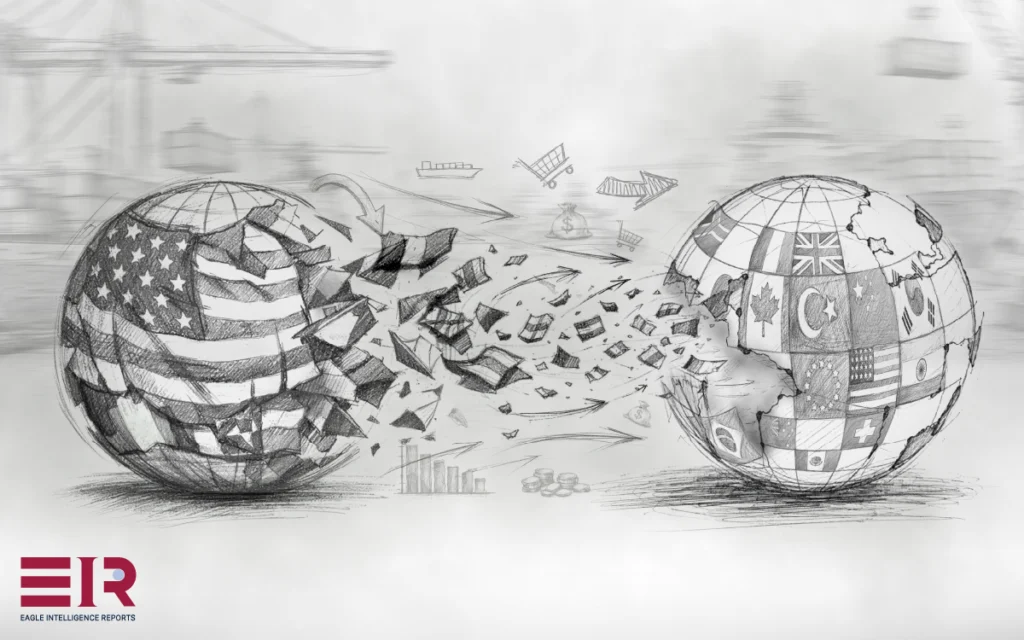
Global trade is no longer anchored by a single guarantor. The system is still standing, but it is no longer self-sustaining in the way its architects once assumed. The question now is not whether the WTO can be restored to some idealized past, but whether trade can be organized around a more volatile United States, and whether middle powers can keep commerce functional while that uncertainty persists.
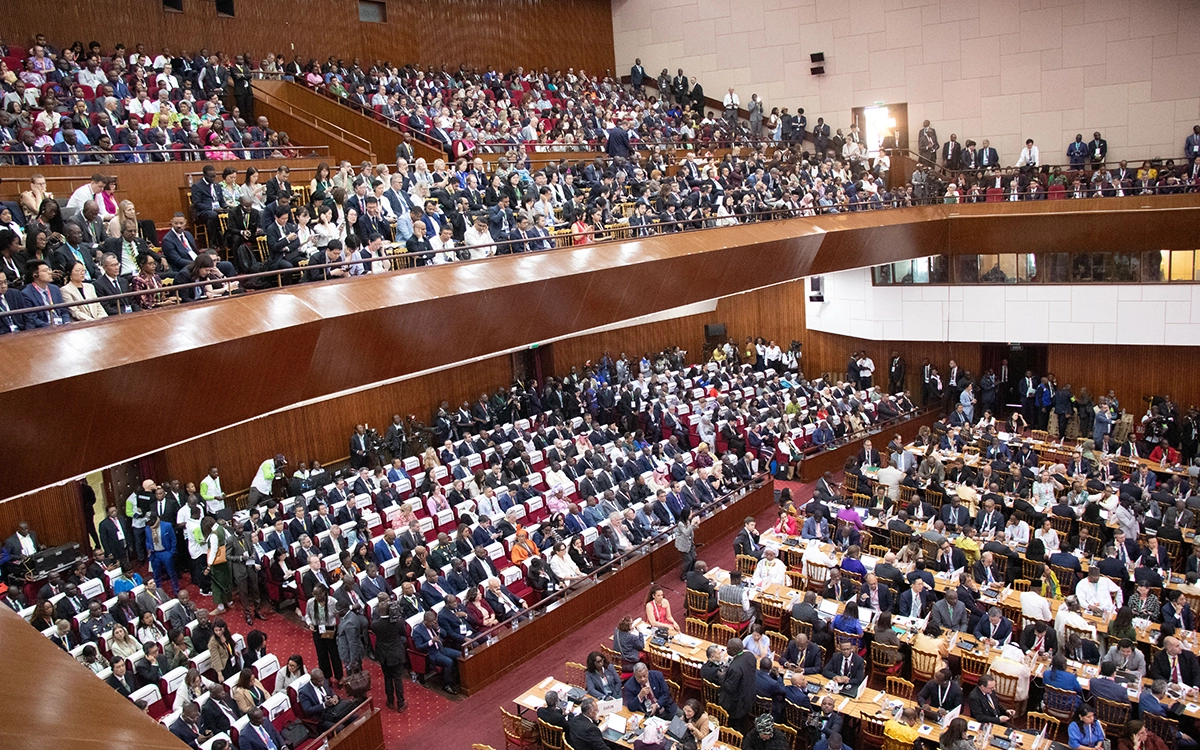
The WTO’s 14th ministerial conference in Yaoundé last week represents more than a routine diplomatic gathering. Director-General Ngozi Okonjo-Iweala told ministers that the old world order has changed irreversibly. At the same time, WTO data show that 72 percent of global trade still operates under its rules, even as the dispute settlement system remains paralyzed and only 64 members filed subsidy notifications for 2025. That combination is the real story.
U.S. Remains Central but Unreliable
The United States is not outside this system. It remains the world’s largest importer, and the EU exported a record $635 billion in goods to the United States in 2025. That is precisely why Europe cannot simply detach itself from Washington, however much it may wish to hedge. Yet the relationship has clearly changed. In the past week, the European Parliament advanced legislation to implement the EU side of a trade agreement with Washington—but only with added safeguards, including a sunset clause and a suspension mechanism if the American side fails to comply. Brussels is still engaging with the United States, but it no longer treats American commitment as a stable assumption.
That same logic is visible in the WTO talks. The United States continues to push for a permanent extension of the moratorium on customs duties for electronic transmissions, while rejecting a temporary compromise. India, after months of resistance, has now signaled it may accept a two-year extension, though the two sides remain far apart. Both Washington and New Delhi have also resisted a detailed WTO reform workplan.
The pattern is clear: the United States still shapes the system when it chooses to engage. But it no longer provides the political predictability required for it to function smoothly.
The U.S. still shapes the system when it chooses to engage. But it no longer provides political predictability
A Partial Middle-Power Architecture
At the WTO meeting in Cameroon, the EU and the members of the Comprehensive and Progressive Agreement for Trans-Pacific Partnership (CPTPP) agreed to advance negotiations on a landmark digital trade deal. Canada’s international trade minister, Maninder Sidhu, described it as potentially historic. Together, they represent roughly 1.6 billion people and about $35 trillion in economic output. The talks covered e-commerce, data flows, and data storage. The language has been cautious—deliberately so—but the direction is clear. The aim is not to replace the United States, but to create a partial architecture that can still function if the multilateral center continues to weaken.
The most important point is not the size of the grouping, but its political character. This is not an anti-American bloc or a new grand alliance. It is a hedge. The EU and the CPTPP states are trying to preserve rule-making capacity in a world where the old universal bargain is no longer reliable. That means narrower, more practical agreements on digital standards, supply chains, and regulatory compatibility. If the WTO cannot deliver a common framework, like-minded states will do what they can among themselves while keeping the multilateral shell. This is a much more modest project than a new world order, but it might also prove to be more realistic.
New Foundations Laid
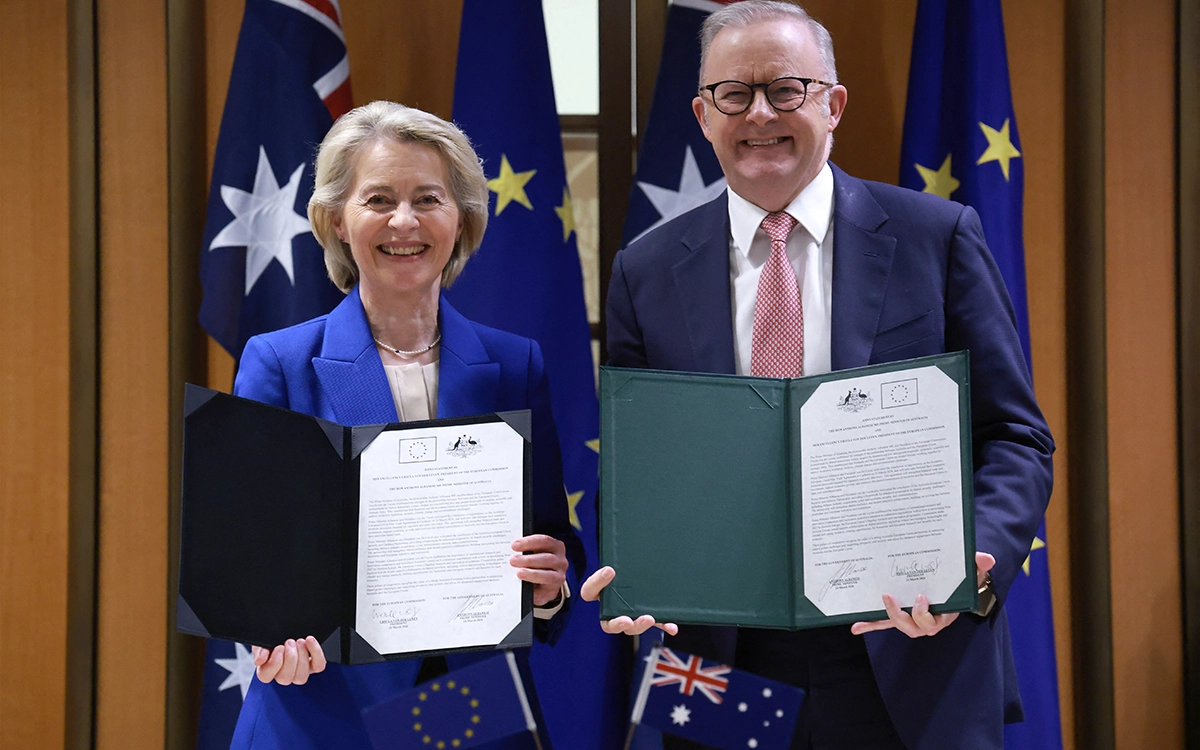
This shift is already taking shape through concrete agreements. Australia and the EU finalized a free trade pact this past week after eight years of negotiation. The deal removes tariffs on nearly all goods, strengthens access to Australia’s critical minerals, and is paired with a new security and defense partnership. Canberra and Brussels are now explicitly separating commercial diversification from strategic alignment. Trade ties can deepen with Europe while security ties remain compartmentalized. It is yet another sign that middle powers are building redundancy into the system.
Canada is doing something similar. In March, the EU and Canada launched talks on a digital trade deal covering data sharing, digital services, cybersecurity cooperation, and emerging technologies. The larger point is that the trade system is being rebuilt from the edges inward. The old model relied on universal rules administered from the center. The new one is increasingly a web of sector-wide, issue-specific arrangements that may be connected over time—or perhaps never connected at all. That may look untidy, but it is how institutions adapt when their central guarantor becomes less predictable.
The larger point is that the trade system is being rebuilt from the edges inward
Even Turkey appears to be moving in the same direction. On Thursday, Ankara lifted its objection to the WTO adopting the Investment Facilitation for Development Agreement, a plurilateral initiative to improve foreign investment rules for developing countries. While not a decisive moment on its own, it still reflects an important broader development. Moving forward, the WTO may increasingly operate through variable geometry, with subsets of members advancing specific initiatives and attempting to fold the result back into the wider framework later. This is the logic of a tiered trade order—slower than a clean bloc, but far more plausible than a universal compromise.
China as Structural Constraint
China is the other indispensable actor in this story. The WTO’s latest trade outlook shows that China remains the world’s largest exporter, with merchandise exports of $3.58 trillion. At the same time, the EU’s goods trade deficit with China reached $410 billion in 2025—something European Commissioner for Trade Maroš Šefčovič has rightly called unsustainable. The European Commission captures the dilemma in its own language: China is a partner, competitor, and systemic rival. That triple formulation is not diplomatic decoration but an admission that Beijing is too large to exclude, too interventionist to treat as a normal market economy, and too deeply embedded in supply chains to ignore. Any middle-power architecture that pretends otherwise will quickly run into reality.
The issue is not simply volume, but asymmetry. The EU says China’s low-tariff access to European markets is not matched by equivalent openness inside China, while state support, overcapacity, and selective technology controls distort competition in ways the existing WTO rulebook struggles to manage. These pressures are now visible in the EU itself, where trade officials are tightening customs and e-commerce rules in response to Chinese platforms and imports that are increasingly viewed through a security and industrial-policy lens. The question is no longer just trade balance—it is the variety of capitalism on offer.
China is also unlikely to ignore the emerging middle-power architecture. In Yaoundé, Commerce Minister Wang Wentao signaled a willingness to actively expand imports from the EU, while urging Brussels to ease high-tech export restrictions and avoid politicizing trade. Earlier this month, Premier Li Qiang pledged further opening and more balanced trade after China posted a record $1.2 trillion trade surplus in 2025.
The tone sounds conciliatory, but the underlying model remains unchanged. China is very unlikely to abandon the state-led model that has created such imbalance, from which it derives significant geopolitical leverage. The more probable Chinese response to a more tightly coordinated EU-CPTPP trade architecture is not open confrontation but selective engagement combined with bilateral leverage and the threat of targeted restrictions wherever Beijing sees its strategic interests challenged.
Toward a Tiered Trade System
The emerging model is better understood as layered than alternative. At the WTO talks in Yaoundé, reform has been increasingly framed as proceeding at different speeds among different groups of members, with plurilateral agreements later incorporated into the wider framework. The EU, the UK, China, the CPTPP members, and others have all been pulled into this debate in one way or another. If no reform path can be agreed, more countries will move into smaller coalitions and issue-specific arrangements that operate outside the old consensus model. That would not dismantle the WTO, but it would increasingly shift its role from sole rule-maker to umbrella, forum, and source of legitimacy.
The U.S.-India dispute over the e-commerce moratorium illustrates clearly why this matters. It has produced a deadlock on precisely the kind of issue that now defines the future of trade. The old arguments about tariffs and quotas have not disappeared, but they are no longer the center of gravity. The decisive questions are digital, regulatory, and institutional: who controls data flows, who writes the rules for investment, and who defines when trade is free and when it is conditioned by reciprocity.
Hedging, Not Seceding
The key insight is that the middle powers are not trying to escape the United States. They are trying to insulate themselves from American volatility without breaking the transatlantic relationship. That is why Europe is adding safeguards to its trade deal with Washington even as it deepens cooperation with the CPTPP and signs new agreements elsewhere. That is why Australia can finalize a trade pact with the EU while simultaneously strengthening its security ties. The strategy is compartmentalization: trade with Europe, security with the United States, and a widening set of smaller arrangements that reduce dependence on any single partner. This is hedging in its purest form.
Middle powers are not trying to escape the U.S. They are trying to insulate themselves from American volatility without breaking the transatlantic relationship
This is also why the rhetoric of a clean break is misleading. There is no coherent anti-American trade order in the making. There is only a growing willingness to build around the United States when Washington proves too erratic to anchor the system. This is a weaker proposition than global decoupling, but it is also a more credible one. It reflects not ideology, but risk management.
Capital Allocation Amid Fragmentation
For companies, the implications are immediate. Investment flows not into abstractions, but toward legal certainty, customs efficiency, digital compatibility, and predictable access. That is why the EU-CPTPP digital track carries such significance. If it advances, it will shape how data moves, where it is stored, and how governments can tax it. If it stalls, more states will begin improvising their own digital duties and data restrictions, and firms will shift towards the jurisdictions that offer the clearest rules. In that sense, the current negotiations are not just about trade policy—they are about where capital will feel secure in a more fragmented world.
The old multilateral system did not disappear in a single collapse. It is being hollowed out and rebuilt at the same time. The center still matters, but no longer commands automatic obedience. That is why the middle powers’ strategy is so revealing. They are not announcing a new order but building enough structure to keep commerce moving while the old one loses its authority.
The old multilateral system did not disappear in a single collapse. It is being hollowed out and rebuilt at the same time
Forecast
The most likely outcome is modular pluralism. The EU, the CPTPP states, Australia, Canada, Japan, the UK, and other middle powers deepen overlapping bilateral and plurilateral arrangements on digital trade, supply chains, investment facilitation, and critical materials, while the WTO persists mainly as an umbrella of legality and partial repair. This is the direction current negotiations are already taking, and it aligns more closely with the incentives of the actors involved than any single grand alternative.
A second scenario is a partial reset. In this case, the WTO extends the e-commerce moratorium, absorbs some plurilateral initiatives into its framework, and slows further erosion of the most-favored-nation (MFN) principle. This would preserve more of the existing order, but it requires the United States and India to narrow differences that remain substantial. India’s recent willingness to consider a two-year extension is an encouraging signal, but not enough by itself to shift the baseline.
The worst scenario is fragmentation. The moratorium expires, subsidy transparency remains weak, MFN erodes further, and trade governance hardens into competing standards and political conditionality. This outcome is still not the most likely, but it is no longer implausible. It emerges if major powers continue to weaponize and leverage trade while middle powers fail to build sufficient connective structure among themselves.
Middle powers are not rebuilding the old order. They are trying to keep trade governable while the United States remains too important to ignore but too erratic to trust.
Middle powers are not rebuilding the old order. They are trying to keep trade governable