


The recent 2025 agreement on the delimitation of the Exclusive Economic Zone (EEZ) in the Mediterranean Sea between Cyprus and Lebanon put a definitive end to two decades of ambiguity surrounding the maritime borders of the two states. It is a development of particular significance in the Eastern Mediterranean, one of the few regions where maritime disputes remain the norm rather than the exception amid intense geopolitical rivalries.
For Nicosia, the agreement represents another step in its long-standing effort to create a coherent and internationally recognized legal framework at sea, strengthening its role as a stabilizing actor. For Beirut, it provides a rare economic respite at a time when the country is sinking into a multifaceted political and financial crisis.
However, the positive momentum of the agreement immediately encounters the already tense balances in the region. Turkey hastened to reject the delimitation, arguing that it ignores Ankara’s maritime claims in the Eastern Mediterranean. This reaction serves as a reminder that even the most “technical” bilateral arrangements can hardly escape the broader geopolitical landscape that continues to shape developments in the waters of the region.
The positive momentum of the Cyprus–Lebanon maritime border agreement immediately encounters the already tense balances in the region
Historical Background
The first attempt at demarcating the maritime borders between Cyprus and Lebanon dates back to 2007, when the two sides signed an EEZ agreement. However, the process soon froze: the Lebanese Parliament never proceeded with its ratification due to internal political disputes and pressures exerted by Damascus at the time. The signing of the Cyprus–Israel EEZ agreement in 2010 further complicated the geopolitical landscape. Beirut raised objections, arguing that Cyprus’s delimitation with Israel caused a loss of Lebanon’s maritime space.
This dispute was eventually resolved in 2022 through an agreement achieved with American mediation. The bilateral landscape began to change after the election of President Joseph Aoun in January 2025, when negotiations between Nicosia and Beirut resumed at an intensive pace. In September 2025, the two sides met in Beirut and drafted a revised version of the agreement, which was approved by the cabinets of Cyprus and Lebanon on October 15 and 23, respectively.
A stable obstacle throughout the entire process remained Turkey’s firm opposition, as it had for years tried to prevent the signing of the agreement. Eventually, after months of technical discussions and diplomatic interventions, Cyprus and Lebanon signed the final delimitation pact this year.
This historical background explains the deal’s importance: it closes a long cycle of uncertainty and allows the two countries to plan their next steps with greater security and predictability.
Delimitation’s Impact on Energy Prospects
The successful conclusion of the negotiations not only stabilizes the legal environment in the region but also opens a new chapter in energy and infrastructure cooperation. With the removal of a critical source of uncertainty, Cyprus and Lebanon can now confidently re-approach investors, who were previously hesitant.
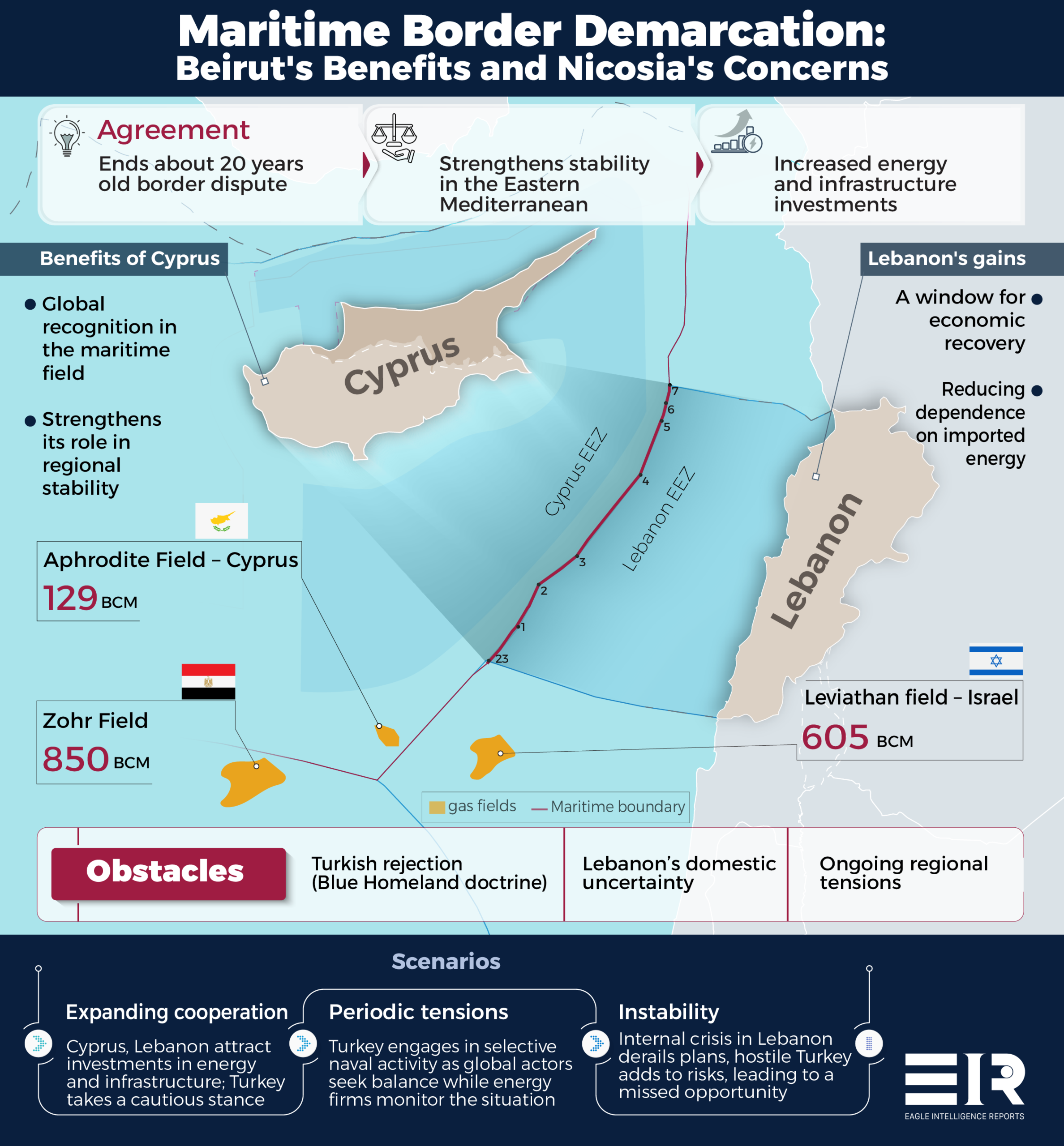
The Eastern Mediterranean contains some of the largest offshore natural gas fields discovered in recent decades. The Zohr field in Egypt is estimated to hold 850 billion cubic meters of gas reserves, the Leviathan field in Israel 605 billion cubic meters, and Cyprus’s Aphrodite field 129 billion cubic meters.
Overall, average estimates place the Eastern Mediterranean reserves at 2 to 3 trillion cubic meters, making the region one of the most promising energy basins worldwide. In this context, Cyprus and Lebanon now have a clearer geological and legal horizon, a crucial factor for major investors.
Apart from strengthening prospects for energy cooperation in the Eastern Mediterranean, the agreement supports interconnected infrastructure projects such as electrical interconnections toward Europe. At a time when the EU is seeking alternative energy sources, the stabilization of the region enhances the potential energy corridors to the continent.
Beyond its economic and energy footprint, the agreement also embeds a deeper strategic dimension: it constitutes another foundation of regional stability in an area marked by intense challenges and frequent tensions. Nevertheless, the actual exploitation of new opportunities will depend greatly on the political stability and functional capacity of both Cyprus and Lebanon.
The actual exploitation of new opportunities will depend greatly on the political stability and functional capacity of both Cyprus and Lebanon
Lebanon’s Internal Dynamics
A pivotal factor for the success of the delimitation is Lebanon’s internal situation. Despite the new window of investment, the country is facing one of the deepest economic crises globally since the 19th century. The Lebanese economy shrank by more than 40 percent between 2018 and 2023, while the Lebanese pound lost about 95 percent of its value.
Moreover, Lebanon imports almost 100 percent of the energy it consumes, which makes its energy strategy directly dependent on the external environment. Added to this already fragile context is the conflict with Israel since October 2023.
The situation has further threatened political and social stability, intensifying the sense of insecurity and negatively affecting investor and citizen confidence. If Beirut fails to ensure coherent governance and functional institutions, the benefits of the agreement risk remaining theoretical. The window of opportunity exists, but the country’s internal stability will determine its duration.
Turkey as a Destabilizing Factor
Even if Lebanon’s domestic reality permits the exploitation of the agreement, external factors remain equally decisive. In terms of regional balances, Turkey’s reaction reminds us that no bilateral arrangement in the Eastern Mediterranean develops in a vacuum. Ankara, with Hezbollah’s contribution, obstructed the agreement for many years.
The recent weakening of Hezbollah, the Lebanese political organization, prompted Cyprus to cooperate with Lebanon to define their EEZs based on international law, the law of the sea, and the EU’s principles of good neighborly relations. Turkey’s immediate rejection of the agreement is tied to both its broader strategy in the Eastern Mediterranean and the “Blue Homeland” doctrine, which treats maritime zones as a key avenue of power and diplomatic influence.
Ankara sees maritime arrangements as tools of pressure to advance its interests and has long argued that Turkish Cypriots’ rights cannot be bypassed. Turkey’s stance often translates into operational action. It has repeatedly responded to similar developments with naval patrols, seismic surveys, and power-projection maneuvers, practices that have previously led to escalation.
Although Ankara’s reaction so far has been diplomatic, an increase in activity cannot be ruled out in areas where the Republic of Cyprus exercises sovereign rights but which Ankara disputes politically. The possibility of Turkish moves, even limited ones, highlights that the stability of the new delimitation does not depend solely on the directly involved parties.
As with every development in the Eastern Mediterranean, the geopolitical landscape is shaped not only by the actions of Cyprus, Lebanon, or Turkey, but by a much broader structure of power in which international and regional actors maintain decisive roles.
The Eastern Mediterranean geopolitical landscape is shaped not only by the actions of Cyprus, Lebanon, or Turkey, but by a much broader structure of power in which international and regional actors maintain decisive roles
External Actors Shaping the Equation
The Cyprus–Lebanon delimitation agreement holds particular significance for the European Union, the United States, and regional actors such as Qatar and the United Arab Emirates. For the EU, any development that strengthens stability, predictability, and international law in the Eastern Mediterranean is positive, especially at a time when energy security remains a strategic priority.
The United States, having renewed its active presence in the region, views the agreement as an opportunity to strengthen its ties with reliable partners and as a tool promoting a more stable regional architecture. Beyond economic and energy benefits, Washington perceives the Eastern Mediterranean’s energy network as a field of geopolitical convergence and a mechanism that can further normalization processes among states in the wider region.
For the United States, energy cooperation functions as a platform for de-escalation, dialogue, and stabilization in one of the most geopolitically sensitive regions. Israeli security also benefits from the stabilization of the maritime environment through delimitation, an element that fits well into American strategic planning.
The recent meeting between Cypriot Foreign Minister Constantinos Kombos and US Secretary of State Marco Rubio further strengthened this picture, with bilateral relations described as excellent. Washington increasingly views Cyprus as a strategic partner in the Middle East, a fact that gives even greater political weight to the new delimitation.
Scenarios of Development
Given that the new delimitation lies at the center of a complex web of internal, regional, and international parameters, the possible scenarios for the following period vary.
Expanded Cooperation
A positive scenario foresees Cyprus and Lebanon attracting significant energy and infrastructure investments, capitalizing on the legal stability provided by the agreement. Cooperation gradually expands with the involvement of Greece and Israel, while Turkey, facing economic limitations and more fluid international alliances, adopts a cautious stance, allowing for a more stable operational environment in the Eastern Mediterranean.
Periodic Tensions
An intermediate scenario describes a region marked by periodic tensions. Ankara continues to issue statements and conduct selective naval activity, but without any major escalation. International actors seek balance, while energy companies remain in a wait-and-see mode until conditions become clearer.
Instability and Destabilization
A negative scenario sees internal instability in Lebanon, derailing energy plans and critical implementations. At the same time, a more aggressive Turkish posture leads to increased risks and destabilization. In this environment, investors retreat, and although the agreement remains legally valid, it becomes strategically inactive. This scenario reinforces the image of yet another missed opportunity in the Eastern Mediterranean.
Promoting Stability and Transparency
The Cyprus-Lebanon maritime demarcation marks a crucial step for stability and legal transparency in the Eastern Mediterranean, a region where successful maritime arrangements remain rare.
The Cyprus-Lebanon maritime demarcation marks a crucial step for stability and legal transparency in the Eastern Mediterranean, a region where successful maritime arrangements remain rare
The agreement has the potential to reshape the regional security architecture, strengthen energy prospects, and serve as a marker of reliability for international actors. Its true value, however, will be judged by the ability of the two countries to implement it consistently, and by regional and international actors contributing to a stable environment.
The United States has a particular interest in a more predictable maritime order, which it strives to ascertain by strengthening its cooperation with Cyprus and ensuring the continuity of its strategic and energy planning. Looking to the future, the agreement may act as a catalyst for a new era of cooperation, investment, and regional convergence.
Should internal weaknesses and regional tensions prevail, the agreement will become yet another missed opportunity in a region where geopolitical fluidity too often undermines diplomatic progress.
Prospects for Regional Alignment
The agreement has revived discussion about whether it could catalyze a more structured alignment among Lebanon, Cyprus, Greece, and Israel, a cooperation that, under the right conditions, could reshape the balance of cooperation in the Eastern Mediterranean. These states share overlapping interests in maritime security, the protection of critical infrastructure, and the diversification of energy routes.
In addition to these factors, the growing interdependence of regional electricity and gas networks, along with the need for coordinated responses to cyber, hybrid, and maritime threats, creates a natural incentive for closer engagement. If the diplomatic momentum generated by the delimitation is sustained, it could serve as an initial platform for cooperation on offshore safety standards, search-and-rescue protocols, and long-term energy planning.
Yet, the prospects for a full-fledged alignment remain uncertain. Lebanon faces structural governance challenges that limit its capacity to commit to ambitious regional frameworks, particularly those requiring continuity, regulatory coherence, and cross-sector coordination. Israel’s strategic priorities are in flux following successive rounds of conflict, while its domestic political landscape remains unpredictable. Cyprus must also navigate the persistent constraints of its unresolved relationship with Turkey, a factor that affects the willingness of external actors to deepen formal cooperation.
Moreover, any multilateral format involving Lebanon and Israel would require sustained diplomatic management, confidence-building mechanisms, and potentially external facilitation from actors such as the United States or the European Union to ensure political viability.
For now, what appears more realistic is a gradual, issue-based form of coordination rather than a formal alignment, including collaboration on energy connectivity, maritime safety, infrastructure protection, and emergency response. Whether such cooperation can evolve into a more structured framework will depend on the stabilization of domestic politics in Lebanon, the evolution of Israel’s security posture, and broader regional dynamics that remain highly fluid.