
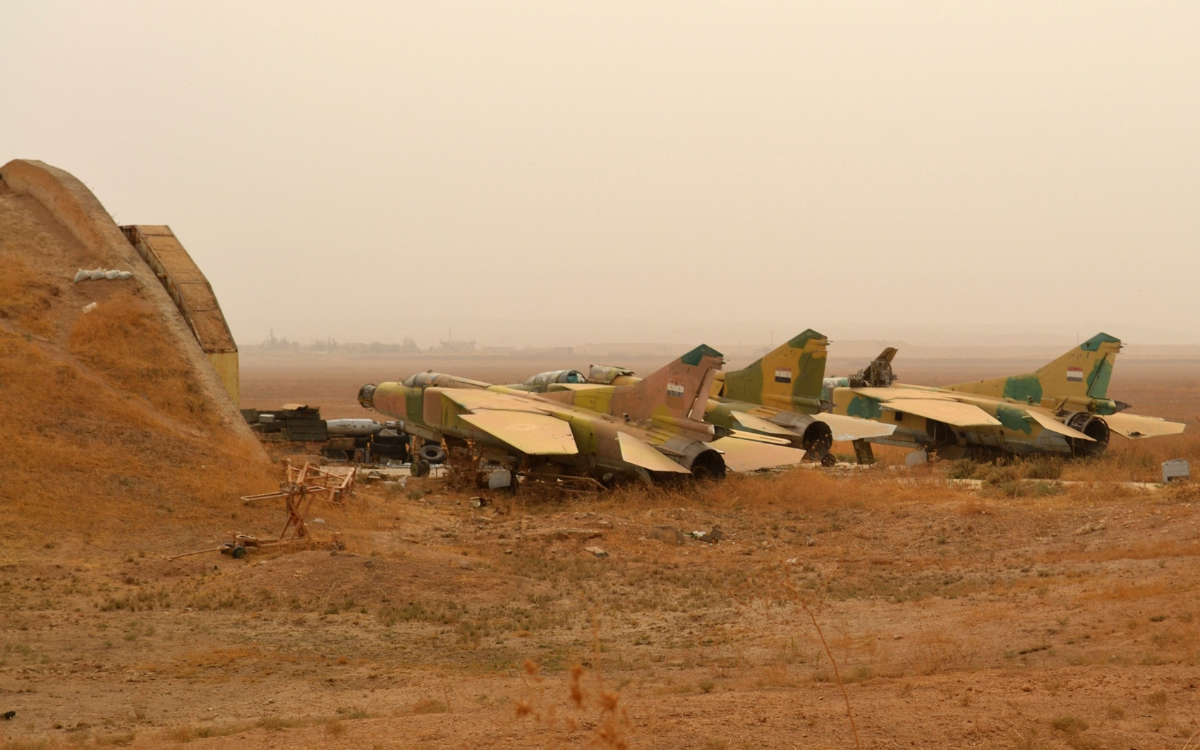
U.S. envoy for Syria Tom Barrack said Israel was behind strikes on a disused air base in the country’s northwest on Tuesday.
“The confirmed Israeli airstrikes on Abu al-Duhur Airbase constitute an unnecessary escalation that does not advance regional stability,” he wrote in a post on X, adding “we encourage all parties to prioritize logical discourse over further military incidents.”
We are deeply concerned that the confirmed Israeli airstrikes on Abu al-Duhur Airbase constitute an unnecessary escalation that does not advance regional stability.
The Al-Sharra government has neither adopted a predatory posture nor maintained proxy forces. It has, in fact,…
— Ambassador Tom Barrack (@USAMBTurkiye) August 18, 2026
The statement comes as Syria’s foreign ministry condemned what it said was an “unjustified” Israeli “act of aggression.” According to the Syrian Observatory for Human Rights monitor, the attack followed “a visit by a Turkish military delegation to the airfield in recent days, as part of efforts to reactivate it.” Israel has not commented on the incident.
Israel has been conducting hundreds of strikes on Syria since the December 2024 overthrow of longtime ruler Bashar al-Assad. Turkey is a key ally of the new authorities. Last month, Syrian Foreign Minister Asaad al-Shaibani condemned “the continuation of Israeli military actions” and warned that “the unlawful occupation of our land beyond the 1974 line is a direct threat to the security of the region.” But last week Israeli Defense Minister Israel Katz said that his country planned to keep troops in Syria.
The U.S. criticism marks a notable shift in the increasingly complex security competition unfolding in post-Assad Syria. The Israeli strikes could indicate growing concerns from Tehran over the expansion of Turkish influence and military infrastructure in Syria. The characterization of the strikes as an “unnecessary escalation” also exposes potential tensions between U.S. efforts to stabilize Syria and Israel’s strategy of using military force to prevent perceived threats from taking root. The incident underscores how Syria is becoming an arena of overlapping Israeli, Turkish, and U.S. security interests, increasing the risk that localized military actions could trigger wider regional friction. (EIR)