

The war of words and weapons between the US and Venezuela involves much more than a conflict over drug trafficking and democracy; it’s a test of how effectively President Donald Trump can project power in America’s own hemisphere without creating more problems than he solves.
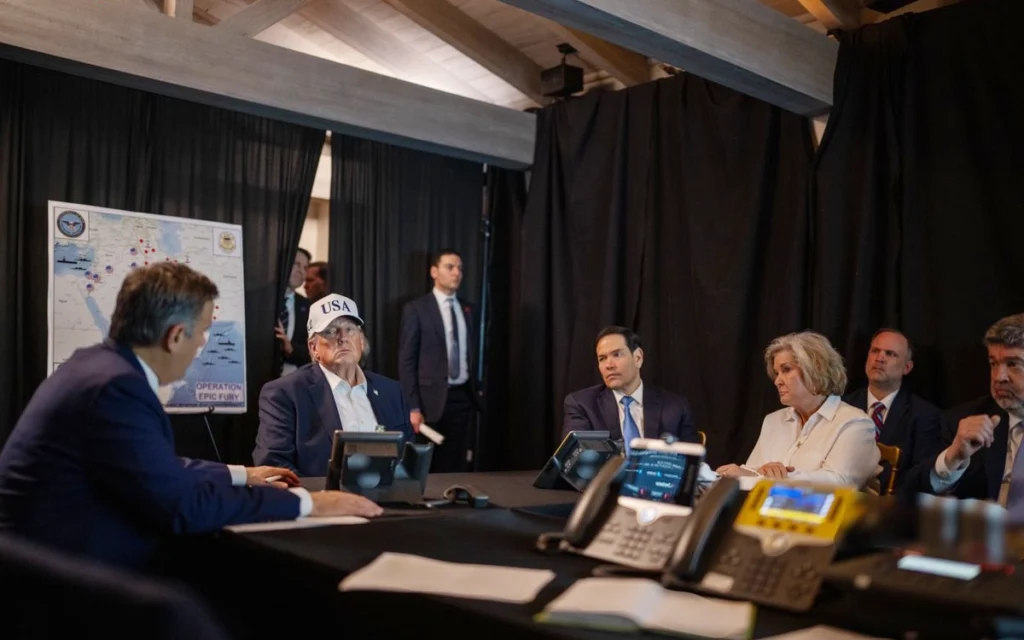
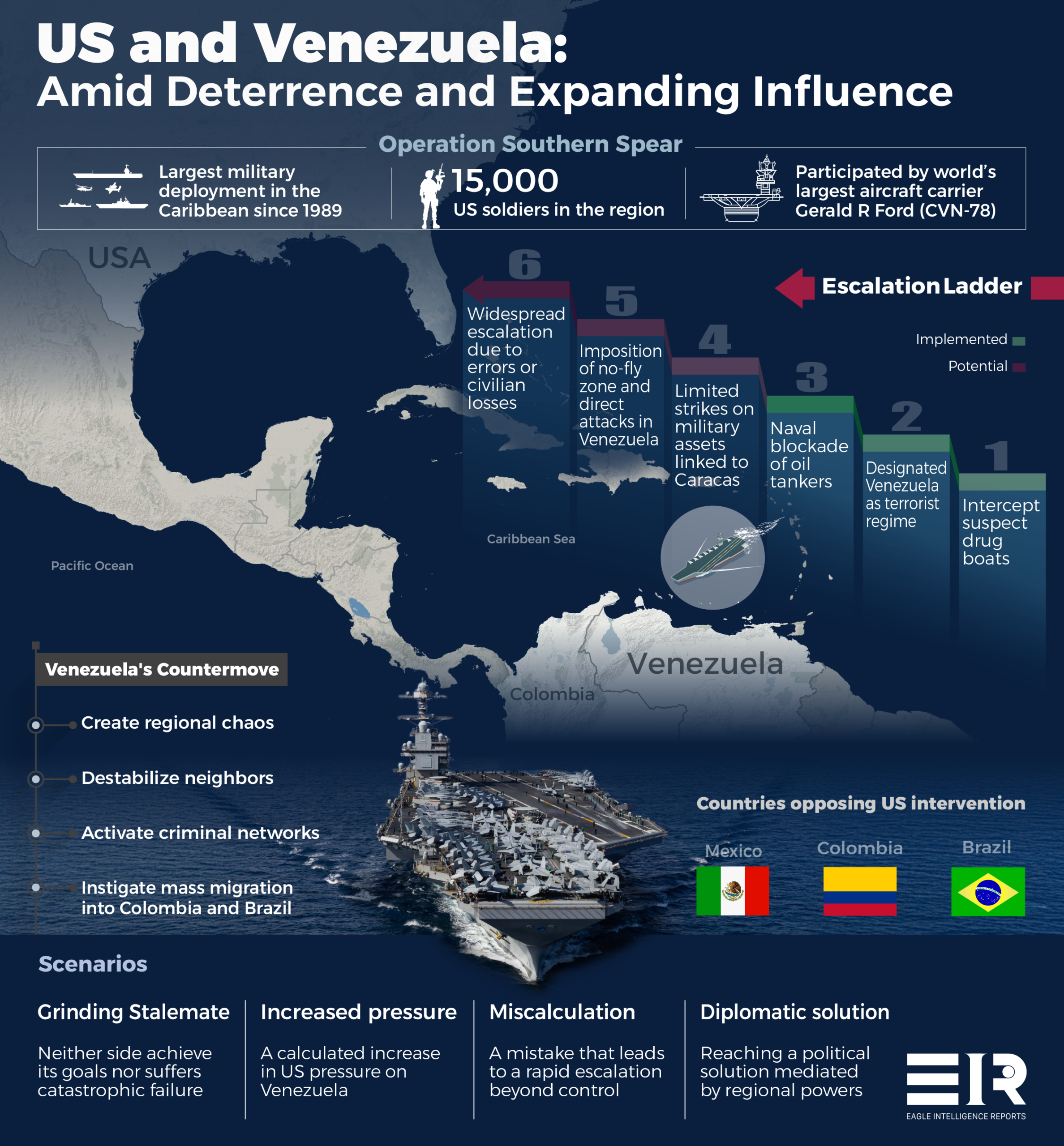
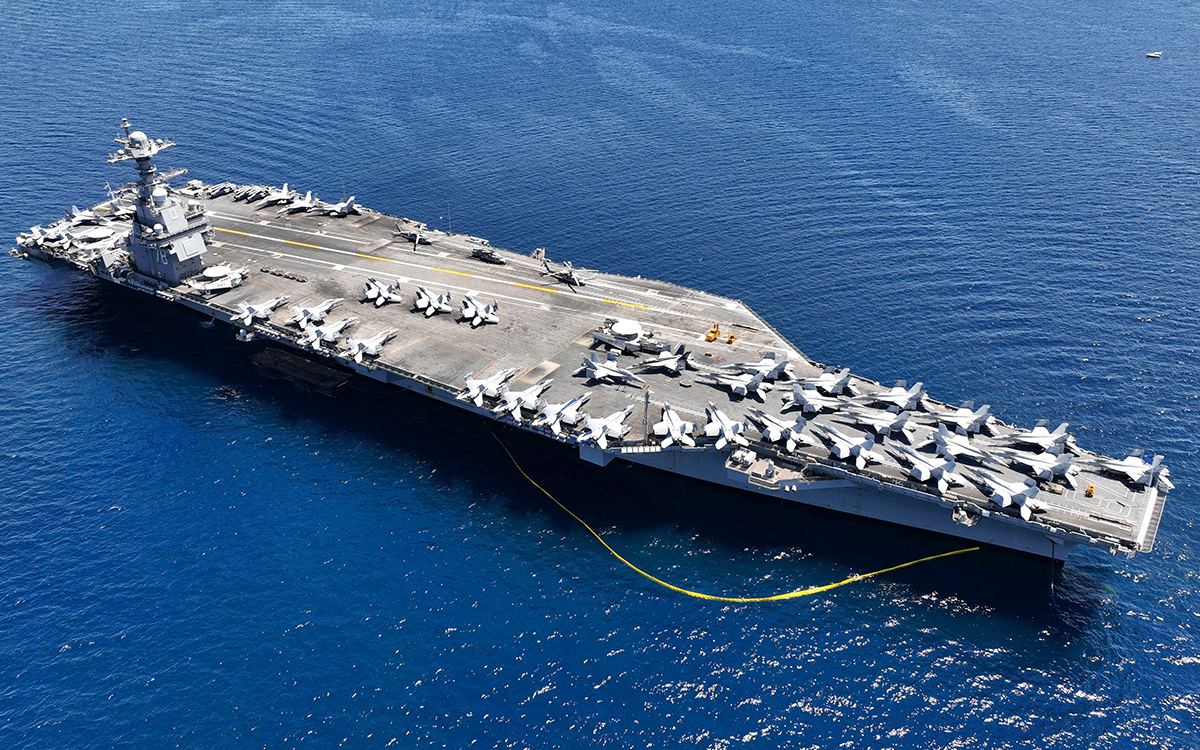
With the world’s largest aircraft carrier, USS Gerald R. Ford, positioned off the waters of Venezuela, Trump’s Department of War – renamed from the Department of Defense by executive order in early September – assembled “Operation Southern Spear,” the most significant commitment of US troops in the region since America invaded Panama in 1989. Various reports suggest that America now has about 15,000 US troops deployed in or near the Caribbean.
Officially, Trump says he dispatched US troops there to combat Venezuelan narco-terrorist drug cartels with whom America is at war. By alleging that large trafficking operations, such as those run by the Cartel de Los Soles, smuggle drugs that harm American citizens, Trump elevates the status of drug runners to combatants, a designation that makes them military targets instead of common criminals. Some experts opine that the designation is illegal and skirts the requirement to obtain congressional approval for his venture. Others suggest that the president’s war on drugs is simply a cover for his wider goal of toppling Venezuela’s President Nicolas Maduro, signaling America’s dominance in the Western Hemisphere, which the nation considers its backyard.
President Trump’s war on drugs is simply a cover for his wider goal of toppling Venezuela’s President Nicolas Maduro, signaling America’s dominance in the Western Hemisphere
Start of the Escalation
American forces have launched strikes on vessels in the Caribbean Sea and the East Pacific, with at least one incident raising serious legal questions: American forces hit an alleged drug-trafficking boat twice, killing two persons clinging to the wreckage, an action that could constitute a war crime. US forces also commandeered, without casualties, an oil tanker bound for Cuba and China in violation of American sanctions. The tanker is now in US possession, and the country intends to keep the oil contained in the tanker, according to the White House.
The second strike that killed two survivors stirred a rare bipartisan effort in Washington to determine who ordered the fatal strike. Although critics raise doubts about the legality of equating drug running with an act of war, the Republican-led House and Senate Armed Services Committees focused its investigation on the double hit strike. The legality of the underlying strategy that placed US forces there in the first place remains both unexplained and unexamined. Regardless of the scope of the inquiry, the repercussions of the ongoing tensions will no doubt be felt far beyond Caracas.
American troops are conducting combat operations in an area of the world where regional crises clash with geopolitical competition, energy market vulnerabilities, and political instability. It’s easy to see how a miscalculation or unintended mistake could quickly escalate into a wider war that could realign hemispheric relationships more fundamentally than any action since the Cold War.
“The United States is not on a predetermined path to war with Venezuela,” said Andrew Latham, a professor of international relations at Macalester College, in an assessment published by the National Security Journal. “But it is skating close to a line that could be crossed inadvertently – an over-eager pilot, a jittery militia commander, a political need to look unblinking on television.”
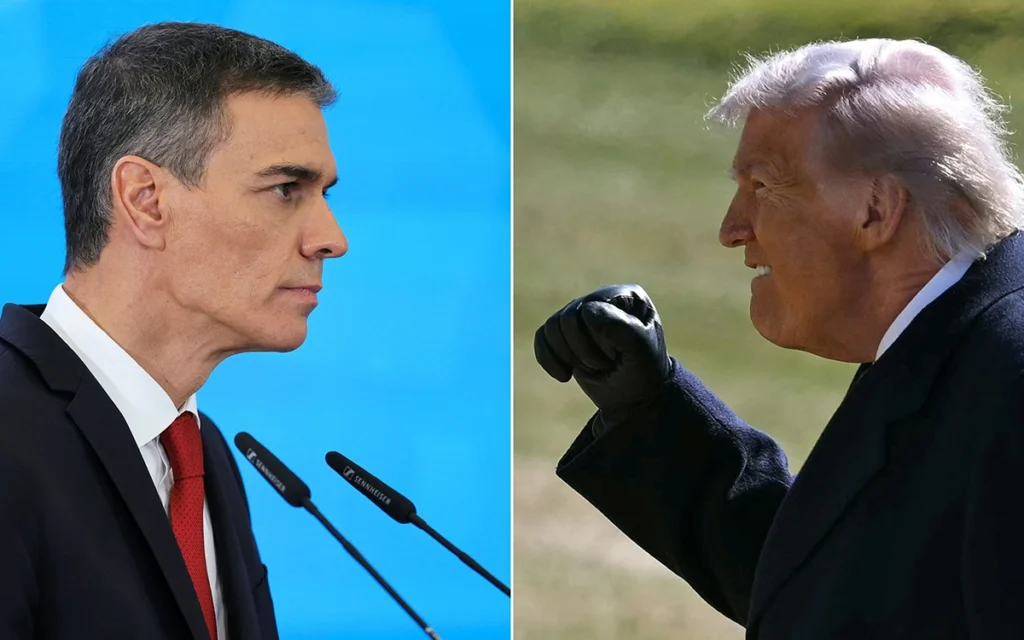
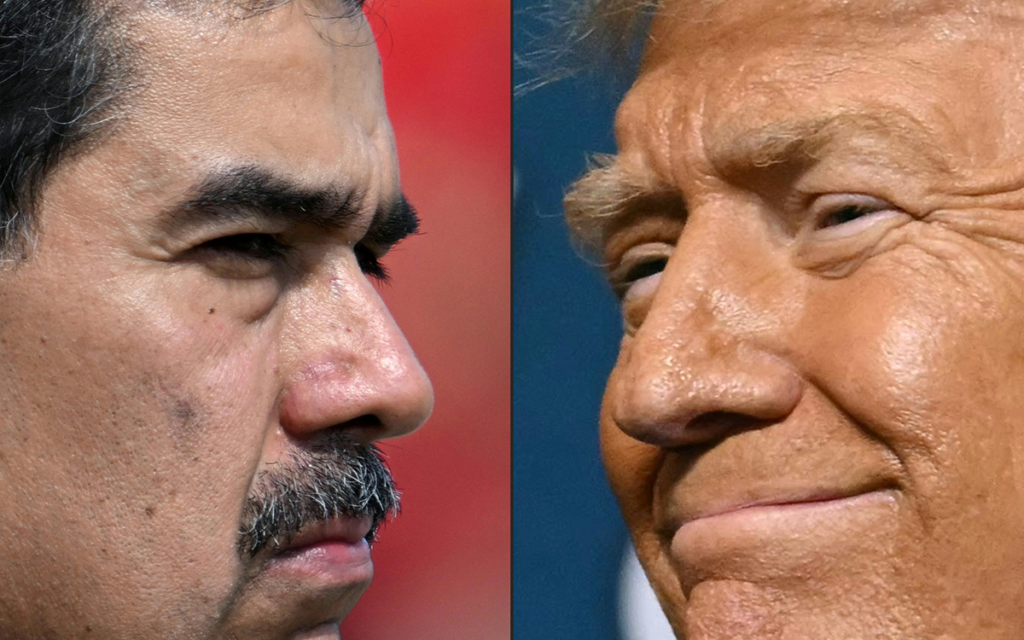
A recent phone call between the two presidents crystallized how Trump and Maduro have maneuvered themselves into a stand-off that could easily push both leaders toward more drastic actions. From most accounts, the White House initiated the call on November 21 as a last-ditch effort to avoid a direct military confrontation between the two nations.
Amnesty in Exchange for Leaving
According to several reports, Trump delivered an ultimatum to Maduro: Resign immediately, and America would guarantee safe passage to a third country for Maduro, his wife, and son. Maduro countered, saying he wanted full amnesty, removal of all US sanctions, dismissal of a pending International Criminal Court case against him, and sanctions relief for numerous Venezuelan officials. Trump rejected most of Maduro’s request and gave him a week to depart.
But Maduro has stayed put. In fact, once the call became public, Maduro held a major rally and defiantly danced for supporters. Indeed, instead of settling their differences, the call left both leaders cornered, where any sign of backing down involves significant risks.
Trump must now demonstrate the credibility of his threats. To remain in power, Maduro must survive the pressure and cement his position, an act that would humiliate the US on the world stage, closely monitored by America’s adversaries, particularly China.
Trump must now demonstrate the credibility of his threats. To remain in power, Maduro must survive the pressure and cement his position
So far, no credible third party has emerged to de-escalate the situation. The best option seems to be neighboring Brazil, whose President Luiz Inacio Lula da Silva, although critical of the US deployment in the Caribbean, has offered to mediate any disputes between the two sides. Yet, his efforts have gone nowhere, leaving both parties on the bottom rungs of an escalation ladder with distinct thresholds that could make things worse.
Naval Operations
Currently, operations remain at the interdiction level, with naval forces targeting suspected drug vessels in international waters. The next operational step of escalation would involve targeted strikes on Venezuelan military assets such as radar installations, coastal defense positions, or airfields. President Trump has hinted that the US might initiate attacks inside Venezuela.
The next logical step would be the imposition of a no-fly zone or naval blockade, but such a step would constitute a violation of international law and require action by Congress.
In a post on his Truth Social account, President Donald Trump wrote that his administration has designated the Venezuelan regime a Foreign Terrorist Organization, accusing it of financing itself through what he described as stolen oil fields, drug trafficking, human trafficking, and terrorism. He also ordered what he called a “total and complete blockade” of all sanctioned oil tankers entering or leaving Venezuela, claiming the country is now “completely surrounded by the largest armada ever assembled in the history of South America.”
The declaration marks a dramatic escalation from maritime interdictions toward measures that, under international law, could be interpreted as acts of war, significantly narrowing the space for de-escalation.
A Venezuelan attack on US forces, civilian casualties from American air strikes, or a direct threat to commercial shipping lanes could trigger escalation. What makes the escalation ladder so unstable is that neither side knows who might take the next misstep. A panicked patrol boat commander or a daring US pilot could unintentionally start a fight that forces both presidents to take steps that place a premium on forceful actions, and would be hard to de-escalate.
Although the duel between the two nations plays out on the high seas, the frayed relations stem from something far more concrete: Trump’s domestic homeland security policies. Earlier in the decade, Venezuelans fleeing Maduro’s corrupt and inept government flooded the US southern border, the protection of which Trump made a major campaign issue and a pillar of his MAGA movement. Once in office, the president unleashed an unprecedented crackdown on immigrants, directing his harshest language at Venezuelans.
US Objectives in the Caribbean
The president’s recently released National Security Strategy (NSS) makes it clear that Trump isn’t merely veering off script when he threatens Maduro and Venezuela. The document contains a not-so-subtle hint about his underlying strategy and goals for America’s backyard. “We want to ensure that the Western Hemisphere remains reasonably stable and well governed enough to prevent and discourage mass migration to the United States,” it reads. In line with Trump’s practice of mixing commercial and diplomatic interests, the document says governments in the Americas, many of whom have significant Chinese investments, will be enlisted to control migration and curb drug flows. They are also expected to grant the US control over key assets, resources, and strategic locations, or at least a veto over “hostile foreign ownership” of them, the document states, delivering a clear warning against Chinese investments that leverage ports or assets such as the Panama Canal. Where law enforcement has failed to halt drug smuggling, America will use its armed forces, the document says, as it has in the Caribbean.
Although some Latin American countries voice support for the deployment, not everyone agrees that Trump’s motivation is to stop drug runs or democratize Venezuela. Oil is “at the heart” of the US pressure campaign, says Colombia’s President Gustavo Petro. Venezuela possesses the world’s largest proven oil reserves, but the nation produces only about a million barrels a day, which is less than one percent of the average global crude production per day. Decades of mismanagement, corruption, and sanctions limit the country’s oil exports, which flow mainly to China. Petro believes Trump’s true motive lies in accessing and capitalizing on the reserves, not freeing Venezuela from an autocratic leader or stopping drug traffickers.
Although some Latin American countries voice support for the deployment, not everyone agrees that Trump’s motivation is to stop drug runs or democratize Venezuela
Trump’s stated goal has its own logical hurdles. The president says his actions in the Caribbean reinforce his vow to stop the flow of fentanyl into the US, which harms American citizens. If that’s the case, he’s attacking the wrong boats. Venezuela is a transit point for cocaine that mainly flows to European markets, not America. Most fentanyl in America comes through Mexico. Moreover, Trump signed an executive order formally classifying fentanyl as a weapon of mass destruction, describing the drug as more destructive than a bomb.
A fundamental question, overshadowed by Trump’s rhetoric, is what would victory in a fight with Maduro look like? The administration’s objectives ambiguously shift between regime change, behavior modification, and deterrence. If the goal is toppling Maduro, what’s next? Where does he go, and who replaces him?
If the objective is behavior change, Maduro would have to curb drug trafficking, reduce migration outflows, and distance himself from Russia, China, and Iran. Could he be trusted to take such steps? If success is deterrence, then any move would have made other hemispheric leaders hesitant to challenge an America that is now throwing its weight around in their turf.
Complex geopolitical equations
Complex geopolitical equations dominate the Western Hemisphere and complicate Trump’s moves against Maduro. Mindful of many past American imperial misadventures and CIA-sponsored coups, the leaders of Brazil, Mexico, and Colombia, all crucial partners in any attempt to oust Maduro, are critical of the US deployment.
Brazil’s president, popularly known as Lula, rejects foreign intervention in the region. He has publicly criticized the US military build-up in the Caribbean. Colombia’s Petro, who does not recognize Maduro’s electoral legitimacy, nevertheless accused Trump of “murder” and “acts of tyranny.” Colombia shares a long border with Venezuela and hosts nearly three million Venezuelan refugees. Brazil is in a similar situation. Both nations worry that continued American aggression could push waves of new refugees and armed combatants across their long borders with Venezuela.
Maduro’s support within his country is weak, too. Opposition leaders had hoped American pressure would spur defections and defiance within the military ranks. But that has not yet happened, and prospects for such actions appear bleak. Defense Minister Vladimir Padrino Lopez and other military leaders are standing by Maduro as they have in the past. Maduro ensures loyalty in the ranks through a carrot-and-stick approach that rewards officers with sweetheart drug deals, oil, and other goods. He buys loyalty with a spoils system that also incentivizes officers to be active partners in his schemes. By designating Maduro’s military as a criminal organization, the US seeks to fracture elite loyalty by forcing officers to choose between defection and the risk of future prosecution.
Maduro Not to Be Underestimated
Maduro responded to stepped-up American attacks with a massive mobilization of military personnel, weapons, equipment, and reserves needed to battle, what his defense minister called an “imperialist threat.” Ironically, Trump’s campaign appears to have strengthened Maduro’s hold on power. Even though Maduro faces a strong internal opposition, epitomized by Maria Corina Machado, the recipient of the Nobel Peace Prize, Venezuelans, like many Latin Americans, tend to adopt a “rally around the flag” mentality when threatened by foreign forces.
Maduro can’t be underestimated, either. Though America enjoys overwhelming conventional military superiority, Maduro can nevertheless impose costs on America and its regional partners. Migration is a potent weapon. He can deliberately orchestrate refugee surges into Colombia and Brazil, destabilizing neighboring countries. Most concerning, he can activate networks of criminal organizations throughout Central and South America, and flood smuggling routes with drugs, weapons, and contraband, thus creating chaos beyond Venezuelan borders.
Maduro can’t be underestimated. Though America enjoys overwhelming conventional military superiority, he can nevertheless impose costs on America and its regional partners
Possible Scenarios
Perhaps, the most profound consequence of the Venezuelan crisis is what it reveals about the limits of American power in its own hemisphere. America can destroy the Venezuelan military and kill or deport Maduro. What it can’t do, without cooperation from other nations in the region, is create a stable alternative to Maduro or prevent spillover impacts that undermine US self-interests.
The Venezuelan gambit mirrors the insensitivity and dangers that Trump’s America First foreign policy imposes on alliances the nation needs to help keep the peace. With diplomatic channels frozen and military pressure intensifying, the region now faces a narrowing set of possible outcomes.
The diplomatic paralysis leaves the region with four paths forward. The most likely scenario involves a grinding stalemate, wherein neither side achieves its objectives nor suffers catastrophic failures. A more dangerous pathway is a deliberate but measured ramp-up in US pressure on Venezuela. A third possible path is a miscalculation that leads to a rapid escalation that defies restraint. The least likely but most desirable would involve a diplomatic settlement mediated by regional powers.