

Since assuming office in January 2025, President Donald Trump has attempted to fulfill his campaign promise to end the Russia–Ukraine war. While the administration has made significant progress toward a settlement, negotiations remain stalled over the Donbas region and the Russian-occupied Zaporizhzhia nuclear power plant. Yet the prospects for peace are no longer solely dependent on settling disputes within Ukraine. Russia’s deepening integration with North Korea has transformed the conflict from a regional war into a strategic global touchstone. As a result, any peace settlement that fails to address the Moscow–Pyongyang nexus risks exacerbating nuclear proliferation and strategic instability in the Indo Pacific.
Any peace settlement that fails to address the Moscow–Pyongyang nexus risks exacerbating nuclear proliferation and strategic instability in the Indo‑Pacific
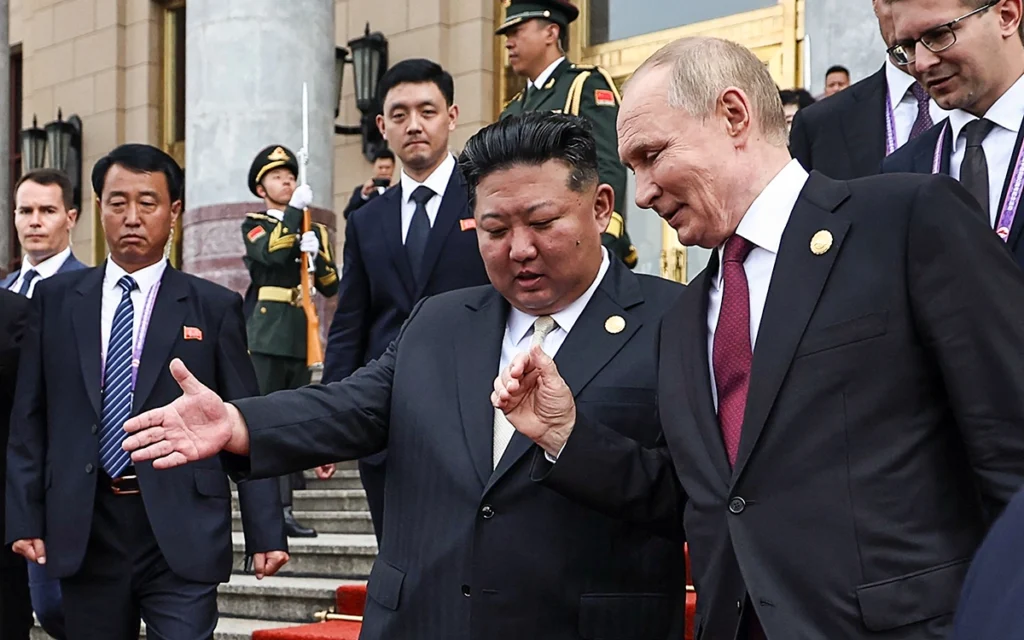
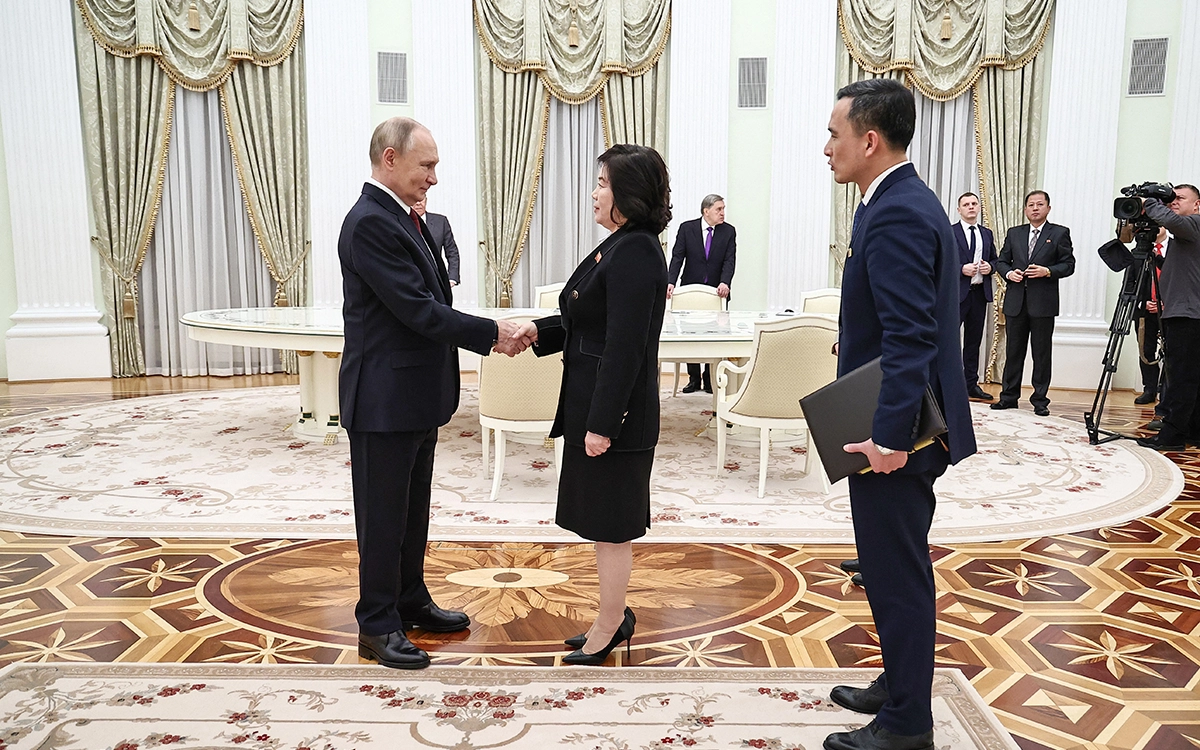
Since the mutual defense treaty was signed in June 2024, North Korea has transformed from a mere munitions supplier into an active combat partner for the Kremlin. An initial deployment of 11,000 soldiers to the Kursk region in late 2024 has, according to recent intelligence assessments, expanded to approximately 30,000 personnel. This “invincible alliance,” as North Korean leader Kim Jong Un put it in his New Year’s address, has enabled Russia to sustain its prolonged war of attrition without politically risky domestic mobilization, thereby reinforcing Russian President Vladimir Putin’s leverage at the negotiating table.
In exchange for vital manpower, North Korea is securing a substantial transfer of Russian military technology that circumvents decades of UN sanctions. Reports suggest that Moscow is providing technical assistance across several advanced weapons technologies, including reconnaissance satellites, advanced missile guidance systems, and nuclear submarine design. This technology-for-troops swap effectively modernizes Pyongyang’s conventional and strategic arsenal, creating a more lethal threat to South Korea and the United States.
A durable settlement in Ukraine is no longer achievable without direct and simultaneous negotiations with North Korea. The deployment of North Korean troops on European soil has globalized the conflict, such that any ceasefire leaving the Russia–North Korea alliance intact would effectively neglect Pyongyang’s continued military expansion. Absent a framework to compel or incentivize the withdrawal of North Korean troops, Washington risks a scenario in which peace in Europe is secured at the cost of entrenching a less isolated, more empowered, and technologically advanced North Korean regime.
Trump’s Failed Proposal for Talks with Kim
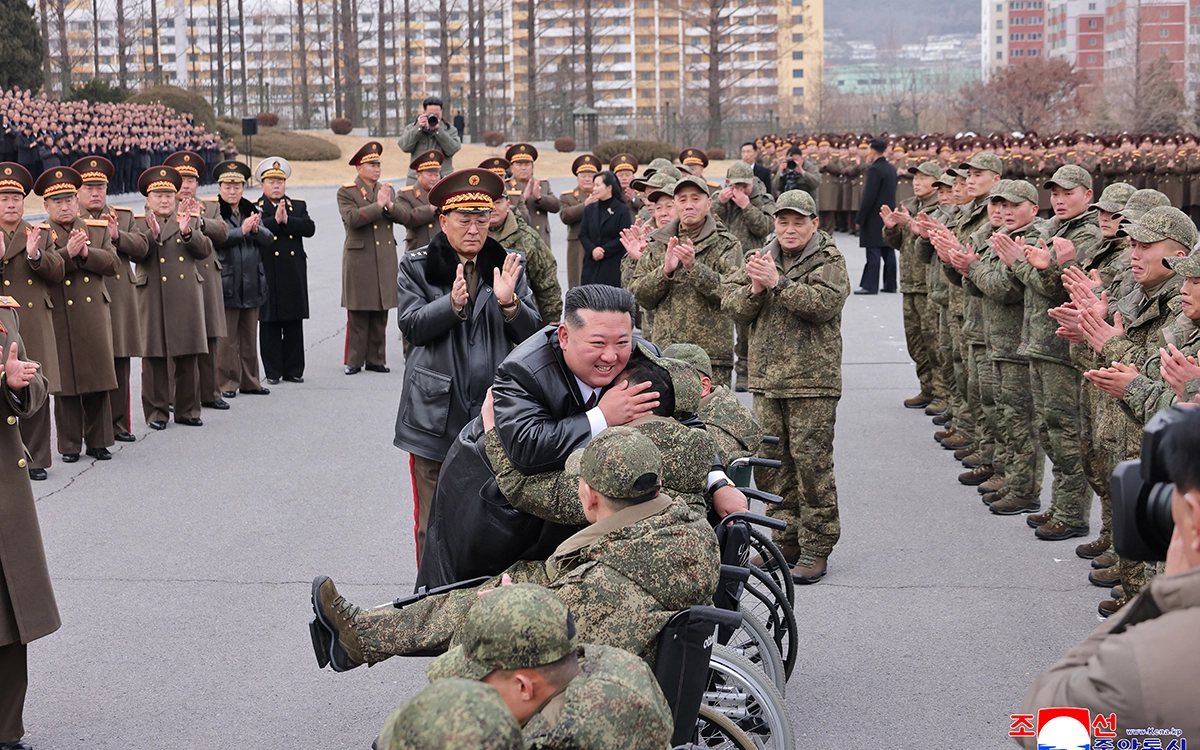
While the White House has signaled a willingness to reengage Kim to restore Trump’s personal chemistry with the North Korean leader, Pyongyang has remained defiant. It has demanded the total removal of U.S. “hostile policies” and North Korea’s recognition as a nuclear power as preconditions for talks. The diplomatic impasse reflects a fundamental shift in Pyongyang’s strategic position: its escape from economic isolation and its deepening military partnership with Moscow have reduced Washington’s leverage at the negotiating table.
Pyongyang has remained defiant. It has demanded the total removal of U.S. “hostile policies” and North Korea’s recognition as a nuclear power as preconditions for talks
For decades, Washington’s primary lever over Pyongyang was economic isolation enforced through UN-backed sanctions. However, the June 2024 mutual defense treaty between Kim and Putin has effectively rendered that lever obsolete. By providing Russia with millions of arms and roughly 30,000 troops for the war in Ukraine, North Korea has secured an alternative lifeline of food, fuel, and hard currency. Until Washington can negotiate terms that dissuade Kim from this partnership, the North Korean leader has little rational incentive to discuss a nuclear freeze, having reduced his dependence on Western-led sanctions relief for regime survival.
A critical risk of pursuing a Ukraine peace deal while delaying engagement with Pyongyang is the irreversible modernization of North Korea’s nuclear delivery systems via Russian technology transfers. Should the Trump administration initiate nuclear talks without first addressing this technology-for-troops swap, it may confront a North Korea that has already achieved a qualitative advance in its second-strike capability.
Moreover, the deployment of North Korean troops on European soil has effectively transformed Pyongyang into a stakeholder in European security. If Washington ignores the Moscow–Pyongyang nexus, a ceasefire in Ukraine could allow Russia to continue underwriting North Korea’s military expansion during peacetime. Thus, U.S. concessions in Europe would directly enable nuclear proliferation in the Asia-Pacific.
Conversely, if the Trump administration insists on denuclearization as a starting point without first addressing the Russia factor, it is likely to face a cold shoulder from Kim. Any viable diplomatic strategy must begin by strategically de-linking negotiations with Kim from the Ukraine war. Before pursuing denuclearization or even a nuclear freeze, Washington needs to establish a framework to secure the withdrawal of North Korean troops from Europe and halt the transfer of Russian missile technology. Breaking this transactional loop would restore meaningful economic and security leverage for nuclear concessions. Otherwise, North Korea will continue using the Ukraine war for combat experience and to fund its nuclear program.
Before pursuing denuclearization or even a nuclear freeze, Washington needs to establish a framework to secure the withdrawal of North Korean troops from Europe
Options for the Trump administration
The strategic landscape facing Trump on North Korea in 2026 bears little resemblance to that of his first term. In 2018, when the two met, Kim was an isolated leader seeking relief from U.S. pressure through personal diplomacy with Trump. Today, the power dynamic has shifted decisively: North Korea is no longer a supplicant, but a crucial wartime partner to major nuclear powers Russia and China.
In response to this new strategic reality, Trump is likely to pivot toward a transactional containment or managed coexistence framework, abandoning the maximalist goal of CVID (Complete, Verifiable, Irreversible Dismantlement) that defined his 2018 diplomacy. This may involve offering interest-driven incentives—such as limited sanctions waivers—in exchange for the verified withdrawal of North Korean troops from Europe and a freeze on long-range missile testing. By shifting the focus from the elimination of nuclear weapons to the reduction of proliferation, this strategy would aim to secure a limited deal that stabilizes the Asia-Pacific while enabling Washington to focus on closing the European theater of war.
South Korean intelligence provides a concrete timeline for diplomatic re-engagement. A November 2025 assessment by the National Intelligence Service judged there to be a high probability that a third Trump–Kim summit could occur as early as April 2026. The report forecasts that Kim may seek a meeting with Trump following the conclusion of U.S.–South Korea joint military exercises in March, potentially using Trump’s planned state visit to Beijing in April as a logistical anchor for talks on the sidelines or en route.
If an April 2026 summit materializes, the most likely outcome would not be a denuclearization roadmap, but a security management agreement, potentially including a peace declaration to replace the 1953 Armistice. For Kim, the primary objective would be de facto recognition as a nuclear state and partial normalization with Washington to offset his growing dependence on Beijing and Moscow. For Trump, success would be defined by a freeze on North Korea’s intercontinental ballistic missile (ICBM) program and a commitment to cease military aid to Russia. This would enable Trump to claim that he has neutralized the most dangerous secondary actor in the Ukraine conflict.
Whereas the 2019 Hanoi summit collapsed over competing definitions of denuclearization, a 2026 meeting would likely sidestep that issue entirely in favor of arms control and strategic stability. The success of such a summit would be measured not by the dismantling of warheads but by whether it successfully de-links Pyongyang from Putin’s war machine. If Trump can persuade Kim that his long-term survival is better guaranteed by a normalized relationship with Washington than through continued dependence on Moscow, he may achieve the breakthrough that eluded him in his first term.
South Korea’s Reaction
As the Trump administration attempts to rapidly end the Ukraine war while calling for bilateral talks with North Korea, Washington has increasingly pushed for South Korea to assume greater responsibility for conventional defense against North Korea. Hence, Seoul’s most acute source of anxiety stems from the looming specter of a reduction in U.S. Forces Korea (USFK), which could be used as a bargaining chip in Trump’s negotiations with Kim. Although the U.S. Senate passed legislation in late 2025 to maintain a 28,500-troop presence, even a minor drawdown—such as the rumored deactivation of an Apache attack helicopter battalion—could signal a weakening of the U.S. extended deterrence commitment.
This erosion of trust in the U.S. nuclear umbrella has pushed the domestic debate over South Korea’s own nuclear armament into the political mainstream. Proponents argue that if Trump’s 2026 diplomacy leads to a nuclear freeze that accepts North Korea as a de facto nuclear state, South Korea will require its own strategic insurance. While the Lee Jae Myung government officially adheres to the non-proliferation regime, it has sought to renegotiate the atomic energy pact—dubbed the 123 Agreement—and has pressed Washington for approval of nuclear-powered submarines as an intermediate capability short of acquiring nuclear weapons.
Ultimately, South Korea’s response to Trump’s 2026 strategy is likely to take the form of “pragmatic self-help.” If a potential April summit leads to a sustained U.S. troop reduction without a verifiable end to North Korea’s nuclear program, Seoul may feel forced to cross the nuclear threshold to ensure its national survival. The Lee administration’s challenge is to convince Washington that the stability of the Asia-Pacific is inseparable from the terms of any Ukraine peace deal. For Seoul, any agreement that allows Kim to retain a Russian-upgraded nuclear arsenal while the U.S. draws down its ground presence is not a peace deal, but a prelude to a far more dangerous regional conflict.
For Seoul, any agreement that allows Kim to retain a Russian-upgraded nuclear arsenal while the U.S. draws down its ground presence is not a peace deal, but a prelude to a far more dangerous regional conflict
China and Japan
Any effort by the Trump administration to decouple Pyongyang from Moscow, however, would necessarily involve China, a critical but often understated player. While Beijing has avoided a formal alliance to preserve strategic autonomy, it is increasingly concerned that the Russia–North Korea military relationship could legitimize nuclear development in both South Korea and Japan. As a result, any U.S. negotiating framework would require China’s tacit approval, as Beijing alone can offer the long-term economic normalization capable of reducing or replacing Pyongyang’s reliance on Russia.
Nevertheless, any Trump-led effort to reshape negotiations would also face resistance both abroad and at home. Japan, a critical stakeholder who has been sidelined from high-level dialogue, has expressed firm opposition to a nuclear freeze, fearing it would leave Tokyo more vulnerable to regional missile threats. Prime Minister Sanae Takaichi has signaled little tolerance for unilateral changes.
Domestically, Trump’s executive maneuverability is tempered by a skeptical U.S. Congress, with the National Defense Authorization Act passed in December already restricting reductions in U.S. troop levels in South Korea absent certified security benchmarks. Taken together, these constraints mean that any “grand bargain” struck at a potential April summit will face intense scrutiny and resistance from a security bureaucracy wary of legitimizing Pyongyang’s “hostile two-state” doctrine.
Finally, securing lasting peace requires countering Russia’s long-term incentive to retain its partnership with North Korea. Russia now sees North Korea not as a temporary expedient for the Ukraine war, but as a permanent strategic asset in its broader confrontation with the West.
Russia now sees North Korea not as a temporary expedient for the Ukraine war, but as a permanent strategic asset in its broader confrontation with the West
The transfer of advanced technologies—such as nuclear submarine design and advanced satellites—fundamentally and irreversibly upgrades North Korea’s military, narrowing the window for preventive diplomacy. If Washington fails to break this transactional loop before the Ninth Party Congress in early 2026, Pyongyang’s enhanced lethality, embedded through Russian engineering, will render future arms control efforts exponentially more difficult.
Scenario 1: The “Grand Decoupling” and Normalized Containment
A successful April 2026 summit could yield a security management agreement that trades a verifiable freeze of North Korea’s ICBM program and the withdrawal of 30,000 North Korean troops from Russia for limited sanctions waivers and the suspension of large-scale U.S.–ROK live-fire exercises. Such an outcome would remove the North Korean factor from the Ukraine conflict, easing a Trump-led peace deal. At the same time, South Korea would confront an increased threat from a de facto nuclear North Korea that has integrated advanced Russian capabilities, including hypersonic and unmanned systems.
Scenario 2: The “Nuclear Autonomy” Pivot in Seoul
Trump’s transactionalism leads to a significant drawdown of USFK as part of a peace deal with Kim. Interpreting the erosion of the U.S. nuclear umbrella amid a more capable North Korean threat as strategic abandonment, Seoul moves to develop an independent nuclear deterrent, utilizing its nuclear-powered submarine program. Such a shift would complicate U.S. non-proliferation goals and risk triggering a regional arms race involving Japan and Taiwan.
Scenario 3: Fortified North Korea–Russia Ties
The April 2026 summit collapses due to Kim’s demands for the complete removal of U.S. “hostile policies” and Russia’s refusal to halt technology transfers. Pyongyang and Moscow deepen their Comprehensive Strategic Partnership. For Washington, this strategic conundrum would entail a frozen Ukraine conflict persistently vulnerable to North Korean escalation, necessitating a costly expansion of U.S. military commitments across both the European and Asia-Pacific theaters simultaneously.